Let’s get one of the biggest myths out of the way right from the start. No, you absolutely do not need a Turkish partner to start a business in Turkey. It’s a common misconception that stops a lot of talented entrepreneurs in their tracks, but the reality is thankfully much more straightforward.
Turkish law gives you the freedom to maintain 100% ownership of your company. Full stop.
Debunking the Turkish Partner Myth
I’ve heard the rumour countless times: to set up shop in Turkey, you have to bring a local partner on board. It’s just not true. The country’s legal framework is actually designed to attract foreign investment, not put up walls against it. At its heart, the system is built on a simple principle: treat all investors equally.
This open-door policy means that whether you’re from Istanbul or London, the rulebook for starting a company is pretty much the same. You’re given the same rights, responsibilities, and opportunities as any local business owner.
Your Path to 100% Ownership
The right for a foreigner to fully own their Turkish company isn’t some loophole; it’s written directly into the country’s core legislation. Turkish foreign direct investment (FDI) laws clearly state that foreign investors can establish wholly-owned companies or branches with no requirement for local partnership. This has been a key part of Turkey’s economic strategy for years, helping thousands of international businesses make a home here.
The ability to retain full control over your business is a massive advantage. It means quicker decision-making, simpler management, and making sure your original vision for the company stays completely intact.
This straightforward approach is quite different from the rules you might find in other popular expat destinations. For a bit of perspective, comparing Turkey’s regulations with those for starting a business as an expat in Thailand really shows how investor-friendly the policies here are.
One of the most persistent myths is that you’re forced into a partnership. To make this crystal clear, let’s break it down.
Partnership Requirements Myth vs Reality
| Aspect |
Common Misconception |
Legal Reality in Turkey |
| Ownership Stake |
A Turkish citizen must own at least 51% of the company. |
Foreigners can own 100% of their company. No local shareholding is required. |
| Legal Requirement |
It’s a legal obligation to have a local partner. |
There is no such law. It’s an outdated and incorrect assumption. |
| Decision-Making |
A local partner will have the final say in business matters. |
As the sole owner, you retain full control over all business decisions. |
As you can see, the idea of mandatory partnership is just that—a myth. So, you can move forward with your business plans in Turkey with complete confidence, knowing the company can be entirely yours.

Visualizing the myth versus reality of partnership requirements for foreign investors.
Understanding Turkey’s Welcoming Investment Laws
So, what’s the secret sauce that lets a foreigner own a business in Turkey without a local partner? It all boils down to the country’s forward-thinking investment laws, specifically the Foreign Direct Investment (FDI) Law No. 4875. This is the cornerstone legislation that essentially levels the playing field, putting you on par with any local entrepreneur.
Think of this law as Turkey’s official “open for business” sign for the rest of the world. It completely overhauled the old system, which was clunky and based on getting approvals, and replaced it with a modern, notification-based approach. In the past, you might have felt like you were asking for permission to invest. Now, you’re simply announcing your arrival.
The Principle of Equal Treatment
The entire FDI Law is built around a powerful concept: ‘equal treatment’. It’s a simple idea with huge implications. It guarantees that as a foreign investor, you have the exact same rights and responsibilities as a Turkish one. This is what allows you to own 100% of your company and play by the same rulebook.
This legal equality knocks down many of the typical roadblocks that make foreign investment a headache in other countries. Your business isn’t seen as a foreign entity; it’s a Turkish company, plain and simple, with full legal standing. It’s a crucial protection for your investment and your rights.
The move to a notification-based system was a game-changer. Instead of going through a long, uncertain approval process, you just register your business and inform the authorities. This makes setting up a company far quicker and much more predictable for foreign nationals.

Depicting equality and fairness in Turkish business and investment regulations.
Key Rights Guaranteed to Foreign Investors
This commitment to equal treatment isn’t just talk. It translates into concrete, practical rights for anyone looking to set up shop in Turkey on their own. These guarantees are what make the country such a stable and attractive place to invest.
Here’s what that looks like in practice:
- Unhindered Profit Transfers: You have the freedom to transfer your profits, dividends, or any funds from selling your company back to your home country without getting tangled in red tape.
- Access to Real Estate: Once your company is registered in Turkey, it can buy property and land just like any Turkish-owned company can.
- No Arbitrary Expropriation: Your investment is secure. The government can’t just seize your assets unless it’s for a proven public benefit, and even then, they must provide immediate and fair compensation.
- Dispute Resolution: If a commercial dispute arises, you have access to both national and international arbitration, ensuring you get a fair hearing.
At the end of the day, Turkey has intentionally designed its laws to attract foreign capital, not create barriers. They offer the legal security and peace of mind you need to build a business here, completely on your own terms.

Simplify your business setup with Workon’s all-in-one company registration service in Turkey.
Choosing the Right Business Structure for You
So, you’ve discovered you don’t need a local partner to start your business in Turkey. That’s great news! The next big question is: what kind of company should you set up? This isn’t just a bit of paperwork; your choice of business structure is the very foundation of your company. It shapes everything from your personal liability and tax obligations to how you can raise money down the line.
Thankfully, Turkey keeps things relatively simple for foreign investors, with two main paths to choose from. The most common options are the Limited Liability Company (LLC), which you’ll see called a Limited Şirketi (Ltd. Şti.), and the Joint-Stock Company (JSC), known as an Anonim Şirketi (A.Ş.). For most people I work with—especially those starting small or medium-sized businesses—the LLC is the perfect fit. Think of it as a financial firewall; it separates your personal assets from your business debts, so your home and savings stay protected if the company runs into trouble.

Understanding LLC and Branch Office Options for Foreign Investors
LLC vs JSC for Foreign Investors
To help you see the differences more clearly, here’s a quick comparison of the two main company types available to you.
| Feature |
Limited Liability Company (LLC) |
Joint-Stock Company (JSC) |
| Ideal For |
Startups, SMEs, solo entrepreneurs, and family businesses. |
Large corporations, businesses planning to go public, or those needing to raise significant capital. |
| Minimum Capital |
50,000 TRY |
250,000 TRY |
| Share Transfer |
More formal; requires a notarised share transfer agreement. |
Simpler and more flexible; shares can be transferred easily without a notary. |
| Liability |
Personal assets are protected. Liability is limited to the capital you invested. |
Same protection. Shareholder liability is limited to their paid-in share capital. |
| Management |
Flexible. Can be managed by one or more managers (who can also be shareholders). |
More rigid. Requires a formal Board of Directors. |
As you can see, the Joint-Stock Company is built for bigger ambitions. It’s the right choice for large-scale operations, especially if you have plans to raise serious capital or eventually list on the stock exchange. It comes with a more formal management structure (you’ll need a board of directors) and a significantly higher minimum capital requirement. The principles are similar to understanding the differences between different business structures like S Corps and LLCs in other countries—it’s all about matching the legal form to your operational needs and future goals.
Ultimately, getting this decision right from day one is crucial. It saves a world of headaches, time, and money later on. To dive deeper into the nuances and make sure your legal foundation is rock-solid and aligned with your business vision, check out our detailed guide on which company type you should choose in Turkey.
Are There Any Exceptions You Should Know About?
While Turkey’s business landscape is incredibly welcoming, it’s true that not every industry plays by the exact same rules. The principle of 100% foreign ownership is the standard for the vast majority of sectors, but the government understandably keeps a closer watch on a few strategic areas.
Think of it like this: most of a city is open for anyone to build on, but key zones like the airport or power grid have special regulations for security and public interest. This doesn’t mean these fields are a complete no-go for foreign investors. It just means that launching a business in one of these regulated industries involves a few extra hurdles beyond the standard company registration. You might encounter specific requirements like obtaining special permits, facing caps on foreign shareholding, or needing to partner with a local entity.
Key Regulated Sectors to Note
Knowing about these exceptions from the get-go is vital. It saves you from hitting unexpected roadblocks down the line and helps you confirm whether your business plan fits into a standard or a specially regulated category. The main industries where you’ll find specific rules include:
- Broadcasting: Covering TV and radio, this sector has firm rules on foreign ownership percentages to protect national media interests.
- Aviation: If you’re looking to own and operate an airline or other aviation services, you’ll find that a majority of the company often needs to be held by Turkish nationals.
- Maritime Transport: Much like aviation, cabotage laws and ownership restrictions apply to businesses involved in domestic shipping and port services.
- Mining and Energy: As you might expect, the exploration and extraction of natural resources are considered strategic activities, subject to specific government concessions and licensing.
- Education and Healthcare: Foreigners can certainly establish private schools and hospitals, but they must first secure special approvals and licences from the relevant ministries.
Getting a handle on these distinctions is a crucial first step in your business planning. If you’re considering more complex corporate structures, you can dive deeper with our complete guide to setting up a subsidiary, branch office, or liaison office in Turkey to see how different business types are treated under Turkish law.
Your Step-by-Step Guide to Company Formation
So, you’re ready to get your business off the ground in Turkey. The good news is, the old myth about needing a Turkish partner is just that—a myth. However, you do need to follow a clear set of steps to get registered. Think of it less like a bureaucratic maze and more like a roadmap with clearly marked signposts.
With the right preparation, setting up your company as a sole foreign owner is completely within reach. The journey essentially involves getting your foundational documents in order before moving on to the official registration.
Preparing for Registration
Before you can knock on any official doors, you need to get your paperwork sorted. The first, and most important, document is your company’s Articles of Association. This is the constitution for your business—it must be in Turkish and lays out everything from your company’s purpose and management structure to its share capital.
At the same time, you and any other foreign founders will need to get a potential Turkish tax identification number. This is a pretty simple task you can handle at a local tax office, and it’s a non-negotiable step for opening a bank account and handling other formalities.
Once you have these initial preparations squared away, the core registration flow begins.
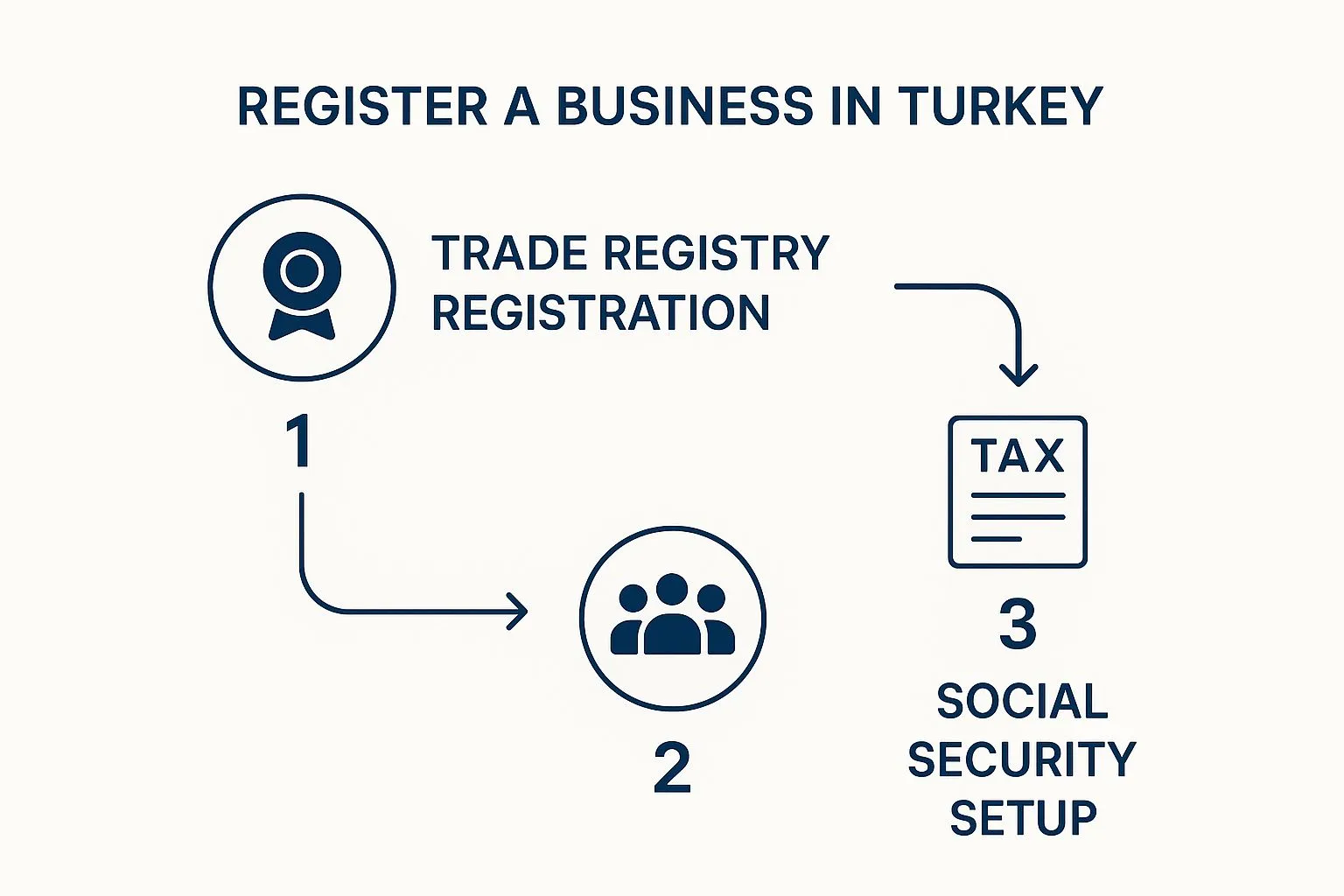
Visual guide outlining the three main stages of company registration for foreign investors in Turkey.
Finalising Your Company’s Legal Status
With your notarised documents and tax ID ready, you’re set for the main event: submitting everything to the Trade Registry Office at the local Chamber of Commerce. This office is designed to be a “one-stop shop” for incorporating your business. You’ll file your application, your Articles of Association, and proof that you’ve paid a small fee to the Turkish Competition Authority.
Once the Trade Registry officials give your application the green light—which can sometimes happen on the very same day—your company legally exists. It gets announced in the Turkish Trade Registry Gazette, which makes its existence official and public.
From there, the registry takes care of notifying the Tax Office and the Social Security Institution, which triggers the activation of your company’s official tax number. For a more granular look at every single step, our full guide on establishing a company in Turkey step-by-step breaks down each requirement in detail. As you can see, it’s a logical sequence. The Trade Registry is the main hub that communicates with the other government agencies on your behalf.
Why Global Entrepreneurs are Choosing Turkey
The ability for a foreigner to own 100% of their company is a huge green light, but honestly, it’s just the start of the story. Smart entrepreneurs are flocking to Turkey not just because the law lets them go it alone, but because it’s a strategically brilliant move for real, sustainable growth. Turkey offers a rare blend of geographic power, market access, and economic energy that you just can’t find anywhere else.
Think of it this way: Turkey is the ultimate bridge between East and West. That’s not just a nice phrase for a travel brochure; it’s a massive logistical and commercial advantage. When you set up shop here, you’re placing your business at the very crossroads of the world’s biggest markets. Suddenly, hundreds of millions of consumers across the EU, the Middle East, North Africa, and Central Asia are within easy reach. This position alone can slash your supply chain headaches and open up revenue streams you hadn’t even considered.
A Strong and Welcoming Economic Climate
Location is one thing, but the business environment is another. Turkey’s economy is actively structured to help new businesses succeed. The country has a young, educated, and incredibly ambitious workforce, giving you access to a deep talent pool whether you’re in tech, manufacturing, or tourism. This human capital is a game-changer for any company that’s serious about scaling up.
On top of that, the government sweetens the deal with a whole menu of incentives for foreign investors. Depending on what you do and where you set up, you could tap into:
- Tax Reductions: Get a serious break on corporate taxes if you operate in certain sectors or designated development zones.
- VAT and Customs Exemptions: Imagine importing all the machinery and equipment you need to get started without paying hefty taxes. It’s a massive saving.
- Social Security Support: The government can even help cover the employer’s share of social security payments for new staff you hire.
These aren’t just small perks; they are real financial benefits that dramatically lower your start-up and running costs. It makes it so much easier for a new business to get established and start turning a profit.
The numbers back this up. The consistent flow of foreign investment proves that the answer to “do foreigners need a Turkish partner?” is a firm no—a no that’s built on solid economic sense. According to the Central Bank of Turkey, foreign direct investment has averaged a steady $806.57 million annually for the past two decades, with some years spiking as high as $6.5 billion. Investors clearly feel confident taking direct control here. If you want to dive deeper, you can explore Turkey’s FDI trends and economic data on TradingEconomics.com.
Got Questions About Starting a Business? We Have Answers.
Let’s tackle some of the most common questions we hear from foreign entrepreneurs looking to set up shop in Turkey. Think of this as your quick-start guide to navigating the first few hurdles with a bit more clarity.
What’s the Minimum Capital I Need to Start a Company?
For a Limited Liability Company (LLC), which is the most popular choice, you’ll need a minimum share capital of 50,000 TRY. If you’re looking to establish a Joint-Stock Company (JSC), that figure goes up to 250,000 TRY.
A quick heads-up: these amounts can change. It’s always a good idea to double-check the latest official requirements before you get started.
Can I Get a Work Permit by Launching My Own Company?
Absolutely. As a shareholder and managing director of your new Turkish company, you can apply for a work permit.
However, there are a few conditions. The government wants to see that your business is a genuine, contributing entity. This means your company will need to meet certain criteria, like having sufficient paid-in capital and, often, hiring a number of Turkish citizens.
The Bottom Line: You don’t need a Turkish partner to open a business, but getting your own work permit through it means playing by the rules. The requirements are there to make sure your company is adding real value to the local economy.
Do I Physically Need to Be in Turkey to Register Everything?
Not necessarily, but it can make things smoother. Being there in person is definitely helpful for certain steps, especially opening the company bank account.
That said, you can handle the entire setup remotely. The key is to grant a Power of Attorney (POA) to a reliable representative in Turkey, like a lawyer or a specialised firm, who can then act on your behalf.
Jumping through the legal hoops of company formation can feel overwhelming. At Workon, our job is to make it simple. We manage everything from the initial registration to securing your permits, making sure your business gets off to a correct and efficient start. Let us worry about the paperwork so you can focus on what you do best: growing your business.
Ready to get started? Let our experts guide you through starting your business in Turkey.
Yes. Turkish law allows 100% foreign ownership with no requirement for a local partner, ensuring full control of your company.
The Foreign Direct Investment (FDI) Law No. 4875 guarantees equal rights for local and foreign investors, allowing full ownership and legal protection.
You need at least 50,000 TRY for a Limited Liability Company (LLC) or 250,000 TRY for a Joint-Stock Company (JSC).
No. You can establish your company remotely through a Power of Attorney, though being in Turkey can simplify certain steps.
Yes, regulated sectors such as aviation, media, and energy may require special permits or partial Turkish ownership.