Quick answer: MERSİS is the Ministry of Trade’s central commercial-registration system for company and commercial-enterprise registration, changes and deregistration. For a new company, it is the digital layer where core data such as founders, capital, headquarters, activity and representation are prepared before the relevant Trade Registry completes the legal registration process.
This guide covers MERSİS system deep-dive and data-quality. For the complete Trade Registry filing file, use Company Registration in Turkey: MERSİS & Filing Guide. For the end-to-end company-formation process, use Company Formation in Turkey: Complete 2026 Guide.
What MERSİS Is—and What It Is Not
The Ministry of Trade describes MERSİS as a central information system with two core functions: managing registration/change/deregistration procedures electronically and providing a single identifier/data source for legal entities and other economic units.
| MERSİS does |
MERSİS does not do by itself |
| Prepare and store company/commercial-registry data electronically |
Replace the Trade Registry’s legal review and registration decision |
| Support establishment, amendments, address/capital/authority changes and other registry procedures |
Guarantee bank-account approval |
| Create/maintain the company’s unique MERSİS identifier after registry integration |
Grant a work permit or sector licence |
| Provide electronic workflows and digital-signature/identity-verification options |
Make every foreign document automatically acceptable |
MERSİS rule: Treat MERSİS as the master data layer of the registry file, not as a substitute for the supporting documents or the Trade Registry’s legal review.
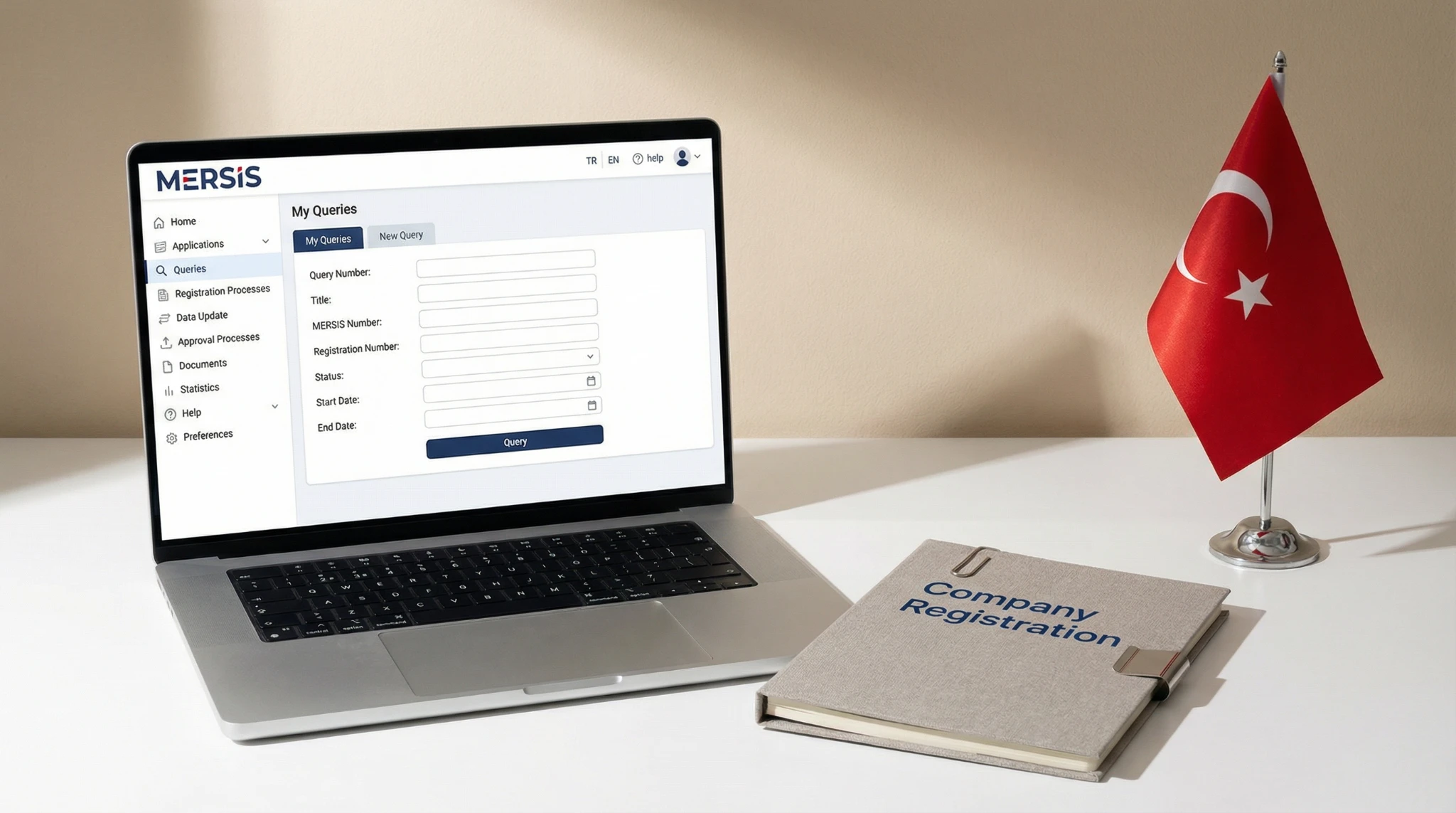
MERSİS is the central electronic layer for commercial-registry procedures, including company establishment and changes.
What Is a MERSİS Number?
The Ministry of Trade defines the MERSİS number as a 16-digit unique identifier assigned in MERSİS to companies and commercial enterprises registered with the trade registry. It is used as a consistent identifier across commercial-registry and connected public-sector processes. If an international counterparty or platform asks for a separate D-U-N-S identifier, see the DUNS Number Turkey application and verification guide.
Do not confuse the MERSİS number with:
- the company’s tax number;
- a Trade Registry Gazette issue number;
- a MERSİS application/tracking number;
- a bank customer number.
How Users Can Access MERSİS in 2026
Current MERSİS notices state that users can access the system through supported identity-verification methods including e-Devlet, electronic signature and mobile signature, depending on the user and process. The Ministry has also expanded MERSİS Mobile to cover establishment, change and structural-change procedures.
Do not assume every foreign founder must first purchase an e-signature before any MERSİS work can begin. The required authentication/signature route depends on the person, identity type and transaction. Foreign-founder cases may also involve a representative or power-of-attorney workflow.
Official portal: MERSİS.
The Core MERSİS Data Fields to Prepare Before Entry
| Data area |
What should be decided first |
What it must match |
| Company title |
Legal trade name |
Articles and registry naming rules |
| Founders/shareholders |
Identity/legal-entity data and ownership percentages |
Passport, tax data or foreign corporate records |
| Headquarters |
Registered Turkish address |
National address data and right-to-use arrangement |
| Capital |
Total capital, shares and commitments |
Company type, articles and required capital evidence |
| Management |
Managers/directors |
Appointments, corporate resolutions and identity data |
| Representation |
Individual/joint signing authority and limitations |
Articles, appointment decisions and PoA where used |
| Purpose/activity |
Actual planned business activities |
Articles, sector needs and relevant activity classification |
Foreign Founders: Identity Data Must Be Prepared Before Finalising the File
Official Ministry guidance explains that foreign persons can be added in MERSİS using passport-based information, but foreign-founder workflows can require tax-number and registry identity-matching steps before the person is usable in the application.
The practical risk is not simply “missing a tax number.” It is inconsistency between:
- passport spelling;
- tax-number record;
- sworn translation;
- MERSİS identity entry;
- power of attorney;
- foreign corporate records where the shareholder is a legal entity.
Use one master spelling/data set before translations and filings are finalised.
Foreign Corporate Shareholders Need an Authority Map
If the shareholder is an overseas company, MERSİS data must be backed by documents proving the parent company’s existence and authority structure.
Typical proof questions include:
- Does the foreign company currently exist?
- Who can bind it?
- Who approved the Turkish investment?
- Who is authorised to represent it in Türkiye?
- What ownership percentage will it hold?
Do not upload or legalise documents merely because they look relevant. First identify what the Turkish filing must prove, then select the source record and correct apostille/consular legalisation route.
Company Name: MERSİS Is Part of the Check, Not a Branding Guarantee
The proposed trade name must comply with Turkish trade-name rules and be distinguishable as required. A name can also raise trademark or commercial-brand issues that are separate from simple MERSİS availability.
For a dedicated check workflow, use Turkey Company Name Check.
Activity and NACE: Do Not Treat the Code as the Entire Legal Purpose
The company’s real activity should be accurately reflected in the formation file. Activity classification/NACE information can affect tax, licensing, SGK, banking and sector workflows, but it should not be treated as a magic list of everything the company is legally allowed to do.
Before finalising the activity data, ask:
- What is the primary revenue-generating activity?
- Will the company import/export goods?
- Will it operate a regulated business?
- Does the activity require specific premises or a municipal licence?
- Will banking/payment providers ask for evidence of this business model?
Registered Address: Use the Official Address Data Correctly
MERSİS works with official address data rather than a free-form marketing address. The registered headquarters should be real, supportable and suitable for the activity.
The legal address question is separate from whether the company uses a virtual office, coworking space, serviced office or dedicated premises operationally.
For the decision framework, use Registered Business Address in Turkey.
Representation Rules Deserve More Attention Than Most Founders Give Them
MERSİS/Articles data should make clear who can bind the company and whether authority is individual, joint or otherwise limited by the valid corporate structure.
A representation model that is technically registrable can still create operational friction if it does not fit:
- bank-signature requirements;
- commercial contracts;
- remote management;
- parent-company governance;
- future manager/director changes.
Decide the real signing model before the PoA and corporate resolutions are finalised.
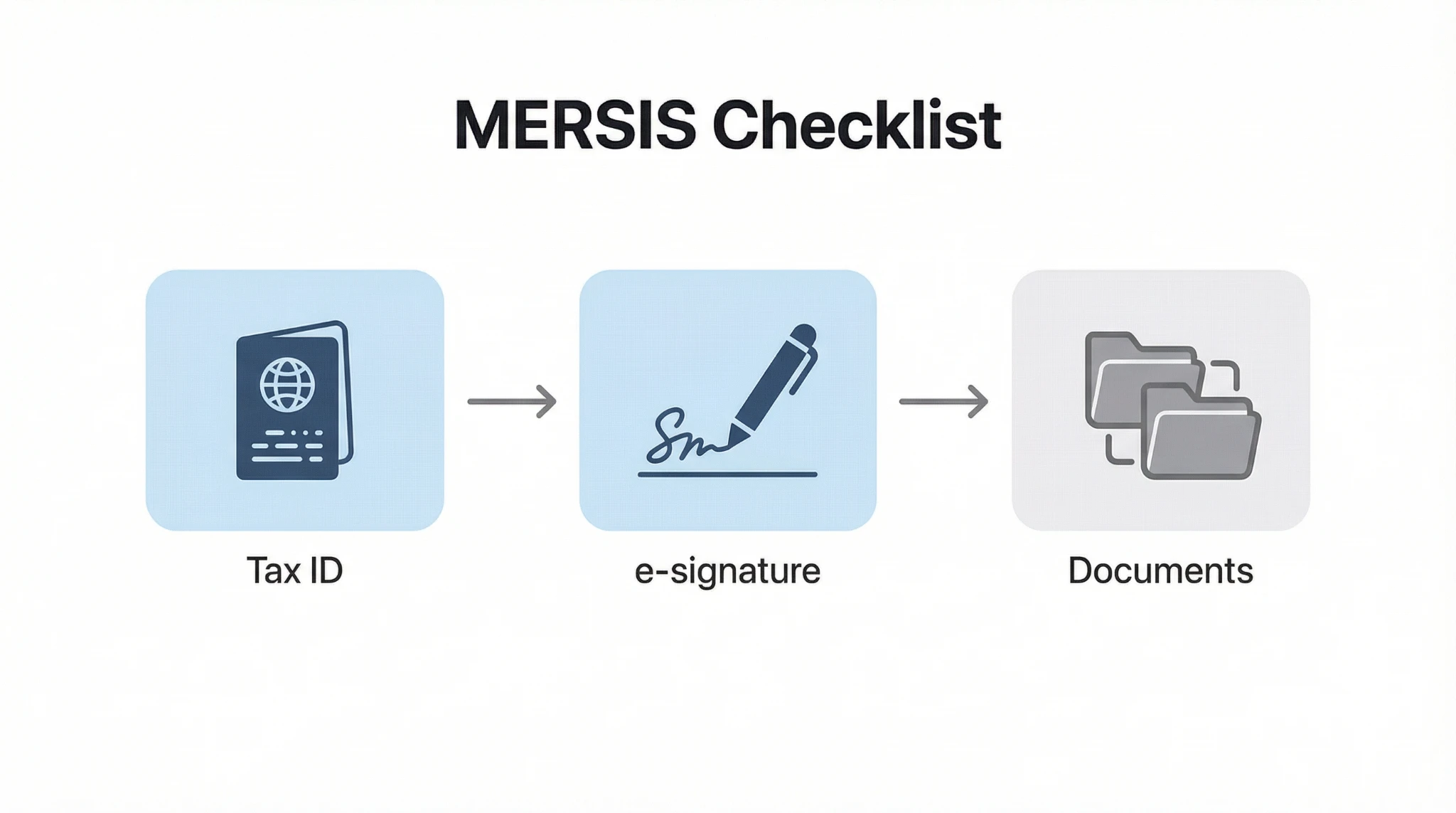
The most important MERSİS preparation is data consistency across identity, ownership, address, capital and authority.
Electronic Signature and Digital Signature Declarations
MERSİS supports electronic-signature workflows, and current Ministry guidance includes digital signature-declaration procedures for authorised persons in establishment applications. Electronic-signature actions can have the same legal effect as wet-signature actions where the applicable digital procedure is used.
However, do not reduce the process to “buy a USB token and press submit.” The required signature/acceptance method depends on the type of person and transaction, and the Trade Registry process still has its own legal requirements.
MERSİS Submission Does Not Equal Legal Registration
This is one of the most important distinctions for foreign founders.
| Status |
What it means |
| MERSİS data/draft prepared |
The electronic formation file is being built |
| Required signatures/approvals completed |
The application is ready for the relevant registry workflow |
| Trade Registry accepts and registers |
The company reaches the legal-registration milestone |
| Post-registration operational setup |
Tax/CPA, banking, digital, employment and sector requirements are handled separately as applicable |
Do not promise a fixed MERSİS-to-registration duration. File completeness, registry review, foreign documents and corrections can change the schedule.
Common MERSİS Errors Worth Preventing
- Name mismatch: passport, translation, tax record and MERSİS use different spellings.
- Wrong shareholder type: an individual-style file is used for a foreign corporate shareholder.
- Authority mismatch: the PoA or parent-company resolution does not support the manager/director/representative structure entered.
- Address inconsistency: the headquarters data do not match the supportable official address.
- Capital inconsistency: share percentages, capital commitments and Articles do not reconcile.
- Activity overreach: activity wording is copied generically without checking licences or the real operating model.
- Assuming digital submission finishes the project: Trade Registry and post-registration institutions are ignored.
What Happens After MERSİS?
After the registry process is completed, the company may still need, depending on the facts:
- licensed CPA/tax onboarding;
- tax-office commencement/address-verification procedures;
- corporate bank-account application;
- KEP/e-signature/financial-seal/e-invoicing steps where applicable;
- SGK/employer procedures where employees or the workplace model require them;
- work permits for foreign personnel where required;
- municipal or sector licences.
For the sequence, use Process of Establishing a Company in Turkey.

Workon coordinates the company-registration file and connected operational steps according to the agreed scope.
How Workon Coordinates MERSİS Preparation
Workon supports foreign founders and overseas companies with company-formation and operational-readiness coordination. Depending on the agreed scope, this can include foreign-document sequencing, registered-address preparation, MERSİS/Trade Registry coordination, power-of-attorney workflow, bank-application preparation, licensed CPA onboarding coordination and connected post-registration requirements.
Regulated legal, tax and licensed CPA/SMMM work is handled by appropriately authorised professionals. Trade Registry, banking and authority-facing steps are coordinated under the relevant institution’s current procedure.
Review Workon’s company registration and operational coordination service.
Official MERSİS Sources
Last reviewed: 17 September 2026. This guide explains MERSİS data preparation and system logic; exact registry procedures can vary by company form, person/document type and current implementation.
Frequently Asked Questions
MERSİS is the Ministry of Trade's central commercial-registration system used to prepare and manage company and commercial-enterprise registration, changes and deregistration electronically. It is the registry's digital data layer, not a substitute for the Trade Registry's legal review.
No. Current MERSİS access and signature routes can include supported identity-verification methods such as e-Devlet, electronic signature and mobile signature depending on the person and transaction. Foreign-founder cases can also use representative or power-of-attorney workflows where applicable.
Yes. Foreign individuals and foreign corporate shareholders can participate in Turkish company formation, but identity, tax or registry data and supporting foreign documents must be prepared consistently. Passport spelling, translations, powers of attorney and corporate authority records should reconcile before filing.
No. MERSİS is the electronic data and filing layer, not a standalone end-to-end processing clock. Overall timing depends on document readiness, signatures, the competent Trade Registry’s review and any correction requests.
No. After Trade Registry registration, the company can still need tax and licensed CPA onboarding, banking and KYC, digital compliance tools, SGK or employment steps, work permits and municipal or sector licences depending on its activity.