
A director change in Turkey involves more than updating the Trade Registry. Whether you are replacing an LLC manager or a JSC board member, the transition also requires attention to signing authority, bank mandates, KEP access and e-signature arrangements. For foreign-owned companies, document legalisation and coordination from abroad can add further complexity.
The hard part is that these steps don’t always move together. A filing can be registered, published in the Gazette, and still leave the company exposed if the signature circular, bank mandates, and authorised user records haven’t been refreshed. For foreign-owned companies, the friction is higher because foreign documents may need legalisation, the appointee may need a Turkish tax number, and the person handling the handover often sits in another country while the local records keep moving.
Why a Registry Filing Is Only Half the Job
Consider a foreign-owned company that has approved a new manager or board member, filed the required documents and received confirmation that the Trade Registry record has been updated. Then the bank calls to say the old signatory is still on the mandate. The accounting team still has outdated signatory details in its internal records. The company’s KEP account still has an outdated authorised-user and signing workflow. The legal change happened, but the business still isn’t fully operational.
That gap matters because a director or manager change in Turkey runs in two phases. The first is the corporate decision and registration phase, where the company adopts the appropriate resolution and completes the applicable MERSİS, Trade Registry and publication steps. The second is the operational readiness phase, where the company updates the signature circular, bank instructions, electronic signing tools, tax and social security touchpoints, and any contracts that rely on named authority.
Practical rule: if the new authority cannot sign, bank, log in, or represent the company in the systems the business actually uses, the transition is not complete.
For foreign-owned companies, the hidden friction is usually not the resolution itself. It’s the chain reaction after registration. A foreign appointee may need a Turkish tax number before the filing sequence can move cleanly, and foreign-issued documents may need apostille or other legalisation before they’re accepted in the file. That makes the transition less like a single filing and more like a coordinated handover across legal, financial, and administrative systems.
The quickest way to think about it is simple. The corporate decision and registry record document the change, while operational updates help the new authority function in practice. If those two are out of sync, someone in the company will eventually sign, pay, or file with the wrong authority attached.
LLC Manager Versus JSC Board Member Changes
The biggest source of confusion is that Turkish guides often blur two different roles. In an LLC, the relevant change is usually the manager of the company. In a JSC, the focus is a board member, and the governance process is usually more formal because the board and general assembly can both matter depending on the company’s internal structure. If you use the wrong template, the filing may still be rejected even though the business intent is clear.
The underlying reason is that the legal authority sits in different places. An LLC manager is typically the person who legally represents and runs the company day to day. A JSC board member sits inside a broader governance structure where appointment mechanics can be shaped by board decisions, general assembly decisions, and the representation rules already embedded in the company’s articles.
A practical comparison helps more than theory.
| Requirement |
LLC, Limited Company |
JSC, Joint Stock Company |
| Core role being changed |
Manager |
Board member |
| Typical corporate decision |
General assembly resolution |
Board resolution or general assembly decision, depending on the matter |
| Filing path |
MERSİS and Trade Registry submission |
MERSİS and Trade Registry submission |
| Representation impact |
Direct impact on who can act for the company |
May affect board composition and authorised representation separately |
| Downstream updates |
Signature authority, bank, KEP, e-signature, tax and SGK records |
Signature authority, board records, bank, KEP, e-signature, tax and SGK records |
Important distinction: changing a JSC board member does not necessarily change the company’s registered signing authority. Review the articles of association, the relevant corporate decisions and the registered representation arrangements separately. For LLC manager appointments, the Istanbul Chamber of Commerce’s official LLC registry checklist identifies the resolution, signature declaration and, for an external manager, an acceptance document among the applicable requirements.
If you’re working through a company change and need the role distinction mapped cleanly, the foreign-owner version of the issue is covered in Foreign Sole Director in Turkey for LLC and JSC structures.
The Filing Process From Resolution to Gazette Publication
The cleanest way to handle the filing is to treat it as a sequence, not a single form. For the broader filing mechanics, see Workon’s MERSİS and Trade Registry filing guide; this article focuses specifically on changes to management and representation. Start with the appropriate corporate decision, prepare the supporting documents, and complete the applicable MERSİS, Trade Registry and publication steps. Check separately when the appointment takes legal effect and how the change can be relied upon against third parties; these questions should not be reduced to a single publication date. For foreign directors, the practical sequence commonly includes a board or general assembly resolution, a Turkish tax number for the individual, MERSİS filing, physical submission to the Trade Registry Office, and Gazette publication (Istanbul Lawyer Firm).
The Ministry’s trade registry guidance says correction or update requests for MERSİS records must be submitted to the trade registry directorate where the company is registered (Ministry of Trade trade registry guidance). That matters because a wrong assumption about which office can fix the record often delays the change more than the appointment itself.
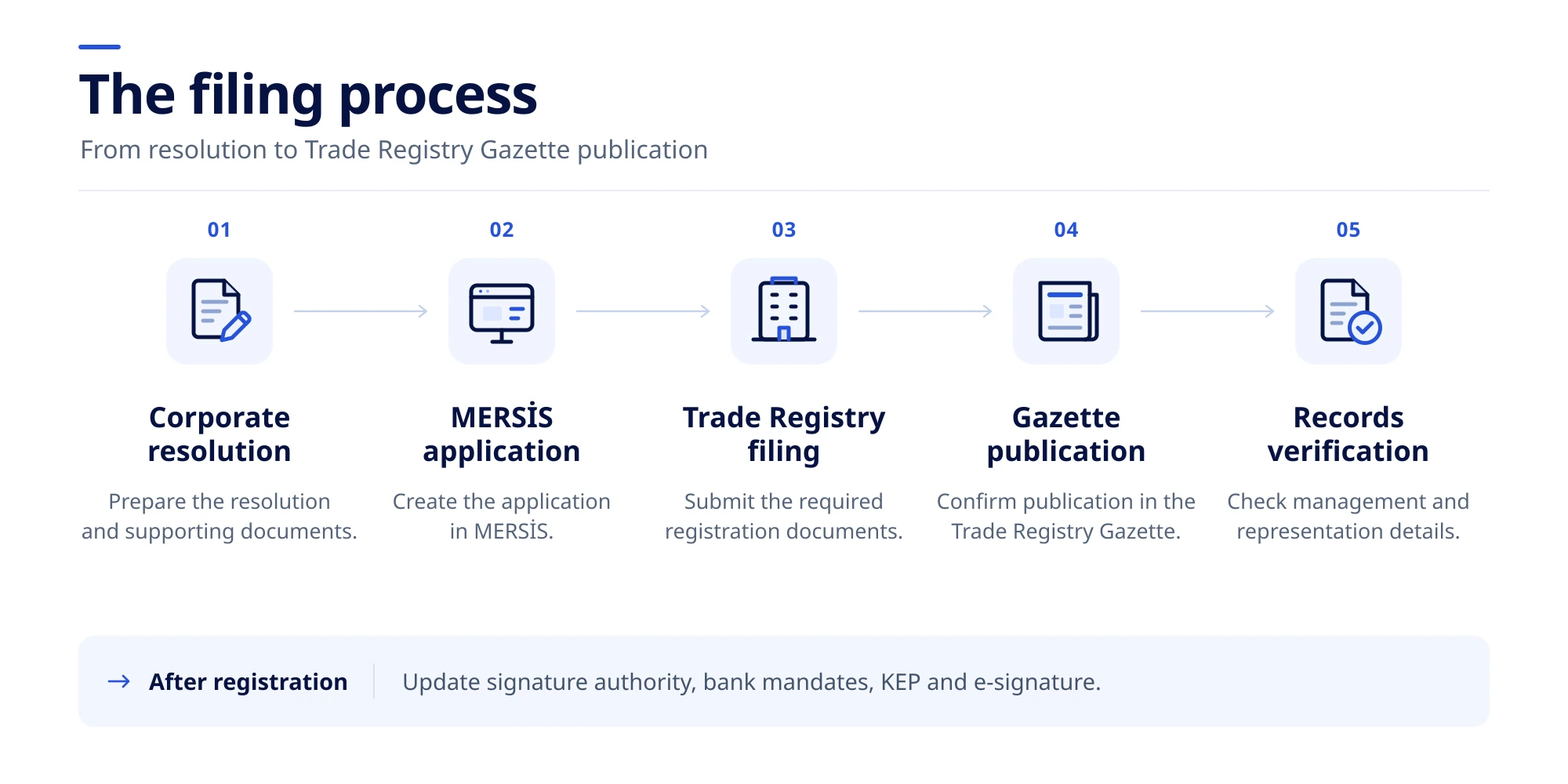
From corporate resolution to Gazette publication: the filing stages of a director or manager change in Turkey.
Documents and legalisation that usually slow things down
Documents issued abroad may require a notarised Turkish translation and apostille or other legalisation, depending on the document and country of issue. For an LLC manager appointed from outside the shareholder group, the Istanbul Chamber of Commerce’s filing instructions specify an acceptance document and additional identification requirements for foreign appointees. Under Article 30 of the Turkish Commercial Code, the general period for requesting registration is 15 days unless another statutory rule applies; Article 31 extends registration rules to changes in registered matters. The period is one month for persons residing outside the registry office’s jurisdiction. This is a deadline for requesting registration of a registrable event, not a universal separate deadline for every resignation or acceptance letter. Check the applicable trigger date and any special rule for the specific filing with the Trade Registry Office (Turkish Commercial Code, Articles 30–31).
Check the distinction: the corporate decision, registration and publication are separate steps. The legal effect of an appointment and whether it can be relied on against third parties depend on the relevant rules and facts; do not assume Gazette publication alone determines every aspect of authority.
For foreign founders, much of the practical pain lies here. The company can approve the change in one meeting, but the documents still have to pass through translation, legalisation, and registry acceptance. The legal decision matters, but the registry record, signature arrangements and third-party systems must each be reviewed before assuming the new representative can act without interruption.
You can verify how published records are searched in the Turkish Trade Registry Gazette search tool, which is useful when you want to confirm that the change is visible outside the company file.
Downstream Updates That Most Guides Overlook
The Trade Registry filing is not the end of the story. It’s the point where the company can finally start fixing the rest of its records. The most common failure is assuming the new director can immediately act everywhere just because the registry has been updated. In reality, the company usually still needs to refresh the signature circular, bank mandates, KEP access, e-signature certificates, and the internal list of people who can approve, file, or contract on behalf of the business.
The signature circular is often the first operational document that needs attention because it proves who can sign and how. If the company uses the old circular after the change, you can end up with a file that looks correct at the registry level but still causes confusion when a bank, supplier, or public office asks for proof of authority. For that reason, the signature circular in Turkey should be updated in step with the new representation set-up, not left for later.
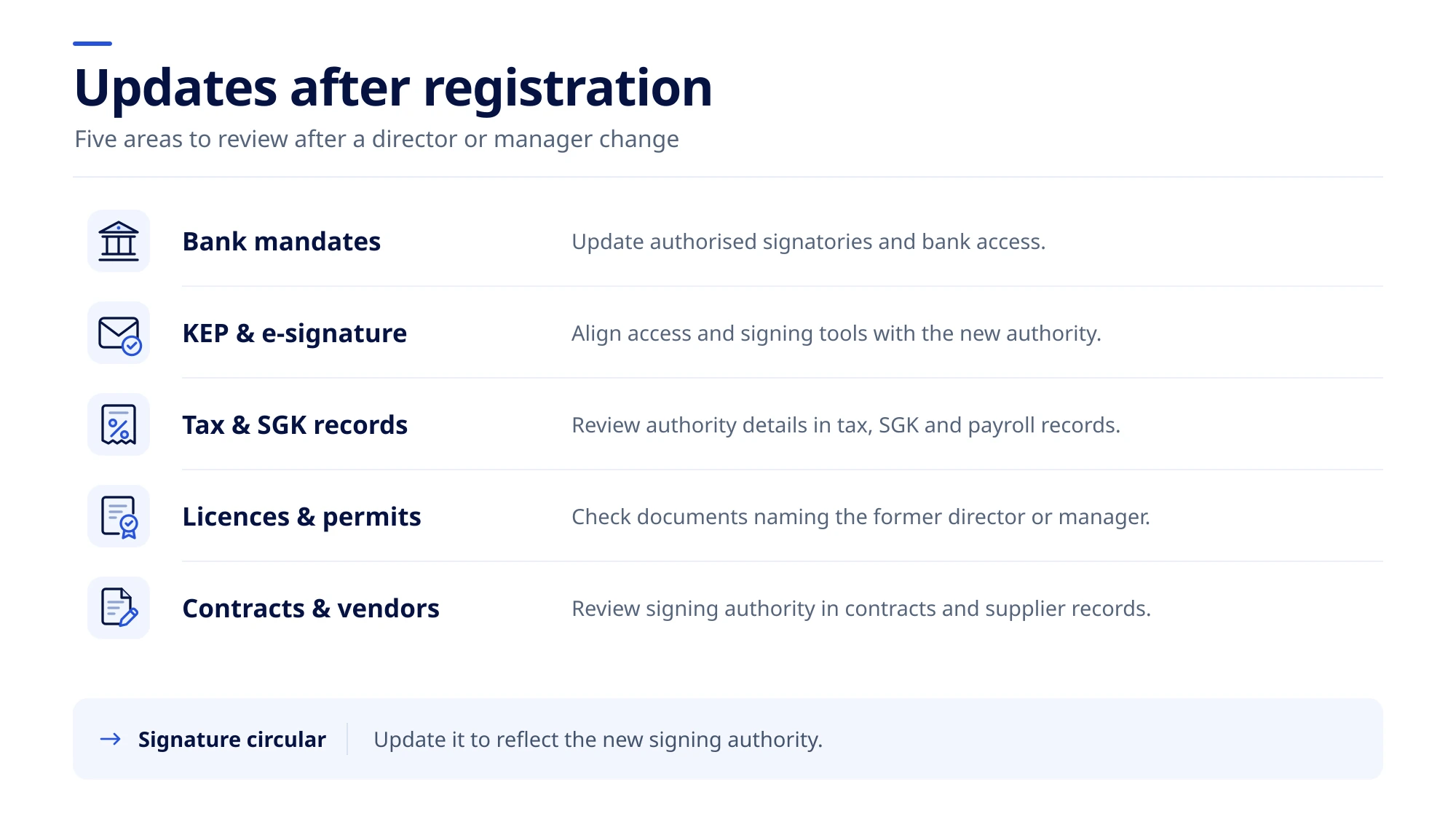
Key records and access permissions to review after registering a director or manager change in Turkey.
The updates that usually get missed
- Bank mandates: The bank needs the new authorised signatory details, because the Trade Registry does not automatically rewrite the bank’s internal mandate.
- KEP and e-signature: The company’s registered electronic mail and electronic signature tools need to match the person who will file and receive official notices.
- Tax and SGK records: Internal and portal-facing records often need to reflect the new authority so payroll, filings, and notices don’t keep pointing to the outgoing director.
- Licences and permits: Any licence or permit that names the former director should be reviewed and, where needed, updated.
- Contracts and vendor authorisations: Long-running contracts, signing authorities, and vendor files should be checked so nobody relies on obsolete authority language.
A common underserved angle is the difference between changing a person and changing legal representation. Recent coverage notes that Turkish trade-registry practice has been moving towards more digitised handling, while still relying on specific documents and post-registration updates, and that many guides stop at the resolution and filing steps instead of the bank, KEP, and e-signature fallout (Mondaq overview of Trade Registry practice).
The main operational risk is a gap in authority. If the outgoing director’s power is removed before the new one is fully active in every system, the company can end up with a valid registry change but no usable signer on the ground. That’s the kind of break that causes frozen banking actions, delayed filings, and avoidable contract problems.

Simplify your business setup with Workon’s all-in-one company registration service in Turkey.
Common Mistakes and How to Avoid Them
Most problems in director or manager changes come from speed, not resistance. The company wants the old authority gone quickly, but the legal and operational steps don’t always end on the same day. The result is a transition that looks clean in the registry and messy everywhere else.
The first mistake is missing the statutory registration application deadline. Articles 30–31 of the Turkish Commercial Code generally allow 15 days to request registration of a registrable change, unless another legal rule applies, and provide a one-month period for applicants residing outside the registry office’s jurisdiction. The triggering date and any special rule must be checked for the actual corporate event; this is not a separate universal deadline for each resignation or acceptance letter. The second is treating foreign documents as if they can be submitted without checking translation or legalisation requirements. If the document came from outside Türkiye, check the acceptance format early, because delays at that stage can hold up the whole appointment.
Another common error is revoking the old authority before the new one is fully usable. That creates a dangerous gap where the company is technically in transition but practically unable to sign, bank, or file with confidence. In a foreign-owned company, that gap is even more fragile because the appointee may still be waiting on a Turkish tax number, a fresh e-signature setup, or a bank appointment.
Practical checkpoint: don’t let the outgoing signatory disappear from the process until the incoming signatory has been accepted by the registry and propagated into the systems that actually run the business.
There’s also a quieter problem, assuming the MERSİS update fixes everything else by itself. It doesn’t. Banks, KEP providers, payroll teams, tax workflows, and licensing files usually need separate attention. If nobody owns the downstream list, each department waits for someone else to close the loop, and the company stays half-transitioned longer than expected.
A final mistake is using the old signature circular for new commitments. That can be especially awkward with suppliers and counterparties that ask for proof of authority before they release funds, goods, or approvals. The safest approach is to treat the corporate resolution, registry filing, and operational signatory documents as one chain, not three separate jobs.
Timeline, Costs and Coordinated Support
Practical handover checklist: (1) identify whether the change concerns an LLC manager, JSC board membership or registered representation; (2) confirm the company’s articles and the required decision-making body; (3) prepare the resolution, identity, acceptance and translation/legalisation documents applicable to the case; (4) submit the MERSİS and Trade Registry application; (5) check the registered representation and Gazette record; and (6) assign owners for bank mandates, signature documents, KEP/e-signature access and any affected tax, SGK or licensing records. The exact sequence can vary by company and filing.
A director or manager change usually moves in stages, not all at once. The resolution and notarisation stage is often the quickest if the documents are ready. MERSİS submission and Trade Registry processing follow, then Gazette publication, then the downstream updates across bank, KEP, e-signature, tax, SGK, and internal authorisation files. For many companies, the registry part feels like the finish line, but the practical finish comes only after the operational updates are done.
The cost picture is also layered. Expect separate components for notary work, Trade Registry charges, Gazette publication, and professional coordination. The exact amount changes, so it should be checked against current first-party sources before budgeting. What matters operationally is not the headline figure, but the full decision cost, because a cheap filing that leaves the bank and signature records unchanged isn’t cheap.
Turkish trade registry updates are handled through the MERSİS Central Registry Record System, and the Ministry’s guidance says correction or update requests for MERSİS records must be submitted to the trade registry directorate where the company is registered (Ministry of Trade trade registry guidance). That’s the administrative anchor for the whole process.
What coordinated support usually covers
Workon coordinates this kind of transition as an Istanbul-based business setup and operational coordination platform, which means document preparation, legalisation workflows, MERSİS filing support, bank mandate follow-up, and KEP transfer coordination can be handled in one flow. Where regulated legal, tax, or accounting work is needed, that part stays with the appropriately licensed professionals involved.
The useful part of coordination is not speed for its own sake. It’s reducing the chance that the company updates one system and forgets the other four that depend on it. That matters most when the director is foreign, the records are split across institutions, and the company needs to keep operating while the change is being closed out.
If you’re handling a director or manager change now, use Workon to coordinate the registry filing, signatory updates, and the post-registration clean-up that usually gets missed. It’s the practical way to get from legal change to operational readiness without leaving bank mandates, KEP, e-signature, or authority records behind.
The company adopts the appropriate corporate resolution, applies through MERSİS and completes the Trade Registry filing and required publication. The approval process differs between LLC manager changes and JSC board member changes.
Common requirements include the corporate resolution, registry application, identification details and any required acceptance or signature declarations. The exact list depends on the appointment; foreign-issued documents may require legalisation and notarised Turkish translations.
Timing depends on document readiness, any translation or legalisation, and Trade Registry processing. Allow additional time after registration for bank mandates, signing documents and digital access updates.
Costs can include registry and publication charges, notarial work, translation, legalisation and professional support. The total depends on the documents and services needed; confirm the applicable registry fees before budgeting.
Where signing authority changes, review the signature circular, bank mandates, online banking permissions, KEP users and e-signature arrangements. Also check tax, SGK, licensing and contract records that refer to the outgoing representative.