A Virtual POS in Turkey is an online card-acquiring service that lets an approved merchant accept card payments through a bank or an authorised payment institution. There is no single universal application checklist or approval timeline: the merchant entity, website, business model, settlement account, ownership/KYC profile and provider policy all matter.
For a foreign founder, the first question is therefore not “Which document guarantees approval?” but which merchant entity will contract with the provider and which provider is authorised and willing to onboard that business model.
Reviewed: 17 September 2026. Provider eligibility, licence scope, pricing and onboarding requirements can change; confirm the current rules with the bank or authorised payment/electronic-money institution before relying on a route.
Quick Answer: How to Prepare a Virtual POS Application
- Choose the merchant entity: confirm which company will sign the merchant agreement and whether the provider accepts that entity/settlement structure.
- Verify the provider: for a non-bank provider, check its current CBRT authorisation and licence scope.
- Prepare KYC and company evidence: keep ownership, authorised-person, company and settlement information current and consistent.
- Make the website review-ready: clearly show products/services, prices, contact details, delivery/cancellation/return terms, privacy/security information and the transaction currency where relevant.
- Confirm commercial and technical terms: compare fees, settlement timing, reserves/chargebacks, supported cards/currencies, integration method and security requirements before signing.
What a Virtual POS Is in Turkey
A Virtual POS is the online equivalent of card-acquiring functionality: the merchant integrates a bank or payment-provider solution into its website or application so customers can pay by card. The provider then settles eligible transactions according to the merchant agreement.
The commercial decision is not only “bank or fintech.” You also need to compare merchant eligibility, card coverage, instalment options, settlement timing, reserve/chargeback rules, integration method, security requirements and total pricing.

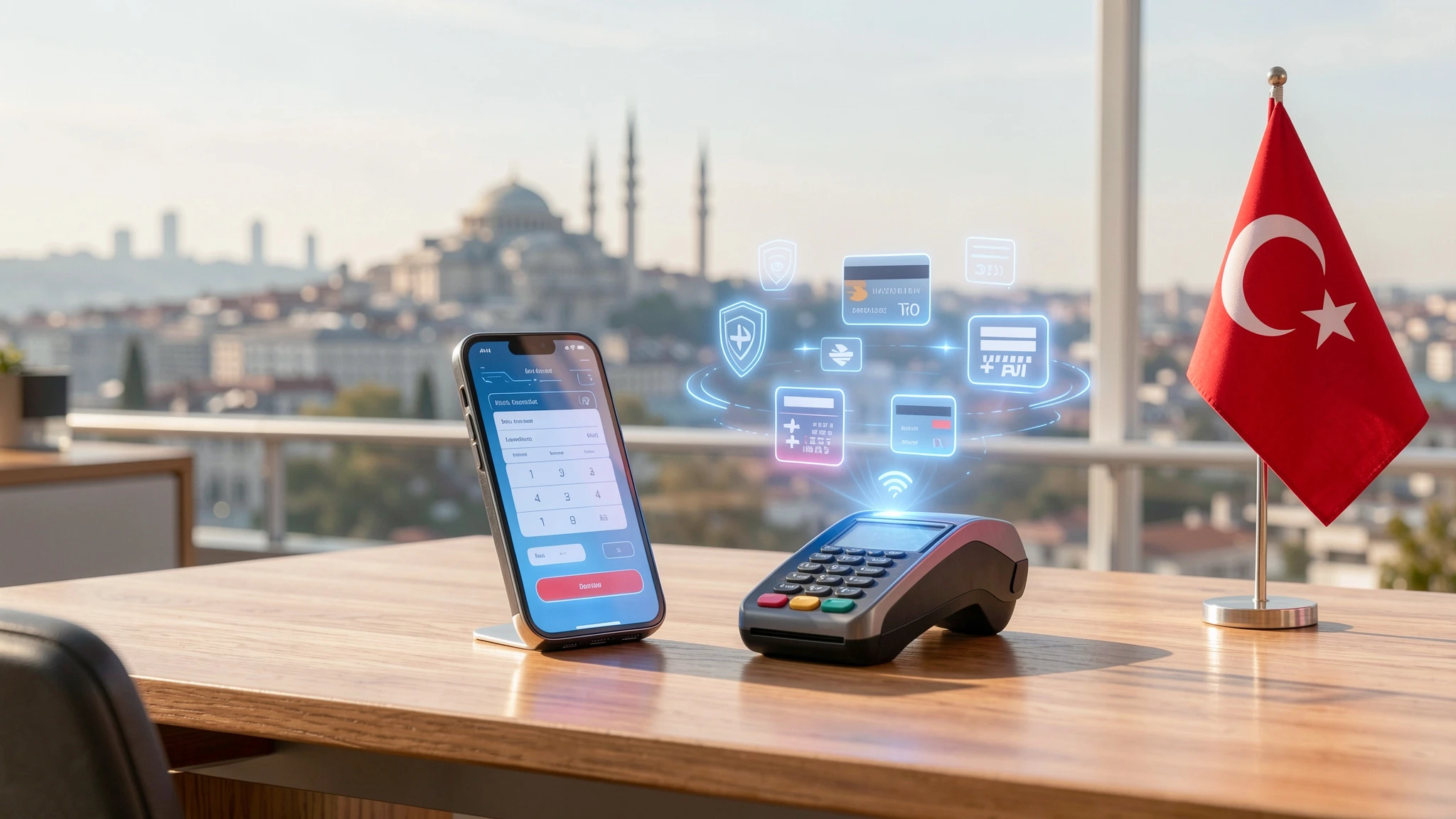
How mobile wallets, contactless cards, and online POS systems power Turkey’s fast-growing digital economy
Who Regulates Payment Institutions?
Under Law No. 6493, the Central Bank of the Republic of Türkiye (TCMB/CBRT) regulates and supervises payment and electronic-money institutions. TCMB publishes the current authorised institutions and the payment-service scope of each licence.
For merchant acquiring, licence scope matters. TCMB’s current payment-institution table expressly notes that an authorisation shown under Article 12(1)(c) is limited to acquiring payment instruments for authorised payment institutions. An institution appearing on a payment or e-money list should therefore not be treated as automatically authorised for every payment service or every Virtual POS product.
Official sources: TCMB authorised payment institutions and licence scopes and TCMB authorised electronic-money institutions and payment-service scopes.
When a Virtual POS Is Relevant
A Virtual POS is relevant when a business needs to accept card payments online through a Turkish acquiring relationship. It can be useful for e-commerce, SaaS, online services, reservations and other remote-payment models, subject to the provider’s merchant and sector rules.
Approval should not be confused with market demand: even a technically ready website can be declined or asked for more information if the provider does not accept the business model, ownership profile, settlement setup or risk exposure.
Virtual POS Is Not the Same as Becoming a Payment Institution
A merchant applying to accept card payments is not applying for a payment-institution licence simply because it uses a Virtual POS. A company that intends to provide regulated payment services to others is a different case and may fall under a separate TCMB licensing framework.
This guide follows the merchant’s application: selecting a provider, preparing the company and website, agreeing settlement terms and testing checkout. If your business plans to provide payment services to other users rather than only accept payments for its own sales, review the payment and electronic-money authorisation guide before treating merchant onboarding as the appropriate route.
Merchant Readiness: Documents and Website Requirements
There is no universal Virtual POS document list. A bank or authorised payment institution can request different company, ownership, signatory, settlement and business-model evidence according to its onboarding rules.
The practical objective is to make the merchant easy to verify: current company records, authorised-person information, UBO/ownership data, settlement-account details and a website that clearly explains what the customer is buying and on what terms.

Virtual POS onboarding can require current company, ownership, signatory and settlement-account evidence depending on the provider.
Company and KYC File
Depending on the provider, be ready to supply the information needed to identify the legal entity, authorised applicant, owners/controllers and settlement arrangement. For a Turkish company, common source records can include trade-registry, tax and signatory documentation, but the provider’s current request controls the final checklist.
- Legal entity: current company-registration and tax information requested by the provider.
- Authorised applicant: identity and authority evidence for the person signing or managing the merchant application.
- Ownership/control: shareholder and UBO information requested for KYC and risk review.
- Settlement: the bank-account details or other settlement information required by the acquiring provider.
- Business evidence: website, product/service description, pricing, contracts or other records requested to understand the merchant activity.
Keep the file current and internally consistent. Do not assume that one fixed set of four documents is sufficient for every bank, payment institution or business model.
Does a Foreign Company Need a Turkish Entity?
Do not treat this as a universal legal yes/no rule. The practical answer depends on which provider, merchant contract, settlement arrangement and business model are being used. A provider may require a Turkish legal entity and Turkish settlement relationship for its local acquiring product, but that requirement should be verified with the specific provider.
If a Turkish entity is required, registration is only the first layer. The company may also need a registered business address, bank/settlement setup, tax/compliance coordination and a website that is ready for merchant underwriting before it is operational for online card acceptance.
If the selected provider requires a Turkish merchant entity, build the operational sequence around that requirement: establish the company, complete the registered-address and tax/compliance setup, prepare the settlement relationship required by the provider, and then submit the merchant application. Do not create a Turkish entity solely on the assumption that every Virtual POS route requires one.
Choosing Your Virtual POS Provider in Turkey
A Turkish merchant can obtain online card acquiring from a bank or from a payment/e-money institution whose licence covers the relevant payment service. Do not assume one route is always faster, cheaper or more flexible; compare the actual merchant agreement and technical/product scope.
For non-bank providers, verify the institution and its current licence scope on the CBRT list of authorised payment institutions or the authorised electronic-money institutions list. Under Law No. 6493, acquiring payment instruments is a specifically regulated payment-service activity, so the relevant service scope—not the brand name or a generic payment/e-money licence—is the key check.
Bank Virtual POS
A bank Virtual POS is an acquiring product supplied under that bank’s merchant rules. The bank evaluates the merchant, website, business model, card-acceptance risk, settlement structure and required documentation. Integration and pricing differ by bank and product; there is no universal rule that a bank route is slower or cheaper.
Authorised Payment or Electronic-Money Institutions
Some non-bank institutions also provide merchant acquiring or payment-acceptance services within the scope of their CBRT authorisation. Their product model can bundle different bank/card integrations behind one merchant interface, but the exact card coverage, instalment options, settlement method, reserve policy and technical tools depend on the provider.
Do not treat every payment institution as authorised for every payment service. Check the current CBRT licence table and the provider’s own merchant terms before relying on a route.
Bank vs. Payment Institution: What to Compare
Compare the actual merchant product rather than choosing by provider category alone.
| Feature |
Traditional Banks |
Payment Service Providers (PSPs) |
| Onboarding timeline |
Depends on merchant review, website readiness, documentation and bank policy. |
Depends on merchant review, licence/product scope, documentation and provider policy. |
| Integration |
May offer API, hosted-payment-page or platform-specific options; check the bank’s current documentation. |
May offer API, hosted-payment-page, plugins or other integrations; availability is provider-specific. |
| Fee structure |
Compare commission, fixed/annual fees, settlement terms, foreign-card pricing and other merchant charges. |
Compare commission, fixed/annual fees, reserve/settlement terms and any product-specific charges. |
| Merchant support |
Check implementation support, dispute/chargeback handling, reporting and merchant-service channels. |
Check implementation support, dispute/chargeback handling, reporting and merchant-service channels. |
| Product scope |
Check supported card schemes, instalments, foreign cards/currencies, refunds, pre-authorisation and reporting. |
Check supported card schemes, instalments, foreign cards/currencies, refunds, payment methods and reporting. |
There is no universal winner. Choose the route that accepts your merchant profile and provides the card coverage, settlement model, integration, risk terms and total pricing your business actually needs.

Simplify your business setup with Workon’s all-in-one company registration service in Turkey.
What Providers Review Before Approving a Virtual POS
Virtual POS onboarding combines merchant KYC with commercial and technical review. The provider needs to understand who owns and controls the merchant, what the business sells, where customers are located, how payments will be accepted, where settlement goes and whether the website/app meets the provider’s current merchant requirements.
Approval is provider-controlled. A complete file improves review quality but does not guarantee acceptance or a fixed timeline.
Merchant KYC and Authorisation
Expect the provider to verify the legal merchant, authorised representative, ownership/control information and settlement details. The exact evidence depends on the merchant and provider; do not assume that one document mismatch automatically stops the process or that every provider checks the same sources in the same way.
Website and Merchant Readiness
The provider also reviews whether the sales channel is ready for card acceptance. Requirements differ by provider, but İş Bankası’s current Virtual POS criteria provide a useful primary-source example of the type of information a merchant website may need to show clearly.
- Products/services and prices: describe what is sold and display the relevant price information clearly.
- Cancellation, return and delivery terms: make the customer-facing rules visible and consistent with the actual sales process.
- Merchant identity and contact: show the commercial title, business address/country and customer-service contact details.
- Transaction information: make the transaction currency and other relevant payment information clear.
- Privacy and information security: publish the required privacy/security information and use a secure payment flow. İş Bankası currently requires SSL for the payment page, while also offering its own secure hosted payment-page option for merchants that use that product.
See the official İş Bankası Virtual POS merchant requirements. These are an example of one bank’s current rules, not a universal checklist for every provider.
A website that clearly shows what is sold, who the merchant is, how customers can contact the business and what the cancellation/return rules are gives the provider concrete information to review. It does not guarantee approval.

Bank and payment-institution Virtual POS products should be compared by merchant eligibility, integration, settlement, risk terms and pricing rather than assumed speed.
Do not assume a non-bank provider is automatically faster or a bank automatically cheaper. Compare the current merchant offer and contractual terms.
How Long Does Virtual POS Onboarding Take?
There is no reliable universal number of days. A provider may need to review the merchant entity, ownership/KYC, website, business model, technical setup and settlement details before enabling live processing.
Timing varies by provider and file. Additional document requests, website changes, sector-specific review, settlement-account issues or technical testing can extend onboarding.
Do not use broad digital-banking adoption statistics to predict Virtual POS approval. Merchant onboarding depends on the specific provider and merchant file.
If the chosen merchant product settles to a Turkish corporate bank account, prepare that banking relationship separately. See how to open a business bank account in Turkey.
Integration and Go-Live
After merchant approval, follow the integration method offered for that product. Depending on the provider, this may be a hosted payment page, plugin/module, API or another approved checkout flow. Do not assume that every provider issues API keys or supports the same platforms.

Successful online card payment processed through a Turkish virtual POS system
Choose the Provider-Supported Integration
- Hosted payment page: card data is entered on a payment page operated or supplied by the provider; this can reduce the merchant’s direct handling of card data, subject to the provider’s implementation and PCI requirements.
- Plugin/module: use a provider-supported integration for the relevant e-commerce platform when available.
- API/direct integration: custom development may be appropriate when the provider supports it and the merchant can meet the required security and testing standards.
Test the Checkout Before Go-Live
If the provider supplies a sandbox or test environment, use it to validate the checkout before live processing. If it uses another certification or test procedure, follow that instead.
- Successful payments: Does a simple, happy-path transaction work perfectly?
- Declined cards: What happens when a payment fails? Does the customer get a clear message?
- Installment options: If you offer them, can a customer select their desired plan and check out without a hitch?
- Refunds: Can you easily process a full or partial refund from your end?
Test successful and failed payments, refunds/cancellations and any instalment or pre-authorisation flows that the merchant will actually use. Keep the test scope aligned with the provider’s current integration documentation.
Security, PCI DSS and 3D Secure
Card-security responsibilities depend on the checkout architecture and merchant/provider relationship. A hosted payment page can reduce the merchant’s direct exposure to card data, but it does not mean the merchant has no PCI DSS or information-security responsibilities.
Confirm the applicable PCI DSS scope with the provider and the current PCI Security Standards Council guidance. Also confirm the provider’s 3D Secure, fraud-control, chargeback and dispute procedures. These controls reduce particular risks; they do not guarantee that fraud or chargebacks will never occur.
Where Workon Fits
Workon helps foreign founders and international companies establish and operate businesses in Turkey. For a Virtual POS project, the relevant role can include coordinating the Turkish company and registered-address setup where needed, corporate documentation, business bank-account preparation and the operational information required to approach a bank or authorised payment provider.
Workon does not issue Virtual POS licences, control provider underwriting or guarantee approval/timing. The bank or authorised payment institution decides whether to onboard the merchant and under which commercial and technical terms.
If the merchant still needs a Turkish company, see company formation in Turkey for foreign founders. If the chosen merchant route requires a Turkish corporate account, see business bank account application support.
Frequently Asked Questions
A Virtual POS is an online card-acquiring service that allows an approved merchant to accept card payments through a bank or an authorised payment or electronic-money institution whose licence covers the relevant service. It is a merchant-acquiring product, not a payment-institution licence for the merchant itself.
No universal rule applies. The required merchant entity and settlement structure depend on the provider and product. A provider may require a Turkish legal entity and local settlement relationship, but that should be verified with the specific bank or authorised institution before forming a company solely for this purpose.
There is no safe universal two-to-five-day or two-to-four-week promise. Timing depends on merchant KYC, ownership, website readiness, business model, sector risk, settlement setup, requested documents, technical integration and the provider's underwriting process.
There is no single checklist for every provider. Be ready with current company and tax information, authorised-person and ownership or UBO evidence, settlement-account details and business or website information, but the bank or authorised payment institution's live request controls the final document set.
No. Compare the actual merchant offer, including eligibility, commission and fixed fees, settlement timing, reserves and chargebacks, card and currency coverage, instalments, integration method, security requirements and support. Provider category alone does not determine price or speed.
No. A clear website, current KYC file and consistent merchant information improve review readiness, but the bank or authorised provider controls underwriting and approval. It can request further evidence, impose risk terms or decline the application according to its current policy.
Disclaimer: This guide provides general merchant-acquiring and payment-operations information, not legal, regulatory, tax, financial or technical-security advice. Virtual POS eligibility, merchant onboarding, website requirements, pricing, settlement, reserves, card coverage, integration and approval depend on the bank or authorised payment institution, the merchant profile and the rules in force for the relevant period. Confirm material requirements directly with the selected provider and obtain appropriately qualified advice where needed.