Quick answer: Türkiye’s beneficial-owner reporting rules require covered entities to identify the natural person or persons who ultimately own or control the structure and report the required information to the Turkish Revenue Administration (GİB). For Turkish corporate-income-tax taxpayers, beneficial-owner information is reported through the relevant tax-return framework; a new taxpayer registration or later change in previously reported information must also be notified within the period set by the rules.
This guide covers beneficial owner / UBO tax-compliance. It does not replace bank KYC, MERSİS shareholder records or Trade Registry filings. Those systems can ask overlapping ownership questions for different legal purposes.
What Is a Beneficial Owner in Turkey?
Under Tax Procedure Law General Communiqué No. 529, a beneficial owner (gerçek faydalanıcı) is the natural person or persons who ultimately control or exercise ultimate influence over a legal person or arrangement.
For legal entities, the identification sequence is:
- Natural persons owning more than 25% of the entity;
- if a person above that threshold is suspected not to be the true beneficial owner, or no natural person exceeds 25%, identify the natural person or persons who ultimately control the entity by other means;
- if no beneficial owner can be identified through the first two tests, identify the natural person or persons with the highest executive authority.
UBO rule: A corporate shareholder can sit in the ownership chain, but the beneficial-owner test ultimately looks for natural persons.

Beneficial-owner analysis looks through the legal ownership chain to the natural person or persons who ultimately own or control the structure.
Who Has a Reporting Obligation?
Communiqué No. 529 covers corporate-income-tax taxpayers and specified other taxpayers/persons. For Workon’s typical foreign-founder cases, Turkish LLCs and JSCs fall within the corporate-taxpayer reporting framework.
| Scenario |
Core UBO question |
| Individual-owned Turkish LLC |
Which natural persons directly own more than 25%, and is anyone else the ultimate controller? |
| Turkish subsidiary owned by a foreign company |
Who are the natural persons behind the foreign parent or wider ownership chain? |
| Multi-layer holding structure |
Trace each corporate layer until natural persons and control rights are identified |
| No natural person above 25% |
Apply the ultimate-control test, then the senior-executive fallback if necessary |
Do not use the simplified rule “every formal entity in Türkiye files exactly the same form on the same date.” The reporting route and period depend on the taxpayer/entity category.
More Than 25% Ownership: What the Threshold Means
The threshold in the Communiqué is more than 25%, not “25% or more.” A natural person who directly or indirectly owns more than 25% is an initial beneficial-owner candidate under the statutory test.
Ownership percentage is only the first test. A lower-shareholding person can still be relevant if the person ultimately controls the entity through another mechanism. Conversely, a nominee or intermediary shareholder should not be used to stop the analysis at the legal-owner level.
Prepare the Ownership Evidence Before the Declaration
Where a foreign company owns the Turkish entity, complete the natural-person ownership and control analysis before preparing the tax submission. Keep the resulting ownership chart, source records and documented basis for each reportable person together so the person preparing the declaration can reconcile them with the identity and contact information.
For indirect-percentage calculations, control rights and the executive fallback, use the UBO identification and ownership-mapping guide. The sections below explain how that completed analysis feeds into GİB reporting. A bank’s separate AML/KYC review can still require additional evidence.
What Information Is Reported?
Communiqué No. 529 requires information including the beneficial owner’s:
- name and surname;
- nationality;
- identity number;
- address;
- available telephone, fax and email information;
- reason/basis for beneficial-owner status.
For an international structure, use consistent identity and address information across the UBO file, tax records, shareholder records and bank KYC documents. A spelling mismatch does not change ownership, but it can create unnecessary reconciliation work.
How Corporate Taxpayers Report Beneficial Owners
For corporate-income-tax taxpayers, Communiqué No. 529 provides for beneficial-owner information to be reported through provisional tax returns and the annual corporate income-tax return.
Do not tell every Turkish LLC that its only compliance obligation is a standalone annual “Gerçek Faydalanıcı Bildirim Formu” in August. GİB’s 2026 tax calendar continues to list the annual August form specifically for taxpayers/persons outside the corporate-income-taxpayer category that are subject to that separate form requirement.
New Company or UBO Change: The One-Month Rule
The Communiqué requires covered taxpayers/persons to notify a new taxpayer registration or a change in previously reported beneficial-owner information within one month following the event. Current GİB guidance also explains the filing route for corporate taxpayers: if that one-month period falls within the applicable corporate/provisional tax-return filing period, the information is reported with the return; otherwise the beneficial-owner form in the Digital Tax Office is used.
Events that should trigger a UBO review can include:
- share transfer;
- capital increase that changes ownership percentages;
- new investor entering the structure;
- change in an upstream foreign parent/shareholder;
- change in ultimate-control rights;
- change in the senior executive reported under the fallback rule;
- changes in reportable personal information.
The correct question after a corporate change is not merely “Did the direct Turkish shareholder change?” but “Did any previously reported beneficial-owner information change?”
Electronic Filing: Do Not Use an Old Paper-Form Workflow
The Communiqué requires the relevant standalone notification form, where applicable, to be submitted electronically through the Revenue Administration’s electronic tax system. Paper submission by hand or post is not treated as the standard valid route under the rule.
The filing can be made by the taxpayer or, where the conditions in the Communiqué are met, through an authorised SMMM/CPA or YMM under the relevant professional engagement.
Because statutory tax filing is regulated professional work, Workon coordinates the process where included in the agreed scope, while the tax analysis/submission is handled through the appropriately licensed Turkish tax professional.
Beneficial Owner Declaration vs MERSİS Shareholder Record
| System / document |
Main purpose |
| MERSİS / Trade Registry |
Registered legal ownership and company/corporate data |
| GİB beneficial-owner reporting |
Natural person(s) who ultimately own/control the structure for tax-transparency purposes |
| Bank KYC/AML |
Institution-specific customer, controller, source-of-funds and transaction-risk assessment |
| Trade Registry Gazette |
Published registered corporate events and history |
These records should be coherent, but they are not interchangeable.
Beneficial Owner Declaration vs Bank UBO/KYC
A bank may ask for an ownership chart, passports, proof of address, corporate documents, source of funds, source of wealth and explanations of control even when the company has already complied with its GİB beneficial-owner reporting.
Under the current MASAK customer-due-diligence framework for a trade-registry legal person in a continuing business relationship, obliged institutions identify natural-person shareholders holding more than 25%; if that test does not identify the true beneficial owner, they move to the natural person or persons who ultimately control the entity, and if that still does not identify a person, the highest executive authority is used as the fallback. MASAK also requires identification of legal-entity shareholders above the relevant 25% threshold in that CDD layer. This is why a bank can legitimately ask for ownership-chain evidence beyond the GİB tax filing itself.
Do not promise that a GİB UBO filing will automatically satisfy the bank or prevent account restrictions. Banks conduct their own AML/KYC reviews and decide which supporting evidence is required.
For bank onboarding, use How to Open a Business Bank Account in Turkey.
From Ownership Analysis to a Consistent Reporting File
| Reporting-file situation |
Practical check before submission |
| A foreign parent sits above the Turkish company |
Attach the completed ownership/control analysis rather than recording only the foreign corporate shareholder as the final beneficial owner. |
| A share transfer or upstream restructuring has occurred |
Compare the updated ownership analysis with the last reported information and assess the change-reporting route described above. |
| The person reported under the executive fallback changes |
Recheck the basis for the fallback and identify which previously reported personal information needs updating. |
| The tax-return period and a separate reporting event overlap |
Confirm the applicable return or standalone-form route with the person responsible for the filing; avoid treating the calendar alone as proof of completion. |
| The bank asks for additional ownership records |
Keep the bank request separate from proof that the GİB reporting step was completed. |
Keep a copy of what was submitted, its supporting records and the submission acknowledgement together. The objective is to be able to explain both why the reported persons were identified and which reporting step was completed.
Records Should Be Retained
Communiqué No. 529 requires reported beneficial-owner information to be retained for five years starting from the beginning of the calendar year following the reporting date.
For a foreign parent structure, keep the ownership chart and source documents that support how the UBO conclusion was reached. That becomes especially useful after a later share transfer, bank refresh or tax review.
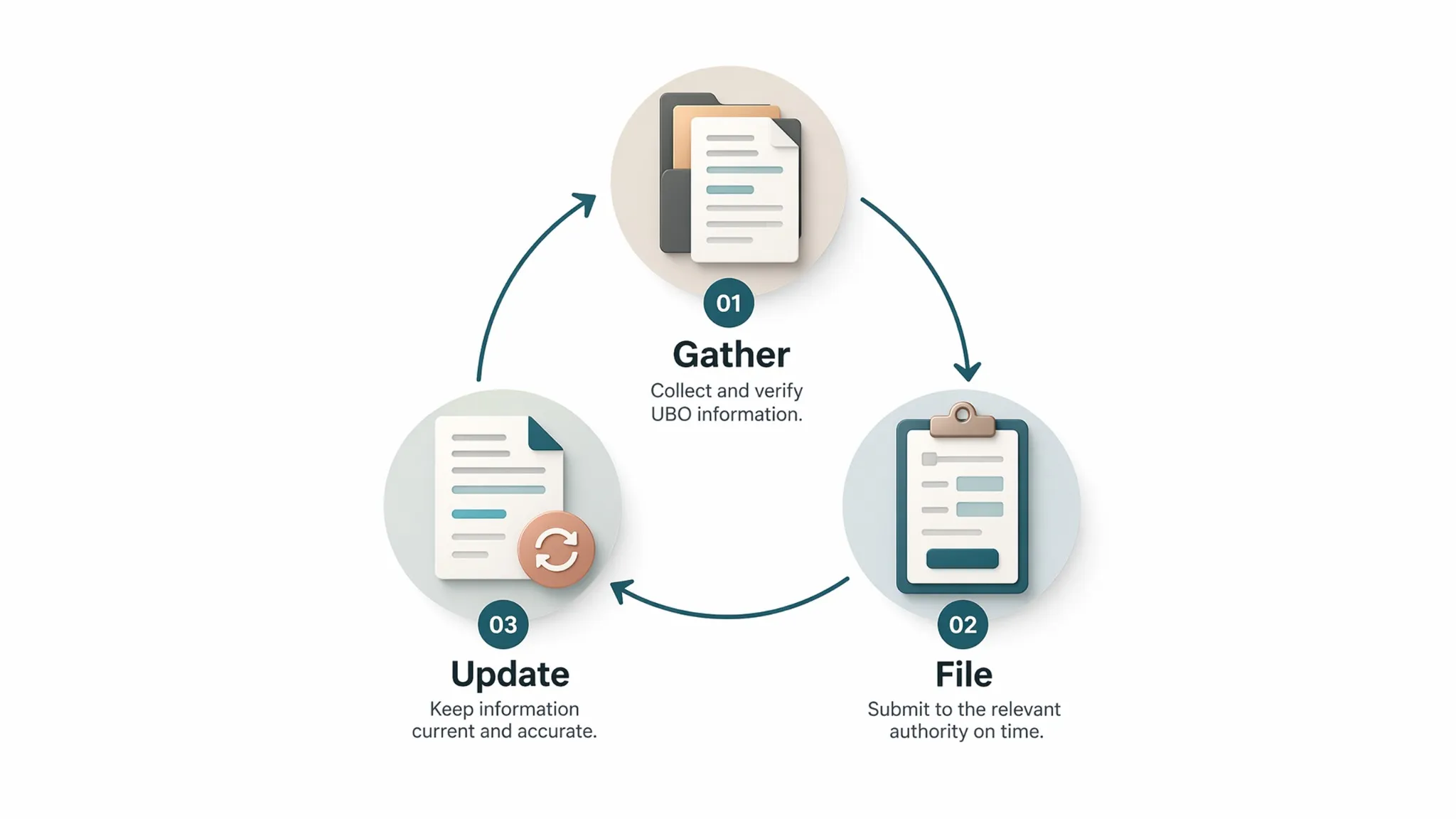
UBO compliance is an ongoing identify–report–update process, not a one-time incorporation document.
What Happens if the Information Is Missing or Incorrect?
The rules provide for penalties where required beneficial-owner information is not reported or is incomplete/misleading. Following the later statutory/Communiqué changes, non-compliance can trigger the applicable special irregularity penalty framework at an increased level.
Do not hard-code a TRY penalty amount into an evergreen article because statutory penalty amounts are revalued and can change. Check the current-year Tax Procedure Law penalty schedule and the facts of the violation.
UBO Compliance Checklist for a Foreign-Owned Turkish Company
- Draw the direct and indirect ownership chain to natural persons.
- Calculate ownership percentages, including indirect ownership.
- Apply the more-than-25% test.
- If needed, analyse ultimate control beyond share percentage.
- Use the senior-executive fallback only when the first two tests do not identify a beneficial owner.
- Collect identity, nationality, address and contact data consistently.
- Record the reason each person qualifies as UBO.
- Coordinate the required tax-return/form reporting with the licensed SMMM/CPA.
- After ownership/control changes, re-run the UBO analysis and respect the one-month change-reporting rule.
- Retain the supporting ownership records for the required period.

Workon coordinates company-setup and operational compliance workflows; regulated tax filings are handled through licensed professionals.
How Workon Fits Into the UBO Workflow
Workon supports foreign founders and overseas companies with business setup and operational coordination in Türkiye. For international ownership structures, the workflow can include collecting shareholder/corporate documents, mapping the ownership chain, licensed CPA/SMMM onboarding coordination and aligning company-registration and bank-document files.
The determination and statutory submission of tax information is handled by the appropriately licensed SMMM/CPA or other authorised tax professional under the applicable engagement. Workon does not present itself as the regulated tax-filing or licensed professional.
Review Workon’s company registration and operational coordination service.
Official Reference Points
Legal basis: Tax Procedure Law General Communiqué No. 529, as amended. Last reviewed: 17 September 2026. This guide provides general operational information and does not replace case-specific tax or legal advice.
Frequently Asked Questions
Corporate-income-tax taxpayers, including Turkish LLCs and JSCs and covered foreign-company branches, report beneficial-owner information through the corporate-tax reporting framework. Communiqué No. 529 also covers specified other taxpayers, partnerships and persons, whose reporting route and annual timing can differ from corporate taxpayers.
The beneficial owner is the natural person or persons who ultimately own or control the company. The first ownership test looks for natural persons holding more than 25%. If that does not identify the true beneficial owner, ultimate control is assessed; if ownership and control still do not identify a person, the senior-executive fallback applies under the relevant rules.
Do not stop the analysis. Identify the natural person or persons who ultimately control the entity by other means. If no such person can be identified after the ownership and control tests, the highest executive authority is considered under the fallback rule.
Corporate taxpayers report beneficial-owner information with the applicable provisional tax returns and annual corporate income-tax return. For a new taxpayer registration or a change in previously reported information, the one-month rule applies; if that period falls outside the relevant return-filing period, current GİB guidance points to the beneficial-owner form in the Digital Tax Office. Statutory filing can be handled by the taxpayer or an appropriately authorised licensed SMMM\/CPA or YMM under the applicable engagement and rules.
No. GİB reporting is a tax-transparency obligation. Banks and other MASAK-obliged institutions apply their own customer-due-diligence rules, including the more-than-25% natural-person ownership test, ultimate-control review and senior-executive fallback, and can request broader ownership and KYC evidence.
Late, incomplete or misleading reporting can trigger the applicable special irregularity penalty framework under Turkish tax procedure rules. Because monetary penalty amounts are revalued, the current-year Tax Procedure Law schedule and the facts of the violation should be checked rather than relying on an old fixed TRY amount.