A branch office and a Turkish subsidiary can both conduct commercial activity in Türkiye, but they are legally different structures. A branch is the foreign parent company operating in Türkiye through a registered local extension; it has no separate legal personality. A subsidiary is a separate Turkish company whose shares can generally be owned wholly or partly by the foreign parent, subject to sector-specific restrictions.
The choice should be made before foreign corporate documents are ordered, because the parent-company resolution, legalization route, representative structure, banking/KYC file and post-registration obligations differ between the two models.
Last reviewed: 17 September 2026. The Republic of Türkiye Investment Office’s current Establishing a Business guide is the primary official reference for the branch framework and foreign legal-entity shareholder requirements.
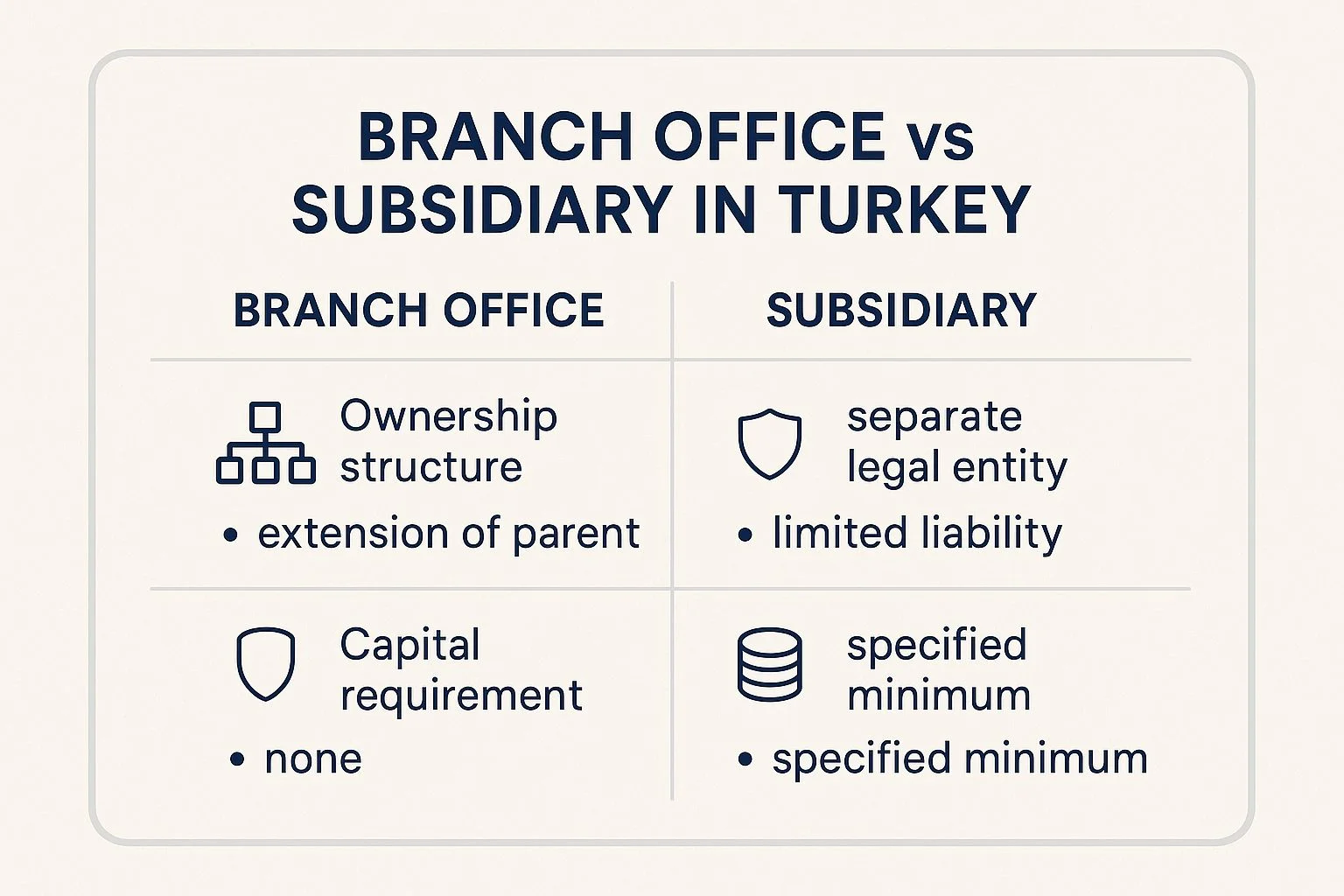
A branch keeps the foreign parent’s legal identity; a subsidiary creates a separate Turkish legal entity.
Branch vs Subsidiary in Turkey: Quick Decision Table
| Decision factor |
Branch office |
Turkish subsidiary |
| Separate legal entity |
No |
Yes |
| Shareholders |
No shareholders of its own |
Foreign parent can be shareholder |
| Commercial activity |
Yes, within parent-company purposes |
Yes, within its own Turkish articles and licenses |
| Statutory share capital |
No branch share-capital minimum |
Depends on Turkish company type |
| Parent-company exposure |
Direct structural link to branch obligations |
Separate legal personality, subject to guarantees and other facts |
| Governance |
Parent appoints resident branch representative |
Managed under Turkish company-law structure |
| Future investors |
No branch shareholding structure |
Shares can be transferred or new shareholders admitted |
| Activity flexibility |
Cannot exceed parent-company purposes |
Defined in the Turkish company’s own articles |
The First Question: Who Should Be the Contracting Entity?
If customers in Türkiye should contract directly with the foreign parent through its Turkish presence, a branch may fit the group structure. If the group wants contracts, assets, employees and banking relationships held by a separate Turkish company, a subsidiary may fit better.
This is more useful than asking which structure is “cheaper” in isolation, because the legal identity drives the document, tax, governance and liability consequences that follow.
Liability: Branch Means Direct Parent Link; Subsidiary Means Structural Separation
A branch is not a separate legal person, so its obligations belong to the same legal enterprise as the parent company. A subsidiary starts from a different position because it is a separate Turkish legal entity.
Do not turn that distinction into an absolute promise that a subsidiary shields the parent from every claim. Parent guarantees, intercompany contracts, management conduct, tax issues and other facts can still create exposure. The accurate statement is separate legal personality, not an unconditional liability firewall.
Can the Foreign Parent Own 100% of the Subsidiary?
Generally, yes. Current official investment guidance states that there are no nationality restrictions on shareholders or management rights except in specific sectors. The foreign parent can therefore be the legal-entity shareholder of a Turkish LLC or JSC in ordinary activities, subject to any sector-specific rules.
For the wider three-way choice including a non-commercial presence, use Subsidiary, Branch or Liaison Office in Turkey.
Capital: Do Not Compare “Zero” With the Wrong Number
A branch has no statutory share-capital requirement because it is not a separate shareholding company. The parent should still allocate enough operating funds for the Turkish business.
A subsidiary must comply with the statutory capital rules of the Turkish company type selected. The capital is part of the company structure; it should not be confused with a professional service fee or treated as money automatically lost on formation.
For current company-type and capital comparisons, see Types of Companies in Turkey.
Activity Scope: Where the Difference Becomes Operational
A branch may operate only for purposes within the scope of the foreign parent company. If the proposed Turkish activity is outside that scope, the parent may need corporate changes before the branch route works.
A subsidiary has its own Turkish articles of association. This can provide more room for local business lines, future investors or Turkish-specific activities, although sector licenses and regulatory restrictions still apply separately.
Governance and Representative Structure
The branch registration file includes a resident representative appointed by the parent with authority for the Turkish branch. That representative is not a shareholder; the parent remains the underlying legal enterprise.
A subsidiary is governed under the selected Turkish company form. A limited liability company uses manager/manager structures; a joint stock company uses its board structure. The foreign parent controls the subsidiary through shareholder rights and the governance design of the Turkish entity.
Foreign Parent Documents: Branch and Subsidiary Files Are Not the Same
| Parent-company evidence |
Branch |
Subsidiary |
| Current legal existence/status |
Required |
Required for foreign corporate shareholder |
| Parent constitutional documents |
Filed as part of branch setup |
May be needed depending on corporate-shareholder file |
| Corporate resolution |
Resolution to open Turkish branch |
Resolution authorizing Turkish investment/establishment |
| Representative / signatory proof |
Branch representative authority |
Foreign shareholder signatory authority and Turkish company management structure |
| Power of attorney |
Where process/representation uses POA |
Where incorporation is followed by proxy |
Current official guidance requires a foreign legal-entity shareholder’s certificate of activity to show the company’s current status and signatories. It also requires the competent corporate body to authorize the establishment. This is why a generic “Certificate of Good Standing” may be insufficient if it does not prove all the information the Turkish filing needs.
Apostille and Translation: Confirm the Document Before You Legalize It
Foreign documents used in Turkish registration generally need the applicable apostille or Turkish-consular legalization route and official Turkish translation/notarial steps. The correct route depends on the issuing jurisdiction and document type.
The expensive mistake is legalizing the wrong document. First confirm that the record contains the required current-status, signatory and corporate-approval information; only then complete the legalization chain.
Tax: Both Structures Need Turkish Compliance
A Turkish subsidiary and a Turkish branch both create Turkish tax and accounting obligations, but the tax base, profit-remittance mechanics and treaty analysis can differ. The parent jurisdiction and relevant double-tax treaty matter.
Do not select the structure from a generic claim that a branch is always cheaper or a subsidiary is always tax-efficient. Structure selection should be reviewed together with the planned activity, contracts, group flows and tax advice from the licensed professionals responsible for the case.
Banking and KYC: Legal Registration Does Not Guarantee an Account
Both structures may need Turkish corporate banking, but banks perform their own KYC and risk review. Foreign parent documents, ownership/UBO information, expected activity, source of funds and signatory arrangements may be relevant to the bank’s review.
A Trade Registry registration is therefore not the same thing as guaranteed banking approval or fully usable e-banking. For the banking workflow, use the dedicated corporate bank-account application page.
When a Branch Usually Fits Better
- the foreign parent itself should be the Turkish contracting business;
- the Turkish activity mirrors the parent’s existing purposes;
- no separate Turkish shareholder structure is needed;
- direct parent-company governance is preferred;
- the group accepts the direct legal link between parent and branch obligations.
When a Subsidiary Usually Fits Better
- the group wants a separate Turkish operating entity;
- the Turkish business should hold its own contracts, assets and local governance;
- future investors or shareholders may join;
- the Turkish activity may evolve independently from the parent’s existing scope;
- the group wants a structurally distinct long-term Turkish operation.
Registration Is Only the First Milestone
After either structure is registered, operational readiness may still require registered address, tax registration and licensed SMMM/CPA onboarding, banking/KYC, SGK and payroll, work permits, e-signature/KEP, municipal or sector licenses and other activity-specific steps.
This matters for budgeting and timing: “registered” should not be used as a synonym for “fully operational.”

Workon coordinates foreign-company market-entry and post-registration operational setup in Türkiye.
How Workon Supports Branch or Subsidiary Setup
Workon coordinates foreign-company market-entry workflows in Türkiye, including subsidiary or branch setup, registered address and workspace, parent-document sequencing, corporate bank-account application support, licensed SMMM/CPA onboarding coordination and post-registration operational steps. Regulated legal, tax and accounting work is handled by the appropriately licensed professionals involved.
If the branch route is already selected, continue with How to Register a Branch Office in Turkey. If you still need to compare a liaison office, use the broader three-structure guide.
A branch is the foreign parent operating in Turkey through a registered local extension and has no separate legal personality. A subsidiary is a separate Turkish legal entity whose shares can generally be owned by the foreign parent, subject to sector-specific restrictions.
No universal rule applies. The branch and subsidiary use different parent-company documents, governance, capital, tax and operating structures. Compare the intended contracting entity, liability structure, activity scope, future investors and long-term operating model rather than assuming one is always cheaper or faster.
Generally yes. A foreign legal entity can generally be the sole shareholder of a Turkish LLC or JSC in ordinary activities, subject to sector-specific ownership or authorisation restrictions.
A branch has no statutory share-capital minimum because it is not a separate shareholding company, while a Turkish subsidiary follows the capital rules of its selected company type. Compare operating funding needs separately from the subsidiary’s statutory capital requirement.
Both can create Turkish tax and accounting obligations, but the tax base, profit-remittance or distribution mechanics, group flows and treaty analysis can differ. The structure should be assessed with the licensed professionals responsible for the specific tax case.
A branch may operate only within the foreign parent company's purposes. A subsidiary has its own Turkish articles of association, which can accommodate local business lines and future plans. Sector licences and regulatory restrictions still apply separately to either structure.