
To change business activity in Turkey, first check whether your company’s registered business scope covers the new activity. This guide explains when a NACE code update may be sufficient, when an articles amendment is needed, and which tax, registry and operational records to review. Illustrative scenario: An Istanbul limited company with foreign shareholders has been trading for six months. The founders now want to add e-commerce to the company’s activities, but their bank still sees the old business description, the tax certificate carries a different NACE code, and a supplier is asking for a Gazette copy showing the new scope. The MERSİS application looks simple. The compliance work after it is not.
To change a company’s business activity in Turkey, treat the process as a coordinated chain, not a single online amendment. First, the Trade Registry record and, where necessary, the articles of association must reflect the new activity. Then the Tax Office must align the company’s tax certificate and NACE code. The Chamber, SGK, bank, e-invoice records, and any licensing authority may also need updates.
The correct route depends on whether the new activity already fits within the company’s registered purpose, whether the articles must change, and whether the sector is regulated. Turkey’s company-change transactions are handled electronically through MERSİS, but the legal effect of an articles amendment depends on Trade Registry registration and announcement in the Turkish Trade Registry Gazette, as explained by the Istanbul Chamber of Commerce guidance on Gazette records.
What Changing a Business Activity Actually Means in Turkey
The first question isn’t, “Which button do I click in MERSİS?” It’s, “What exactly is changing?”
A company’s commercial activity is reflected in its constitutional documents, Trade Registry record, Chamber registration and tax records. For activity-code updates, consult the NACE classification and the codes currently accepted by the relevant Turkish authority. The activity code should accurately describe the actual business, and any material mismatch with the registered corporate purpose should be resolved before filing. Do not assume that an administrative code correction automatically requires a constitutional amendment.
Consider the Istanbul company adding online retail. If its articles already contain a broad commercial purpose covering retail, distribution, online sales, or related lawful activities, the company may need an administrative NACE update rather than a full constitutional amendment. If the articles limit the company to software consultancy and say nothing broad enough to cover commerce, the shareholders may need to amend the relevant purpose clause first.
Three changes that founders often confuse
A NACE-code update changes the activity classification used in the company’s administrative and tax records. It doesn’t automatically expand the legal wording in the articles of association.
An articles of association amendment changes the company’s registered business purpose or subject matter. For registered companies, that amendment must go through the Trade Registry and be announced in the Turkish Trade Registry Gazette before it has effect against third parties.
A sector-specific licence is separate again. Adding a financial, food, healthcare, education, tourism, transport, or energy activity to the registry doesn’t give the company permission to operate that activity. The relevant regulator may require an approval, permit, registration, or operating certificate.
Practical rule: A tax-office-only NACE change is not a substitute for updating the Trade Registry when the company’s registered purpose is too narrow.
This process also isn’t a brand refresh, trade-name change, address change, or internal management decision. A new website, a different trading name, or a new product line doesn’t by itself amend the company’s registered activity. Conversely, a formal change approved by shareholders isn’t complete merely because the resolution has been signed.
The Trade Registry record is the starting point for downstream checks. Tax officials, Chambers, banks, counterparties, and licensing bodies may compare their records against the public registry. A mismatch can leave the company legally active but operationally unprepared to invoice, open a banking relationship, sign certain contracts, or obtain a local permit.
Choosing the Right Path for Your Company Type
Most founders can route the matter quickly by testing three questions:
- Does the new activity already fit the wording in the articles of association?
- Does the company only need its NACE and tax records aligned?
- Is the proposed activity regulated or licence-dependent?
A limited company with a broad purpose clause that wants to add ordinary consulting may follow the administrative route. A joint-stock company moving into food production may need both a constitutional amendment and sector approvals. A branch cannot rewrite its own articles because its scope comes from the foreign parent. Its route depends on the parent’s resolution and the applicable Turkish registrations.
The wider company-structure context is set out in this guide to types of companies in Turkey.
Three paths to change a company business activity in Turkey
| Path |
Trigger |
Corporate Resolution |
MERSİS Filing |
Tax Office Impact |
Typical Timeline |
| Simple NACE-code update |
The existing registered purpose already covers the activity |
Usually an authorised management or company decision, subject to the Chamber and registry practice |
Check the applicable tax-office and Chamber procedure; a Trade Registry amendment is only needed if the registered scope must change |
Confirm the correct activity code with the Tax Office, including whether a registry amendment is actually necessary |
Depends on registry and tax-office review |
| Articles of association amendment |
The company’s registered subject or purpose must be expanded, narrowed, or replaced |
LLC approval follows the applicable shareholder decision process. For a joint-stock company, the general assembly generally approves the amendment and the board handles filing |
MERSİS application with amended constitutional wording and supporting documents |
New activity must then be reflected in the tax record |
Longer than a simple administrative update because approval, registration, and Gazette publication are involved |
| Sector-specific permit or licence route |
The new activity is subject to regulatory approval |
Corporate approval may be required before the application |
MERSİS registration doesn’t replace the regulatory application |
Tax, invoicing, and operational records may remain restricted until clearance |
Driven by the regulator, not only the Trade Registry |
For a joint-stock company, the division of responsibility matters. The general assembly generally approves an articles amendment, while the board of directors completes the Trade Registry filing at the company’s registered office and branches, as described in this analysis of Turkish articles amendments.
A branch should not be treated like a subsidiary. It follows the parent company’s registered scope and normally requires a parent-company resolution, supporting corporate documents, and properly authenticated authority documents. A liaison office has a narrower position still, because it cannot conduct ordinary commercial sales activity merely by changing an internal description.

Simplify your business setup with Workon’s all-in-one company registration service in Turkey.
The MERSİS and Trade Registry Workflow
The Ministry of Trade describes MERSİS as the electronic system for company registration, amendments and deregistration. That means it is the application infrastructure, not a substitute for deciding whether the change needs a Trade Registry filing, tax-office update or sector authorisation in the first place.
Before filing: Request a comparison of the company’s current registered purpose, the proposed new activity and the intended NACE code. Mark each as (a) already covered by existing articles, (b) requiring an articles amendment, or (c) subject to additional regulatory approval. This decision sheet helps avoid filing a constitutional amendment for a purely administrative activity-code correction.
The registry stage should be prepared in Turkish, not improvised from an English translation. The wording must describe the intended activity accurately and align with the relevant NACE Rev.2.1 classification. A vague phrase can create a correction request, while an overbroad phrase can create a mismatch with the Chamber or Tax Office.
Use this sequence:
- Review the current record. Obtain the latest Trade Registry extract, articles of association, Chamber registration, tax plate, and existing activity list.
- Draft the new wording. Check whether the change is an additional activity, a replacement, or a deletion. Confirm that the requested NACE code is compatible with the registered business subjects.
- Approve the corporate decision. The required body depends on the company form and the articles. For a joint-stock company, the general assembly generally approves an articles amendment. For an LLC, the shareholder decision and manager filing responsibilities must be checked against the proposed change.
- Prepare signatures and documents. Foreign signatories may need notarisation, apostille, certified Turkish translation, or a Turkish power of attorney, depending on how the filing is executed.
- Open the MERSİS transaction. Establishment, amendment, and closure transactions are processed electronically through MERSİS. The application should reproduce the approved Turkish wording exactly.
- File with the Trade Registry Office. Upload the resolution, amended articles where required, signature documents, tax information, Chamber forms, and other requested evidence.
- Follow registration and publication. Once accepted, the amendment is registered and announced in the Turkish Trade Registry Gazette. MERSİS provides the electronic infrastructure, but the Trade Registry Office controls the filing review.
- Collect the updated evidence. Keep the Gazette page, updated registry documents, amended articles, and any registry confirmation together.
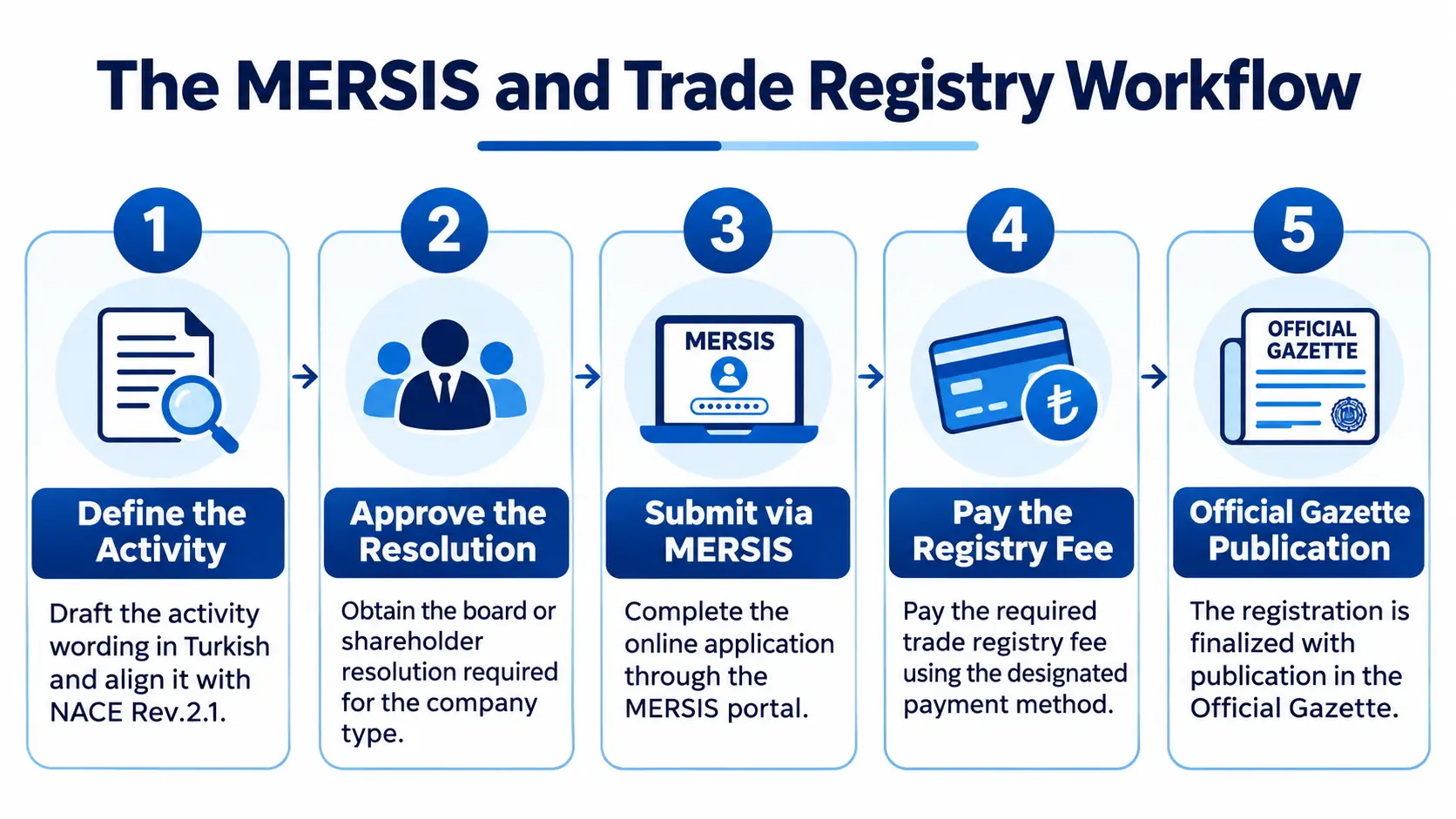
The five key steps for registering a business activity change in Turkey through MERSİS and the trade registry.
What usually causes corrections
Registry officers may question inconsistent tax identification details, signatures that don’t satisfy authentication requirements, missing corporate authority, or a NACE code that doesn’t match the company’s registered subjects. A Chamber record that still shows the old activity can also complicate the update.
For a branch, the parent company’s resolution and letter of activity become central documents. The branch has no independent articles of association to amend. A representative office is different again, because it cannot use an activity change as a route into commercial trading.
The MERSİS company registration guide is useful for understanding the electronic filing environment. The practical point is simple: MERSİS starts the application, but the Trade Registry registration and Gazette publication establish the public record.
Updating the Tax Office, Chamber, and Operational Records
The registry filing doesn’t close the matter. The next job is to make every operational record tell the same story.
Where an activity is added or changed, the company should confirm which Tax Office and Chamber records need updating. Not every activity-code change requires an articles amendment or a new Trade Registry filing. Chamber guidance states that the requested primary or additional NACE code must align with the business topics already registered. If it doesn’t, the company may first need to amend its Trade Registry record before the Tax Office will update the tax certificate, as described by İskenderun Chamber’s MERSİS activity-change guidance.
The post-registry sequence
- Tax Office: Submit the Gazette page or registry evidence, current tax plate, petition, and authorised signatory documents. The Tax Office should align the NACE and activity records with the registered change.
- Chamber of Commerce: Notify the company’s registered Chamber and confirm that the membership activity record matches the new business scope. This is separate from Gazette publication.
- SGK: If the company has employees, ask the payroll adviser to check whether workplace and employer records need reconciliation. A new activity can affect the way the company describes its workplace or business line.
- E-invoice and e-archive: Review the company’s invoicing profile, commercial descriptions, and any activity-sensitive onboarding information. Don’t assume the invoice system updates automatically.
- Bank: Give the relationship manager the Gazette page, updated articles, Tax Office confirmation, current tax plate, and authorised signatory identification. Refresh the bank’s KYC activity description and signature records.
- Municipality or customs: Where the new activity involves premises, goods, imports, exports, or local operations, check the relevant municipal, customs, free-zone, or operating records.
Carry a consolidated file rather than separate documents sent at random. The minimum practical pack usually includes the current Gazette page, amended articles if applicable, tax plate, registry extract, company resolution, and authorised signatory ID.
Bank requirements vary. Ask the relationship manager which updated registry, tax and KYC documents the bank needs; neither registration nor a tax-record update guarantees bank approval. Registry publication and banking readiness are separate checkpoints.
The Trade Registry guidance from the Ankara Chamber of Commerce also highlights the importance of timely amendments and checking the latest filing status, not merely confirming that the company remains active. A stale record can create friction with banks and counterparties even when the company has not been deregistered.
Sector Licences and Regulatory Approvals
A licence track can block the commercial rollout even when the registry amendment succeeds. The company may register a new activity, but it still can’t lawfully perform the regulated work until the responsible authority accepts the application or grants the required permission.
The correct regulator depends on the activity. Financial services may involve the Banking Regulation and Supervision Agency, the Capital Markets Board, or payment-system authorities. Food and agricultural operations may involve the Ministry of Agriculture and Forestry and municipal registrations. Healthcare activities can require permissions involving the Turkish Medicines and Medical Devices Agency or private healthcare authorities. Tourism, education, transport, and energy each have their own approval structures.
Regulated activities require separate routing
| Sector or activity |
Approving authority |
Typical lead time |
Operate without it? |
| Banking, finance, and payment services |
Relevant financial regulator, including the Banking Regulation and Supervision Agency, Capital Markets Board, or payment authority |
Regulator-dependent |
No, not merely because the activity appears in MERSİS |
| Insurance |
Relevant insurance regulatory and sector registration bodies |
Regulator-dependent |
No |
| Food production or food sales |
Ministry of Agriculture and Forestry and, where applicable, the municipality |
Application-dependent |
No where a permit or registration is required |
| Healthcare |
Turkish Medicines and Medical Devices Agency or the applicable private-health authority |
Permission-dependent |
No |
| Tourism operations |
Ministry of Culture and Tourism and the applicable local authority |
Certificate-dependent |
No |
| Education services |
Ministry of National Education |
Institutional-approval dependent |
No |
| Transport and logistics |
Ministry and transport registration systems relevant to the activity |
Registration-dependent |
No |
| Energy generation or distribution |
Energy Market Regulatory Authority |
Licence-dependent |
No |
A published company charter illustrates the point. It states that an amendment to the company’s purpose and field of activity required prior permission from the Ministry of Customs and Commerce and the Capital Markets Board before the general assembly resolution could be registered, as shown in the published charter document.
Digital commerce often looks unregulated because it can begin with a website and payment provider. That doesn’t remove obligations connected to distance sales, consumer information, personal-data processing, electronic records, and sector-specific products. A company selling ordinary goods online may face a different compliance profile from a company selling financial products, medicines, food supplements, or regulated professional services.
Avoid guaranteeing a client that a NACE code “grants access” to a sector. It only classifies the activity. The regulator decides whether the company may perform it.
Common Mistakes That Block Invoices, Banks, and Contracts
The most expensive mistake is treating the Gazette page as the finish line. It proves that a public filing occurred. It doesn’t prove that the Tax Office, bank, Chamber, e-invoice profile, or licensing authority has completed its own review.
Errors that create downstream friction
- NACE-code mismatch: The registered code, articles wording, tax certificate, and actual commercial work describe different activities. Chamber guidance requires the requested code to align with the registered business topics, so the company may need a registry correction before the Tax Office acts.
- Regulated activity added too early: A company adds food, health, tourism, finance, or another controlled activity before securing the relevant approval. Registry publication doesn’t replace the sector licence.
- Stale corporate documents: The bank receives an old signature circular or outdated articles and can’t verify who may sign contracts or approve the revised activity.
- Incomplete Turkish wording: A loose translation changes the commercial meaning or omits the actual activity. Foreign shareholders signing remotely may also need an apostilled power of attorney and certified Turkish translation.
- Unfinished tax-office update: The company keeps the old tax certificate after the registry change. Invoicing, e-archive, e-invoice, withholding, and bank KYC checks can then show inconsistent business information.
- Missing Chamber notification: The registry record changes, but the Chamber membership file remains stale. Local licence renewals and administrative correspondence can then be delayed.
- Personal-data oversight: An e-commerce or digital-services activity processes personal data, but the company doesn’t review its KVKK documentation and related compliance duties.
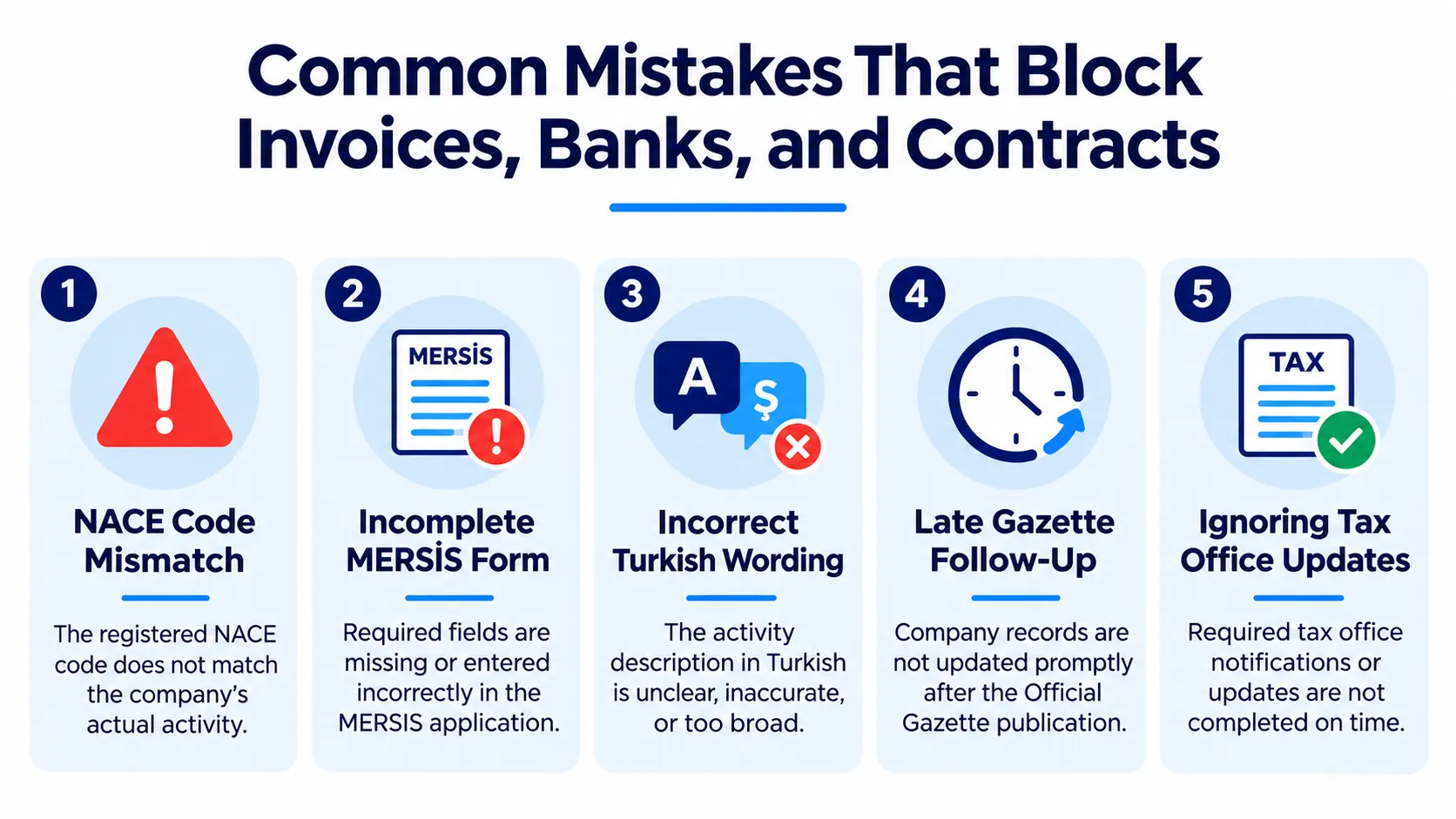
Five common registration mistakes that can disrupt invoicing, banking processes, and contracts when changing a company’s business activity in Turkey.
Before you call the change complete, compare the latest Gazette page with the bank’s KYC file, the Tax Office certificate, the Chamber record, and the company’s actual contracts and invoices. If the records disagree, the company isn’t operationally ready.
For a related banking risk, review the practical implications in this guide to a company bank account freeze. The same principle applies here: an account can remain open while a documentation mismatch prevents the bank from processing a transaction smoothly.
Practical Checklist and Timeline for Each Company Type
Start with Day 0, the date the properly signed board, shareholder, or parent-company resolution is ready. The sequence after that depends on the entity and the activity, but every company should track the registry, tax, Chamber, operational, and licensing records on one action sheet.
Limited company checklist
- Corporate approval: Confirm whether the existing purpose clause covers the activity. If not, approve the amended wording and prepare the updated articles.
- MERSİS filing: Enter the Turkish activity wording and matching NACE Rev.2.1 code.
- Trade Registry: Submit the resolution, signatures, articles where required, tax information, and Chamber documents.
- Gazette evidence: Obtain the published amendment and updated registry documents.
- Tax Office: Align the NACE and activity records with the registered change.
- Operational records: Notify the Chamber, review SGK records, refresh e-invoice and e-archive information, and update the bank’s KYC file.
- Licence track: Complete any sector permission before commercial launch.
Joint-stock company checklist
A joint-stock company needs a sharper governance check. The general assembly generally approves the articles amendment, while the board completes the filing process. Prepare the meeting documentation, resolution, amended constitutional wording, authorised signatures, and any prior regulatory permission before opening the MERSİS file.
After Gazette publication, give the Tax Office and bank the same final document set. A board resolution that approves the change isn’t enough if the registered articles, tax certificate, and bank KYC description still differ.
Branch or representative office checklist
- Parent approval: Obtain the foreign head office or parent-company resolution and confirm the signatory’s authority.
- Authentication: Arrange apostille or consular authentication, notarisation, and certified Turkish translation where required.
- Scope check: Confirm that the requested Turkish activity is permitted by the parent’s constitutional documents and the branch registration.
- MERSİS and Registry: File the change through the Turkish branch’s registration route. A branch doesn’t amend Turkish articles because it has no separate Turkish charter.
- Tax and Chamber: Align the Tax Office and Chamber records after registration.
- Bank and contracts: Refresh KYC, signature, and counterparty documents.
- Representative-office limit: Don’t use a representative office activity update to begin commercial sales or revenue-generating operations.
Action sheet for the accountant or Istanbul coordinator
| Checkpoint |
LLC |
Joint-stock company |
Branch or representative office |
| Day 0 decision |
Shareholder or authorised management decision, depending on the change |
General assembly approval where articles change, followed by board filing |
Parent-company resolution |
| Corporate wording |
Turkish activity wording and NACE alignment |
Amended articles where required |
Parent documents and branch scope |
| Registry stage |
MERSİS and Trade Registry filing |
MERSİS, Trade Registry, and Gazette |
MERSİS, Trade Registry, and parent evidence |
| Tax stage |
Tax Office NACE alignment |
Tax Office NACE alignment |
Tax Office activity alignment |
| Operational stage |
Chamber, SGK, e-invoice, bank, licences |
Chamber, SGK, e-invoice, bank, licences |
Chamber, tax, bank, and any sector records |
| Final test |
Gazette, tax, bank, Chamber, and actual contracts match |
Same records match the approved articles |
Turkish branch scope matches parent authority |
Keep the checklist open until every record matches. A company can be active at the Trade Registry and still fail a bank KYC review, invoice onboarding check, or licence application because the latest activity change wasn’t carried through the full compliance chain.
Workon can coordinate the corporate decision, MERSİS and Trade Registry filing, document preparation, and post-registration updates for foreign-owned companies changing their activities in Türkiye. If your registry, tax, Chamber, bank, or licensing records no longer match, visit Workon to discuss the practical coordination needed to close the gap.
First, check whether the new activity falls within your company’s registered business scope. If it does, a NACE and administrative records update may be sufficient. If it does not, amend the registered scope before completing the relevant activity-code updates.
Yes. You can request an additional NACE code for an activity covered by your company’s registered business scope. If the activity falls outside that scope, the registered scope must be amended first.
No. A NACE code classifies the company’s activity; an articles amendment changes its constitutional wording. Updating the code alone does not amend the registered business scope, and the requested code must be compatible with that scope.
Requirements depend on the requested change and your Chamber. For a primary NACE code change, Istanbul Chamber lists a petition, a tax certificate showing the requested code, and a notarised signature specimen copy. A scope amendment requires separate supporting documents.
There is no single timeline for every case. Timing depends on whether the change involves only administrative records or also an articles amendment, registry review, foreign-document authentication, or sector approvals. Confirm the expected schedule after identifying the required procedure.