To register a trademark in Turkey, the filing is made within the framework of Industrial Property Code No. 6769 and administered by the Turkish Patent and Trademark Office (TÜRKPATENT). A strong filing starts with three decisions: who will own the mark, what sign will be protected, and which goods/services need coverage. Search, classification and applicant ownership should be settled before filing so the application reflects the intended protection scope from the start.
For 2026, the practical route is: clearance search → applicant/ownership decision → Nice classification → national or Madrid filing → formal examination → absolute-grounds examination → publication → two-month opposition period → registration fee → registration → use/renewal/monitoring.
This guide explains the filing process: search, classes, applicant choice, TÜRKPATENT procedure, fees, opposition and post-registration controls. For Workon’s commercial coordination and professional handoff scope, use Trademark Registration Support in Turkey.
Quick Answer: How Does Trademark Registration Work in Turkey?
| Stage |
What happens |
Key control |
| Search & strategy |
Check identical/similar marks and choose owner/classes. |
A database hit is not the only risk; similarity and earlier rights matter. |
| Application |
File mark, applicant details and goods/services with TÜRKPATENT. |
Filing date/priority and correct class scope. |
| Formal examination |
TÜRKPATENT checks procedural/formal requirements. |
Deficiencies generally have a two-month remedy period. |
| Absolute-grounds examination |
TÜRKPATENT examines registrability under Article 5. |
Distinctiveness, descriptiveness and other absolute refusal grounds. |
| Publication |
Accepted application is published in the Official Trademark Bulletin. |
Third parties have two months to oppose. |
| Opposition / appeal |
Earlier-right holders or other eligible parties can raise Article 6 grounds. |
Similarity/likelihood of confusion, earlier unregistered rights, bad faith and other relative grounds. |
| Registration |
After the stages are completed and the registration fee is paid, the mark is entered in the register. |
Protection lasts 10 years from filing date and can be renewed. |
Official process: TÜRKPATENT Trademark Guide.

Trademark strategy should be decided before the brand is heavily committed to the Turkish market.
1. “First to File” Is Useful Shorthand, But Not the Whole Law
Trademark protection under the Industrial Property Code is acquired by registration, so early filing is strategically important. But the statement “the first person to file automatically gets all rights regardless of prior use” is too broad.
Article 6 recognises relative grounds that can be raised by opposition, including:
- earlier registered/applied marks where similarity creates likelihood of confusion;
- earlier rights in an unregistered trademark or another sign used in trade;
- well-known/reputed marks under the applicable conditions;
- name, trade name, copyright or other intellectual-property rights;
- applications filed in bad faith.
Therefore, early filing is strategically valuable while earlier rights should still be included in the clearance analysis.
2. Search Before Filing: Identical Search Is Only the First Layer
A clearance search should test more than the exact spelling. Review:
- identical marks;
- phonetic similarity;
- visual similarity;
- conceptual similarity;
- overlap in goods/services;
- trade names and other earlier rights where relevant;
- well-known/reputed marks;
- market use that could create opposition or infringement risk.
A TÜRKPATENT database search is an important first clearance step. For a commercially important brand, a registered trademark attorney can assess similarity, earlier rights and opposition considerations in more depth.
3. Choose the Applicant Before Filing
The applicant becomes the owner if the mark registers, so ownership should match the commercial structure.
Typical questions:
- Should the mark be owned by the Turkish operating company?
- Should a foreign parent/IP company own it and license it to Türkiye?
- Is the founder filing personally before the company exists?
- Will investors expect the operating company’s core IP to sit inside the company?
- Are there tax, transfer-pricing, licence or group-IP implications?
File in the ownership structure that matches the intended commercial and IP strategy, rather than simply using the name of the person handling the application.
4. Nice Classification: Protect the Actual Commercial Scope
Trademark applications cover specified goods/services under the Nice Classification. The applicant should select the classes and descriptions based on the actual and reasonably planned business model.
Examples:
- downloadable software and SaaS/cloud services can fall into different relevant classes;
- retail/marketplace services should not be confused with protection for the products being sold;
- a restaurant brand, packaged food brand and food-delivery platform can require different class strategies;
- financial/insurance services, education, marketing and technology services should be classified from the real service, not only the company NACE code.
Adding another class after filing is not the same as expanding the existing application freely; new coverage can require a separate application. Avoid both under-filing and class stuffing.
5. 2026 TÜRKPATENT Official Trademark Fees
TÜRKPATENT’s 2026 official fee schedule currently lists:
| Official transaction |
2026 TÜRKPATENT fee |
| One-class trademark application |
TRY 2,820 |
| Second class |
TRY 2,820 |
| Each class beyond two |
TRY 3,150 |
| Trademark registration fee |
TRY 7,010 |
| Opposition to a published trademark application |
TRY 1,150 |
| Appeal against a trademark decision |
TRY 2,720 |
| Renewal up to two classes |
TRY 8,730 |
These are official TÜRKPATENT transaction fees for 2026, not the total professional/legal cost. Trademark-attorney fees, translations, legal opinions, opposition work, Madrid/WIPO fees and other services are separate.
Current official schedule: TÜRKPATENT Trademark Fees.
6. Direct National Filing vs Madrid Protocol
| Route |
Best when |
Important limitation |
| Direct TÜRKPATENT filing |
Turkey is a key standalone market or the applicant wants a direct Turkish application. |
Türkiye-specific application and prosecution. |
| Madrid System designation |
The applicant qualifies for Madrid and wants to seek protection in multiple member jurisdictions through one international system. |
Requires a qualifying basic mark/application through the office of origin; international registration remains dependent on the basic mark during the Madrid dependency period. |
Do not assume Madrid is automatically cheaper or faster after a fixed number of countries. Cost and strategy depend on designated territories, classes, WIPO/office fees, objections and local representation needs.
TÜRKPATENT’s official guidance confirms that Türkiye accepts Madrid Protocol applications. Madrid eligibility depends on nationality, domicile or real/effective industrial or commercial establishment in a Protocol member jurisdiction and on the required basic application/registration.
7. Foreign Applicants: Representation Rule
TÜRKPATENT’s current guidance states that persons domiciled outside Türkiye, except those making an application through the Madrid Protocol route, can only be represented before TÜRKPATENT by authorised trademark attorneys.
This does not mean every trademark file universally requires a foreign notarised and apostilled power of attorney. Representation formalities should be confirmed with the registered Turkish trademark attorney for the specific transaction rather than copied from a generic company-formation checklist.
TÜRKPATENT maintains an official trademark-attorney search.
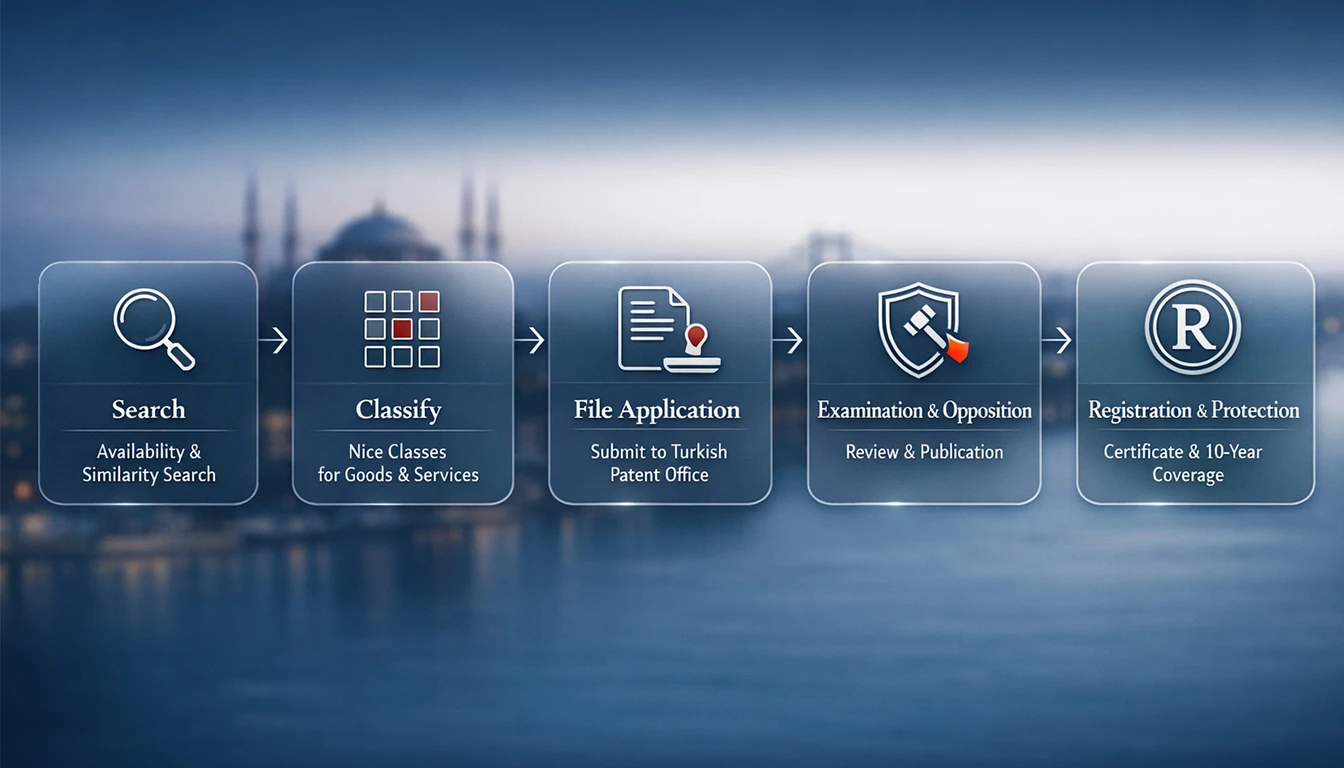
The Turkish process separates formal examination, absolute-ground review, publication/opposition and registration.
8. Formal Examination: Two-Month Deficiency Window
TÜRKPATENT first examines formal compliance. If the application has a correctable deficiency, the Office gives the applicant two months to remedy it under the current process. An unremedied deficiency can result in cancellation or, for unpaid multi-class fees, examination continuing only for paid classes as applicable.
This is a statutory procedural period, not a statement that the entire trademark registration takes two months.
9. Absolute Grounds: What TÜRKPATENT Examines Ex Officio
After formal review, TÜRKPATENT examines the application under Article 5 absolute grounds. Risks can include:
- lack of distinctive character;
- descriptive/generic signs;
- certain signs relating to kind, quality, intended purpose, value, geographical origin or other characteristics;
- public order/morality and other statutory absolute grounds;
- certain identical/indistinguishably similar earlier registrations/applications in the specific Article 5 framework, subject to the consent mechanism where applicable.
If the Office refuses all or part of the application, the applicant can challenge the decision within the applicable two-month appeal period.
10. Relative Grounds Usually Enter Through Opposition
A common misconception is that TÜRKPATENT conducts a full ex-officio likelihood-of-confusion search against every similar earlier mark and rejects the application automatically. The official process separates absolute-ground examination from opposition-based relative grounds.
If the application passes the initial examination, it is published in the Official Trademark Bulletin. Third parties then have two months from publication to file an opposition.
An opponent can invoke grounds such as confusing similarity, earlier unregistered rights, reputation, other IP/name rights or bad faith under Article 6 where the legal conditions are met.
11. Genuine-Use Evidence Can Matter in Opposition
If the opponent’s earlier trademark has been registered for at least five years at the relevant date, the applicant can, under the statutory conditions, request proof that the opponent genuinely used the mark for the relied-on goods/services during the relevant five-year period or had proper reasons for non-use.
This can materially narrow or defeat an opposition. Opposition strategy should therefore review both similarity and the status/use of the earlier rights.
12. Registration Timeline: Avoid a Fixed 6-, 8- or 10-Month Promise
There is no single official total processing time that can safely be promised for every application. Timing depends on:
- formal deficiencies;
- absolute-ground objections/refusals;
- publication scheduling;
- third-party opposition;
- evidence submissions;
- appeals/re-examination;
- payment/completion of final registration requirements.
A clean, unopposed application can progress much faster than a contested one, but a serious opposition or appeal can extend the process materially. Use procedural milestones rather than a guaranteed “8–10 months.”
13. Registration and Protection Period
After the examination/publication/opposition stages are successfully completed and the registration fee is paid, TÜRKPATENT records the trademark in the register.
Trademark protection lasts 10 years from the application date and can be renewed for successive 10-year periods. Renewal should be calendared well before expiry rather than left to the final day.
14. Non-Use: Registration Is Not a Permanent Warehouse Right
A registered trademark that is not put to genuine use in Türkiye for the registered goods/services within the statutory five-year framework can become vulnerable to cancellation/non-use consequences, subject to the legal conditions and any proper reason for non-use.
Maintain evidence such as:
- invoices and sales records;
- packaging/labels;
- advertising and campaign evidence;
- website/platform sales directed to Türkiye;
- distribution contracts;
- dated marketplace/product materials.
The evidence should show real commercial use for the relevant goods/services—not merely ownership of a domain or a dormant registration.

After registration, renewal, genuine use and monitoring protect the practical value of the trademark.
15. Monitoring and Enforcement
TÜRKPATENT registration does not automatically monitor every future application or infringement for the owner. A brand owner should consider:
- watching new trademark applications;
- monitoring major marketplaces/domains/social channels;
- documenting suspected infringement;
- using opposition procedures within the two-month publication window when appropriate;
- obtaining legal advice before cease-and-desist, court, customs or platform-enforcement action.
Trademark disputes and infringement litigation are legal work. Workon should not be presented as the authority deciding confusing similarity or conducting legal enforcement.
16. Company Name, Domain and Trademark Are Different Rights
Registering a Turkish company name does not automatically create a trademark registration, and owning a domain does not automatically give trademark rights for the relevant goods/services.
Before market entry, check the brand across:
- Trade Registry / company name;
- TÜRKPATENT trademark records;
- domains;
- major marketplaces/social handles;
- relevant foreign trademark territories if the business will expand internationally.
For company-name availability, see Turkey Company Name Check: 2026 Guide.
17. Practical Filing Checklist
- Decide the intended trademark owner.
- Freeze the exact word/logo/version to be filed.
- Run identical and similarity clearance searches.
- Map current and realistic future goods/services.
- Select Nice classes and precise descriptions.
- Choose national vs Madrid route.
- If domiciled outside Türkiye and filing directly, appoint an authorised Turkish trademark attorney.
- File and preserve filing/priority evidence.
- Track formal examination and any two-month deficiency response.
- Monitor publication and the two-month opposition period.
- Prepare opposition/use evidence strategy if challenged.
- Pay the registration fee after the application clears the required stages.
- Calendar 10-year renewal and build genuine-use evidence.

For commercial filing support, Workon can coordinate the setup and handoff to the appropriate registered trademark professional.
How Workon Can Support the Process
Workon can coordinate the business setup, applicant/company document readiness and commercial handoff for trademark registration and connect the matter with appropriately registered trademark professionals where professional representation or legal analysis is required. The registration process is completed through TÜRKPATENT, with regulated representation and legal opinions handled by registered trademark attorneys or legal counsel where applicable.
For Workon’s commercial support scope, see Trademark Registration in Turkey.
Key Takeaways
- Trademark rights are acquired by registration, but “first to file” does not erase every earlier unregistered, reputational or bad-faith right.
- Search and Nice classification should be completed before filing.
- 2026 official TÜRKPATENT fees include TRY 2,820 for the first class and TRY 7,010 registration fee; professional/WIPO costs are separate.
- Foreign applicants domiciled outside Türkiye who file directly are represented before TÜRKPATENT by authorised trademark attorneys; Madrid is a separate route.
- TÜRKPATENT examines formal requirements and absolute grounds; relative grounds such as confusing similarity are primarily handled through opposition.
- Published applications have a two-month opposition period.
- Protection is 10 years from filing and renewable.
- Five-year genuine-use rules can become important in opposition and cancellation/non-use contexts.
- The blog process guide and Workon’s commercial trademark service page have separate roles.
Frequently Asked Questions
There is no reliable universal six-to-ten-month promise. A clean application still passes formal examination, absolute-ground review, publication and the two-month opposition period, while deficiencies, refusals, oppositions, evidence and appeals can extend the process. Track procedural milestones rather than a fixed total duration.
The guide records current TÜRKPATENT fees of TRY 2,820 for a one-class application, TRY 2,820 for the second class, TRY 3,150 for each class beyond two and TRY 7,010 for the registration fee. Opposition, appeal, renewal, attorney, translation and international-filing costs are separate.
Yes. Foreign applicants can seek Turkish trademark protection. For a direct national filing, persons domiciled outside Turkey are represented before TÜRKPATENT by authorised trademark attorneys under the current guidance, while Madrid Protocol designations follow their separate international route.
Choose from the territories, applicant eligibility, existing basic application or registration, classes, costs and prosecution strategy. A direct filing can suit Turkey as a standalone priority market; Madrid can coordinate multiple member jurisdictions. Neither route is automatically cheaper or faster in every case.
No. Registration is central to Turkish trademark protection, but earlier registered or applied marks, earlier unregistered trade signs, reputation, other name or IP rights and bad-faith allegations can become relevant under the opposition framework. A proper clearance search should therefore go beyond exact-name matching.
A mark that is not put to genuine use for its registered goods or services within the applicable five-year framework can become vulnerable to non-use consequences, subject to the legal conditions and any proper reason for non-use. Keep dated evidence of actual commercial use.
Note: Last reviewed 17 September 2026. This guide provides general operational information on trademark registration in Türkiye. Workon coordinates filing readiness and the application workflow with TÜRKPATENT and appropriately registered trademark professionals according to the mark and protection scope.