Transferring shares in a Turkish Limited Liability Company (LLC) is not a deal. Transferring shares in a Turkish Limited Liability Company (LLC) follows a process set out in the Turkish Commercial Code. The law, at the core of that process requires a notarised written agreement. The law also requires, unless the company rules say otherwise approval from the General Assembly. Transferring shares in a Turkish Limited Liability Company (LLC) therefore looks very different, from transferring shares in a Joint Stock Company.
The Legal Groundwork for Turkish LLC Share Transfers
Before I even think about drafting an agreement I need to understand the landscape. The rules are not just tape. The rules protect the seller, the buyer, the company and the creditors. The Turkish Commercial Code (TCC) sets the core requirements. The Turkish Commercial Code (TCC) does not make those requirements optional.
Why is there formality? I think the formality makes a obvious record of who owns what. Skipping the steps does not just cause an problems. Skipping the steps can make the whole transfer legally void.
Foundational legal documents involved in a Turkish LLC share transfer process.
What the Turkish Commercial Code Demands
I notice that the TCC draws a line, between LLCs and Joint Stock Companies (JSCs). I see that the TCC makes the distinction clear in how sharesre transferred. I find that, for an LLC the process is more rigid.
The main part of any transfer is a notarised share transfer agreement. The notarised share transfer agreement is not a suggestion; the notarised share transfer agreement is mandatory. The notarised share transfer agreement makes the deal legally binding. The notarised share transfer agreement matters. The key difference, from JSCs is that a simple written agreement can sometimes be enough. I have seen the notarised share transfer agreement save a transfer that would otherwise fail. The transfer fails without a notarised share transfer agreement. If you want detail check out our guide on the distinctions between LLCs and Joint Stock Companies in Turkey.
By default the TCC also requires the General Assembly of shareholders to approve any transfer. In my experience the shareholder then has a 30 day window to register the transfer, with the Trade Registry. The registration makes the transfer fully official and recognised.
Don’t Forget the Articles of Association
In practice the Articles of Association (AoA) of your company add another set of rules that you must follow. The Articles of Association (AoA) serve as the constitution of your company. The Articles of Association (AoA) can add conditions or outright bans, on transferring shares.
Before you go further you must do a review of the AoA. The review must look for clauses covering:
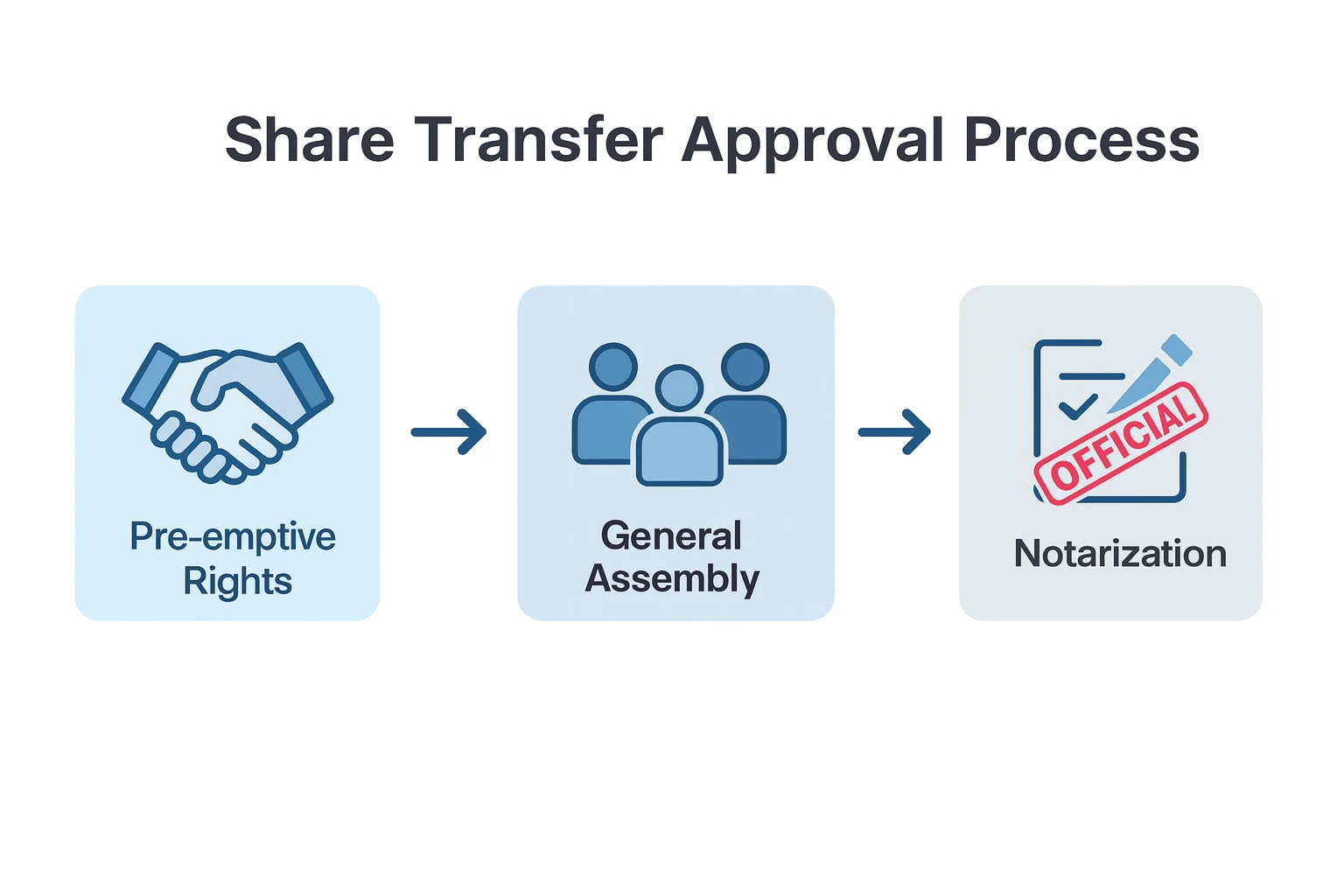
Pre-emptive Rights: These give existing shareholders the first chance to buy the shares before they’re offered to an outsider.
Approval Requirements: The AoA might demand a higher-than-usual majority vote to approve a transfer, or it might even do away with the need for General Assembly approval altogether.
Transfer Restrictions: Some companies limit who can become a shareholder, perhaps by requiring them to have specific professional qualifications or industry experience.
The mistake I see all the time is that people think the TCC is the rulebook that matters. I have personally seen deals delayed for weeks because the parties did not check the AoA. The parties later find a pre‑emptive rights clause that the parties completely missed. The mistake creates a problem that’s frustrating. The problem is completely avoidable.
I have learned that ignoring your company’s AoA is as risky, as ignoring the Commercial Code. The AoA rules bind every shareholder. Getting the AoA knowledge right is the key, to a process that works. Getting the AoA knowledge right also prevents surprises.
LLC vs JSC Share Transfer Key Differences
I see the differences, between LLCs and JSCs are clear. I made a comparison of the legal hurdles that companies must deal with.
Requirement
Limited Liability Company (LLC)
Joint Stock Company (JSC)
Written Agreement
Mandatory. Must be in writing.
Mandatory. Must be in writing.
Notarisation
Mandatory. The agreement and signatures must be notarised.
Not Required for registered shares, unless the AoA states otherwise.
Shareholder Approval
Required by the General Assembly by default. Can be restricted or waived in the AoA.
Not Required by default. Transfers are generally free unless restricted by the AoA.
Registration
Mandatory. Must be registered in the company’s share ledger and with the Trade Registry.
Not Required with Trade Registry. Must only be recorded in the company’s share ledger.
I see that the table makes clear how the LLC structure is made for a controlled group of owners. I also see that the JSC is made for owners who can transfer ownership freely. You need to know which rules apply to the LLC structure or, to the JSC. Knowing the rules for the LLC structure or the JSC is the step, to a transfer.
Navigating Pre-emptive Rights and Company Consent
You have shaken hands. You have signed a share transfer agreement. That is a step. Do not celebrate yet. I have seen many deals stop at the stage. The real hurdles often appear after the initial deal is made. Two major checkpoints can block your path: the rights of existing shareholders and the official green light, from the company itself.
Getting through the phase correctly is very important, for a Share Transfer in Turkish LLCs. The phase is not a hoop to jump through. The protective steps are not paperwork. The protective steps are there to give the partners a say in who the current partners do business, with. I have seen that missing the steps can make the whole deal invalid. The whole deal may become invalid.
The required approval steps: pre-emptive rights, General Assembly vote, and notarization.
Understanding Pre-emptive Rights: The Right of First Refusal
Imagine you are, in a LLC with two partners. One day the partner says the partner will sell the partner’s stake to a competitor. That feels like a nightmare. That nightmare is what rights also called the right of first refusal are designed to stop. Pre‑emptive rights give the remaining partners the chance to buy the stake before the competitor. The right of refusal lets the remaining partners step in first. I have been, in that situation. I know how scary it can be.
The right gives the existing shareholders the chance to buy the shares on the same terms that the outsider receives. The right is a tool, for the existing shareholders to keep the control. The right also keeps the parties out of the boardroom. I think the right helps the existing shareholders protect the control. The legal basis for the right can come from the Commercial Code (TCC). The legal basis, for the right is often written out in the company’s Articles of Association (AoA).
The process follows a path:
The Offer: The selling shareholder must formally notify all other partners about the proposed sale. This isn’t just a casual email; it needs to include the price, key terms, and who the potential buyer is.
The Clock Starts Ticking: Once notified, the other shareholders have a set window to respond. The AoA will specify this timeframe, but it’s often 30 days.
The Decision: If any of the existing partners want to buy the shares, the deal goes to them. If everyone passes or the deadline expires, the seller is finally free to sell to the original third-party buyer.
I have seen this times. A partner receives an offer from an investor but the remaining founders worry about a culture clash. Because of the rights of the remaining founders the remaining founders can match the offer. Buy the shares themselves. The remaining founders keep the company’s vision and the team intact.
Securing General Assembly Approval
Beyond the rights of each shareholder the company, as a whole also gets a vote. The TCC says the General Assembly must approve every share transfer. The General Assembly serves as a check to make sure the transfer matches the company’s interests.
I have seen the default rule need a majority vote of the share capital at the meeting.. The companys Articles of Association can completely change the game.
The AoA might, for example:
Raise the Bar: Ask for a supermajority. Ask for a two‑thirds vote or ask for a vote. I have seen family businesses and partnerships use a supermajority because the trust and the alignment cannot be broken.
Streamline the Process: Waive the approval requirement completely. Waiving the approval requirement speeds up the share transfer, in LLCs. I have seen that waiving the approval requirement makes the share transfer, in LLCs move faster. Companies structured for investment also waive the approval requirement.
Set Conditions for Rejection: I think the AoA can list reasons for the General Assembly to stop a transfer. The reasons can be the buyer has finances or a clear conflict of interest.
Not checking the AoA for those rules is an costly mistake that I see. I have seen this happen times. I always treat the AoA as the word. The AoA clauses override the TCC rules. Knowing what the AoA says will keep you from a surprise voting requirement. That requirement could derail your transaction.
The Notarization and Documentation Process
I have seen that once you have cleared the hurdles of approvals and pre‑emptive rights the next step is to make the share transfer legally official. The paperwork then turns handshakes and resolutions into a reality. The share transfer, at this stage is not about negotiation. The share transfer is, about execution. The Turkish notary serves as the gatekeeper of the transaction.
Getting the part right is not a box‑ticking exercise. The part is a requirement, under the Turkish Commercial Code. I have seen many deals fall apart when the part is not done right. A transfer that is poorly documented or that is not properly notarised can be declared invalid. The transfer can leave the buyer and the seller, in a mess. The stage is the core steps that give the deal its strength.
Submitting notarized documents and completing MERSIS registration for a valid Turkish LLC share transfer.
Your Essential Document Checklist
To make sure your trip, to the notary is quick and successful you will need to have the set of documents prepared and ready. Every document has a purpose, from proving the terms of the agreement, to confirming the company’s consent. I have seen that missing one document can stop the process.
Here is the core package you will need to assemble:
The Notarised Share Transfer Agreement: The Notarised Share Transfer Agreement is the core of the deal. The Notarised Share Transfer Agreement is signed by the seller and the buyer. The Notarised Share Transfer Agreement must be signed in front of a notary. I always make sure that the Notarised Share Transfer Agreement is signed by both parties and that the Notarised Share Transfer Agreement is signed before a notary.
General Assembly Resolution: You will need a notarised copy of the resolution. The resolution must show the shareholders formally approved the transfer. The resolution is your proof that the company’s, on board.
Updated Share Ledger (Pay Defteri): I have a copy of the page, from the company’s share ledger that shows the ownership. The company’s director(s) must sign the Updated Share Ledger page.
Identity Documents: Every person who signs must provide an ID. Valid IDs mean the passports, for foreigners and the Turkish ID cards, for citizens.
Power of Attorney (If Applicable): If a person signs for another person the Power of Attorney must include notarisation and apostille. The Power of Attorney must stay attached.
A tip, from experience: Do not just collect the documents—cross check the documents for consistency. I have personally seen the transfers get stuck because the number of shares, in the resolution did not exactly match the number of shares in the transfer agreement. The notary will check every detail. The precision matters.
Drafting a Bulletproof Share Transfer Agreement
The Share Transfer Agreement is more, than a formality. I think the Share Transfer Agreement is the line of defence against any disagreements. The notary checks that the Share Transfer Agreement meets requirements. The real content of the Share Transfer Agreement rests with you. A written Share Transfer Agreement should leave no room, for interpretation.
Make sure to include these key clauses:
Parties: Clearly state the full legal names and addresses of the seller (transferor) and the buyer (transferee).
Share Details: Be specific. Note the exact number of shares being transferred and their total nominal value.
Purchase Price and Payment: Clearly state the total price. Then, break down how it will be paid—is it a lump sum at signing, or will it be in instalments with clear due dates?
Representations and Warranties: The seller needs to formally declare that they own the shares outright and that there are no liens or claims against them. This is a critical piece of protection for the buyer.
Simplify your business setup with Workon’s all-in-one company registration service in Turkey.
The Role of the Turkish Notary
In Turkey a notary is more, than a witness. The notary is an official, with a job. The notary checks the identity of each person who signs. The notary confirms that each signer has the capacity to make the agreement. The notary also checks that the document follows law. The notary’s official seal turns the agreement into a binding document.
Remote online notary services help when parties cannot be physically present. I check how remote online notary services work for this transaction. I keep in mind that Turkish law has, in-person requirements for this particular transaction. The focus on documentation and notarisation makes every share transfer, in Turkey clear, recorded and legally sound.
Getting It on the Record: Registration with the Trade Registry and MERSIS
Once the Share Transfer Agreement is signed and notarised many people think they have reached the finish line. That is a mistake I see all the time. The notarised Share Transfer Agreement binds the buyer and the seller. The Share Transfer Agreement is not the word. The process is not done yet. To make the Share Transfer Agreement truly official and binding against anyone you have one step. You must register the Share Transfer Agreement, with the Turkish Trade Registry.
This is not just, about ticking a box on a form. The registration is a part of the share transfer, in LLCs. The registration creates the record of the ownership change and gives legal certainty to the creditors the partners and any other third parties. I have seen that when the registration is missing the deal only exists between you and the other party and can leave both of you in a spot.
The Clock is Ticking: The 30-Day Deadline
In my experience Turkish law stays strict on this point. After the company’s General Assembly greenlights the transfer you have thirty days to file the documents, with the Trade Registry Office. Missing the deadline is not an option. The deadline brings consequences.
I think the biggest risk is, on the seller. Until the registration is finished the seller still appears as the owner of the shares to the public. That means the seller still bears responsibility for company debts that arise after the seller thought the seller had sold the stake. If the buyer does not register the buyer does not get protection, from party claims on the buyers new ownership.
A creditor can decide to sue the company. The creditor will pull the official Trade Registry records. The creditor will see the seller’s name in the records. The creditor can then go after the seller, for the company’s liabilities even if the seller has already been paid for the seller’s shares. I have seen this happen. The situation creates a legal grey area that can be avoided.
MERSIS: Your Digital Gateway to the Registry
These days the whole registration process happens online through Turkey’s Central Registration System called MERSİS (Merkezi Sicil Kayıt Sistemi). The platform simplifies commercial registry. Makes the whole process more efficient. The applicant no longer hauls a stack of papers to a government office; instead the applicant uploads the application and all supporting documents.
I use MERSİS for these transactions because MERSİS is required. I rely on MERSİS. MERSİS keeps the company records accurate. That accuracy is vital, for the integrity of Turkey’s business environment. When I submit my application MERSİS gives me a tracking number. I can then monitor the progress from start, to finish.
Getting Your Documents in Order for MERSIS
To ensure a smooth filing, you’ll need to have clear, scanned copies of several key documents ready for upload. The typical package includes:
A Petition to the Trade Registry: This is a formal cover letter requesting the registration.
The Notarised General Assembly Resolution: The official, stamped copy of the meeting minutes where the transfer was approved.
The Notarised Share Transfer Agreement: The core document itself, bearing the notary’s seal.
An Updated Share Ledger Page: A copy of the relevant page from the company’s official share ledger (Pay Defteri), reflecting the new shareholder’s details and signed by the company director(s).
Having these organised and correctly scanned from the get-go is the secret to avoiding unnecessary delays.
Managing Expectations on Timing
MERSİS makes the process faster. MERSİS does not make the process instant. You submit all documents online. The officials, at the Trade Registry review the application. If the documents are correct the officials complete the registration in three to seven business days. The time can change if the local registry office is busy. Knowing this timeframe helps you set expectations and plan the steps.
Unpacking the Costs and Taxes of a Share Transfer
Once the ink dries on the share transfer agreement you are not, at the finish line. I have seen that the buyer and the seller must understand the side of the share transfer agreement to avoid surprises later. Planning for the side costs is. Negotiating the share transfer agreement is needed.
I have found that any share transfer, in a LLC has a side that comes down to two things. The first thing is the costs, such, as the stamp duty and the notary fees. The second thing is the tax that the seller may have to pay on any profit from the sale.
Stamp Duty: The First Hurdle
I found that the first cost I ran into was stamp duty or Damga Vergisi as it is called locally. Stamp duty is a tax, on documents. Stamp duty also applies to the Share Transfer Agreement. The Share Transfer Agreement must include stamp duty as a non step to make the deal legally solid.
The agreement is subject to stamp duty at a rate of 0.948% of the value stated in the contract. This is typically paid right at the notary’s office when you sign everything. You can explore the specifics of share transfer costs on gurulkan.com to get a deeper dive into the numbers.
It’s crucial to state the transfer price accurately in the agreement, as this figure is what the tax is based on. Getting it right keeps you compliant and avoids issues later. To get a better handle on this tax, you can learn more about what Damga Vergisi is in our detailed article.
Capital Gains Tax: A Seller’s Guide
Usually the buyer pays the fees and the stamp duty. The seller’s biggest financial question is often, about capital gains tax. Capital gains tax is the tax on the profit you make when you sell your shares. Capital gains tax is the difference, between what you paid for the shares and what you sold the shares for.
But here’s where Turkish tax law offers a pretty significant break.
The two-year holding rule makes a difference, for sellers. If you are an individual and you have held your LLC shares for, than two years any profit you earn from selling your LLC shares does not count as taxable income. The two-year holding rule encourages term investment.
Let us put the situation into perspective. Suppose you bought shares for 100,000 TRY held the shares for three years and then you sold the shares for 500,000 TRY. I have seen this happen times. The profit of 400,000 TRY is completely tax free.
If you sell the shares before the two year mark the profit is income. The profit adds to the earnings, for the year. The tax code taxes the profit at rates. The progressive rates could take a bite out of the gain. I have found that the holding period is a part when you are planning the exit.
A Practical Look at the Numbers
I like to see the costs when I budget. It is helpful to see the costs stack up. Here is a table that gives an overview of the costs and taxes, for a LLC share transfer.
Cost Breakdown for a Typical LLC Share Transfer
Let’s use a hypothetical share transfer valued at 500,000 TRY to illustrate.
Cost Item
Calculation Basis
Key Considerations
Stamp Duty
0.948% of the 500,000 TRY transfer value.
This comes out to 4,740 TRY. It’s paid at the notary and is usually handled by the buyer.
Notary Fees
Varies based on the transaction’s value and complexity.
For a transfer of this size, expect fees between 2,000 TRY and 5,000 TRY. This covers document prep and official seals.
Trade Registry Fees
A fixed fee set by the local Chamber of Commerce.
This covers registration and publication in the Trade Registry Gazette. It’s typically a few hundred Turkish Lira.
Capital Gains Tax (Seller)
Depends on the seller’s profit and holding period.
Tax-exempt if the shares were held for over two years. Otherwise, the profit is taxed as regular income.
As you can see, some costs are straightforward percentages while others are more variable. A clear understanding of these figures is essential for both parties to ensure the transaction isn’t just legally sound, but financially smart, too.
Diving Deeper: Common Questions on Turkish LLC Share Transfers
When you’re in the thick of a share transfer, the standard rulebook doesn’t always cover the specific, practical questions that pop up. Real-world situations have a knack for being more complicated than the official guidelines. Let’s tackle some of the most frequent questions we hear from business owners and investors trying to get a deal done in a Turkish LLC.
How Long Does This Whole Process Actually Take?
From start to finish, you can realistically expect a share transfer to take anywhere from 3 to 7 business days. This assumes all your documents are perfectly in order and everyone involved is ready to sign.
The biggest variables are always the notary’s schedule and how busy your local Trade Registry office is. In my experience, delays almost always come down to simple logistics—like chasing signatures from shareholders who are out of the country or having to fix a minor mistake on a document that the notary kicked back. A little bit of upfront planning goes a long way.
Can a Foreigner Buy into a Turkish LLC?
Absolutely, and it happens all the time. Turkey’s Foreign Direct Investment Law (No. 4875) is very clear: foreign investors get the same treatment as local ones. A person or company from another country can buy shares in a Turkish LLC on the exact same terms as a Turkish citizen.
You don’t need to be a resident or have a Turkish passport to own shares. The only extra step for a foreign buyer is getting a potential tax ID number here in Turkey, which is a quick and simple formality needed for the notary to finalise the deal.
What Happens if Another Shareholder Tries to Block the Sale?
This is a classic issue, especially in smaller, tight-knit companies. If a shareholder raises an objection, the first thing you need to do is pull out the company’s Articles of Association (AoA). It’s your rulebook. The AoA might give the other shareholders (the General Assembly) the power to veto a transfer for a “justifiable reason,” like if the new buyer is financially unstable or their involvement could hurt the company’s mission.
If the AoA doesn’t say anything specific and just requires a standard majority vote, a single unhappy shareholder will likely be outvoted. The real trouble starts if their objection is based on a pre-emptive right they had that was ignored. In that case, they could very well go to court to get the transfer overturned.
A Word of Advice: Most of these disputes boil down to poor communication. A partner who feels blindsided is far more likely to cause problems. It’s always a smart move to talk things over with everyone informally before you start the official legal paperwork.
Can We Do This Remotely? I Can’t Fly to Turkey Right Now.
Yes, you can manage the entire transfer without setting foot in Turkey. The key is to grant a specific and carefully worded Power of Attorney (PoA) to someone you trust on the ground, usually a lawyer or consultant.
For the PoA to be legally recognised here, you’ll need to have it notarised in your home country and then “apostilled” under the rules of the Hague Convention. Once that’s done, your representative in Turkey can sign the share transfer agreement at the notary and file all the paperwork with the Trade Registry for you. It makes the whole process completely manageable from anywhere in the world.
What if the Share Price on the Paperwork Seems Too Low?
It’s tempting to put a lower-than-actual price on the official agreement to save a bit on stamp duty. I strongly advise against this. Tax authorities are wise to this tactic and can audit the transaction. If they decide the price doesn’t reflect fair market value, they have the power to reassess it.
The fallout? You could be hit with penalties for the unpaid stamp duty, and the seller could face a nasty bill for capital gains tax they thought they’d avoided. It’s always better to declare the real value of the deal and keep everything above board.
Before you sign on the dotted line for any share purchase, doing your homework is non-negotiable. To make sure you’ve covered all your bases, take a look at this comprehensive due diligence checklist for buying a business, which can help you vet the financial and legal health of the company.
Navigating the complexities of company formation and management in Turkey requires expert guidance. The team at Workon specialises in making these processes seamless, handling everything from incorporation and bank account applications to ongoing compliance. Let us manage the paperwork so you can focus on growing your business. Visit Workon today to see how we can help.
A Turkish LLC share transfer requires a notarised share transfer agreement, General Assembly approval (unless waived in the Articles of Association), and registration with the Trade Registry via MERSIS.
With documents prepared, the process typically takes 3–7 business days, depending on notary availability and Trade Registry processing times.
Yes. Notarisation of the share transfer agreement is mandatory under the Turkish Commercial Code. Without notarisation, the transfer is legally invalid.
No. Foreign buyers have the same rights as Turkish citizens. They only need a Turkish tax number for the notary process.
The transfer is subject to 0.948% stamp duty, and sellers may owe capital gains tax — unless the shares have been held for more than two years, in which case the gain is tax-exempt.
Subscribe to Newsletter
Be notified of the latest news in the business world quickly