Turkish IBAN types play a critical role in how individuals, businesses, and foreign investors manage money in Turkey. Whether you’re opening a personal account, running a registered company, or handling multiple currencies, understanding how Turkish IBANs work is essential for compliant and efficient banking.
This guide explains the structure of a Turkish IBAN, the difference between personal and corporate accounts, and how multi-currency IBANs help foreigners and entrepreneurs operate smoothly in Turkey.
Foreign business operators who want to operate in Turkey must first understand the Turkish financial system by learning about the IBAN (International Bank Account Number). The first impression of this long sequence which contains letters and numbers shows itself as difficult to understand.
The system operates through a basic design framework which provides absolute security to prevent all transaction faults from occurring. The process of understanding financial structure enables you to handle your Turkish money with genuine self-assurance. The code contains multiple sections which function as a unified system to achieve precise identification of your country and bank and account details.
Decoding the 26-Character Format
A Turkish IBAN is always a 26-character alphanumeric code. This standard format is what makes both local and cross-border payments so reliable—it creates a one-of-a-kind identifier for every single bank account in the country. If you’re curious about the global standards, you can learn more about the IBAN system on Wise.com.
Breaking it down makes it much less complicated:
Country Code: It always kicks off with ‘TR’ for Turkey. Simple.
Check Digits: These are two crucial numbers that work like a security seal, validating the entire IBAN before a transfer is even sent.
Bank Identifier: This is a five-digit code that points directly to the specific bank holding the account.
Reserved Digit: A single digit, usually a zero, which is set aside for future system updates.
Account Number: The final 16 characters are your unique account number, often filled out with zeros at the beginning to meet the length requirement.
This simple infographic gives you a great visual of how these parts come together.
Visual breakdown of Turkish IBAN components: country code, check digits, and account number
The Anatomy of a Turkish IBAN
The following explanation will demonstrate this concept by analyzing its operational methods. The table below lays out each component of a standard Turkish IBAN, so you can see exactly what each part does. Your funds need a complete address system for proper delivery.
Component
Example
Length
Description
Country Code
TR
2
Identifies the country as Turkey.
Check Digits
32
2
Two digits used to validate the entire IBAN for errors.
Bank Identifier
0001
5
A five-digit code that uniquely identifies the bank.
Reserved
0
1
A single digit (usually ‘0’) reserved for future use.
Account Number
1234567890123456
16
The specific, individual bank account number.
The organized structure of this system brings a major improvement to operations. The system reduces human errors which used to create numerous problems during the pre-IBAN era.
The check digits are particularly clever. They run the entire IBAN through a mathematical formula (known as a MOD-97 check) to confirm its validity before any money is sent. The system includes this tiny function which stops thousands of unsuccessful or incorrect transfer operations from happening.
Choosing Your Account: Personal vs. Corporate IBANs
When you start managing your finances in Turkey, one of the first crossroads you’ll hit is choosing between a personal and a corporate bank account. The two systems generate Turkish IBAN numbers but they operate in separate financial systems. A personal account functions as your typical hatchback vehicle which you use to buy groceries and drive children to school. Your delivery business requires the heavy-duty van which functions as your corporate account. You wouldn’t use one for the other’s job.
All business owners operating in this area need to follow this requirement because it represents their financial duty and legal requirement. The Turkish legal system requires businesses to keep different financial records for personal and business activities because this practice helps both financial disclosure and proper tax compliance for all individuals. Your first choice will protect you from any upcoming legal problems and financial issues which could arise.
The Personal IBAN: Your Gateway to Daily Life
A personal IBAN is tied to an account for your individual financial life. It’s the account you’ll use for day-to-day transactions that have nothing to do with a business. The financial base for all Turkey residents who work or study or live in retirement exists through this account.
You’ll use it for all the essentials:
Getting Paid: Your employer will deposit your salary directly into this account.
Paying Bills: This is where you’ll handle rent, utilities, internet, and phone subscriptions.
Managing Savings: It’s the perfect place to park funds for personal goals or an emergency fund.
Daily Spending: Linking a debit card to this account for groceries, transport, and shopping keeps your personal budget tidy.
Your personal IBAN serves as your financial identification number which you use for personal financial transactions. The combination of business income with personal funds will create an accounting disaster while it violates tax laws and draws attention from tax inspectors.
The Corporate IBAN: A Non-Negotiable Business Tool
Every commercial operation requires businesses to use corporate IBANs because they are both necessary and legally required. Your registered company maintains this account regardless of its business structure which can be a sole proprietorship or a limited liability company (LLC) or a corporation of any size. It’s the official channel for every single lira that flows in or out of your business.
A corporate account functions as a vital financial and legal protection system which establishes a separation between your personal assets and your business operations. The separation between personal and business finances serves three essential functions which help you maintain proper bookkeeping records and follow tax laws correctly and protect your personal assets from business financial dangers. If you’re looking for the nitty-gritty, our guide on how to open a business bank account in Turkey walks you through the entire process, step by step.
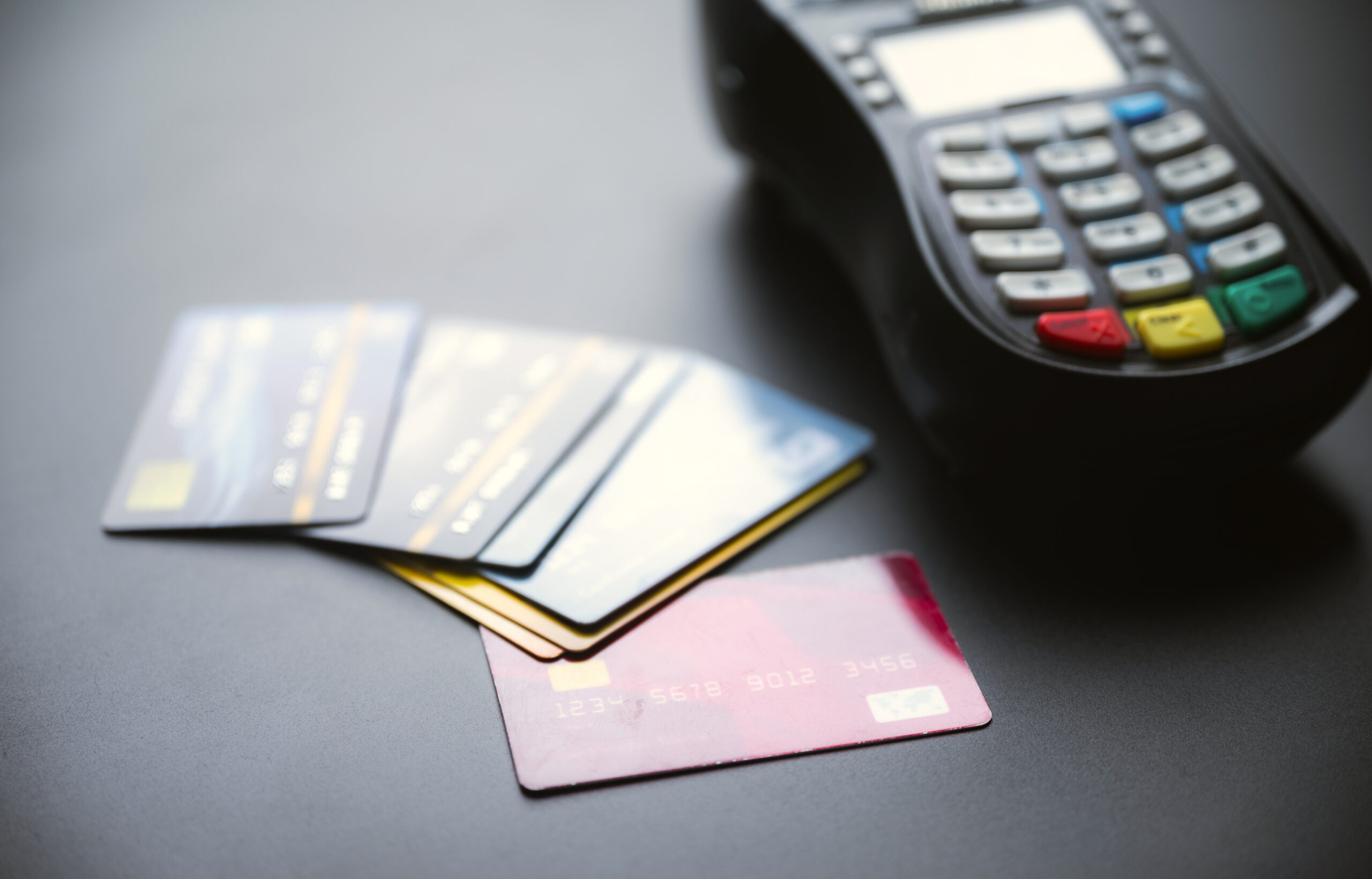
Turkish corporate bank account setup with business IBAN, cards, and official financial documents
A Real-World Scenario: The Freelancer’s Journey
The situation requires immediate resolution because this situation shows its absolute necessity. Elif begins his career as a software developer who works independently as a freelancer. She started her business by working with several tiny clients while using her own IBAN account to get their payments. It seems simple enough.
She chooses to establish a registered company because it will help her obtain major business opportunities. All future developments starting from this point will be determined by the upcoming events. She needs to create a corporate bank account according to the Turkish legal system. The essential nature of this particular action becomes evident through the following reasons.
Legal Compliance: Big corporate clients will only send money to a registered company’s bank account. The company does not have permission to move funds from “Elif’s Software Solutions Ltd.” into Elif’s personal banking account.
Clean Expense Tracking: The corporate account needs all business expenses which include software licences and co-working space fees and marketing costs for payment. The system generates an easily traceable record which proves all tax deduction requests.
Professional Credibility: Handing a client a corporate IBAN shows you’re a serious, legitimate business. Your professional reputation will improve right away because your practice builds trust between you and your clients.
Elif establishes a separate financial path for her business income when she opens a corporate account which separates her professional earnings from her personal compensation. The system defends her from legal problems while establishing an easy-to-understand financial structure which proves vital when dealing with taxes. This is a perfect example of how choosing the right type of Turkish IBAN lays a solid foundation for your business to grow.
Managing Multiple Currencies With Separate IBANs
Expats and entrepreneurs who bank with Turkish institutions find that these financial institutions provide a distinctive service which enables customers to hold multiple currencies through separate IBAN numbers within their personal bank accounts. The system operates as a single banking platform which provides multiple storage areas for users.
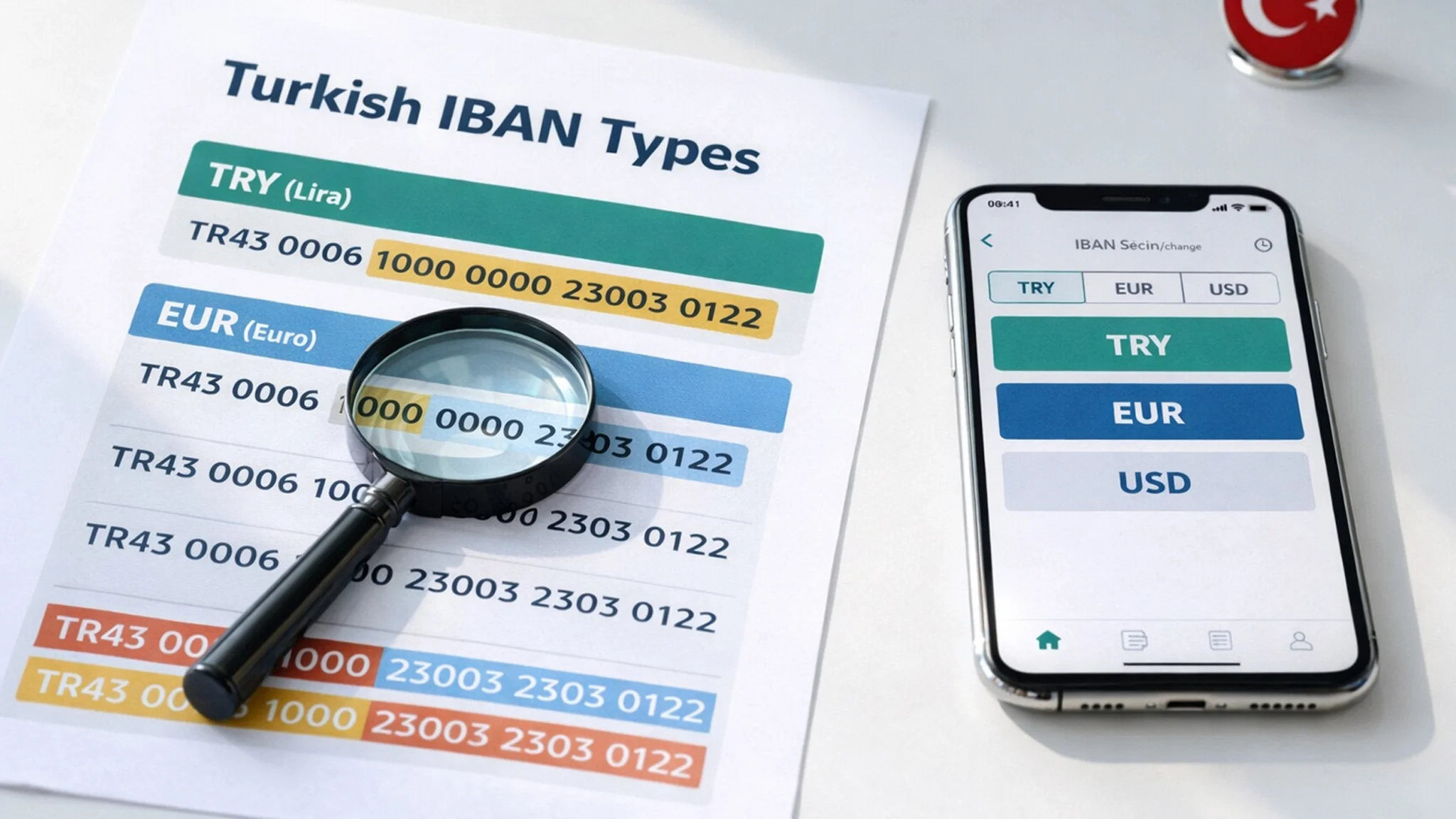
From the moment you open a personal or business account, the bank issues separate IBANs for Turkish Lira (TRY), US Dollars (USD) and Euros (EUR). This means you’re not forced into a single currency—your funds stay in their original form until you decide otherwise.
The Strategic Power Of Currency-Specific IBANs
You would operate an online business based in Istanbul which delivers products to European customers. Your prices are in Euros to match customer expectations. The dedicated EUR IBAN payment system delivers your exact amount of €100 instead of showing the lira value based on current exchange rates.
The receipt of funds in the same currency helps you avoid negative bank exchange rates during transactions. You hold those Euros and convert them only when the exchange rate works in your favour.
The system provides essential value to businesses which obtain their supplies from international suppliers and manage their international invoices. You should use your USD IBAN to pay US vendors while using your TRY IBAN to fund local employee salaries thus maintaining separate financial streams. If you’re new to this world, our step-by-step guide on how to start an e-commerce business in Turkey as a foreigner walks you through every requirement.
How It Works In Practice
Using your currency-specific IBANs is straightforward:
Receive USD: Share your USD IBAN (e.g., TR00 0000 0000 0000 0000 0000 01) with a U.S. client. The funds land as US Dollars.
Receive EUR: Give your EUR IBAN (e.g., TR00 0000 0000 0000 0000 0000 02) to a German partner. They arrive as Euros.
Receive TRY: Use your TRY IBAN (e.g., TR00 0000 0000 0000 0000 0000 03) for local payments, credited in Turkish Lira.
The system protects users from unexpected currency value changes and additional processing fees. Your money stays in its natural state until you choose to exchange it.
How Turkish banks issue different IBANs for each currency under one account
Key Advantages For Entrepreneurs And Investors
Users receive various advantages when they use separate IBANs for their different currency accounts.
Reduced Conversion Costs: No forced currency swaps on incoming transfers.
Exchange-Rate Control: Convert funds when rates peak, not when the bank dictates.
Cleaner Accounting: Track revenues and expenses in the original currency.
Faster Settlements: Currency-specific IBANs can cut processing times.
Your bank account becomes a flexible instrument for worldwide business operations through this system which enables you to handle worldwide financial deals from your Turkish location.
IBAN Account Types And Their Primary Uses
The following section contains a short summary which helps users determine their suitable account selection.
Account Type
Primary User
Common Use Cases
Key Consideration
TRY Account
Local Individuals and Businesses
Domestic payments, payroll, local purchases
Sensitive to TRY exchange-rate movements
USD Account
Exporters, Importers, Freelancers
Paying international suppliers, receiving US income
Must comply with US dollar transaction rules
EUR Account
E-commerce Sellers, EU Partners
Invoicing European clients, cross-border trade
Monitor EUR/TRY rates before conversion
Multi-Currency Account
Global Entrepreneurs
Managing multiple currencies under one roof
Requires disciplined currency management
The selection of IBAN type depends on which payment methods your business receives money from and which costs your business needs to pay. Your ability to perform transfers efficiently will improve while your financial management capabilities will enhance through the selection of your main trading currencies with their IBAN numbers.
How Foreigners Can Get a Turkish IBAN
The process of getting a Turkish IBAN account for foreign citizens seems complex at first but it actually follows a simple procedure. Users can learn basic steps which help them understand how to convert complicated administrative work into an orderly sequence of operations. The financial world of Turkey requires you to obtain one essential document which serves as your admission pass.
Your Potential Tax Identification Number which is known as Potansiyel Vergi Numarası serves as the starting point for this process. Think of this 10-digit number as the master key. The document serves as an essential requirement for performing all official transactions which include bank account openings and lease signings and conducting most Turkish government business. Your tax identifier serves as your official tax number which the tax authorities use to track you regardless of your current tax obligation.
The process of obtaining one turns out to be quite easy to accomplish. You can obtain a tax number by visiting any local tax office (Vergi Dairesi) with your original passport and a photocopy. The entire process takes less than one hour to complete before you can start discussions with banking institutions.
Getting Your Documents in Order
You can start your paperwork process after obtaining your new tax ID number which you should carry with you. All Turkish banks require customers to prove their identity and residential address through standard documents which include a specific set of papers that differ slightly between banks. Having these ready will save you a ton of time and hassle.
You need to have the following details ready for your personal account setup.
Your Original Passport: This is your primary ID, so no copies will do.
Turkish Potential Tax ID Number: The one you just picked up from the tax office.
Proof of Address: This is often the trickiest part. A recent utility bill or rental contract from back home usually works, but it must be officially translated into Turkish and notarised. Some banks are stricter and might ask for a Turkish residence permit or a local address registration (Nüfus Kayıt Örneği).
Your business needs official registration documents from Turkey to establish its legal status as a Turkish company when you want to open an account.
Most individuals face difficulties when handling official documents because they must navigate through documents written in a language they do not understand. Your financial decision should focus on obtaining professional document translation and notarization services before you go to the bank. It prevents major delays.
The Step-by-Step Application
Once all your documents are organised, you’re ready to head to a bank branch. Major city branches now use English as their main language but their staff members might not have English language proficiency. You should consider hiring a translator or seeking professional assistance when your Turkish language skills are not sufficient. For a more detailed look at the potential hurdles, check out our guide on opening a Turkish bank account for foreigners.
The following steps describe what happens during this process.
Pick Your Bank and Visit a Branch: Choose a bank from the list and go to their branch location. Select a major bank because they maintain experience in serving customers who operate abroad.
Present Your Documents: You need to show your passport along with your tax ID and proof of address and all business documents to the banking representative.
Fill Out the Forms: You will need to finish several application forms as part of your process. A translator becomes essential at this point because they protect you from wrong interpretations of vital information.
Make an Initial Deposit: Every bank requires customers to make an initial deposit for account activation.
Get Your Account Details: The bank needs to check all provided details before they will give you access to your account information. The bank will provide you with IBAN numbers which enable you to access Turkish Lira (TRY) and Euro (EUR) and US Dollar (USD) accounts simultaneously.
The process of gaining account access resulted in a major accomplishment. The service enables users to access Turkish financial services which allow them to perform local bill payments and receive international funds and operate their business operations as if they were Turkish residents. With a bit of preparation, it’s a perfectly achievable goal for any foreigner.
Simplify your business setup with Workon’s all-in-one company registration service in Turkey.
Avoiding Common IBAN Transfer Problems
You have obtained your Turkish IBAN which marks a major achievement. The evaluation process starts when you begin conducting financial transactions. All business operations succeed through exact execution of their details instead of creating major problems. Any minor mistake during the process will result in payment delays and rejected transactions and additional unexpected charges.
The majority of transfer problems occur because users accidentally type incorrect characters when they type. Staring at a 26-character string of letters and numbers and trying to type it manually is just asking for trouble. When you swap two numbers and miss one digit your financial transaction will either disappear into a black hole or return to you with a reduced amount because the bank will charge you for their assistance.
Checking IBAN accuracy to prevent rejected or delayed international transfers
Mismatched Currencies: The Classic Blunder
The currency difference between Turkey and other countries represents one of the main obstacles which tourists encounter during their visits to Turkey. As we talked about earlier, you have different IBANs for your Lira, Dollar, and Euro accounts. The selection of an incorrect account will lead to a total failure of the project.
The transfer process will fail when you attempt to send US Dollars to an IBAN account which only accepts Turkish Lira payments. The receiving bank’s system is built to reject anything that doesn’t match the designated currency for that specific account.
To the banking system, a currency mismatch is a non-starter. The system will execute two operations after receiving this transfer request by denying the request and returning the transfer to the sender. The catch?The entire process of returning funds requires multiple business days for completion while banks involved in the transaction process reduce their fees for their role in the unsuccessful transfer.
You need to confirm two vital details with your recipient through email before you proceed with sending your message.
What currency are they expecting? (TRY, USD, EUR)
What is the correct IBAN for that specific currency?
A short message to verify information requires only a few seconds of time. The process of cleaning up from a failed transfer operation requires multiple days to complete.
Navigating Intermediary Banks and International Wires
The process becomes more complicated because wire transfers enable people to send money between nations. Your money follows an indirect path which starts at your bank account before reaching the intended recipient. Instead, it often hops between one or more intermediary banks along the way.
These banks operate as global financial network connectors through SWIFT to enable international payment transactions. But each stop on the journey is a potential point of delay and, you guessed it, fees. Any mistake in the recipient’s information including their name and address and IBAN number will cause an intermediary bank to stop all transaction processing.
International wire transactions need proper handling to prevent them from becoming stuck in processing.
Verify All Recipient Details: It’s not just about the IBAN. The recipient needs to give their full name and address which should match exactly with their bank account details. No nicknames or abbreviations.
Get the SWIFT/BIC Code: For international transfers, the SWIFT/BIC code is just as important as the IBAN. The bank uses its worldwide postcode to send network traffic toward its particular institution which handles fund transfer operations.
Anticipate Fees: The transfer process at intermediary banks requires them to deduct small fees from every amount that passes through their system. You need to send additional funds to the recipient when they require an exact payment amount which includes the costs of deductions.
The entire process needs absolute focus on all individual details. You need to complete several fundamental verification procedures before confirming a transfer because these procedures defend you from standard transfer mistakes which will help you manage Turkish financial transactions better.
Your Answers To Common Turkish IBAN Questions
The first encounter with Turkish IBANs showed an intricate payment system which employed letters and numbers to build an intricate and challenging to understand format. The FAQ provides you with direct answers which expand upon the information presented in our “Turkish IBAN Types Explained” guide.
Is a Turkish IBAN mandatory for every bank transfer in Turkey?
Absolutely. A valid IBAN number serves as a necessary requirement for both domestic and international money transfers because it ensures your funds will arrive at their destination on time.
How many IBANs will I get per currency?
Banks provide their customers with three different IBANs which operate under one account profile for Turkish Lira (TRY) and Euro (EUR) and US Dollar (USD).
To confirm an IBAN is correct, try these quick checks:
Check Digit Formula: Perform a MOD-97 calculation to catch typos.
Bank Portals: Many Turkish banks provide an online IBAN validation tool.
Workon’s Assistance: Our team at Workon can verify your IBANs in minutes.
You should always copy your IBAN number when you need to use it. The process of manual entry operations results in human errors which cause more than 80% of all transfer failure incidents.
Common Limits And Requirements
Foreign transfers sent to Turkish bank accounts face two types of transfer restrictions which include daily and monthly transfer limits. The following example demonstrates the concept.
Individual Accounts: Typically capped at USD 50,000 per day
Corporate Accounts: Can reach USD 100,000 per day
The banking industry maintains different security thresholds which banks use while regulatory changes lead to periodic adjustments of these thresholds.
You should check your bank’s present restrictions because this information enables you to stop both unexpected account freezes and additional compliance assessment work.
The processing of large incoming funds requires businesses to submit supporting documents which include transaction purpose evidence and invoices or contracts to accelerate the verification process. Don’t forget that an accurate SWIFT/BIC code is just as important as an IBAN; missing it can add 2–3 business days to your transfer.
Troubleshooting Quick Fixes
Most hiccups when sending money fall into three categories:
Currency Mismatch: Sending EUR to a TRY IBAN leads to an automatic rejection.
Incorrect SWIFT/BIC: A wrong code can reroute or delay your funds.
Missing Beneficiary Details: Incomplete name, address or tax ID stops transactions in their tracks.
Issue Type
Symptom
Quick Fix
Typo In IBAN
Transfer Rejected Or Returned
Copy-paste the IBAN and validate with a checker
Missing SWIFT/BIC
Delay Of 2–3 Days
Confirm and add the exact SWIFT/BIC code
Currency Mismatch
Immediate Rejection Of Funds
Double-check you’re using the right currency IBAN
You need to contact both your sending bank and your receiving bank right away after your transfer becomes suspended. The process will operate at higher efficiency when you show your reference numbers along with your receipts.
Working with Workon removes these roadblocks. Our team of experts handles all documentation work and IBAN verification and compliance checks to enable you maintain your business growth efforts.
The process of using Turkish banking services has become easier for you. Workon provides complete assistance to its business partners who need assistance with account setup and maintaining regulatory compliance.
Turkish IBANs are issued for personal, corporate, and currency-specific accounts such as TRY, USD, and EUR, each serving different legal and financial purposes.
A personal IBAN is for individual expenses and income, while a corporate IBAN is legally required for business transactions and tax-compliant accounting.
Yes. Foreigners can obtain a Turkish IBAN by first getting a Potential Tax Identification Number and providing a passport and proof of address to a Turkish bank.
Yes. Turkish banks usually issue separate IBANs for each currency (TRY, USD, EUR) under the same account profile.
Sending funds to the wrong IBAN—especially with a currency mismatch—can cause transfer rejection, delays, or additional bank fees.
Subscribe to Newsletter
Be notified of the latest news in the business world quickly