

















Why Turkey’s Residence Permit Rules Are Changing

Why Turkey’s Immigration Policies Are Changing in 2025
Anyone applying for a residence permit in Turkey has felt the ground shift beneath their feet. Gone are the days of simple renewals and predictable requirements. The process has become more complex, and frankly, more demanding. So, what’s really behind this shake-up?
Think of it as a strategic recalibration. Turkey has long been a magnet for expats, investors, and long-term tourists. This immense popularity, coupled with economic pressures and regional dynamics, pushed the government to take a hard look at its immigration policies. These new rules aren’t random; they’re a direct response to a very real need for better control over migration and to shore up economic stability.
The main goal is pretty clear: to make sure foreign residents are in a position to positively contribute to the Turkish economy and integrate smoothly. By hiking up the financial and property value minimums, the government is signalling that it wants to attract people with a solid economic footing.
The numbers already show this policy is having an effect. Data from the Turkish Presidency of Migration Management (PMM) shows that as of November 2024, 1,031,536 foreigners held residence permits. That’s a drop of about 82,225 people from the year before, which tells us these stricter rules are already filtering the applicant pool. For a broader view on these trends, resources like ReliefWeb International offer some great insights.
Key Changes in Residence Permit Rules at a Glance
To help you get a quick handle on what’s different, we’ve put together a summary table. These are the critical updates that you’ll need to be aware of, as they touch on nearly every type of short-term permit, from tourist stays to real estate investments.
| Area of Change | Old Rule (if applicable) | New Rule/Requirement |
|---|---|---|
| Financial Sufficiency | Lower, less strictly enforced proof of funds was often accepted. | Applicants must show a higher monthly income, roughly 1.5 times the Turkish minimum wage. |
| Property Investment | Minimum property value was $75,000 in major cities and $50,000 in others. | The minimum property value for residency has been raised to $200,000 nationwide. |
| Tourist Permit Renewals | Often granted with a simple tourism plan and rental contract. | Renewals based on tourism are now heavily restricted; a new, valid reason is required. |
| “Closed” Neighbourhoods | A smaller list of districts was closed to new foreign residents. | The list of “closed” neighbourhoods (where foreigners can’t register an address) has expanded to over 1,100. |
This table gives you the headlines, but the story behind them is what really matters for your application. Each change is part of a larger strategy.
The core idea behind the turkish residence permit new rules 2025 is to build a more selective residency system that benefits the economy. It’s not about shutting the door, but rather ensuring that those who walk through it are well-equipped to support themselves and contribute.
Understanding the “why” is your first and most important step. It gives you the context you need to put together an application that’s not just complete, but also aligned with what the authorities are now looking for. In the next sections, we’ll dive deeper into what each of these changes means for you.
Meeting the New Financial Requirements
Navigating the financial side of your residence permit application has always been a big deal, but with the 2025 rule changes, it’s now front and centre. You have to think of this less as a box-ticking exercise and more as the very foundation of your application. The government wants to see clear, solid proof that you can support yourself—and any family you bring—without relying on public funds.
This shift means you really need to get your financial planning in order. It’s no longer good enough to just show a lump sum in a bank account; you have to prove a stable and sufficient monthly income. This is Turkey’s way of ensuring that new residents are financially independent, a core part of their bigger picture on migration management.
Calculating Your Required Income
So, what’s the magic number? The new rules tie the required income directly to Turkey’s minimum wage. This makes the target a moving one, but it’s always pegged to the local cost of living. For a single person, you must show a monthly income that is at least 1.5 times the national minimum wage.
The government’s focus on economic stability is clear. The new threshold for anyone sponsoring a family member is now a minimum monthly income of TRY 33,156 for each person. If you’re looking to sponsor a family of four for an application in 2025, that number jumps to a hefty TRY 110,520 per month. It’s a clear signal that the financial checks are getting much stricter.

Simplify your business setup with Workon’s all-in-one company registration service in Turkey.
As these requirements get tighter, having a solid grasp of understanding cross-border financial planning becomes crucial, especially if your money is coming from outside of Turkey.
Proving Your Financial Capacity
Showing you have the funds is all about presenting the right documents in the right way. Vague or incomplete paperwork is one of the quickest routes to a rejection. Your mission is to paint a crystal-clear, undeniable picture of your financial health for the migration authorities.
Here are the most common ways to do that:
- Bank Statements: You’ll need official, stamped statements from a Turkish bank. They should show you have consistent funds to cover your entire intended stay.
- Pension Statements: If you’re retired, official documents detailing your regular pension payments are essential.
- Salary Slips or Employment Contracts: For anyone with a job, recent pay slips and a formal letter of employment are a must.
- Proof of Rental Income: Do you own property that brings in money? You’ll need to show official rental agreements and bank records of the payments.
A common pitfall is submitting statements from a foreign bank without getting them properly notarised and translated. Any financial document not in Turkish must be officially translated and notarised to be accepted by the authorities.
Getting this documentation right is a huge step toward getting your permit approved. For a full checklist, take a look at our detailed guide on Turkish residence permit requirements. It’ll help you make sure nothing gets missed.
How Property Investment Rules Have Shifted

Updated Real Estate Investment Requirements for Residence Permits
For a long time, buying a home in Turkey was one of the most straightforward ways to get a residence permit. Many foreigners followed this path successfully. But with the turkish residence permit new rules 2025, that landscape has changed dramatically.
Think of it like this: the goalposts have moved. The strategy that worked for years might not even get you in the game today. The biggest shift is a major hike in the minimum property value required to even apply. It’s not a small tweak; it’s a fundamental change aimed at bringing more substantial investment into Turkey’s property market.
If you’re considering this route, understanding the new financial requirements is step one. And of course, getting a handle on the ins and outs of financing rental property is essential groundwork before you even start looking.
The New Minimum Investment Threshold
Before, the minimum investment amount depended on where you bought. It was $75,000 in major cities like Istanbul and Izmir, and just $50,000 everywhere else. That system is now gone.
The government has rolled out a new, unified threshold across the entire country. The minimum property value to qualify for a short-term residence permit is now a flat $200,000 USD.
This simplifies the rule, but it also raises the financial barrier quite a bit. A property that would have easily qualified you for residency before might now be well below the new minimum. It’s a change that’s steering investors towards a different calibre of property.
To put these figures into perspective, it’s helpful to see how the residency and citizenship-by-investment thresholds compare.
Property Investment Thresholds for Residency
The table below breaks down the minimum property values needed for both short-term residency and the more demanding citizenship application across Turkey. As you’ll see, the $200,000 rule for residency is now standard everywhere.
| Province/City | Minimum Value for Short-Term Permit | Minimum Value for Citizenship Application |
|---|---|---|
| Istanbul | $200,000 USD | $400,000 USD |
| Ankara | $200,000 USD | $400,000 USD |
| Izmir | $200,000 USD | $400,000 USD |
| All other provinces | $200,000 USD | $400,000 USD |
While the residency requirement has gone up, the citizenship-by-investment threshold has remained at $400,000 USD. This table clearly shows the two distinct paths available through real estate investment.
Essential Rules Beyond the Price Tag
Hitting that $200,000 figure is just the start. The Turkish government has also tightened up the rules to ensure the system is used as intended.
Here are two critical points you absolutely cannot overlook:
- Mandatory Appraisal Report (Ekspertiz Raporu): You must get an official appraisal report from a government-licensed expert. It’s the value in this report—not the price you agreed on or what’s on the title deed (TAPU)—that the immigration office will use for your application. This is non-negotiable.
- “Closed” Neighbourhoods: The list of neighbourhoods “closed” to new foreign residents has grown. If you buy a property in one of these areas, you cannot apply for a residence permit there, no matter how much it’s worth.
I can’t stress this enough: always, always check if a neighbourhood is on the closed list before you even think about making an offer. Buying a beautiful, expensive apartment in a closed district will get you a lovely home, but it won’t get you a residence permit. It’s a very expensive mistake to make.
Getting this right from the start is key. For a deeper dive into making a smart purchase, our guide on https://workon.com.tr/en/investing-in-real-estate-in-turkey-a-guide-for-foreigners/ is a great resource to help you navigate the process under the current laws.
Tourist Permit Renewals: The Rules Have Changed
For a long time, renewing a short-term residence permit for tourism was almost a given for many foreigners living in Turkey. It was a straightforward path. That’s all changed with the turkish residence permit new rules 2025. The government is now cracking down on this route, making it clear that you can’t justify a long-term stay with tourism alone.
This shift is a big deal. It means the old days of simply extending your tourist permit year after year are gone. When you apply for a renewal now, officials are going over every detail, and they’re looking for a very specific, “genuine tourist purpose.” Having a rental contract and wanting to stay just isn’t going to cut it anymore.
What Counts as a “Genuine Tourist Purpose”?
So, what does it take to get an extension approved? You need to provide solid proof that you are, in fact, still a tourist. It’s not about what you say; it’s about what you can show. This means submitting a detailed and believable travel plan that covers the entire period of your requested extension.
Your itinerary needs to be backed up with specifics, including things like:
- Confirmed hotel reservations in various Turkish cities and regions.
- Proof of travel between locations, such as flight or bus tickets.
- A well-thought-out plan showing you’re actively exploring the country, not just living in one place.
Ultimately, the responsibility is now on you to prove that your main reason for being in Turkey is travel and exploration, not just settling down.
This tighter scrutiny is part of a larger government strategy to manage migration more effectively. The goal is to make sure each permit type is used for its intended purpose and to stop tourist permits from being used as a back door to long-term residency.
The 2024 policy updates are a balancing act between Turkey’s international commitments and its domestic migration policies. While managing the temporary protection status for groups like the nearly 2.94 million Syrians is a priority, these stricter rules have broader effects. To get the full picture, it’s helpful to explore more about these policy dynamics and understand Turkey’s current approach to migration.
Better Options for a Longer Stay
If you’re planning to stay in Turkey for more than a quick holiday, trying to renew a tourist permit is a gamble. With rejections becoming the norm, it’s wise to look at more stable and appropriate alternatives. Luckily, Turkey offers other short-term permits that are much better suited for long-term plans.
Think about pursuing one of these more reliable routes:
- Language Course Permit (TÖMER): A very popular and legitimate option. Enrolling in a certified Turkish language course shows you’re serious about integrating into the culture.
- Business Establishment Permit: If you’re an entrepreneur looking to start a company, this permit is designed for you. It’s a path the government encourages because it brings investment and jobs into the local economy.
- Student Permit: For those studying at a university or another educational institution, this permit provides a clear and valid basis for your stay.
These alternatives give you a much stronger and more predictable legal footing. They demonstrate a clear purpose that goes beyond tourism, which is exactly what the authorities are now looking for from anyone wanting to make Turkey their home.
Your Step-By-Step Application Checklist
Trying to get a Turkish residence permit can feel a bit like putting together a complicated piece of flat-pack furniture, especially with the Turkish residence permit new rules 2025 now in effect. If you miss just one screw or one step, the whole thing can fall apart. This checklist is your instruction manual, designed to guide you through every stage, from start to finish.
Think of it this way: your application is the story you’re telling the immigration authorities, the Göç İdaresi. Each document is a chapter that confirms who you are, why you’re here, and that you meet the criteria. A neatly organised, complete file speaks for itself, which is exactly what you want. It dramatically reduces the chance of extra questions, frustrating delays, or even a flat-out rejection.
To give you a clearer picture of what happens after you’ve handed everything in, here’s a look at the official timeline.
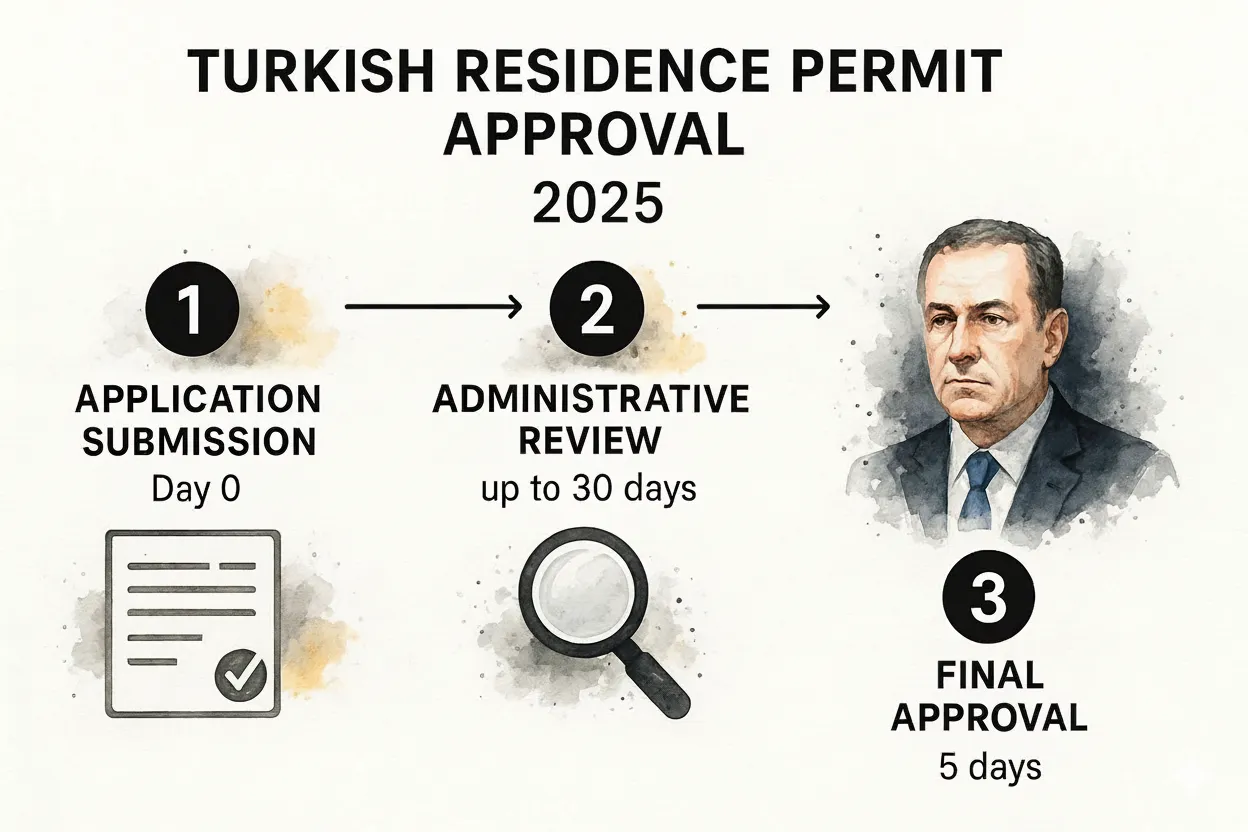
Application, Review, and Final Approval Process Explained
As you can see, the main waiting period is the administrative review. This part can take up to 30 days before you get a final decision, so it’s best to be patient.
Stage 1: Assembling Your Core Documents
Before you even touch the online portal, the very first thing you need to do is get all your paperwork together. This is the bedrock of your application, and getting this part right is non-negotiable. So many people rush this stage and end up creating problems for themselves down the line.
Here’s what you absolutely must have in your file:
- Residence Permit Application Form: This is the form you get from the official e-İkamet system after filling it out online. Make sure it’s printed and signed.
- Passport and Copies: You’ll need your actual passport, plus colour photocopies of the main page with your photo, the visa page, and the page with your latest entry stamp into Turkey.
- Biometric Photographs: Four recent, proper biometric photos. They need to meet the official standards, which usually means a white background and your face clearly visible.
- Proof of Financial Sufficiency: This means getting bank statements from a Turkish bank account. The statements need to show you have enough funds to support yourself for your entire stay, meeting the new income rules.
- Valid Health Insurance: This has to be a policy from a Turkish insurance company that covers the entire period you’re applying for. It’s not just any policy; it must meet the government’s minimum coverage requirements.
Stage 2: The Online Submission
With your stack of documents ready, it’s time to head to the official e-İkamet portal. This is where you’ll officially lodge your application and book your appointment. Be meticulous here—any tiny difference between what you type online and what’s on your physical papers can cause a headache.
The e-İkamet system is the only official way to apply. Be very cautious of third-party websites that claim they can speed things up for a fee. They have no connection to the Turkish government.
On the portal, you’ll upload digital versions of your documents and then choose an appointment date at your local Provincial Directorate of Migration Management, or İl Göç İdaresi Müdürlüğü.
Stage 3: The In-Person Appointment
This is the final hurdle: your face-to-face meeting with an immigration official. You’ll hand over your file with all the original documents and their copies. The officer will look through everything, check your identity, and take your fingerprints.
To make sure your appointment goes off without a hitch:
- Get there early. It helps to avoid any last-minute panic.
- Keep your documents organised. Put them in a folder in a logical order. It shows you’re prepared.
- Bring cash. You’ll need it to pay for the permit card fee and any other taxes on the day.
After the appointment, you’ll get a reference number to track your application online. If all goes well and you’re approved, your residence permit card (the ikamet) will be sent directly to the address you registered in Turkey. Following these steps methodically is the best way to stay on top of the process.
Common Questions About the New Permit Rules

Rising Income and Investment Thresholds Explained
Any time immigration laws change, a flood of questions follows. It’s completely normal to feel a bit lost when faced with the turkish residence permit new rules 2025, as some of the updates can be confusing.
To help clear things up, I’ve put together answers to the questions I hear most often from applicants. Let’s tackle them one by one.
Can I Still Renew My Tourist Permit?
This is probably the most common question right now, and the honest answer is that it has become incredibly difficult. The government has seriously tightened the rules for renewing a short-term permit on the basis of tourism alone.
You can’t just say you want to keep exploring Turkey anymore. Now, you need to present a concrete, day-by-day travel plan for your entire requested extension, backed up with real hotel bookings and flight or bus tickets. If you’re looking for a longer stay, it’s a much better idea to explore other options, like a permit for a Turkish language course or one for starting a business.
What Happens If My Application Is Rejected?
Getting a rejection letter is tough, but it doesn’t automatically mean your journey in Turkey is over. The notice you receive will explain why it was denied, and that reason dictates your next steps.
Generally, you have a few paths forward:
- Appeal the Decision: You have a legal right to challenge the rejection in administrative court, but there are strict deadlines for this.
- Fix and Re-apply: If the problem was simple—say, a missing document or a mistake on the form—you can often correct the error and submit a whole new application.
- Leave and Start Over: For some rejection reasons, the only choice is to exit Turkey and begin the process again from your home country.
The most important thing is to act fast. Don’t just ignore a rejection notice. Get professional advice immediately to understand your options, as ignoring it can lead to fines, a ban from re-entering Turkey, or even deportation.
Do These Rules Affect Existing Permit Holders?
For the most part, no. If you already have a valid residence permit, it’s good until its expiry date. The changes primarily impact people submitting new applications or renewals after the rules were updated.
The key thing to remember is that when you go to renew your current permit, your application will be judged against the new turkish residence permit new rules 2025. This means you’ll have to meet whatever the updated financial or documentation requirements are for your permit type. So, be sure to start preparing for your renewal well ahead of time.
Can I Work on a Short-Term Residence Permit?
This is a firm no. A short-term residence permit, whether for tourism, property ownership, or medical treatment, does not give you the right to work in Turkey. Working without an official work permit is illegal and the consequences are severe, including hefty fines and deportation.
If you want to work legally, your employer must apply for a work permit on your behalf. If you’re planning to launch your own company, the proper route is to look into a business visa for Turkey. Taking this step ensures you stay on the right side of all Turkish employment and immigration laws from day one.
Navigating company formation and permit applications in a new country can be a complex journey. Workon specialises in simplifying these processes, offering expert guidance on everything from business setup to securing the necessary permits. Let our team handle the complexities so you can focus on what matters most—growing your business. Visit our website to learn how we can help you succeed in Turkey: https://workon.com.tr/en