


















Wise and Payoneer should not be treated as interchangeable “international bank accounts” for a Turkish company. Verification is only one part of the decision: first confirm that the provider and the specific feature you need are actually available for a business with a Türkiye-registered address.
Wise’s current Türkiye notice states that restrictions follow the account’s registered address. Türkiye-registered personal and business accounts cannot request new account details; from the account-specific date Wise communicates to an affected customer, functions such as opening new currencies, adding money, receiving money and converting balances can also be restricted, while existing funds can still be withdrawn and international transfers funded from a Turkish bank account can remain available. Payoneer provides payment-account services rather than a traditional bank current account; receiving-account and other features remain subject to eligibility, country/region and the current product offering.
This guide therefore focuses on three separate questions: Is the feature available? What does verification require? What should a Turkish company use instead if the required payment route is unavailable?
Reviewed: 17 September 2026. Provider features and eligibility can change; always confirm the current rules in the provider account or official help centre before relying on a payment route.
Availability Comes Before Verification
Verification confirms identity, business information and ownership for a provider’s compliance process. It does not guarantee that every product feature is available in every country or for every business type.
| Provider | What a Türkiye-registered business should know in 2026 | Verification point |
|---|---|---|
| Wise | Wise’s Türkiye restrictions apply according to the registered address. New account details are unavailable for Türkiye addresses; from the account-specific date communicated to an affected customer, receiving money, adding money, opening new currencies and converting balances can also be restricted. Existing balances can still be withdrawn and international transfers funded from a Turkish bank account can remain available. | Wise verifies the business, key people and, where required, supporting documents; additional review can take up to 10 working days according to its current help guidance. |
| Payoneer | Payoneer is a payment-services platform rather than a traditional business current account. Local receiving-account details and other features depend on eligibility, country, account profile and the current offering. | Payoneer may request identity, business, ownership, activity and supporting transaction information before enabling specific services. |
Official references: Wise restrictions for customers based in Türkiye and Wise Business verification guidance. Payoneer explains that receiving accounts are payment-service features and are subject to eligibility in its current product materials.
What the Türkiye Address Restriction Changes
For Wise, the decisive factor is not nationality but the registered address attached to the relevant personal or business account. A founder living abroad can therefore have a different feature set from a Turkish company whose Wise Business account is registered in Türkiye.
This matters operationally: a Turkish company should not build its invoicing or treasury process around receiving-account details that the provider does not currently make available for its registered address. Confirm the payment rail first, then complete verification for the services that are actually available.
If the objective is a conventional Turkish corporate bank account rather than a payment-provider account, see our business bank account guide for foreign-owned Turkish companies.
Prepare the Verification File Before You Apply
The safest approach is to prepare a consistent identity and business file before starting verification. Requirements vary by provider, country, business type and risk profile, so treat any checklist as a preparation guide rather than a guaranteed document list.
For a Turkish company, the practical file may include current trade-registry records, tax-related company documents, authorised-signatory information, identity documents for relevant owners or controllers, business-address evidence where requested, and records that explain the company’s actual activity.
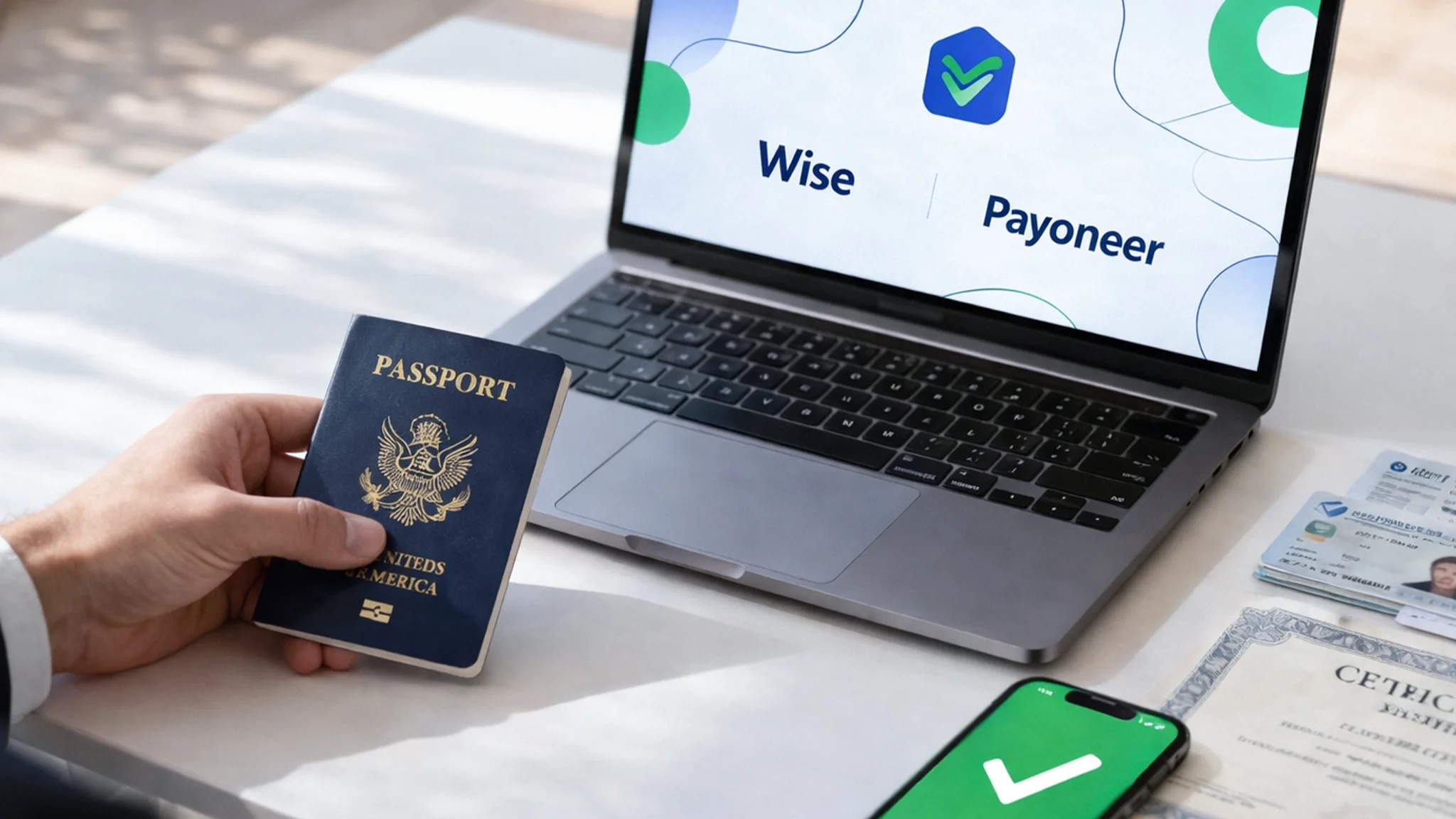
Use the provider’s current account request as the document checklist. An illustration can help you prepare the file, but it does not establish account eligibility or guarantee that a feature is available.

Verification readiness depends on provider eligibility, business information and the documents requested for the specific account.
Personal and Business Verification: What to Prepare
The exact request is provider- and profile-specific. Identity, address, company, ownership and business-activity evidence can all be requested, but the accepted documents and thresholds vary by provider, country and account type.
- Identity: prepare a valid government-issued identity document that meets the provider’s current country and format rules.
- Address: be ready to provide current residential or business-address evidence if the provider requests it.
- Consistency: names, addresses and company details should be factually consistent across the application and supporting records. Minor formatting differences do not justify claiming an automatic rejection.
Verification Preparation Checklist
Use this as a preparation checklist only. The provider’s current account prompt or official support request controls which documents are actually required.
| Document Type | Wise Requirement | Payoneer Requirement | Pro Tip |
|---|---|---|---|
| Personal ID | Valid identity document accepted for the specific country/account flow. | Valid identity document requested by Payoneer for the account holder or relevant person. | Use the document type currently requested in the provider interface; do not assume one document guarantees faster approval. |
| Address | Address evidence may be requested; accepted documents and age limits depend on the current Wise flow and country. | Address evidence may be requested according to Payoneer’s current verification request. | Submit the format and document type specifically requested by the provider. |
| Business registration | Current company information and supporting registration documents if Wise requests them. | Current company-registration evidence requested in the Payoneer Verification Center. | For Turkish companies, keep current registry and tax-related company records available, but submit the exact documents the provider requests. |
| Business address | Wise collects both the registered address and the trading address. Its current guidance says the trading address must be a physical operating location and cannot be a virtual office, mail-forwarding/receiving service, PO Box, lawyer’s office or business-registration agency. | Business-address evidence may be requested depending on the current Payoneer verification request. | Do not treat a Turkish registered-address/virtual-office contract as automatically satisfying a provider’s separate trading-address test. Map the registered address and the real operating/trading location separately. |
| Owners / controllers / authorised persons | Identity or authority evidence for the people Wise asks it to verify. | Identity and ownership/control information requested for the specific Payoneer account. | Prepare a current ownership and authority map; do not assume one universal ownership threshold applies to every provider or account. |
Registered Address and Trading Address Are Not the Same Verification Field
This distinction is especially important for a Turkish company using a virtual office. Wise’s current business-address guidance says it collects both the company’s official registered address and the trading address where the business is actually run day to day. The trading address must be a physical location; Wise says it cannot be a PO Box, mail-forwarding/receiving service, virtual office, lawyer’s office or business-registration agency, while a genuine co-working space can be acceptable. A valid Turkish registered-address arrangement therefore does not by itself answer Wise’s separate trading-address question.
Before you start: confirm that the feature is available for a Türkiye-registered business, make sure company/ownership and registered/trading-address details match the real operating model, and use the provider’s current verification request—not an old blog checklist—as the final document list.
Navigating Business Account Documentation
Business verification normally goes beyond personal identity. The provider may need to confirm the legal entity, who owns or controls it, who is authorised to act for it, what the business does and how the account will be used.
- Company registration: current evidence that identifies the Turkish legal entity and registration details.
- Constitutional/corporate records: articles, registry extracts or other documents requested to understand the company structure.
- Business address: evidence of the registered or trading address if the provider requests it.
- Owners, controllers and authorised persons: provide the people and identity evidence requested in the provider’s current flow; do not assume a single universal ownership threshold applies to every provider, jurisdiction and account.
For foreign founders, the practical challenge is often not the existence of the Turkish company but whether the provider can clearly verify the company, its owners, its address and its real business activity. Registration alone does not make a company fully operational: banking, payment rails, tax/compliance coordination and other operational steps may still be required.
Workon can coordinate Turkish company and operational documents used across foreign-founder workflows, while the provider itself decides what it will accept and whether an account or feature is approved. If you need a conventional Turkish corporate account, see our business bank account guide.
Wise Verification for a Türkiye-Registered Business
Before starting Wise Business verification, confirm that the feature you need is available for the business’s registered address. For a Türkiye-registered Wise Business account, verification does not remove the current Türkiye product restrictions.
Wise’s current business-verification flow asks for information about the business, registered/trading addresses, industry, online presence where applicable, key people and the person opening the account. If additional verification is required, Wise may request supporting corporate, address, ownership or identity documents.
How the Wise Verification Review Works
Wise first collects business and account-holder information during sign-up. It may be able to verify some details from available records; if not, its verification team can request specific documents through the account or an official Wise communication.
Only submit the documents Wise specifically requests. For identity verification, accepted document types and any selfie/liveness step depend on the current account flow and country rules.

Uploading ID and completing selfie verification for Wise users in Turkey
Business Ownership and Authorisation Checks
Wise may need to verify the company’s owners, controllers, directors and the person authorised to open the account. The exact people and documents requested depend on the entity, jurisdiction and account profile. If the applicant is not a director, Wise says it may request proof of authority such as a signed authorisation, power of attorney or board resolution.
For foreign-founded Turkish companies, prepare a clear ownership/control picture and current corporate records so the provider can reconcile the people in the application with the company’s official information.

Simplify your business setup with Workon’s all-in-one company registration service in Turkey.
How Long Can Wise Verification Take?
Do not rely on the old “1–3 business days” promise. Wise’s current guidance says that when additional business verification is needed, its specialist review can take up to 10 working days. The actual timing depends on whether more information is required.
Track the status in the Wise account and respond to official document requests promptly. A verification timeline is not an approval guarantee, and completing verification does not override Türkiye-specific feature restrictions.
Payoneer Verification and Receiving-Account Eligibility
Payoneer is a payment-services platform, not a conventional business current account. Verification establishes the customer and business profile, while individual features—such as local receiving-account details, payment requests, balances or cards—remain subject to eligibility and the current offering.
A business may be asked for identity information, company details, ownership/control information, business activity, counterparties, website or commercial evidence, and supporting documents. The exact request can change according to the service being enabled and the account’s risk profile.
Prepare the Payoneer Business Profile
Be ready to provide the identity, address, company and activity information requested in the Payoneer account. The specific documents can vary, so the current Verification Center or account request should be treated as the controlling checklist.
Consistency matters: the legal company name, registration information, address, ownership/control details and business activity should match the underlying records. Do not claim that a minor punctuation or formatting difference automatically causes rejection.
Describe the Business Clearly
Payoneer may ask for a more detailed business profile before enabling a service. Answer factually: what the company sells, where customers or counterparties are located, how payments arise, and what commercial evidence exists.
- Business activity: use a specific description of the actual products or services.
- Commercial presence: provide the website, marketplace profile or other evidence if the provider asks for it.
- Payment purpose: explain who pays the company, why, and through which business model.
Do not manufacture an online presence for verification. The objective is to make the real business understandable and consistent with its documents and transactions.
When Payoneer Requests Additional Information
An additional-information request is not the same as an approval or rejection. Respond through the official Payoneer channel with the specific evidence requested, which may include business documents, invoices, contracts or information about customers and payment activity.
A DUNS number or other external identifier should not be presented as a shortcut to Payoneer approval unless Payoneer specifically requests it. Verification decisions remain provider-controlled and account-specific.
Common Verification Problems to Check Before Resubmitting
If verification is delayed or more information is requested, first check whether the provider can read and reconcile the submitted information. The most useful review is factual: document quality, current company information, ownership/control data, address evidence and a clear business-purpose explanation.

How unclear or incorrect ID documents delay Wise and Payoneer verification in Turkey
Unreadable or Incomplete Document Images
Providers can reject or re-request a document if required information is hidden, cropped, expired or unreadable. Wise explicitly lists visibility, completeness and accepted file/document type among common document-rejection reasons.
- Place your document on a dark surface which will help the document stand out through its contrast.
- Find a spot with good, even natural light. The flash function on your phone should remain disabled because it produces an unappealing bright light.
- Get directly over the document and make sure all four corners are clearly visible in the frame. Don’t shoot from an angle.
- Before you click the “upload” button, zoom in and confirm that all required information is clearly readable.
Information That Does Not Reconcile
Differences between the application and official records can trigger questions, especially when the discrepancy affects the legal company name, address, ownership or identity. Punctuation or abbreviation differences should not be described as automatic rejection rules.
Before resubmitting, compare the provider profile with the underlying official documents and correct any factual inconsistency through the provider’s approved process.
Incomplete Ownership or Business-Purpose Information
A provider may request more information when it cannot establish who owns or controls the company, what the business actually does, or how expected payments relate to that activity. Use current corporate records and answer the provider’s questions specifically rather than relying on a generic company description.
Workon can coordinate Turkish company, registered-address and operational documentation for foreign founders, but it cannot certify that a document set “meets all Wise or Payoneer requirements” or guarantee provider approval.
Where Workon Fits
Workon helps foreign founders and international companies establish and operate businesses in Turkey. In this context, that can include coordinating Turkish company records, registered-address documentation, corporate bank-account preparation and other operational documents that a payment provider may ask you to explain or reconcile.
Workon does not control Wise or Payoneer eligibility, verification or approval decisions. If your main need is a conventional Turkish corporate bank account, see Workon’s business bank account application support. If you are still establishing the Turkish entity itself, see company formation in Turkey for foreign founders.
Official Reference Points
- Wise — Restrictions for customers based in Türkiye: registered-address restrictions for personal and business accounts and the current feature limits.
- Wise — Business verification: current business/key-person information, authorisation evidence and up-to-10-working-day additional-review guidance.
- Wise — Business-address verification: separate registered/trading-address treatment and the physical trading-address rule.
- Payoneer — Business services guide, July 2026: current receiving/payment features and the statement that service availability depends on eligibility and can vary by country or region.
- Payoneer — Current Terms and Conditions: identity/company verification and additional-information rights for Payoneer services.
Frequently Asked Questions
Disclaimer: This guide provides general payment-provider and business-account eligibility information, not legal, tax, investment or financial advice. Wise, Payoneer and similar providers control their own country eligibility, verification, account functionality, limits, fees and onboarding rules, which can change without notice. Confirm the current Türkiye-specific terms and the exact business use case directly with the selected provider before relying on a route.