Withholding Tax in Turkey (Stopaj): Complete Guide for Foreign Businesses
06.11.2025
If you’re doing business in Turkey, you’ll come across the term ‘stopaj’ sooner or later. This is the local name for withholding tax, and getting to grips with it is fundamental. Think of it as a tax prepayment system. When your company makes a payment for certain services, you hold back a small portion for taxes and send it straight to the government.
It’s not an extra tax. Instead, it’s an advance on the income or corporate tax the recipient will eventually owe. The system is designed to make tax collection smoother and more reliable right from the source.
At first glance, Turkey’s tax rules might seem complex, but the logic behind withholding tax is quite simple. It’s like a “pay-as-you-go” plan for taxes. Rather than leaving the recipient to pay a huge tax bill at the end of the year, the person or company making the payment takes care of a chunk of it right away.
This approach is a win-win. The government gets a predictable stream of revenue and lowers the chances of tax evasion. For businesses, it means tax duties are clear from the get-go for many common transactions.
Who Is Responsible for Withholding
This is the key takeaway: the responsibility to withhold and pay the tax rests with the payer, not the person receiving the money. The payer acts as the official “withholding agent.” If you run a company in Turkey and are paying for rent, services, or dividends, that agent is you.
Common payments where you’ll act as a withholding agent include:
Fees paid to freelancers and other independent professionals.
Rent for your commercial property or office space.
Dividends distributed to shareholders.
Royalties or technical service fees paid to foreign companies.
Getting this wrong isn’t an option. Failing to withhold the correct amount and send it to the tax office can result in hefty penalties. The system works because it places the responsibility on the entity that’s usually better organised—the business cutting the cheque.
By collecting tax right at the source of income, the Turkish system ensures a far more efficient and timely collection process. This method also simplifies things for the income recipient, as part of their tax liability is already squared away when it’s time to file their annual return.
The Scope of Withholding Tax
Withholding tax doesn’t apply to every single payment you make. It’s targeted at specific types of income outlined in Turkey’s Income Tax Law and Corporate Tax Law. It’s a crucial piece of the puzzle within the country’s overall tax structure. For a bird’s-eye view, it helps to understand the full range of taxes in Turkey and see where stopaj fits in.
Knowing which payments are subject to withholding is non-negotiable for staying compliant. This foundational knowledge is your first step towards confidently managing your tax duties and planning your business finances in the Turkish market. From here, we’ll dive into the specific rates and real-world examples you’ll encounter.
Understanding How ‘Stopaj’ Works in Practice
Think of Turkish withholding tax, or ‘stopaj’, as a “pay-as-you-go” system for taxes. Instead of dealing with one massive tax bill at the end of the year, this approach handles tax obligations in real-time, right when a payment is made. It’s a proactive method that keeps things simple for everyone and ensures a steady stream of revenue for the government.
The process is refreshingly direct. When you pay for a service that falls under the withholding tax rules, the tax is handled on the spot. This clever mechanism prevents the service provider from accumulating a large tax debt and saves the tax authorities the headache of chasing down payments later.
At its heart, the ‘stopaj’ system has two key players with very clear jobs. Getting a handle on who does what is the first step to mastering how this all works in the real world.
The Key Players: The Payer and the Payee
In any withholding tax situation, you’ll always have these two distinct roles:
The Payer (or Withholding Agent): This is the person or company making the payment. Under Turkish law, the payer is legally on the hook for calculating the tax, subtracting it from the total payment, and sending it straight to the tax office. In essence, they become a tax collector for the government.
The Payee (or Income Recipient): This is the person or business providing the service and earning the money. The payee gets the net amount—that is, the gross payment after the payer has already withheld and paid the tax.
Let’s say your company hires a freelance graphic designer for a project. In this case, your company is the payer, and the designer is the payee. It’s your responsibility to withhold the tax from their fee before you pay them the rest. This distinction is crucial because the legal duty to pay the tax to the authorities rests entirely with the payer.
What Kinds of Payments are Subject to Stopaj?
Not every single transaction is subject to ‘stopaj’. The system is designed to target specific types of income where this collection method is most practical. For any business in Turkey, knowing which payments fall into this net is fundamental to everyday financial operations.
The main categories you’ll encounter are:
Independent Professional Service Fees: This is a big one. It covers payments to freelancers, consultants, lawyers, accountants, and other self-employed professionals. If you’re paying an individual for their services and they aren’t on your payroll, you’ll almost certainly need to apply withholding tax.
Rental Income: When a business rents a commercial property, it’s responsible for withholding tax from the rent it pays to the landlord.
Royalty Payments: Paying for the right to use intellectual property like patents, trademarks, or copyrights? Those fees are also subject to ‘stopaj’.
Dividends: When a company shares its profits with shareholders, a portion is withheld as tax before the money is distributed.
The guiding principle is beautifully simple: tax is deducted at the source before the income ever lands in the recipient’s bank account. This immediacy is what makes the Turkish withholding tax system so effective.
This approach breaks down tax liabilities into small, manageable chunks throughout the year. For the payee, it means a good portion of their annual tax bill is already taken care of, making their final tax return much simpler. For the payer, it’s a routine compliance task that keeps them in good standing with the tax authorities and helps them sidestep any nasty penalties.
Simplify your business setup with Workon’s all-in-one company registration service in Turkey.
Key Withholding Tax Rates You Need to Know
When it comes to withholding tax in Turkey, knowing the right rates is everything. Get it wrong, and you could be looking at compliance issues. The percentages aren’t one-size-fits-all; they shift depending on what you’re paying for, turning a simple task into a tricky one if you’re not up to speed.
Think of this section as your quick-reference guide. We’ll break down the specific rates for the most common transactions you’ll face as a foreign entrepreneur. Applying the wrong rate can lead to incorrect tax payments and attract unwanted scrutiny from the authorities, so getting these numbers right is crucial for your compliance and cash flow.
Core Rates for Common Business Payments
For most of your day-to-day operations, you’ll run into a few key withholding tax categories again and again. Each has its own rate that you need to apply correctly when you make a payment.
Here are the standard rates you’ll encounter most often:
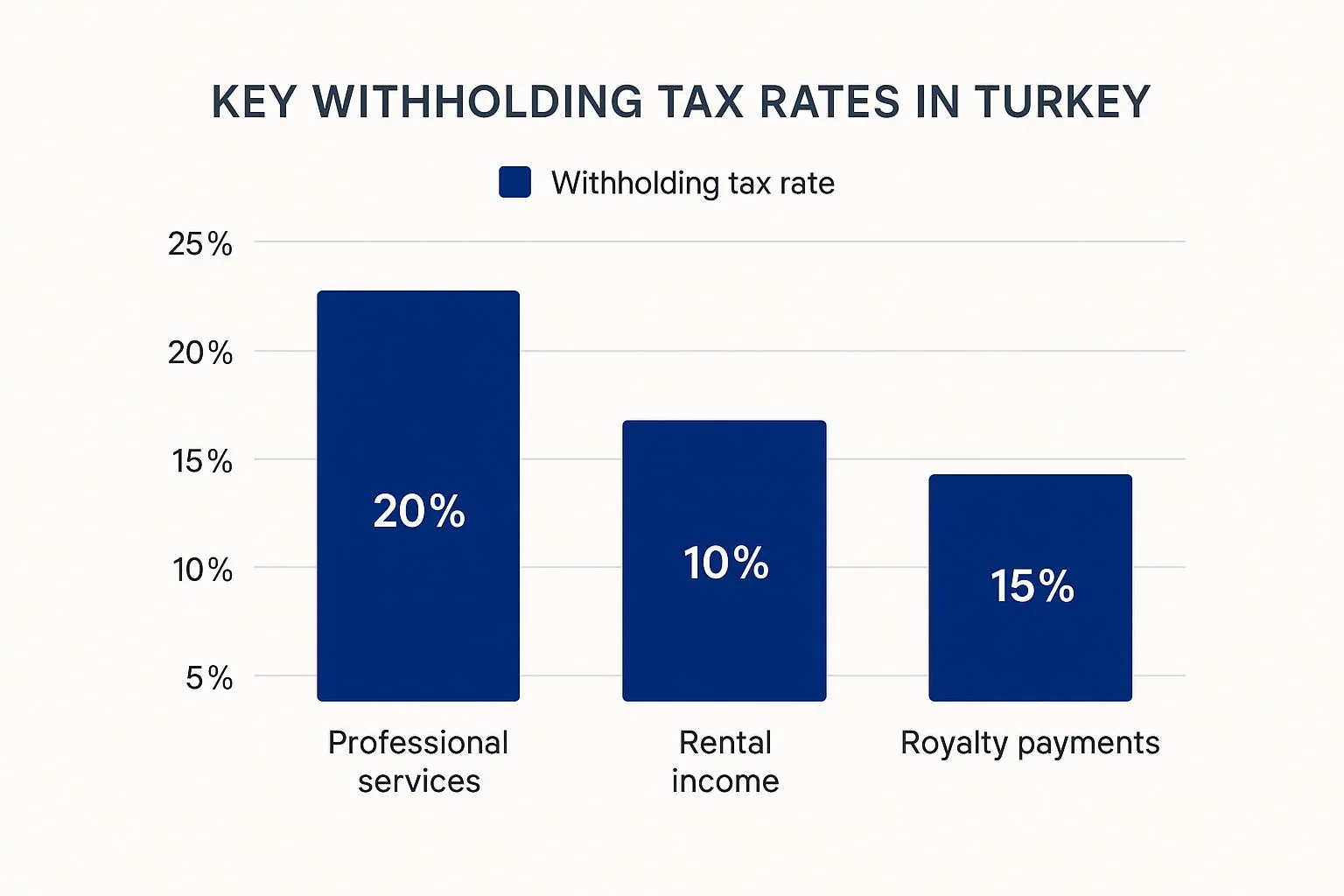
Independent Professional Services: Payments to freelancers, consultants, lawyers, or accountants are subject to a 20% withholding tax. This is probably the one you’ll use most frequently.
Rental Payments: If your business rents a commercial property from an individual landlord, you’ll need to apply a 20% withholding tax on the rent.
Royalty and Licensing Fees: Paying to use intellectual property like patents or trademarks? That typically comes with a 20% withholding tax.
To help you visualise this, here’s a quick overview of how these common rates stack up.
Visual summary of withholding (stopaj) tax rates for common business payments in Turkey.
As you can see, the standard 20% rate for professional services, rent, and royalties keeps things relatively straightforward for these common business expenses.
Let’s summarise these standard rates in a table for easy reference.
Common Withholding Tax (Stopaj) Rates in Turkey
This table provides a snapshot of the standard withholding tax rates for various payments. Just remember, the final rate can be influenced by the recipient’s residency status and any applicable double taxation treaties.
These figures are your starting point for most transactions, ensuring you’re on the right track from the beginning.
The Important Shift in Dividend Withholding Tax
The tax landscape in Turkey is always evolving, and a perfect example of this is the recent change to the dividend withholding tax. This is a big deal for investors and corporations, so understanding it is non-negotiable if you’re distributing or receiving profits from a Turkish company.
The rate used to be 10%, but a Presidential Decree hiked it up to 15%. This 50% increase affects dividends paid to non-resident individuals and entities, as well as any entities exempt from corporate tax. It’s a significant policy shift, showing that the government is adjusting its approach to align with new economic goals, especially for multinational companies.
This increase to 15% for dividends is a critical update for foreign investors. It directly affects the net return on investment and requires careful consideration in any financial forecasting and corporate tax planning.
This rate applies across the board to dividends paid by Turkish companies to non-residents and to domestic entities that are exempt from corporate tax. It really underscores the need to stay on top of legislative changes. To see how this fits into the bigger picture, you can learn more about how these adjustments interact with the overall tax system in our comprehensive guide to corporate tax in Turkey for 2025. Keeping these updated figures in mind ensures your business stays compliant and financially prepared.
How Withholding Tax Works with Investments
If you’re managing financial assets in Turkey, you need to get to grips with how withholding tax applies to your investments. This isn’t just about professional fees or rental income; there’s a whole different set of rules for money earned from financial instruments. Knowing these rules can make a huge difference to your net returns, so it’s a crucial piece of the puzzle for smart financial planning.
The Turkish government often uses investment withholding tax as a tool to guide the economy. By tweaking the rates, it can make certain investments more or less attractive. This means the tax rates on everything from deposit accounts to bonds can shift, which in turn influences how people invest and what the market does.
Visual overview of investment income and withholding tax obligations in Turkey.
Tax on Different Financial Products
Withholding tax rates are not a one-size-fits-all deal; they change depending on the type of financial product. This is a deliberate part of the government’s strategy, allowing it to fine-tune incentives for different parts of the economy. For any foreign entrepreneur or investor, understanding these distinctions is absolutely vital.
You’ll find that income from several common investment types is subject to withholding tax. Here are a few key examples:
Deposit Accounts: The interest you earn on both Turkish Lira and foreign currency accounts in Turkish banks gets hit with withholding tax. The rates often depend on the currency and how long the deposit is locked in for.
Government Bonds and Treasury Bills: These are often given preferential treatment to encourage people to lend money to the government. You’ll sometimes see rates as low as zero during certain periods to attract capital.
Participation Funds: Income from participation accounts, which are common in Islamic banking, is also subject to withholding tax, much like conventional deposit accounts.
Private Sector Bonds: Bonds issued by companies usually have a different withholding tax rate than government securities.
This targeted system means that to successfully invest in Turkey, you have to keep a close eye on the specific rates for the assets you’re interested in.
Using Tax as a Strategic Tool
One of the most interesting things about Turkey’s withholding tax system is how it’s used as a policy tool. The government frequently adjusts the rates to hit specific economic targets, like boosting the amount of cash in the system or encouraging people to save for the long term.
For example, to make government bonds more appealing, especially when the market is a bit shaky, a 0% withholding tax rate has often been rolled out. This incentive gives a direct boost to an investor’s net return, making government debt a much more attractive option compared to other assets.
The key takeaway here is that these tax rates are always on the move. It’s incredibly important to stay up-to-date with the latest Presidential Decrees and legislative changes, because they will directly affect the profitability of your investment portfolio.
On the flip side, rates on other instruments might be pushed up if the government needs to meet its revenue targets. This constant balancing act shows a pretty sophisticated approach to managing the economy while ensuring a steady income for the state.
Recent Changes and What They Mean for You
Turkey has a track record of making timely adjustments to investment withholding tax rates to keep the economy stable. A great example of this was a Presidential Decree that extended reduced tax rates on various types of earnings, including interest and dividends.
Specifically, income from government bonds, treasury bills, and some lease certificates benefited from a 0% withholding tax rate if they were bought within certain timeframes. This move was all about encouraging investment in government debt when the markets were feeling uncertain.
Understanding these shifts isn’t just about staying compliant—it’s about positioning yourself strategically. When you’re aware of the tax incentives and liabilities, you can make smarter decisions that align your financial goals with Turkey’s current fiscal environment.
A Step-by-Step Guide to Filing and Payment
Knowing the different tax rates is one thing, but getting the administrative side right is where the rubber meets the road. To stay compliant in Turkey, you have to master the filing and payment process. It’s the only way to meet your legal duties and avoid any unwanted attention from the tax authorities.
The whole system hinges on one crucial document: the ‘Muhtasar’ tax return. This is your official declaration, where you report all the withholding taxes you’ve collected from others. Think of it as your company’s monthly or quarterly report card to the tax office, detailing every single stopaj you’ve deducted from payments like professional service fees, rent, or royalties.
Filing this return on time isn’t just good practice; it’s a fundamental part of doing business here. It’s how the government tracks and collects these taxes right at the source.
Submitting the Muhtasar Return
The duty to file the Muhtasar return always falls on the payer—that’s you, the company making the payment and withholding the tax. This is a critical point. The responsibility is on your business, not the freelancer, consultant, or landlord you’re paying.
How often you need to file depends entirely on your company’s headcount:
Monthly Filing: If you have more than 10 employees, you’re on a monthly schedule. Your deadline is the 26th day of the following month.
Quarterly Filing: For smaller businesses with 10 or fewer employees, you have the option to file quarterly, which can really lighten the administrative workload.
The return itself asks for specifics, like the recipient’s details, the gross payment, the tax rate you applied, and the final amount withheld. This is where diligent record-keeping pays off. Many businesses also look to automate invoice processing to keep their financial data organised and ready for tax time.
Paying the Withheld Tax
After you’ve filed the return, the final step is to hand over the money to the government. The payment deadline is tied directly to the filing deadline. The total tax you withheld must be paid by the evening of the 26th day of the same month you file the return.
You’ve got a few options for making the payment:
Online through the official tax authority portal.
Directly at authorised public or private banks.
In person at a local tax office (Vergi Dairesi).
Be warned: The Turkish tax authorities don’t take missed deadlines lightly. Failing to file or pay on time can result in penalties, late fees, and interest on the overdue amount. In more serious cases, it could even trigger a full tax audit—a major headache you definitely want to avoid.
Getting into a smooth rhythm with your stopaj obligations is one of the smartest moves you can make. By understanding the Muhtasar return, sticking to the deadlines, and keeping spotless records, you can manage your withholding tax duties with confidence and keep compliance risks to a minimum.
How Double Taxation Treaties Reduce Your Tax Burden
If you’re running a business or investing in Turkey from abroad, one of the biggest financial headaches is the threat of double taxation. Nobody wants to pay tax on the same income twice—once in Turkey and then again back home. This is exactly what Double Taxation Treaties (DTTs) are designed to prevent.
Think of a DTT as a financial rulebook agreed upon between two countries. It sets clear guidelines on which country gets to tax what, ensuring that cross-border trade and investment remain fair and predictable. For you, the foreign entrepreneur, these treaties are your best friend for lowering, and sometimes even completely wiping out, your withholding tax obligations in Turkey.
Bilateral agreements fostering fair international taxation
How Treaties Offer Relief
So, how does this work in practice? The most immediate advantage of a DTT is access to lower withholding tax rates. While Turkey’s standard domestic rate might be 15% on dividends or 20% on royalties, a treaty can cut those numbers down dramatically.
Here’s a look at what a typical DTT might do:
Slash the tax on Dividends from 15% to 10%, or even as low as 5%.
Reduce the rate on Interest Payments from the standard rate to 10% or less.
Bring the Royalty Fee tax down from 20% to a far more reasonable 10%.
These aren’t just small changes; they represent real money back in your pocket. This directly boosts the profitability of your Turkish ventures and improves your overall cash flow.
The whole point of a double taxation treaty is to stop income earned in one country from being unfairly taxed again in another. It’s an incredibly powerful tool for any foreign entrepreneur looking to work more efficiently.
Claiming Your Treaty Benefits
Now for the important part: these reduced rates don’t just happen automatically. You have to actively claim them, and that means proving you’re eligible.
The key is to obtain a Certificate of Residence. This is an official document issued by the tax authorities in your home country that confirms you are a tax resident there. You’ll need to present this certificate to the Turkish company or individual paying you.
Once they have this proof, the Turkish payer is legally allowed to apply the lower withholding tax rate specified in the treaty. If you don’t provide it, they have no choice but to withhold tax at the higher standard Turkish rate. It’s a simple but non-negotiable step to unlock the savings. Remember, combining treaty benefits with other smart financial moves, like using effective tax loss harvesting strategies, can create an even more powerful approach to managing your tax liabilities.
A Few Common Questions About Turkish Withholding Tax
Getting your head around Turkish withholding tax can feel a bit like learning a new language, especially if you’re new to the country. Let’s tackle some of the most frequent questions we hear from foreign entrepreneurs to clear up the confusion and help you move forward.
Think of this as a quick-reference guide for those “what if” moments.
Who Is Actually Responsible for Paying This Tax?
This is probably the most important thing to get right. In Turkey, the legal responsibility to calculate the tax, hold it back, and pay it over to the government always falls on the person or company making the payment—the withholding agent. It’s not the responsibility of the person receiving the money.
So, if your Turkish company pays a local freelancer or your office landlord, it’s on you to handle the stopaj. The person you’re paying simply gets the net amount after the tax has been taken care of at the source. It’s a core principle of how the system is designed.
As a Foreigner, Can I Get an Exemption?
Yes, you absolutely can, but it doesn’t happen automatically. For most non-residents, the best route to a lower (or zero) withholding tax rate is through a Double Taxation Treaty (DTT) that Turkey has with your home country.
To take advantage of a treaty, you need to follow these steps:
First, check if a treaty actually exists between Turkey and your country of tax residence.
Next, get a Certificate of Residence from the tax authority in your home country. This is your proof.
Finally, give this certificate to the Turkish business that is paying you before they make the payment.
If you don’t provide this proof, the payer has no choice but to apply the standard, much higher domestic tax rates.
Are the Withholding Tax Rates in Turkey Always the Same?
It’s a mixed bag. The rates for common payments like professional services and rent tend to be quite stable. However, when it comes to financial investments, things can change quickly. The Turkish government often adjusts withholding tax rates on income from financial products to manage the economy and keep investors engaged.
For example, rates on deposit accounts and participation funds were recently increased, while at the same time, the 0% withholding tax on income from Treasury bills and government bonds was extended. You can read more about these kinds of policy changes on kpmg.com.
This means anyone with investments in Turkey really needs to keep an eye on the latest Presidential Decrees. These changes can directly affect your bottom line.
What Happens If I Mess Up?
Mistakes with withholding tax—like filing late or paying the wrong amount—can unfortunately be costly. The Turkish tax authorities don’t take it lightly and can issue fines, charge interest for late payments, and in more serious situations, even launch a full tax audit of your business.
The best defense is a good offense. Keep your records spotless, make sure you understand exactly what’s required for the Muhtasar return, and be obsessive about meeting deadlines. Being proactive about compliance is always, always the smartest move.
Navigating Turkish tax law requires a sharp eye and local knowledge. At Workon, we handle all the details, from setting up your company to keeping you compliant, so you can put your energy into what you do best: growing your business. Let our team of pros take the complexity off your plate. Start your journey with Workon today.
Withholding tax in Turkey is a system where tax is deducted at the source when payments such as rent, services, or dividends are made.
The payer (company or individual making the payment) must withhold tax and remit it to the Turkish tax authorities.
Common rates include 20% on freelance services, commercial rent, and royalties, and 15% on dividends paid to non-residents.
Turkey’s double taxation treaties can reduce withholding tax rates for foreign investors, sometimes as low as 5% with a residency certificate.
Companies file a Muhtasar return monthly or quarterly (depending on employee count) and pay withheld taxes by the 26th of the following month.
Subscribe to Newsletter
Be notified of the latest news in the business world quickly