Starting a Real Estate Agency in Turkey: Legal, Licensing & Market Guide
15.12.2025
You are considering starting a real estate agency business which operates in Turkey. The process of creating a business plan and selecting office locations requires you to understand the fundamental aspects of the Turkish real estate market. The environment operates as a fast-paced high-risk system which requires you to learn its specific operational rhythm to achieve success.
The evaluation process requires researchers to analyze information which extends past the assessment of national statistics. To build a resilient business, you need to analyse regional trends, from the sky-high prices in Istanbul to the very different value propositions you’ll find in other major cities. The basic understanding which exists between these two entities makes the difference between an agency that succeeds and one that faces challenges.
The Turkish property market contains multiple conflicting elements which make it difficult to understand. It’s not a single, monolithic market. The area contains distinct ecological zones which maintain their natural cycles yet experience various environmental dangers and offer unique benefits. Falling into the common trap of just looking at national average price increases can be incredibly misleading for newcomers.
A successful agency needs to provide authentic specialized knowledge which meets the requirements of its local business clients. The analysis requires researchers to study the fundamental reasons which cause Istanbul’s Şişli district properties to operate independently from Antalya coastal properties and Ankara capital properties. Your ability to understand these subtle elements will develop into your most important skill which you will use to guide clients and build your real estate investment collection.
The Tale of Three Cities: Market Dynamics
The Turkish property market shows two opposing market trends because property values keep increasing while various market conditions impact different areas of the market. Nationally, the average house price has pushed past 3 million Turkish Lira, and the cost per square metre often hovers around 40,000 TRY.
The statistics reported in the study do not show the entire extent of the situation.
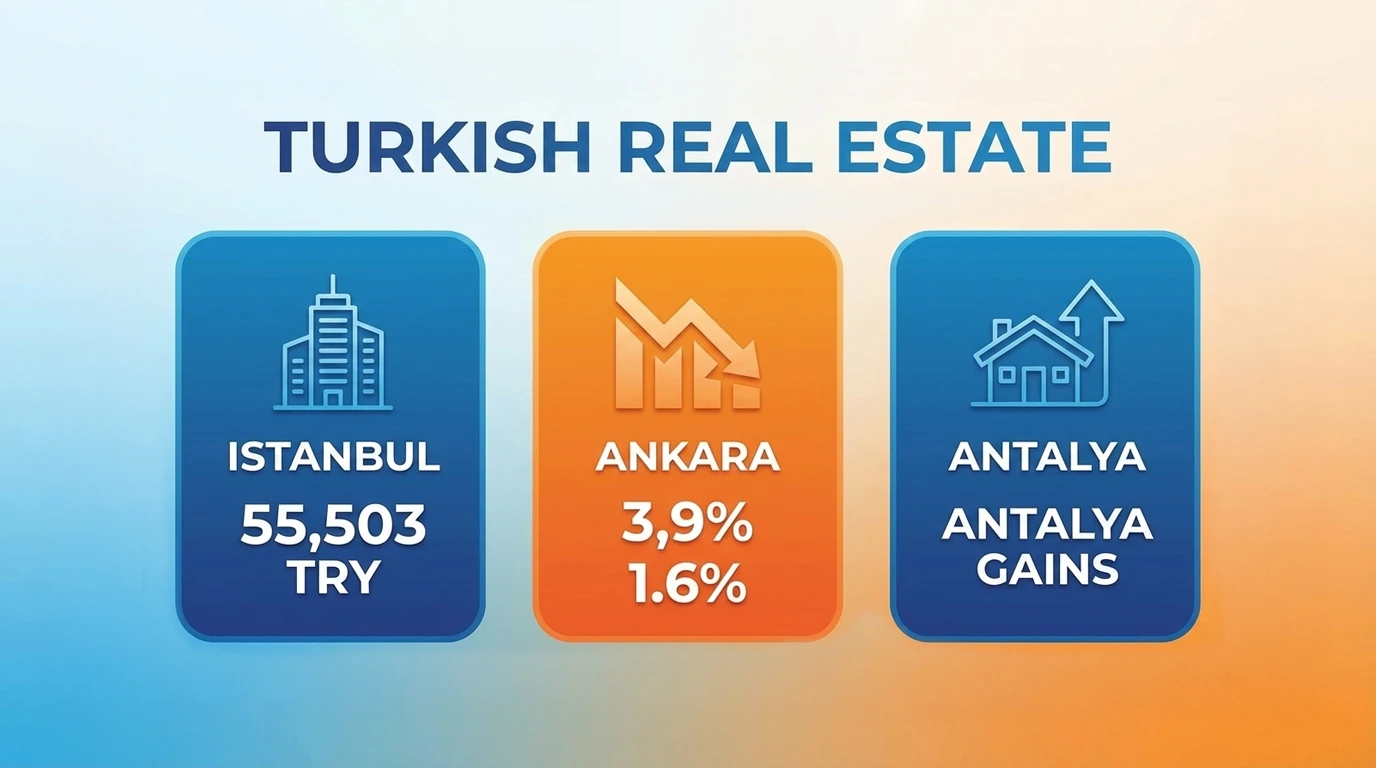
The economic center of Turkey which is Istanbul maintains housing costs at 55,503 TRY/m². However, look closer at cities like Ankara and Izmir. While they’ve seen nominal annual growth of 36.6% and 29.6% respectively, once you factor in inflation, their real-term prices have actually dropped by 3.9% and 8.8%. The Antalya coastal market shows sustainable market expansion because it attracts customers who live in Antalya as well as those who move from outside the region.
The infographic shows vital price data and market patterns which enable you to grasp the Turkish real estate market dynamics in its major cities.
A comparison of property prices and real-term growth trends in Istanbul, Ankara, and Antalya
The market value of Istanbul remains high according to the data but business growth in the city does not guarantee success for all businesses. The inflation-adjusted values in Ankara markets have decreased which agents need to understand for their business operations.
A quick look at the core data gives you a snapshot of the current environment you’ll be navigating.
Key Market Indicators at a Glance
Metric
Recent Figure or Trend
National Average House Price
Exceeds 3 million Turkish Lira
Average Price per Square Metre
Approximately 40,000 TRY
Istanbul Price per Square Metre
55,503 TRY (highest in the country)
Ankara Real-Term Price Change
-3.9% (adjusted for inflation)
Izmir Real-Term Price Change
-8.8% (adjusted for inflation)
Foreign Buyer Interest
Strong, particularly in coastal areas and Istanbul
The statistics demonstrate why analysts need to examine numbers which appear at first glance because they do not reveal the actual state of each regional market.
Economic Factors Shaping the Market
Several powerful economic drivers are constantly influencing property values and demand in Turkey. Your ability to predict market changes will improve through monitoring these indicators which will enable you to provide clients with reliable investment guidance.
Inflation and Interest Rates: Historically, high inflation has pushed people to invest in real estate as a safe haven, driving prices up. At the same time, high-interest rates can make mortgages less affordable, which can cool down demand from domestic buyers. It’s a constant balancing act.
Foreign Investment and Currency Fluctuations: The Turkish Lira shows major value shifts when it makes transactions with US Dollar and Euro currencies. The weaker Lira value creates an attractive buying opportunity for international property investors who mainly purchase coastal properties and luxury Istanbul real estate. If you’re new to the country, you may find our guide to investing in real estate in Turkey as a foreigner helpful.
Government Policies and Incentives: Programmes like the “Citizenship by Investment” scheme have been a huge catalyst for foreign purchases. You have to stay updated on these policies, as any change can have a direct and immediate effect on specific segments of the market.
Key Takeaway: Thriving in Turkish real estate isn’t just about the art of the sale. It’s about interpreting economic signals and regional data to provide expert, value-driven advice. Your ability to see beyond the nominal price tags to understand the real value is what will build long-term client trust and set your agency apart from the competition.
Getting Your Business on the Books: The Legal Nitty-Gritty
Before you can even think about listings and clients, you need to turn your idea for a real estate agency into a real, legal business. Getting this right from the start saves you massive headaches down the road. This is the part where you officially register your company and lay the groundwork for everything that follows in the Turkish market.
Your first major business choice will determine which business entity you should establish. For most people jumping into the Turkish real estate scene, it boils down to two main options: a Limited Liability Company (LTD) or a Sole Proprietorship. The three options have their own rules which determine your personal risk exposure and tax obligations and business expansion potential.
Your Company Structure: LTD or Sole Proprietorship?
The go-to choice for a serious real estate agency is the Limited Şirket (LTD), or Limited Liability Company. A corporation exists as an independent legal entity which operates under its own legal framework. Your business financial resources remain separate from your individual wealth assets through the established framework which serves as a vital protection mechanism. Your personal savings together with your car and home stay safe from financial problems that affect the agency.
The alternative is a Şahıs Şirketi, or Sole Proprietorship. It’s much quicker and cheaper to set up because, legally speaking, the business is you. The system faces its most critical threat through this method. There’s no separation. Your personal debt payment responsibility will directly result from the financial duties which the company needs to fulfill.
I always suggest choosing the LTD business structure because it provides the best options for businesses that want to expand their operations through team hiring. The peace of mind which results from protecting your personal assets makes the additional setup expense worthwhile.
Official documents and digital systems involved in registering a real estate company in Turkey
Still on the fence?The following table provides a fast comparison to assist you in your decision process.
Feature
Limited Liability Company (LTD)
Sole Proprietorship
Personal Liability
Protected. A clear line separates your personal assets from business debts.
Unlimited. You’re personally on the hook for every last lira the business owes.
Credibility
Higher. Banks, clients, and partners see an LTD as a more stable, serious venture.
Lower. It’s often viewed as a smaller, one-person show.
Taxation
A straightforward, flat corporate tax rate is applied to your profits.
Your business income is taxed at progressive personal rates, which can climb much higher.
Growth Potential
Built for growth. It’s easy to bring in partners, sell shares, or attract investors.
Very limited. It’s much harder to transfer ownership or formally add partners.
Setup Cost & Time
More expensive and takes a bit longer, usually 1-2 weeks.
Cheaper and faster, often set up in just a few days.
The Registration Checklist: Getting It Done
The selection of your structure requires you to create an official document. The registration process in Turkey involves a series of steps and paperwork with a few different government bodies. You have to get your documents in order and follow the process to the letter to stay on the right side of the law.
The following steps describe the typical path which people follow.
Drafting the Articles of Association: This is your company’s rulebook. The document explains what your business operations consist of and who your partners are and how the company operates and the structure of your share capital. You’ll need official documents like a Memorandum of Association template to get this done for registration.
MERSIS System Registration: You’ll submit your Articles of Association online through the Central Registration System, known as MERSIS. The organization needs to visit this location to obtain its special identification number.
Getting a Tax ID Number (Vergi Numarası): You and any partners will need to head to the local tax office (Vergi Dairesi) to get a potential tax ID.
Depositing Your Capital: You have to deposit a portion of your company’s capital into a new business bank account. The minimum for an LTD is 10,000 TRY, but I’d suggest putting in more to build credibility.
Registering with the Chamber of Commerce (Ticaret Odası): This is the final step. Once all your paperwork is approved, you register with the local Chamber of Commerce, and just like that, your company officially exists.
Meet Your Most Important Partner: The Mali Müşavir
You need to understand that you will not succeed by yourself. Turkish law requires you to work with a certified public accountant, or Mali Müşavir. The person brings more value than their numerical skills because they will lead you through all the complex administrative procedures.
Your Mali Müşavir will handle the company registration from start to finish. The service will process your tax declaration through monthly submissions while generating official financial reports and keeping you informed about upcoming regulatory changes. Choosing an experienced and trustworthy accountant is arguably one of the most critical decisions you’ll make. The organization requires these employees to prevent expensive errors while maintaining its tax authority endorsement.
How to Get Your Real Estate Licence in Turkey
So, you’ve officially registered your company. Great. The real estate licensing process leads to your official recognition as a licensed professional under state law.
In Turkey’s tightly regulated property market, you can’t just open your doors and start trading. Your business will die before it begins when you operate without proper authorization because this practice violates both legal standards and professional conduct. The legal framework which enables business operations exists in this section.
The golden ticket here is the Real Estate Agent Authorisation Certificate, known in Turkish as the Taşınmaz Ticareti Yetki Belgesi. The document functions as official proof which the Ministry of Trade issues to verify your compliance with national standards. Think of it as your passport to the Turkish property world.
What You’ll Need for the Authorisation Certificate
The certificate serves to check off particular requirements which need to be met. The government has put these rules in place to professionalise the industry and, frankly, to protect buyers and sellers from unqualified players.
First off, the basics. Your agency must be a legally registered business, which we’ve already covered. You and any partners will also need a clean criminal record, particularly concerning financial crimes. The foundation of this system proves your company operates as a reliable business which customers can depend on starting from the first day of operation.
But the real test of your ability comes next.
Simplify your business setup with Workon’s all-in-one company registration service in Turkey.
Passing the Professional Competency Exam (Seviye 5)
To get your Authorisation Certificate, your agency’s designated manager must pass the Vocational Qualification Exam Level 5 (Mesleki Yeterlilik Sınavı Seviye 5). Don’t underestimate this exam. The test serves as a formal assessment which verifies your ability to understand market operations through its technical and legal and ethical aspects.
This isn’t a formality. It’s a comprehensive assessment covering the pillars of the real estate business in Turkey:
Legal Regulations: You need to know Turkish property law inside and out, from the title deed (TAPU) process to the specific rules for foreign buyers.
Valuation Principles: The exam will test your ability to accurately assess a property’s worth based on market trends, location, condition, and other critical factors.
Marketing and Sales: It covers ethical and effective ways to market listings and manage relationships with your clients.
Contract Law: A huge part of the exam focuses on how to correctly draft and execute sales and rental agreements.
The Vocational Qualifications Authority (Mesleki Yeterlilik Kurumu – MYK) stands as your top selection for training enrollment at an approved training facility. These locations provide students with specialized test preparation which leads to higher success rates during their initial attempt. Nailing this exam is a major milestone in starting a real estate agency in Turkey.
For foreign nationals running their own agency, having the legal right to work is obviously crucial. This process runs alongside your business licensing. You can get the full picture by checking out our guide on how to get a Turkish work permit.
Why You Should Join the Chamber of Realtors
The Ministry of Trade requires all agents to obtain its certificate but I recommend all new agents to join the local Chamber of Realtors (Emlakçılar Odası) after obtaining their certificate.
Technically, this isn’t a legal requirement for your licence. But from a business perspective?It’s a game-changer.
These chambers are the heart of the professional real estate community in every city. Joining one plugs you directly into a network of experienced agents, developers, and other industry insiders. It’s an incredible source for referrals, market intel, and finding people to collaborate with.
Membership also typically gives you access to:
Exclusive market data and area reports
Ongoing training seminars and workshops
Mediation services if you ever run into a dispute
Being a member of the local Emlakçılar Odası sends a powerful signal to potential clients. Your commitment to professional standards becomes evident through this code of ethics which distinguishes you from other competitors who lack your level of experience.
You have now overcome all legal obstacles which have led to your receipt of the license. The first step of business development requires entrepreneurs to establish their company. The operational and marketing engine which will propel your agency into success emerges from this stage which transitions you from dealing with documents to working with people and real estate assets.
The correct implementation stands as a vital requirement. A solid plan for your day-to-day operations and how you’ll get your name out there is what separates a successful launch from a business that fizzles out. The process requires three fundamental steps which involve creating an ideal workplace environment and choosing suitable team members and creating successful marketing plans for Turkey’s busy real estate sector.
Modern tools and systems used by professional real estate agents connected through industry organisations
Setting Up Your Operational Core
Your agency depends on its daily operations to serve as its core operational base. The entire structure will start to deteriorate when the foundation loses its ability to maintain stability. It all starts with where you’ll work. The location of your office should be either a modern high-end building in a well-known business area or a cost-effective serviced office space which provides both professional appearance and simple client accessibility.
Your most important resource will be technology because it will provide you with more value than your physical office environment. A CRM system which functions well serves as an absolute requirement for businesses. This is where you’ll manage absolutely everything – from property listings and client contacts to viewing schedules and tracking deals as they progress.
You can find plenty of CRM options, from local Turkish solutions built for this market to bigger international platforms. The search requires a system which performs automated work on small tasks while maintaining lead memory and providing instant access to sales pipeline information.
Your first hires are just as critical as your tech. Don’t just look for slick salespeople. You should look for agents who possess deep knowledge about the local real estate market and who operate in the business environment you prefer. A small team which works well together will outperform a big group that lacks coordination.
Expert Tip: The agent recruitment process needs to start with candidates who understand the local area and show outstanding communication abilities to work with people from the local community. An agent who can move between Turkish and English and Russian and Arabic languages will bring a complete transformation to your property search for international home seekers.
Crafting a Winning Digital Marketing Strategy
Your digital presence serves as the main source which produces new leads for this specific market. A professional website which users can navigate easily serves as the beginning point. Your virtual office operates as a permanent online presence which functions as your virtual office to generate continuous sales throughout the day.
From day one, your website needs to be built with search engine optimisation (SEO) in mind. Your research needs to identify which particular search terms your target audience enters into Google when performing searches like “apartments for sale in Antalya” or “luxury villas in Bodrum.”Writing helpful blog posts that answer common questions about buying property in Turkey is another fantastic way to pull in traffic from people who are actively looking to buy.
The Turkish residential market shows ongoing market activity because its market growth persists even though homebuyers must handle expensive mortgages together with increasing property costs. Home sales reached their highest point of the year when the market recorded 143,319 units in one month which represented a 6.8% annual sales increase. The city of Istanbul started the sales trend with 21,814 transactions while Ankara followed with 12,419 sales and Izmir brought up the rear with 7,695 transactions. These numbers prove just how much opportunity is concentrated in the major cities, and your marketing needs to tap directly into that demand. You can get more insights into Turkey’s hot housing market on Daily Sabah.
Dominating Turkish Property Portals
While your own website is key for building your brand, you simply can’t afford to ignore the sheer power of Turkish property portals. Platforms like Sahibinden.com and Hepsiemlak are the first stop for the vast majority of property hunters in Turkey. You have to be there, and you have to stand out.
But just uploading a listing isn’t enough. Here’s how you make an impact:
Invest in Great Photography: Don’t skimp here. The combination of professional photos with video tours produces higher click rates which drives more customer interest.
Write Compelling Descriptions: Craft clear, persuasive copy in both Turkish and English. Point out the unique features, the local coffee shop, the investment potential—paint a picture for the buyer.
Be Incredibly Responsive: Speed is everything. When an inquiry comes through from a portal, the first agent to respond often gets the client. Set up instant notifications so you’re always ready.
These portals are a battleground for attention. Your listings need to be sharp, professional, and consistently updated to stay visible.
Leveraging Social Media for Brand Building
Finally, don’t underestimate social media for showing off properties and creating a real community around your brand. For real estate in Turkey, nothing beats Instagram for visual appeal.
Use Instagram to share stunning photos and short video reels of your best listings. But think beyond just property shots. Tell the story of the lifestyle that comes with the home or the neighbourhood. The platforms Facebook and LinkedIn enable you to develop targeted advertising campaigns which direct messages to two particular audience segments consisting of foreign investors and local families who want to enhance their residential properties.
The key to social media is engagement, not just posting. You should use your platform to answer questions from your followers while asking them for their input and by sharing important market information which proves useful to your audience. Your agency needs to follow this method to become recognized as a dependable authority.
Mastering Client Acquisition and Property Sales
Your agency obtained all necessary licenses and you completed all legal requirements so your office can start operations. The work begins at this point because I need to locate business prospects and finish their commercial agreements. This is the moment where all your market research and sales instincts need to kick in to start generating revenue. Frankly, your ability to master the sales cycle in Turkey’s fast-paced market will make or break your agency.
Your clients will present themselves with individual characteristics which will differ from one another. One day you could be helping a young Turkish family find their first apartment, and the next you’re on a call with a high-net-worth investor from Dubai looking for a luxury Bosphorus villa. Then there are the international clients seeking property as part of their Turkish citizenship application. The three individuals maintain distinct objectives and communication methods while having different expectations from their interactions.
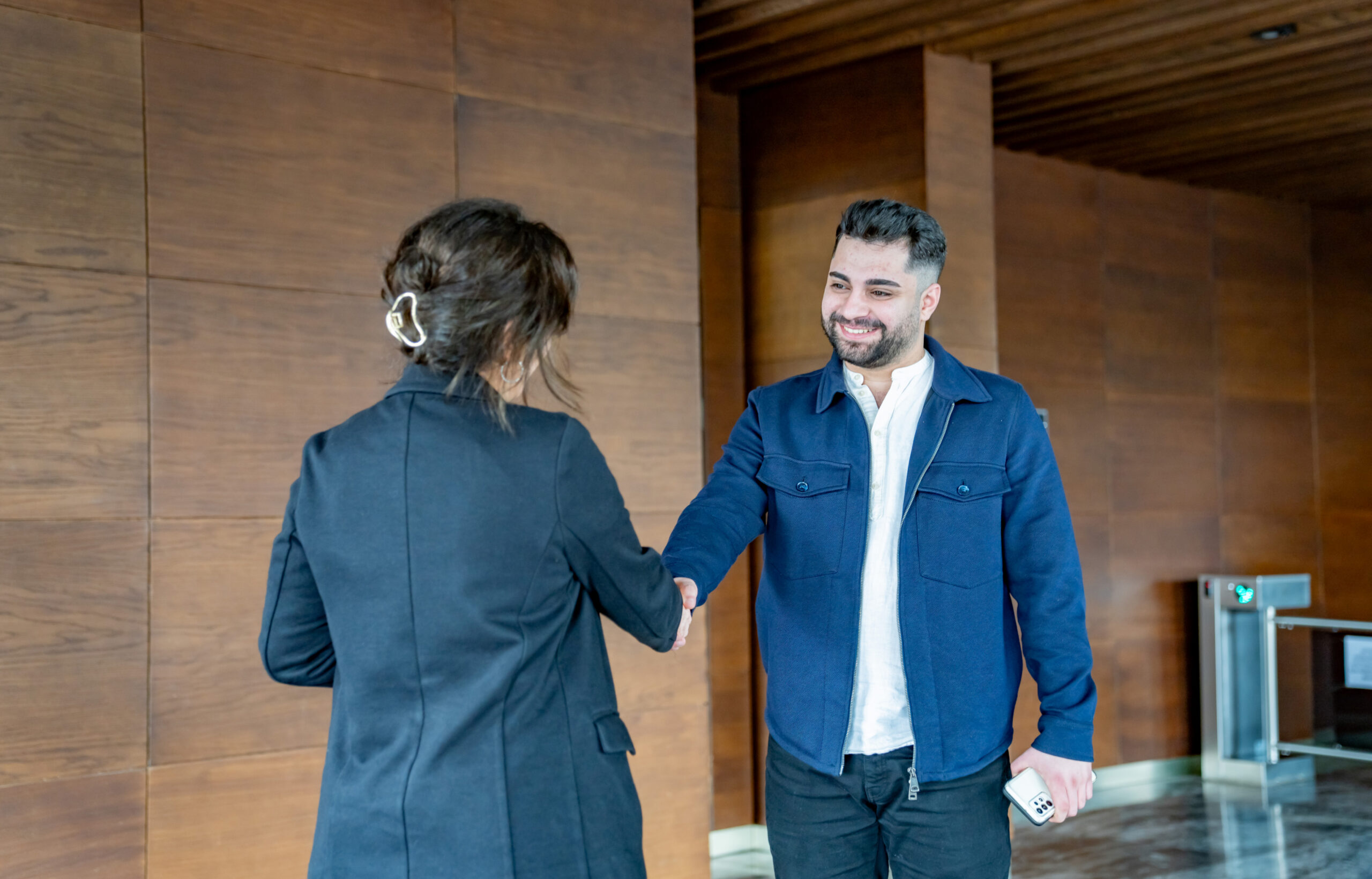
A real estate agent finalising a successful property transaction with clients in Turkey
Your success hinges on being able to adapt to these different profiles. A professional image which is polished must be established right away because it serves as the foundation for gaining customer trust. Spend some time on building a winning real estate agent profile; it’s a small investment that pays off big time.
Building Your Property Portfolio
You need to possess something before you can start selling it. The process of building an attractive property collection requires ongoing effort because it needs effective networking abilities to succeed. You need to build solid relationships with local property developers because they will serve as your future business partners. This is your ticket to getting inside access to new projects, often before they’re even listed publicly.
Don’t forget the individual property owners, either. Many of the most charming and valuable properties, especially in sought-after, established neighbourhoods, are sold by private individuals. When you build a reputation as an honest, effective agent, these sellers will start coming to you.
Navigating the Turkish Property Transaction
The Turkish property market operates through a structured system which outlines the complete process of real estate transactions. Knowing every stage inside and out is absolutely critical so you can guide your clients confidently from that first viewing all the way to handing over the keys.
Here’s a breakdown of the key stages you’ll manage:
Initial Viewings and Negotiation: This is where your matchmaking skills shine. You’ll connect your client’s wish list to your portfolio and then step into the delicate dance of negotiation to land on a price and terms that work for everyone.
Handling the Deposit (Kapora): Once a price is agreed, the buyer puts down a deposit to secure the property. This is a crucial sign of commitment that takes the property off the market.
Preparing the Sales Agreement: Often, a preliminary sales agreement, or Satış Vaadi Sözleşmesi, is drafted. While it’s not the final title transfer document, it formalises the terms and is a standard part of the process.
Conducting Due Diligence: This is where you really earn your client’s trust. You’ll be responsible for verifying the property’s title is clean, confirming there are no outstanding debts or liens, and making sure all permits are in order.
Crucial Insight: Working with foreign buyers involves a few extra, mandatory steps. You’ll need to arrange for a sworn translator to be present at the title deed office. You also have to secure an official property appraisal report (ekspertiz raporu) to verify the property’s market value. This is not optional.
The Final Step: The TAPU Transfer
The climax of every deal is the transfer of the title deed, known as the TAPU. This is the single most important document, as it’s the official proof of ownership. This final, formal step takes place at the local Land Registry and Cadastre Directorate (Tapu ve Kadastro Genel Müdürlüğü).
Both the buyer and the seller (or their representatives with a power of attorney) must be there in person. After all the necessary taxes are paid and the paperwork is signed, the new TAPU is issued in the buyer’s name. The entire process of the transaction has reached its final stage. It’s the moment all your hard work pays off, and your client officially becomes a property owner in Turkey.
Your Top Questions About Opening a Real Estate Agency
Do you plan to invest in Turkish real estate properties?You’ve probably got a lot of questions. That’s a good thing. The solutions I have created enable people who experience similar circumstances to obtain answers for their frequently asked questions. We need to address the three essential matters which include financial issues and property rights and time management.
What’s the Real Minimum Capital I Need to Start?
The Turkish government enables businesses to register as Limited Liability Company (LTD) through a minimum share capital requirement of 10,000 TRY. The approach you have described will produce unimportant results.
The initial capital for your business should be at least 100,000 TRY according to my personal experience. Why?The requirement exists to serve a purpose which extends past the minimum legal requirements. The bigger investment will enable you to pay for your initial office costs during the first few months and it will also pay for your licensing expenses and support your initial marketing efforts. The main advantage of this system shows banks and upcoming business associates that your organization handles business matters with expert-level seriousness. It builds immediate credibility.
If you go the sole proprietorship route, there’s no official minimum. Your business needs to maintain cash reserves which will support all operational expenses during its initial month of operation.
Can a Foreigner Own 100% of a Real Estate Agency in Turkey?
Yes, absolutely. International entrepreneurs find the opportunity to be one of the main reasons they choose to operate in this market. Turkey’s investment laws are incredibly welcoming, allowing for 100% foreign ownership of an LTD. Your company will maintain full control over its operations because you do not need to find a Turkish business partner.
To get started, you’ll just need a potential tax ID number. And if you plan on running the show yourself while living in Turkey, you’ll also need a work permit. The entire process is designed to be quite friendly for international investors.
Key Insight: Being able to own your company outright is a massive advantage. It keeps your management structure simple and ensures all the profits—and decisions—stay with you. It’s your business, through and through.
How Long Does This Whole Setup Process Actually Take?
You should probably budget for about four to eight weeks from start to finish. The process of company registration turns out to be fast because it typically takes only one to two weeks to complete.
The following period requires completion of vital tasks which need to be finished. Getting your mandatory Real Estate Agent Authorisation Certificate involves paperwork and passing an exam, which doesn’t happen overnight. The process requires you to locate appropriate office facilities while you establish business banking accounts and handle all necessary administrative tasks. A two-month planning period helps you maintain control over your workload while preventing you from rushing through the launch process.
The process of understanding new country laws and official procedures appears as an endless complex system. At Workon, we’re experts at making this process straightforward. Our team takes care of all necessary steps from business registration to permit acquisition so you can concentrate on developing your real estate business. Start your business journey in Turkey with Workon today.
Yes. You must obtain the Taşınmaz Ticareti Yetki Belgesi (Real Estate Agent Authorisation Certificate) from the Ministry of Trade, which requires passing the Level 5 vocational competency exam.
Yes. Foreigners can own 100% of a Turkish real estate agency through a Limited Liability Company (LTD) without a Turkish partner, provided they meet licensing and work permit requirements.
The legal minimum capital for an LTD is 10,000 TRY, but most successful agencies start with at least 100,000 TRY to cover office rent, licensing, and marketing costs.
The full process typically takes 4–8 weeks, including company registration, licensing, exam completion, and operational setup.
Istanbul offers the highest transaction volume, while Antalya attracts strong foreign demand. The best location depends on your target clients, budget, and market strategy.
Subscribe to Newsletter
Be notified of the latest news in the business world quickly