









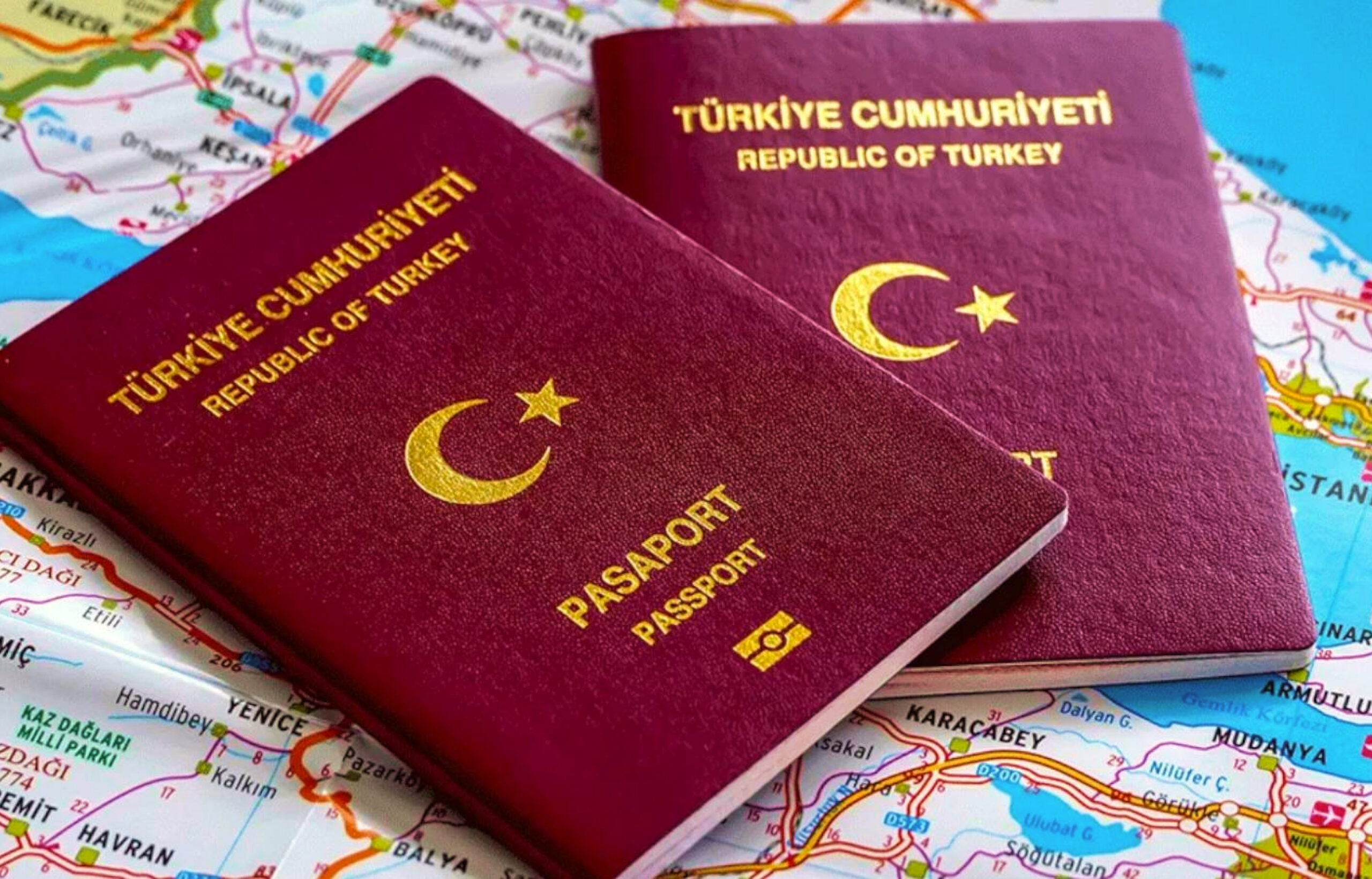









Most foreign nationals need a valid work permit or a recognised work-permit exemption before they start working in Turkey. For an ordinary employee, the Turkish employer normally sponsors a fixed-term permit through the Ministry of Labour and Social Security’s e-İzin system. A residence permit by itself does not authorise employment.
Last reviewed: 22 October 2026. The Ministry’s current 2026 criteria, including the changes effective from 3 August 2026, were rechecked. Permit rules, salary floors, fees and sector exceptions can change; verify the live official pages before filing.
| Question | Short answer |
|---|---|
| Who files? | For ordinary employment, the employer completes the work-permit filing; an overseas case begins with the foreign national at a Turkish embassy or consulate. |
| Can the person work while the first application is pending? | Do not allow productive work unless another valid legal basis already authorises it. The permit or exemption is generally required before work begins. |
| How long is the first permit? | A fixed-term first permit may be issued for up to one year and cannot exceed the employment or service-contract period. |
| Is the permit portable? | An ordinary fixed-term permit is tied to the stated employer, job and workplace/address. A different employer requires a new application. |
| Official decision time? | The Ministry states that a duly completed application is evaluated within 30 days when the information and documents are complete. |
| Does it replace a residence permit? | Most fixed-term, permanent and independent permits do during validity; special protection-status permits are important exceptions. |

The correct route depends on where the applicant is, who will employ them and what work they will perform.
Choose the correct Turkey work-permit route
| Situation | Likely route | First control |
|---|---|---|
| Foreign national hired by a Turkish employer | Employer-sponsored fixed-term work permit | Confirm the job is open to foreign nationals and test employer, wage and sector criteria. |
| Applicant already in Turkey | Domestic e-İzin application | The ordinary route requires a residence permit issued for at least six months and still valid on the application date; limited legally present categories may qualify without it. |
| Applicant outside Turkey | Overseas work-visa and work-permit process | The applicant obtains a 16-digit reference number from the Turkish mission; the employer then files through e-İzin. |
| Person working on their own account | Independent work permit | Do not describe this as an automatic freelance permit; the Ministry evaluates qualifications, activity, investment and economic/employment contribution. |
| Highly qualified professional or investor | Turquoise Card | Eligibility is selective and policy-based; it is not the ordinary employee route. |
| Short or specially defined activity | Possible work-permit exemption | Match the activity and duration to an Article 48 exemption and complete any required e-Muafiyet filing. |
| Foreign shareholder, director or active company owner | Owner/partner-specific analysis | Separate passive ownership from active work or management; use the company-owner work-permit guide. |
A tourist stay, visa exemption, residence permit or business visa for meetings is not a substitute for work authorisation. “Remote,” “voluntary,” “trial” or “unpaid” labels also do not create an exemption by themselves. Check the activity against the official exemption list before the person performs services in Turkey.
Run the employer and job eligibility test first
Do not begin with document uploads. First establish whether the job, workplace and proposed wage can pass the live evaluation criteria. The general 2026 criteria for workplaces using the balance-sheet basis include:
- Employment: generally at least five Turkish citizens at the workplace for each foreign employee application.
- High-turnover relief: a workplace with at least TRY 50 million of prior-year net sales is exempt from the employment criterion for up to five foreign employees.
- New workplace financial test: at least TRY 500,000 paid-in capital where the workplace was established in the most recent financial year and has no year-end statements yet.
- Operating workplace financial test: at least one of TRY 500,000 paid-in capital, TRY 8 million net sales or USD 150,000 exports.
- Role-based wage: the declared remuneration must meet the multiple of the current gross minimum wage assigned to the job category.
These are general criteria, not a universal checklist. Information technology, education, health, domestic work, aviation, tourism, high-tech, public projects and other industries have specific rules or reliefs. Some regulated roles require a prior permit from the relevant authority. Some professions are reserved to Turkish citizens and cannot be cured by paying a higher salary.
Information technology roles: employment and financial criteria can be waived
Under the Ministry’s current criteria, workplaces operating in the information technology sector are assessed without the employment and financial eligibility criteria for specialist roles such as software development, database expertise, mobile software, system/network security and enterprise architecture. At workplaces outside the IT sector, the same relief applies to these specialist roles for up to two foreign workers. The role still needs to fit the listed specialist category, and other applicable requirements remain.
Important domestic-application relief effective 3 August 2026
For a domestic application concerning a foreign national who has legally resided in Turkey for at least one year during the previous three years under a work permit, residence permit or international-protection status, the Ministry states that the employment and financial criteria generally are not applied for up to three qualifying foreign employees. In that workplace, the number of foreign employees covered by this relief must not exceed the number of Turkish citizens.
This relief leaves the salary criterion and applicable sector-specific rules in place. The fourth and later qualifying foreign employees are tested under the ordinary employment and financial criteria unless another rule applies.
Calculate the minimum declared salary by role
The Ministry expresses the salary test as a multiple of the gross minimum wage effective on the application date. Using the 2026 monthly gross minimum wage of TRY 33,030, the current reference points are:
| Role category | Minimum multiple | 2026 monthly gross reference |
|---|---|---|
| Senior executives and pilots | 5× | TRY 165,150 |
| Engineers and architects | 4× | TRY 132,120 |
| Other managers | 3× | TRY 99,090 |
| Jobs requiring expertise or mastery | 2× | TRY 66,060 |
| Domestic work and other professions/jobs | 1× | TRY 33,030 |
The job title, duties, contract and payroll commitment must tell the same story. A label chosen only to reach a lower multiplier creates a credibility and payroll-compliance risk. See the separate Turkey minimum-wage and employer-cost guide for the current statutory floor; recheck both official figures on the filing date.
Apply from within Turkey or from abroad
Domestic application
Under the ordinary domestic route, the foreign national must have a Turkish residence permit issued for at least six months and still valid on the work-permit application date. The relevant employer applies through e-İzin. The Ministry also permits certain foreign nationals who are legally present and designated by the Directorate General to apply without a valid residence permit; do not assume that exception applies without confirming the person’s status.
Application from abroad
- The foreign national applies in person for a work permit/work visa at the Turkish embassy or consulate general in the country of citizenship or legal residence.
- The mission issues a 16-digit reference number.
- The applicant sends that number to the Turkish employer.
- The employer completes and electronically signs the Ministry filing through e-İzin using the reference number.
- After approval and payment, the applicant completes the consular visa step and enters Turkey within the permitted period.
The employee and employer stages form one file. A mismatch in employer name, role, wage, passport details or dates can stop the process. Track the consular and e-İzin steps together rather than treating the visa as a separate substitute for the permit.
Build one evidence file before submission
The Ministry’s general document list includes the following, with additional evidence for some roles and sectors:
- employment contract signed by the employer and foreign national;
- passport copy, plus a certified Turkish translation if the passport is not in Latin characters;
- diploma or temporary graduation certificate with certified Turkish translation where required;
- current Turkish Trade Registry Gazette showing capital and ownership structure;
- prior-year balance sheet and profit-and-loss statement approved by the tax office or authorised professional; and
- sector licence, prior authorisation, equivalency document or activity certificate where applicable.
The Ministry does not process an application made with a passport having less than 60 days’ validity on the application date, and a granted permit is issued for a period ending 60 days before passport expiry. Passport planning therefore belongs at the start of the case.
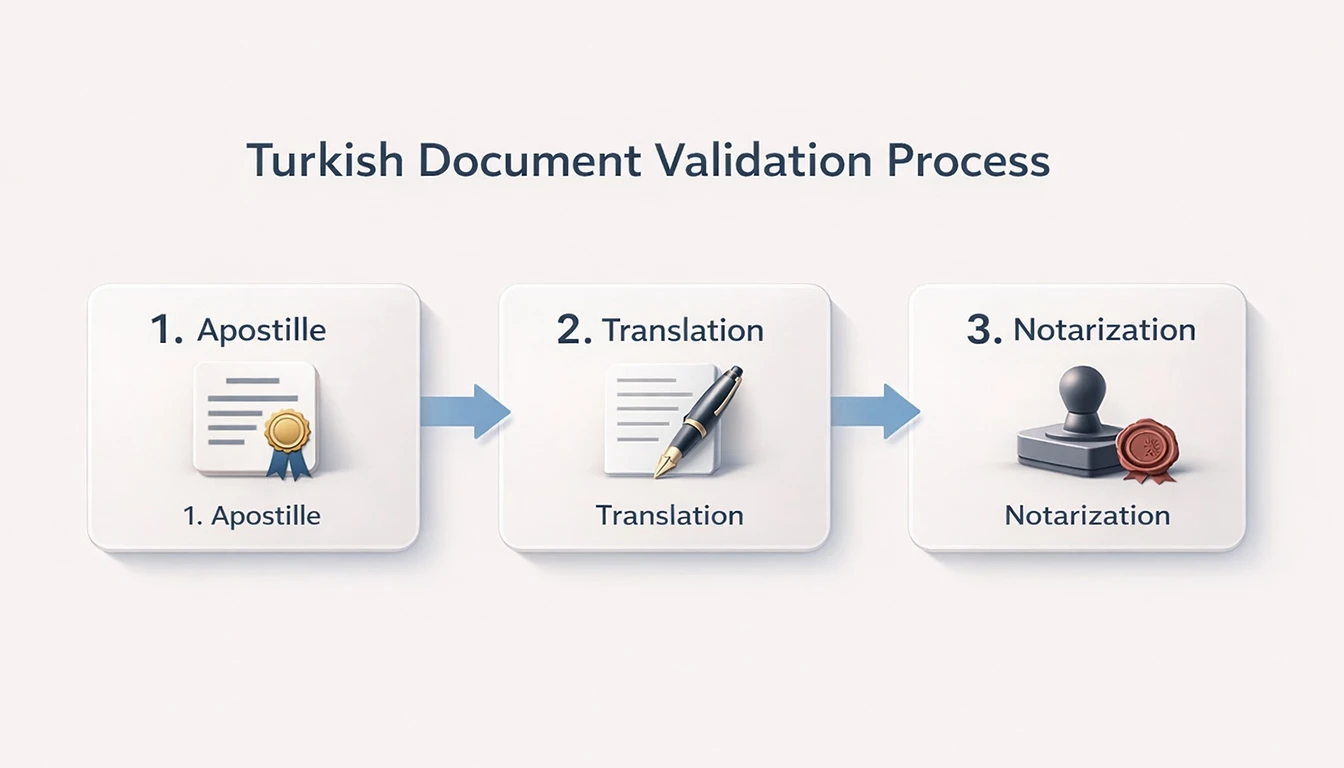
Authentication requirements depend on the document, issuing country and sector; do not apostille or notarise every document by habit.
Keep a submission index with the source, date, signer, translation/authentication status and the e-İzin filename for each item. Uploaded documents generally must be PDF files no larger than 2 MB; the biometric photograph uses the image formats and specifications stated by the Ministry.
Submit, monitor and answer missing-document requests
- Create or confirm the employer record under the correct SGK workplace and authorised e-declaration user.
- Select the actual job and workplace; align it with the signed contract.
- Enter the wage, working arrangement and applicant data from controlled source documents.
- Upload the evidence and complete the application with e-signature. A saved but unsigned file remains incomplete.
- Monitor “Applications under Evaluation” in e-İzin and the email address declared in the application.
- If the Ministry requests another document, upload it to the relevant case and complete that response with e-signature.
The official 30-day evaluation period begins when the application is duly completed with all information and documents, or—if more information is requested—when the requested items are uploaded. Consular appointments, employer readiness, corrections, payment and card delivery are separate stages in the overall timetable.
Check a Turkey work-permit application or card status
For an employer-filed application, use the tracking number under the e-İzin menus for completed applications and applications under evaluation. The final positive or negative decision is also sent to the email declared in the application; an overseas result is transmitted to the relevant Turkish mission.
For an issued card, use the Ministry’s official work-permit inquiry service or scan the QR code on the document. Card shipment can be followed through the post-permit/card-tracking area. Do not upload a passport, permit card or foreign identity number to an unofficial status-check website.
Pay the 2026 permit fee after approval
For 2026, the official fee for a fixed-term permit of up to one year is TRY 12,574.90, and the valuable-paper fee is TRY 964.00—a combined permit-document amount of TRY 13,538.90. Longer fixed-term, permanent and independent permits have different fees. Consular visa or other case-specific costs may be separate.
The Ministry states that the work-permit fee and valuable-paper fee must be paid separately and within 30 days after the payment notice; otherwise the application is rejected. Use the reference-number payment route in the Digital Tax Office or the Ministry’s listed contracted-bank method, and pay the exact notified amounts.
Complete the post-approval employer controls
| Trigger | Current control |
|---|---|
| Domestic approval | The foreign national must start work and the related legal/social-security obligations must be completed within one month from the permit start date. |
| Approval from abroad | The foreign national must start work within one month after entering Turkey and, in any event, enter within six months from the permit start date. |
| Address after overseas entry | Register in the address-registration system no later than 20 days after entry. |
| Commencement, termination or cancellation-triggering change | The employer—and the permit holder where the permit is independent/permanent—is subject to a 15-day Ministry notification duty. |
| SGK and payroll | Register, declare and pay consistently with the full-time work and wage committed in the permit file, subject to applicable social-security agreements. |
| Role, employer or workplace change | Check the permit annotation before the change. A different employer requires a new work-permit application. |
Coordinate this handoff with the SGK employer-registration controls, the foreign-employee hiring checklist and the monthly payroll process. The permit wage, employment contract, SGK start record and payroll cannot contradict one another.
Renew the permit before it expires
An extension application can be filed from 60 days before the current permit expires and must be completed before expiry. For the same employer, a positive first extension may be granted for up to two years and later extensions for up to three years. A move to a different employer is evaluated as a first application.
Where a timely extension is pending, the foreign national may continue working for up to 90 days after expiry only if the work and workplace do not change. Maintain proof of the timely extension and track the decision; do not turn the 90-day ceiling into an assumed extension term.
Understand residence, rights and long-term options
A standard fixed-term, permanent or independent work permit generally gives the holder the right to work and reside in Turkey during its validity. Permits for international-protection applicants, conditional refugees and persons under temporary protection do not substitute for residence permits. A residence permit held for another reason generally does not create a right to work.
Foreign employees receive the protections of the applicable Turkish employment and social-security rules; use the separate Turkey labour-law guide for working time, leave, pay and termination. Social-security coverage can be affected by a bilateral agreement and valid detachment evidence, so treaty cases need an individual check.
There is no single general maximum-age rule on the Ministry’s ordinary employee criteria page. Age can still matter under a sector-specific rule, the domestic-work criteria or another profession/status regime. A work permit also does not automatically confer citizenship. A permanent work permit may be applied for by a person with a long-term residence permit or at least eight years of legal work-permit history, but meeting that condition does not create an automatic entitlement.
Prevent the most common work-permit failures
- letting the foreign national start productive work while relying only on a residence, tourist or business status;
- testing the applicant but not the employer’s staffing, financial and sector criteria;
- using an old salary multiplier or minimum-wage amount;
- choosing a job title that conflicts with the duties, diploma, contract or payroll;
- missing a profession reserved to Turkish citizens or a sector prior-authorisation requirement;
- assuming every applicant in Turkey qualifies for a domestic filing;
- submitting a saved but unsigned e-İzin application;
- quoting “30 days” without excluding preparation, missing-document and consular time;
- paying the wrong amount or missing the 30-day post-notice payment deadline;
- failing to align the permit with SGK registration and payroll; and
- moving the worker to another employer, role or address without checking the permit annotation and new-application requirement.

Workon can coordinate the applicant, employer, e-İzin evidence and post-approval handoff for a controlled work-permit file.
Official sources checked for this 2026 guide
- Ministry of Labour and Social Security — work-permit FAQ
- Directorate General of International Labour Force — application types
- Directorate General — work-permit types and durations
- Directorate General — current work-permit evaluation criteria
- Directorate General — application documents and sector evidence
- Directorate General — professions restricted to Turkish citizens
- Directorate General — 2026 fees and payment methods
- Directorate General — foreign-worker social-security and notification duties
- Directorate General — work-permit exemption types
For case support, see Workon’s residency and work-permit service. The filing decision should be based on the applicant’s status, actual duties, employer records and the official rules effective on the submission date.
Frequently Asked Questions
Current-rule note — 17 September 2026: This guide provides general operational information on Turkish work-permit procedures. Workon can coordinate the application and connected employer workstreams; case-specific immigration, employment, tax and social-security work is handled with the appropriately qualified professionals under the Ministry rules effective on the submission date.