
Quick answer: A company formed through the Trade Registry may already have an automatically created SGK workplace registration (işyeri tescili), so do not open a second file without checking. Before the first Article 4/1(a) employee starts, verify the correct workplace record, establish the authorised filing route and submit the employee entry notice by the applicable deadline. If no automatic registration applies, the workplace declaration is generally due no later than the date insured employment begins.

Before the first hire, confirm the SGK workplace record, the authorised filing route and the employee’s actual start date.
This distinction matters. A company may exist in the Trade Registry and even have an automatically generated SGK workplace record without yet employing anyone. The filing sequence becomes operational when the first person will work under an employment relationship covered by Article 4/1(a) of Law No. 5510.
SGK Workplace Registration: What Actually Has to Happen?
SGK is Turkey’s Social Security Institution (Sosyal Güvenlik Kurumu). In an ordinary private-sector employment setup, the company needs a correctly registered workplace, each employee must be reported through the applicable SGK channel and payroll data must flow into the monthly tax and social-security reporting cycle.
| Compliance item |
What it does |
Do not confuse it with |
| Trade Registry establishment |
Creates the Turkish company and can trigger automatic SGK workplace registration |
Permission for an individual to start work |
| SGK workplace file |
Identifies the employer’s workplace, activity and reporting unit |
The employee’s personal entry notice |
| Employee entry notice |
Reports the insured employee before employment begins under the applicable deadline |
A work permit or employment contract |
| Monthly MPHB filing |
Reports withholding-tax and employee premium/service information through the authorised tax-office channel |
The old private-sector monthly e-Bildirge narrative |
| Premium payment |
Pays employee and employer social-security contributions for the reported period |
Submitting the employee entry notice |
For the wider employment framework, see Workon’s guide to labour laws in Turkey. This article remains focused on the SGK workplace and first-hire activation path. For recurring wage, contribution and monthly-process questions, use the separate payroll setup in Turkey guide.
Do You Need to File a Separate Workplace Declaration?
Do not start with a universal document pack. Start by identifying how the workplace was created and whether SGK already holds the correct record.
| Situation |
Likely route |
Control point |
| New LLC or JSC established through the Trade Registry |
SGK states that workplace registration is performed automatically from the company-establishment data; a separate workplace declaration is not prepared for that event |
Verify that the file exists and that its address, activity and employer details are usable before the first hire |
| Existing business begins employing an insured worker and no automatic file applies |
Submit the electronic workplace declaration |
The declaration is generally due no later than the date insured employment starts |
| New branch, additional operating location or separately organised workplace |
Assess whether a separate SGK workplace file is required |
Legal address alone does not decide the answer; review where and how the employee will actually work |
| Business or workplace transfer |
Transaction-specific notification applies |
SGK states a ten-day period for the new employer after a workplace transfer |
| Address change |
The treatment depends on whether the move is within the same SGK unit, into another unit in the same province or to another province |
Coordinate the registry change and SGK action instead of treating every move as a new file |
| Foreign employer without an ordinary Turkish company setup |
Fact-specific analysis is required |
Do not copy the LLC/JSC incorporation route without checking establishment, employment and treaty facts |
If the company is still at the incorporation stage, review the company registration service for foreign founders. If the company is changing location, use the separate company-address change guide for the Trade Registry and post-change sequence.
2026 SGK Deadlines at a Glance
The following are the standard rules published by SGK for ordinary private-sector cases. Statutory exceptions exist, so the actual employment and workplace facts should be checked before filing.
| Action |
Standard deadline |
Important qualification |
| Workplace declaration |
No later than the date the first insured employee starts |
No separate declaration is prepared for company establishments that receive automatic registration from the Trade Registry |
| Employee entry notice |
Generally at least one day before the employee starts |
SGK lists exceptions for specified sectors and circumstances; confirm them rather than assuming the general rule always applies |
| Employee termination notice |
Within ten days after employment ends |
The correct termination date and reason code matter |
| Monthly Muhtasar ve Prim Hizmet Beyannamesi |
Generally by 23:59 on the 26th of the following month |
For private-sector employers, the electronic filing goes to the authorised tax office; check the current official tax calendar for holidays or extensions |
| Social-security premium payment |
Generally by the end of the following month for employees paid for the 1st–30th period |
Different payroll periods and officially announced extensions can change the date |
A calendar entry is not enough. Keep evidence of the employee’s agreed start date, the successful submission receipt and the workplace number used for the filing. A notice submitted under the wrong workplace file can create a different problem from a late notice.
Pre-Hire Readiness Checklist
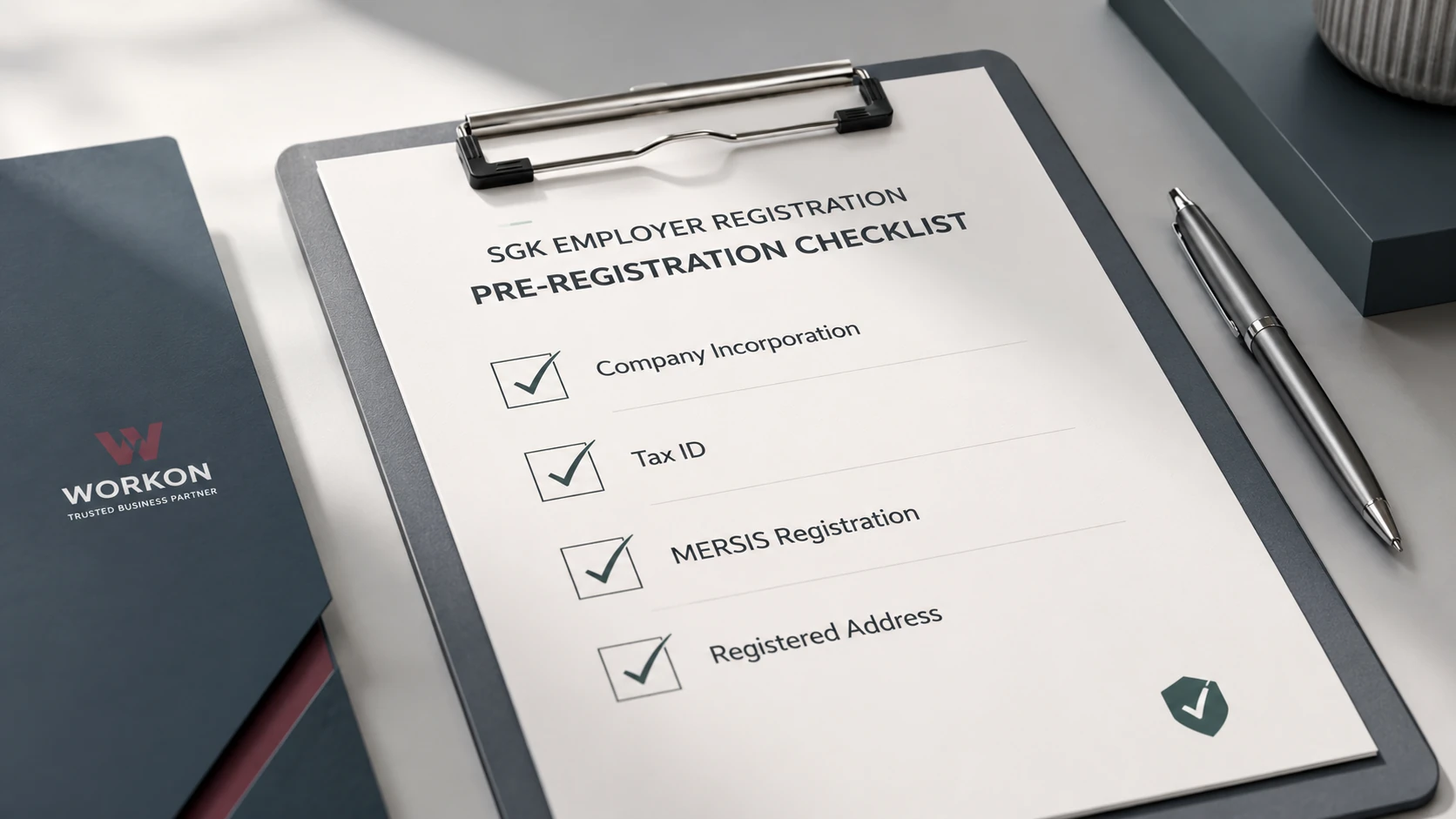
A useful pre-hire check starts with the existing government records, not a generic bundle of paper documents.
- Company status: confirm the legal name, tax number, Trade Registry record and MERSİS information.
- Workplace record: determine whether SGK created it automatically and identify the correct workplace registration number.
- Location and activity: check the operational address, NACE/activity information and applicable occupational-risk classification.
- Filing authority: identify who is authorised to use the employer systems and who will retain submission receipts.
- Payroll chain: align HR data with the licensed CPA/SMMM responsible for the relevant tax and payroll filings.
- Employee data: verify identity, social-security information, job title, wage, start date and employment terms before submission.
- Foreign employee control: confirm the person’s valid right to work and the correct permit-linked start date before allowing work to begin.
- Health and safety: determine the employer’s occupational health and safety obligations by workplace and hazard class.
The MERSİS record is one part of this chain, not a substitute for SGK verification. See the MERSİS company-registration guide for the system’s proper role.

Workon coordinates company setup and the handoff from incorporation to operational readiness for foreign founders.
Step-by-Step SGK Employer Activation
1. Classify the Company and the Workplace
Confirm whether the employer is a Turkish legal entity, a branch, an individual business or another structure. Then identify the physical or organised workplace in which the insured work will be performed. A registered office address and an SGK workplace are related concepts, but they are not automatically identical in every operating model.
2. Check for Automatic Workplace Registration
For a company established through the Trade Registry, first search for the automatically created workplace record. Do not submit a duplicate declaration merely because the company has not hired before. Check the workplace number, employer identity, address, activity and the SGK unit attached to the record.
3. Submit a Workplace Declaration Only When Required
If automatic registration does not apply or the relevant event requires a declaration, use the electronic workplace-declaration route. SGK’s published guidance says that the declaration itself is generally sufficient for registration and that electronically available records should not be requested again. Additional evidence depends on the case.
For example, SGK identifies specific supporting-document rules for subcontractors, ordinary partnerships, public-tender work and construction workplaces. That is why a universal list requiring a Trade Registry Gazette, signature circular, lease, notarised power of attorney and every company document for every application is unreliable.
4. Confirm Employer-System Access and Responsibility
Set up the authorised access needed for employee notifications and other SGK employer transactions. Record who controls the credentials, who prepares the data, who submits it and who checks the receipt. Remote founders should avoid sharing unrestricted passwords across multiple providers; use documented authority and a controlled handoff.
5. File the Employee Entry Notice
For an ordinary Article 4/1(a) employee, the standard rule is submission at least one day before the start of work. The date should match the employment record and the employee should not begin performing duties merely because an internal onboarding meeting has been labelled “orientation.” If an exception may apply, confirm its exact statutory scope before relying on it.
6. Connect the Monthly Reporting and Payment Cycle
Employer activation is not complete when the workplace number appears. Employee wage and service data must enter the monthly Muhtasar ve Prim Hizmet Beyannamesi process, and the resulting social-security premiums must be paid by the applicable deadline. For a private-sector company, responsibility should be assigned to the employer’s authorised user, licensed CPA/SMMM or other appropriately authorised professional, as applicable.
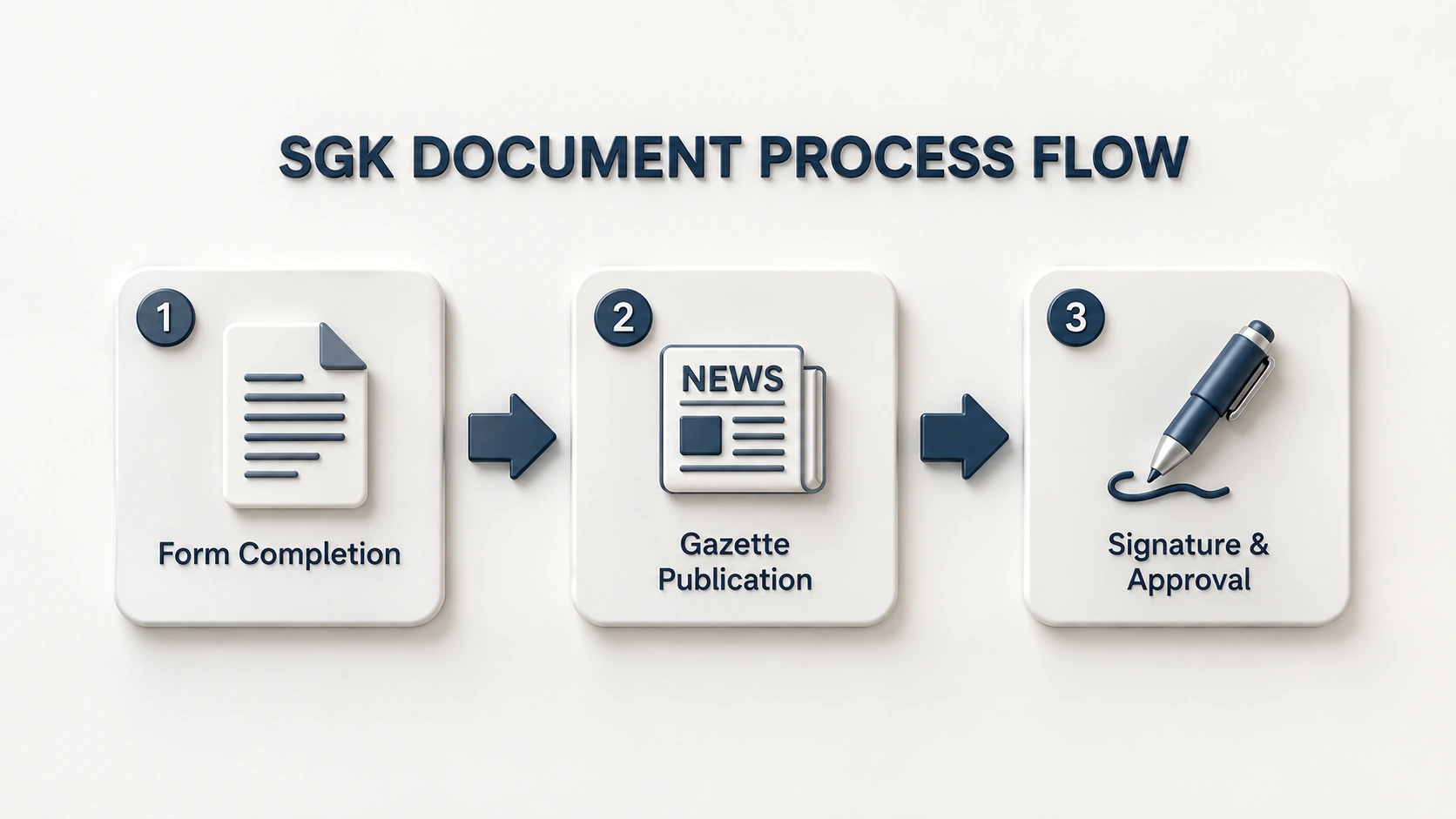
The correct sequence is workplace verification, authorised access, employee entry, monthly reporting and premium payment.
What Information Should Be Verified?
| Data point |
Why it matters |
Evidence to retain |
| Legal employer name and tax number |
Links the workplace to the correct legal entity |
Current registry/tax record and successful SGK result |
| Workplace address and SGK unit |
Determines the workplace file and change procedure |
Current address record and workplace detail screen |
| Main activity/NACE information |
Affects workplace classification and connected compliance checks |
Registry/tax/SGK data and any correction correspondence |
| Employee start date |
Controls the entry-notice deadline |
Signed employment record and filing receipt |
| Job, wage and working arrangement |
Feeds payroll, premium and employment-law analysis |
Employment documents and approved payroll input |
| Work authorisation for a foreign employee |
SGK reporting does not replace permission to work |
Applicable work permit or exemption evidence and date check |
Changes After the Workplace Is Registered
SGK treatment changes with the event:
- Different province: SGK states that a workplace declaration is sent to the unit for the new address within ten days after the move.
- Different SGK unit within the same province: a written notice is made to the old and new units within ten days, and a new file is created by the receiving unit.
- Different address within the same SGK unit: the new address is notified in writing within ten days; a new workplace file is not created solely for that move.
- Company merger, type conversion or participation in another company: SGK publishes a ten-day notification rule linked to the Trade Registry announcement.
- Trade-name change: SGK guidance indicates written notification with the Trade Registry Gazette rather than a new workplace declaration.
These rules should be coordinated with the Trade Registry, tax office, bank, licence and other system updates. A change recorded in one database should not be assumed to have corrected every downstream record.
Common SGK Registration Risks
- Submitting a second workplace declaration without checking whether the Trade Registry already triggered automatic registration.
- Registering the employee under the wrong workplace number.
- Allowing work to begin before the employee entry notice or foreign-employee permission is valid.
- Using inconsistent start dates across the contract, HR file, permit record, payroll and SGK submission.
- Assuming a power of attorney, company manager appointment or CPA engagement automatically grants every SGK system permission.
- Completing the entry notice but failing to connect the employee to monthly MPHB reporting and premium payment.
- Ignoring a branch, workplace transfer or address change because the company’s tax number remained the same.
Official Sources and 2026 Verification
This guide is grounded in the Social Security Institution’s current public guidance on workplaces, employers and workplace declarations and employer obligations. Official portals, filing calendars and case-specific professional advice should be checked again when the hiring date is fixed.
How Workon Supports the First-Hire Handoff
Workon can coordinate the operational handoff from company establishment to first-hire readiness: checking which records already exist, organising company and employee inputs, coordinating authorised access and aligning the timetable with the licensed CPA/SMMM, employment counsel and occupational health and safety professionals where required. SGK and the appropriately licensed professionals retain responsibility for their respective authority decisions, regulated filings and professional scopes.
Last reviewed: 17 September 2026.
Message Workon with the company type, workplace location, whether an SGK workplace number already appears and the planned first working day. We can map the operational sequence before the employee starts.
No. For company establishments registered through the Trade Registry, SGK states that workplace registration can be created automatically. Check whether the correct workplace file already exists before submitting a separate declaration and creating a duplicate.
Before the first insured employee starts, verify the correct workplace record and authorised filing route. Where no automatic registration applies, the workplace declaration is generally due no later than the date insured employment begins.
For an ordinary private-sector Article 4\/1(a) employee, the standard rule is generally at least one day before the employee starts work, subject to statutory exceptions for specified cases. The actual start date and correct workplace number should be verified before submission.
Check the legal employer, existing workplace record, address, activity and NACE information, authorised filing access, payroll chain, employee identity, job, wage and start date, and any foreign-worker authorisation. Supporting documents depend on the workplace and transaction.
No. For ordinary private-sector payroll, withholding-tax and employee premium\/service information flows through the Muhtasar ve Prim Hizmet Beyannamesi process via the authorised tax-office channel. Employer-system access and other SGK transactions still need to be controlled separately.
No. SGK reporting and work authorisation are separate. A foreign employee should not start work until the applicable work permit or other valid right-to-work basis is effective and aligned with the employment start date.