




















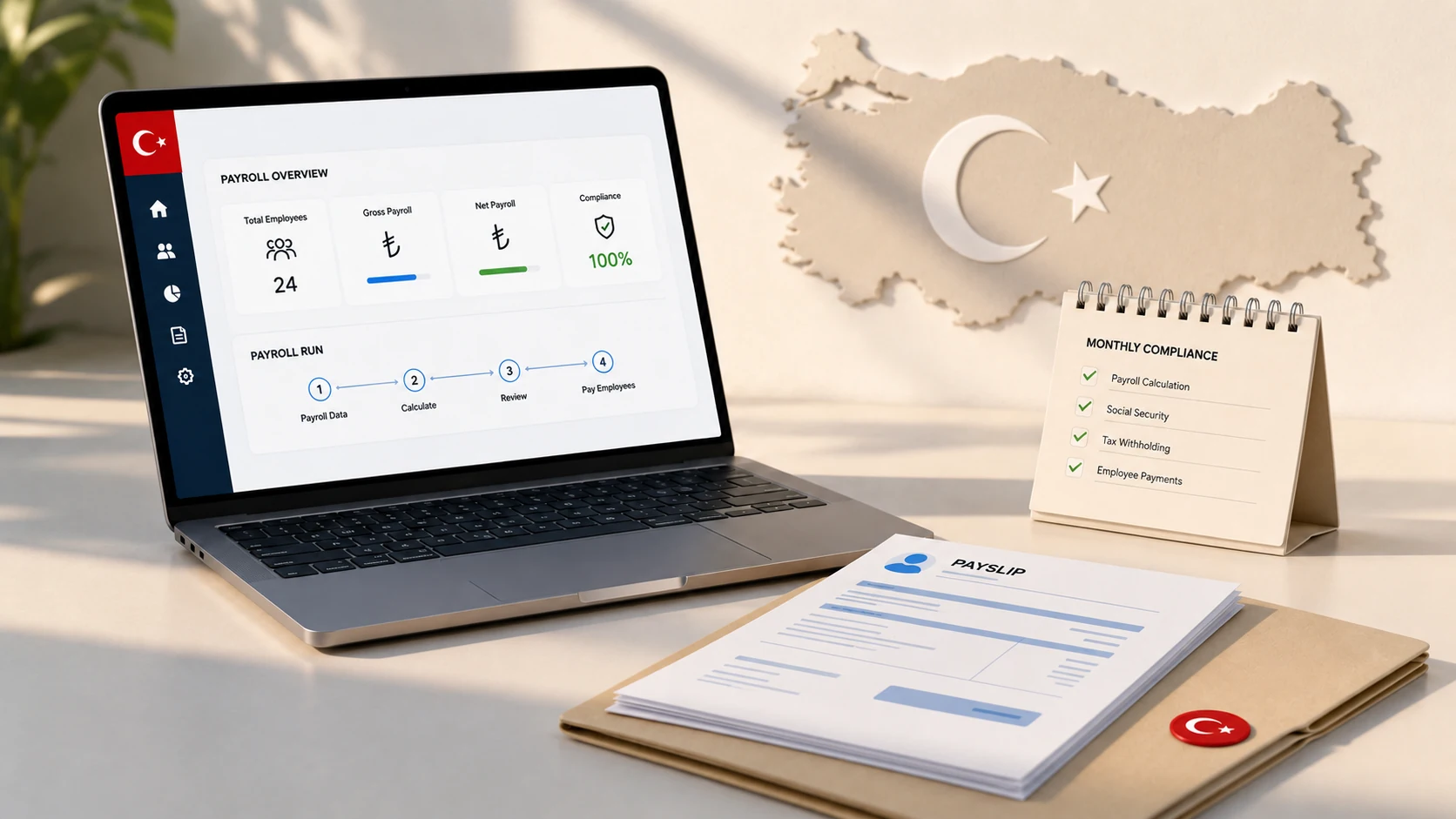
Payroll setup in Turkey is complete only when every employee, earning, deduction, approval, payment and declaration can be reconciled to evidence. For a typical private-sector employer, the monthly process connects the employment contract and time records to gross-to-net calculation, a wage-account slip, bank/payment evidence, the Muhtasar ve Prim Hizmet Beyannamesi (MPHB), tax payment, SGK premium payment and accounting entries.
Last reviewed: 2 September 2026. Rates, minimum/maximum premium bases, tax brackets, exemptions, incentives and filing extensions can change. Load the parameters effective for the payroll period instead of copying figures from an older month.
| Payroll term | What it means | Employer control |
|---|---|---|
| Gross wage | Contractual wage before employee deductions | Confirm period, currency clause, hours and recurring benefits |
| SGK premium earnings | Earnings included in the social-security base, subject to current floor/ceiling and exclusions | Classify every cash and in-kind item; do not assume gross wage equals the base |
| Income-tax base | Taxable wage after applicable statutory deductions/exemptions | Maintain the correct cumulative base and employer history |
| Net pay | Amount due after lawful deductions | Reconcile the approved payroll to payment evidence |
| Total employer cost | Gross pay plus employer charges and other employment costs | Separate statutory payroll cost from benefits, equipment and provider fees |
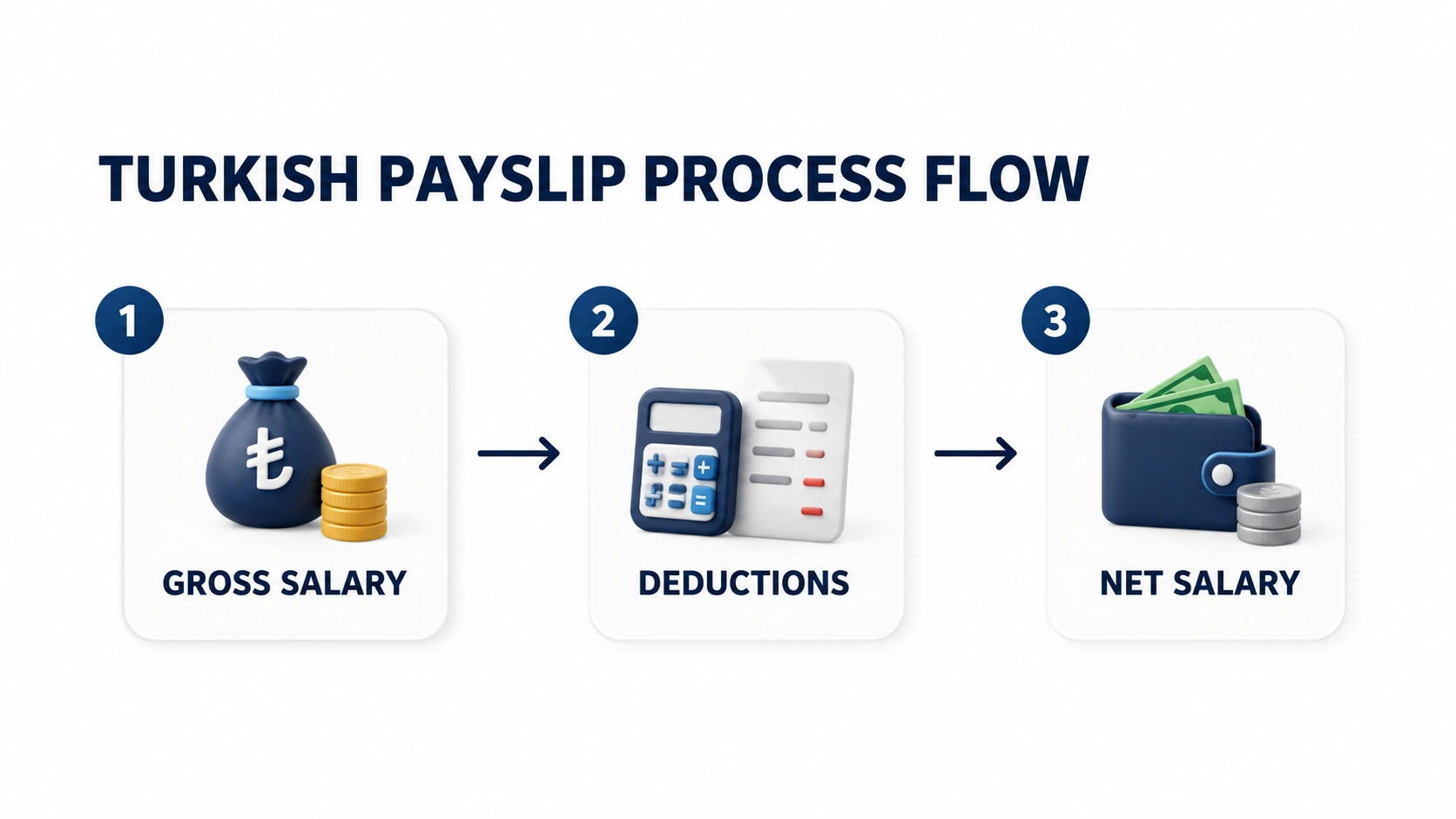
Gross salary, net pay and total employer cost are different control totals.
Where Payroll Fits in the Employment Process
This guide covers recurring payroll operations after a worker is approved to start. Use the separate hiring process in Turkey for recruitment-to-start-date controls, the SGK employer-registration guide for workplace and first-hire activation, and the Turkey labour-law guide for contracts, working time, leave and termination.
Assign named owners for HR inputs, time approval, payroll preparation, payroll review, authorised filing, payment and accounting reconciliation. A provider can prepare calculations, but the employing company still needs approval controls and access to the evidence.
Build the standing payroll master before the first run
The standing master should contain only controlled, current data:
- legal employer, SGK workplace number, tax office and authorised filing route;
- employee identity, start date, SGK status and permitted job/workplace for a foreign employee;
- contract type, normal hours, gross wage, payment period and bank/payment instruction;
- recurring cash and in-kind benefits, incentive/exemption flags and their evidence;
- cost centre, accounting mapping and approval hierarchy; and
- effective-dated changes with requester, approver and supporting document.
Do not overwrite a salary or bank account without an effective date and approval trail. Restrict access because payroll combines identity, financial, attendance, health/leave and sometimes immigration data.
Understand the 2026 social-security baseline
SGK’s current rate table for a typical employee insured under Law No. 5510 Article 4/1-a shows the following standard shares before any applicable reduction:
| Component | Employer share | Employee share |
|---|---|---|
| Long-term insurance branches | 12% | 9% |
| General health insurance | 7.5% | 5% |
| Short-term insurance branches | 2.25% | — |
| Unemployment insurance | 2% | 1% |
| Standard total | 23.75% | 15% |
2026 premium-base control: for ordinary private-sector 4/1-a employees, SGK lists the monthly premium-earnings floor as TRY 33,030 and the monthly ceiling as TRY 297,270 for 1 January–31 December 2026 (daily TRY 1,101 and TRY 9,909 respectively). The ceiling is nine times the daily lower limit under the current rule. Apply the correct day count and earning classification rather than treating these figures as a generic salary cap.
The rate applies to the relevant premium earnings, not automatically to every lira of total compensation. Different insured statuses, pension work, special risk/activity rules, incentives, international social-security arrangements and the statutory premium ceiling can change the calculation.
Do not hard-code a five-point incentive for every company. The Ministry’s 2026 minimum-wage examples distinguish an eligible five-point manufacturing scenario, an eligible two-point other-sector scenario and no reduction. Eligibility depends on the current law and the employer’s facts, including timely reporting/payment and other conditions. See the official scenarios in the 2026 minimum wage and employer-cost guide.
Run a controlled monthly input cut-off
Set an internal cut-off early enough to review changes before the contractual pay date. The input pack should include:
- new hires, exits, unpaid days and workplace transfers;
- approved attendance, overtime, additional hours and shift data;
- annual leave, sickness, statutory absence and supporting records;
- bonuses, commissions, expense reimbursements and benefits;
- salary, role, cost-centre, bank and work-permit changes;
- court, enforcement or authorised deduction instructions; and
- retroactive items and corrections to a prior period.
Use a three-way check: approved HR event, effective-dated master change and payroll result. A manager’s chat message is not a sufficient salary, unpaid-leave or termination instruction.

Payroll cannot repair a missing employer, workplace or employee-start registration after the fact.
Calculate gross earnings before deductions
Begin with the agreed gross wage and the period actually worked. Add overtime, bonuses, commission and benefits in the correct earning period. Identify unpaid time and lawful deductions separately. Then classify each component for:
- SGK premium earnings and the current minimum/maximum base;
- income-tax withholding and the employee’s cumulative tax base;
- the minimum-wage income-tax and stamp-duty exemptions where applicable;
- stamp duty and any item-specific exemption;
- net payment; and
- employer cost and accounting.
Turkey uses a progressive income-tax tariff. An employee’s net pay can therefore change as the cumulative base moves through brackets even where gross salary is unchanged. A fixed-net promise transfers that variability to the employer and should never be entered into without a documented gross-up method and approval.
Treat benefits item by item
Do not use a rule such as “cash is always taxable” or “a card is always exempt.” Meal, transport, private insurance, accommodation, vehicle, gift and other benefits can have different income-tax, stamp-duty and SGK treatment, and the thresholds or conditions may change by year. The commercial form—cash, reimbursement, card, invoice or service—matters but is not the only test.
For each benefit, maintain a short tax-and-SGK position note, current limit, documentary requirement and payroll code. If the facts do not meet the exemption, route the item to taxable/premium earnings instead of forcing a preferred code.
Check special cases before calculating net pay
| Case | Payroll question | Evidence |
|---|---|---|
| New employer during the year | How should the cumulative income-tax base be handled under the current rule and employee request? | Prior-employer data and documented treatment |
| Foreign employee | Do tax residence, a social-security agreement/detachment certificate or permit wage commitment change treatment? | Permit, residence/travel facts and treaty/coverage evidence |
| Company partner or director | Is the person genuinely insured as 4/1-a, 4/1-b or another status? | Corporate role, shareholding and SGK classification |
| Remote or cross-border work | Where is work physically performed and which employer bears the wage? | Work calendar, assignment agreement and tax/social-security review |
| Termination payment | Which items are wage, notice, severance, leave or settlement and which ceilings/exemptions apply? | Legal route, service data and signed calculation |
A foreign employee’s payroll is not automatically identical to a Turkish citizen’s. Confirm work authorisation through the Turkish work-permit guide and analyse any treaty or detached-worker evidence before changing SGK treatment.
Review, approve and issue the wage-account slip
Use a preparer-reviewer-approver sequence. At minimum, compare headcount, gross pay, net pay, employer cost and statutory liabilities with the prior month; explain every material movement. Reperform a sample across a new hire, leaver, overtime case, benefit, minimum-wage case and high earner.
Labour Law Article 37 requires a wage-account slip showing the payment day and period plus additions and deductions such as overtime, weekly/public-holiday pay, tax, insurance and other deductions. Give the employee an intelligible record and protect the confidentiality of other employees’ data.
Payment should follow the contract and applicable wage-payment regulation; wages must generally be paid at least monthly. Confirm whether bank payment is mandatory for the employer’s facts and retain a payment file that reconciles exactly to approved net payroll. A foreign or Turkish payment channel does not cure missing wage evidence.
File MPHB and pay the liabilities on the right calendar
The old monthly premium and service document (Aylık Prim ve Hizmet Belgesi) should not be described as the ordinary current private-sector filing. Employee premium/service data and wage withholding are reported through the electronic Muhtasar ve Prim Hizmet Beyannamesi to the authorised tax office.
| Action | Current ordinary calendar | Control |
|---|---|---|
| Monthly MPHB filing | By 23:59 on the 26th of the following month | Check official holiday/extension notices and the employer’s registered periodicity |
| Withholding taxes arising on monthly MPHB | Within the return-filing period | Reconcile tax accrual to payroll and payment receipt |
| SGK premium payment for a 1st–month-end payroll period | By the end of the following month | Reconcile employee and employer shares to SGK accrual; special periods differ |
| Employee exit notification | Generally within 10 days after termination | Match exit date/reason to HR, permit, final payroll and access closure |
Taxpayers that are entitled to report certain withholdings on a three-month basis under Income Tax Law Article 98(3) still do not switch employee premium/service reporting to a quarterly cycle merely because that tax right exists. Where they employ workers, MPHB is filed monthly for the employee premium and service information; the eligible withholding-tax section can follow the permitted quarterly treatment under the registered route. A licensed CPA/SMMM or other appropriately authorised filer should confirm the employer’s actual filing periodicity.
Reconcile payroll after filing
Close the month only after these totals agree:
- HR headcount and days to payroll headcount and days;
- approved gross-to-net register to employee wage-account slips;
- net-pay register to bank/payment evidence and rejected transfers;
- payroll tax and SGK bases to MPHB lines;
- MPHB accruals to GİB and SGK payment receipts;
- payroll journal to the general ledger and cost centres; and
- claimed incentive/exemption to its eligibility evidence.
Store the submitted version, acceptance/accrual receipt, payment receipt, approved payroll and correction history together. If a return is corrected, record why, who approved it and which employee/payment/accounting records were updated.

Keep employer setup, payroll evidence and statutory filings in one controlled operating model.
Maintain the personnel file without over-collecting
Labour Law Article 75 requires an employee personnel file containing legally required documents and records. The same article also requires the employer to use employee information honestly and lawfully and not disclose information where the employee has a justified interest in confidentiality.
Build the file from a role-based checklist; do not collect every possible identity, health or family document for every employee. Separate restricted medical or disciplinary records, define retention periods and log access. The contract, amendments, time/leave records, wage slips, statutory notices and termination calculation should tell a coherent story.
Common payroll failures to prevent
- using the outdated 20.5% employer SGK rate or adding components twice;
- automatically applying a five-point incentive without checking current sector and eligibility rules;
- copying last year’s income-tax brackets, premium ceiling or benefit limits;
- treating every benefit card as exempt or every cash benefit as fully taxable;
- confusing gross wage, SGK earnings, taxable wage and employer cost;
- using the former monthly premium document instead of the current MPHB route;
- missing a new-hire, exit, unpaid-day or workplace change in the monthly data;
- paying net salary before reviewer approval or without reconcilable evidence;
- assuming foreign employees always have identical SGK treatment; and
- filing on time but failing to pay or retain the accepted accrual and receipt.
Official sources for the 2026 payroll file
- SGK — current employer and employee premium rates
- SGK — current minimum and maximum premium earnings
- SGK — employer premium-payment rules
- Revenue Administration — current return and payment deadline table
- Revenue Administration — MPHB preparation guide
- Revenue Administration — 2026 wage-income guide
- Labour Law No. 4857 — official consolidated text
Workon can coordinate the monthly input pack, calculation review and compliance evidence with the company’s authorised team. Tax returns, SGK filings and regulated advice should be completed or confirmed by the appropriately authorised Turkish professional.
Frequently Asked Questions
Disclaimer: This article is general information, not legal, tax, social-security or payroll advice. Confirm the employee status, payroll period, current official parameters and any incentive or treaty before calculation and filing.