You cannot eliminate every SWIFT cost in Turkey with one universal trick. The realistic goal is to understand which fees can be controlled, which may come from correspondent or receiving banks, and when a different payment rail is genuinely available for the company and transaction.
For Turkish businesses, the main cost drivers are the sending bank’s fee, possible correspondent/intermediary-bank charges, the receiving bank’s policy, FX spread when currencies are converted, and the charge instruction used for the transfer. The exact route and cost vary by bank, currency, country and transaction.
Quick answer for 2026: reduce avoidable SWIFT costs by matching the payment currency to the correct account, checking the bank’s current tariff and correspondent route, choosing the appropriate OUR/SHA/BEN instruction, giving the sender precise payment details, and using a legitimate local payment rail only when your company is actually eligible to use it.
Confirm the beneficiary account can receive the invoice currency without forced conversion.
Ask the sending bank which OUR/SHA/BEN options are available for that route.
Check the current sending, receiving and possible correspondent fees.
Verify the IBAN/account number, SWIFT/BIC and invoice reference before sending.
If you plan to use a local rail instead of SWIFT, confirm that the Turkish company is actually eligible for the provider-issued receiving details.
Where SWIFT Costs Come From
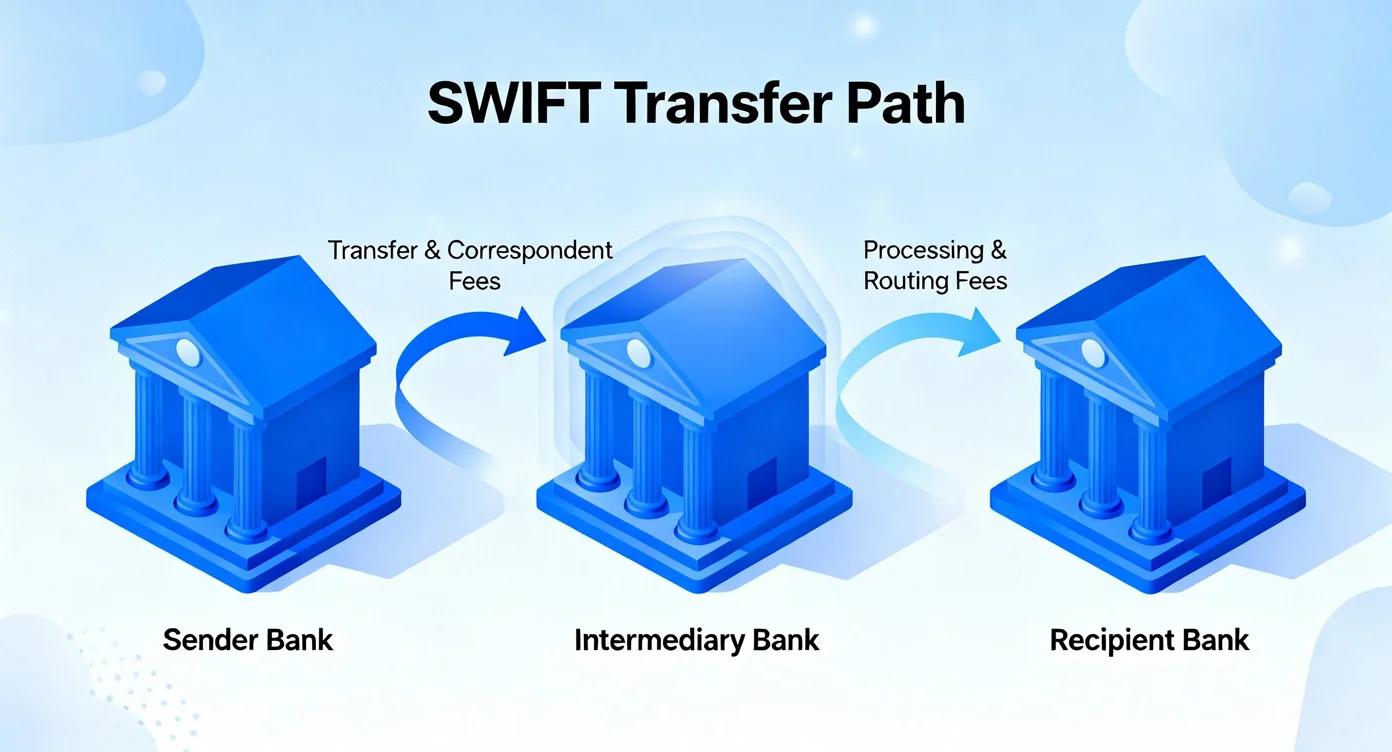
A SWIFT transfer can involve more than the sender’s and recipient’s banks. If the two banks do not settle directly in the relevant currency, one or more correspondent/intermediary banks may participate. Each institution can apply its own fee under the applicable route and charge instruction.
That is why the amount received can differ from the amount originally sent. It is also why there is no reliable universal rule such as “every transfer passes through three banks” or “every intermediary deducts $20–$50.”
Main Cost Layers to Check
Sending-bank fee: the bank initiating the transfer may charge a fixed or percentage-based SWIFT fee.
Correspondent/intermediary charges: banks in the payment chain may apply additional fees depending on the route and charge option.
Receiving-bank fee: the beneficiary bank may charge for incoming SWIFT according to its current tariff.
FX spread: if the payment is converted, the bank’s buy/sell rate can create a separate cost from the transfer fee itself.
Cut-off/value date: timing affects when a payment is processed, but SWIFT does not have one guaranteed universal delivery time.
International transfer cost can come from several layers: sending bank, correspondent route, receiving bank and currency conversion.
Do Not Compare SWIFT With a Generic “Modern Alternative”
Payment services differ by country, registered address, business eligibility, currency and the type of receiving details they provide. A provider that works for one company may not be available to a Turkish-address business at all. Compare the exact route available to your company rather than assuming every fintech offers local EUR, USD or GBP receiving accounts in Turkey.
OUR, SHA and BEN: Who Is Intended to Pay the Fees?
The charge instruction is one of the most important controllable variables in a SWIFT payment. Banks commonly use three codes:
OUR: charges are intended to be borne by the sender. This can reduce the risk of deductions from the principal amount, but it should not be described as a universal guarantee that the beneficiary will receive the exact invoice amount. The receiving bank can still apply its own incoming-transfer fee depending on its policy.
SHA: the sender pays its own bank’s charge; other charges can be borne by the beneficiary according to the route and bank policies.
BEN: transfer charges are borne by the beneficiary and can be deducted from the transferred amount.
Do not assume SHA is always the default or that OUR is always available in the same way for every bank, currency and corporate transaction. Confirm the current option with the sending bank before putting a charge instruction on an invoice.
Why Reconciliation Shortfalls Happen
If a company invoices EUR 1,000 but receives less, the difference may come from the sender’s fee structure, correspondent-bank deductions, the receiving bank’s fee, or an FX conversion. The practical response is to trace the transfer advice and bank statement rather than assume one fixed “hidden SWIFT fee.”
For a new Turkish company, align the company setup and banking structure before deciding how international payments should be received.
Correspondent Routes Are Bank- and Currency-Specific
The sending bank may be able to identify its usual correspondent route or provide an estimate, but the exact deductions can still depend on the banks involved and the transaction. Ask for the payment confirmation or SWIFT advice after a transfer if you need to reconcile a shortfall.
This is also why a company should compare the cost of the actual transfer route it can use—not assume SWIFT is always the most expensive option or that an alternative provider is automatically cheaper.
When an Alternative Payment Rail Can Reduce SWIFT Use
A local payment rail can reduce SWIFT use only when the company is genuinely eligible for the relevant receiving account or payment service. Provider availability changes by registered address, business type and country, so do not build an invoicing workflow around a fintech feature until the provider confirms it for the Turkish company.
Current Provider Reality for Turkey-Based Businesses
Wise: Wise states that its Türkiye restrictions apply according to the account’s registered address and apply separately to business accounts. A Türkiye-registered Wise Business account cannot request new account details; Wise’s current Türkiye notice also says that, from the account-specific date communicated to affected customers, functions such as receiving money, adding/holding new currencies and converting balances can be restricted or removed. Do not build a Turkish company’s collection workflow around Wise receiving details unless the live account itself confirms the feature is currently available.
Revolut: Türkiye is not currently listed among the supported countries for standard Revolut signup or Revolut Business eligibility. Do not present it as an available Turkish-company solution without a provider-confirmed eligible structure.
Payoneer and similar payment providers: eligible customers may receive local account details in supported currencies, but availability is subject to provider rules and eligibility. A receiving account is a payment-service feature, not necessarily a traditional bank account.
Provider rules can change. Check the company’s registered address, legal entity, intended payment type, supported currencies, fees, withdrawal route and account ownership before placing any payment details on an invoice. For the separate availability and document-verification checks, use the Wise and Payoneer verification guide. Compare transfer costs only after the required receiving service is confirmed for the company.
A SWIFT route can involve correspondent banks; an alternative local rail is useful only when the business is actually eligible to use it.
Six Practical Ways to Reduce International Transfer Costs
Receive into the correct currency account. If your Turkish company invoices in EUR and has an appropriate EUR current account, avoid an unnecessary EUR→TRY conversion on receipt unless the business actually needs TRY.
Compare OUR, SHA and BEN before invoicing. Choose the charge instruction intentionally and confirm how the sender’s bank implements it.
Check the current bank tariff. Sending, receiving and correspondent charges change. Use the bank’s current corporate fee schedule rather than old examples.
Ask about the correspondent route. For recurring payments in the same currency/corridor, ask whether the bank can identify the usual correspondent bank and likely deductions.
Use a legitimate local rail only when eligible. SEPA, ACH or local GBP details can be useful when the company has provider-approved account details for that rail. Do not use another person’s account or an ineligible structure just to avoid SWIFT.
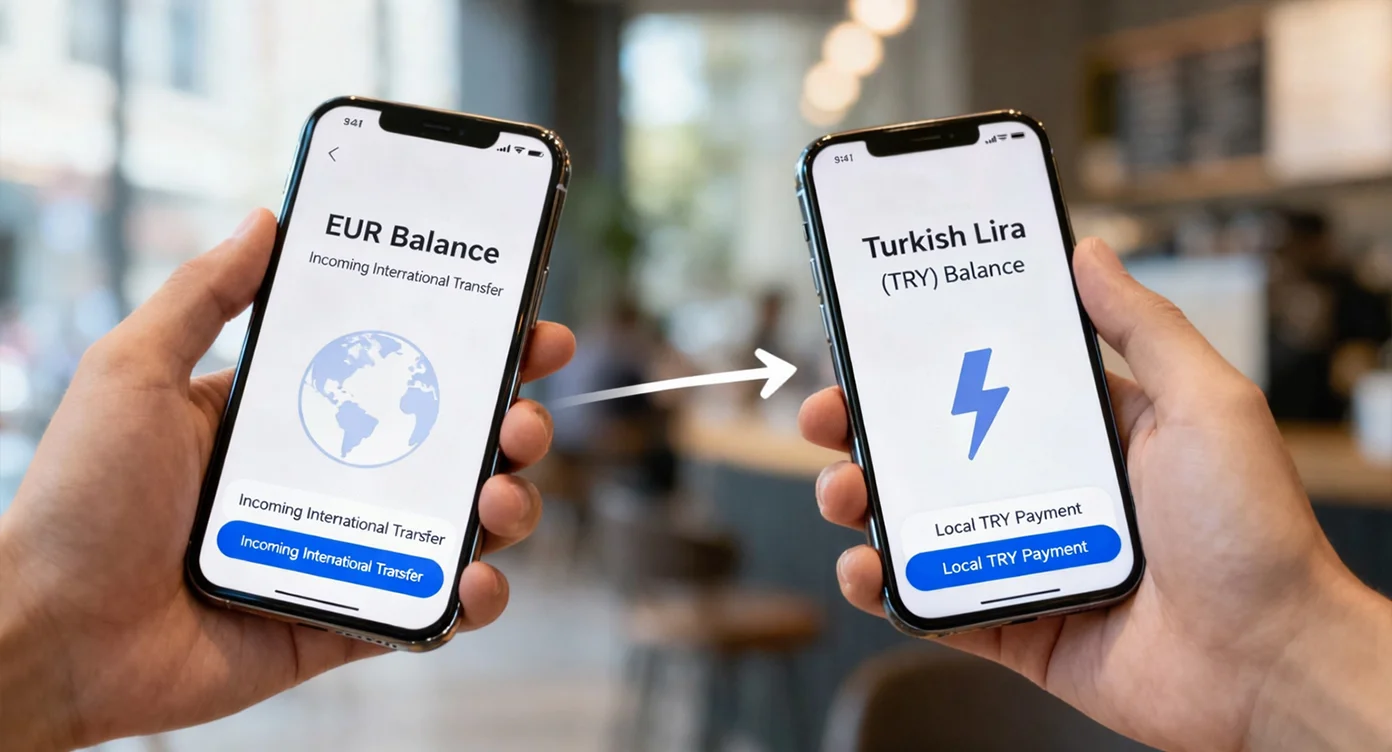
Separate the international and domestic payment legs. Once funds are lawfully available in a Turkish TRY account, domestic TRY payments can use Turkish rails such as FAST where appropriate.
FAST Helps with the Domestic TRY Leg — Not the International SWIFT Leg
FAST is the Central Bank of the Republic of Türkiye’s instant domestic payment system. It is relevant after funds are available for a domestic TRY payment; it is not a global replacement for SWIFT and it does not itself bring EUR, USD or GBP from an overseas bank into Türkiye.
As of 26 August 2026, the FAST transaction limit for money transfers and Request-to-Pay payments is TRY 300,000, increased from TRY 100,000. Bank-specific fees, channel rules and transaction limits should still be checked with the bank.
FAST can optimize the domestic TRY payment leg after funds are available in Türkiye; it does not replace the international transfer leg.
Create Payment Instructions That Match the Real Route
Clear payment instructions reduce avoidable errors. The invoice should tell the sender exactly which account and transfer method are approved for that transaction, rather than presenting a generic “cheapest” method.
If the Payment Will Be Sent by SWIFT
Beneficiary legal name
Beneficiary bank and branch details where required
IBAN/account number
SWIFT/BIC
Payment currency
Invoice/reference number
Agreed charge instruction: OUR, SHA or BEN
Any correspondent/intermediary instruction supplied by the bank, if relevant
If a Local Rail Is Available
Use SEPA, ACH, Faster Payments or another local rail only when the company has valid provider-issued receiving details for that rail and the payment is permitted under the provider’s current terms. Confirm the beneficiary name and account ownership before sending those details to a customer.
Payment Instruction Checklist
Item
Why it matters
What to confirm
Correct currency account
Reduces unnecessary conversion and routing errors.
The account can receive the invoiced currency.
Transfer rail
SWIFT and local rails have different eligibility, cost and settlement rules.
Use only a rail the beneficiary account is actually approved to receive.
Charge instruction
OUR/SHA/BEN changes who is intended to bear transfer charges.
Do not promise that OUR universally guarantees the exact net amount; confirm bank treatment.
SWIFT/BIC and IBAN/account number
Incorrect details can delay or return a transfer.
Copy from current bank/provider records.
Invoice reference
Supports reconciliation.
Use the exact invoice or contract reference.
How Workon Can Coordinate the Banking and Payment Setup
Workon does not guarantee that a bank or payment provider will approve a customer, that a particular payment rail will be available, or that SWIFT charges can be eliminated. The useful role is to coordinate the Turkish company’s banking file and payment-flow setup so the customer knows which routes are actually available.
Corporate bank-account preparation: organize company, signatory, shareholder/UBO and KYC records for the selected bank route.
Currency-account planning: identify recurring invoicing and supplier currencies before deciding which foreign-currency accounts are operationally useful.
Bank communication: clarify current fees, transfer functionality, signing steps and online-banking requirements with the selected bank.
Remote route coordination where available: some eligible corporate cases can use a bank-approved remote process; other cases require physical attendance. Final approval remains with the bank.
Payment-flow review: distinguish Turkish bank accounts from external payment-provider services and verify eligibility before using provider-issued local receiving details.
Payoneer — Receiving accounts: local receiving details are eligibility-dependent and are not the same as a traditional bank account.
Reviewed on 17 September 2026. Bank fees, correspondent routes, FAST limits and payment-provider eligibility can change. Confirm the current terms for the selected bank, provider, currency and company before acting.
Frequently Asked Questions
No. The practical objective is to reduce avoidable costs. A SWIFT payment can involve the sending bank, correspondent or intermediary banks, the receiving bank and any FX conversion. The exact charges depend on the banks, currency, corridor and charge instruction.
The difference can come from the sending bank's pricing, correspondent or intermediary deductions, the receiving bank's fee or an FX conversion. Trace the payment advice and bank statement rather than assuming a fixed hidden-fee amount or a specific number of intermediary banks.
They indicate how transfer charges are intended to be allocated. OUR generally places charges on the sender, SHA separates the sender's own bank charge from other route charges, and BEN places charges on the beneficiary. None should be described as a universal guarantee that the beneficiary will receive an exact net amount; confirm the selected bank's treatment for the route.
No. A local rail is useful only when the company is genuinely eligible for provider-issued receiving details or another supported route. Confirm the provider, registered-address eligibility, account ownership, currency, fees and permitted business use before changing invoice instructions.
Do not assume so. Wise applies Türkiye restrictions by registered address; Türkiye-registered business accounts cannot request new account details and affected accounts can also lose receiving, currency-holding or conversion functions from the date Wise communicates. Türkiye is also not currently listed as an eligible incorporation country for standard Revolut Business. Check the provider's live eligibility and the actual account features before placing any receiving details on an invoice.
Use the correct currency account, compare current bank tariffs and FX spreads, choose OUR\/SHA\/BEN intentionally, verify payment details, ask about correspondent routing for recurring corridors and use an eligible local payment rail only where the company is approved for it. Compare the actual all-in route rather than a generic bank-versus-fintech claim.
Disclaimer: This guide provides general banking and international-payment information, not legal, tax, investment or financial advice. SWIFT fees, correspondent charges, FX spreads, OUR/SHA/BEN treatment, payment-provider eligibility, settlement timing and transfer functionality depend on the selected institutions, currency corridor, company profile and transaction. Confirm material payment instructions and costs directly with the relevant bank or authorised provider before sending funds.
Subscribe to Newsletter
Be notified of the latest news in the business world quickly