
Quick answer: A Turkish board resolution (yönetim kurulu kararı) is a decision of the board of directors of a joint-stock company (A.Ş.). There is no single universal template that works for every corporate action. The correct decision-maker, quorum, wording, registration/publication requirement and supporting documents depend on the specific transaction.
This guide explains board resolutions for a Turkish joint-stock company (A.Ş.). For a limited liability company, use the LLC governance guide to identify the correct decision-maker and the LLC general assembly guide for shareholder-meeting procedure. For proof of signing authority rather than the decision itself, use Signature Circular in Turkey.
Board Resolution vs LLC Decision: Start With the Company Type
| Company |
Main decision body relevant here |
Do not assume |
| Joint-stock company (A.Ş.) |
Board of directors for matters within board authority; general assembly for matters reserved to shareholders |
Every corporate change is a board-only matter |
| Limited liability company (Ltd. Şti.) |
Manager(s) and/or general assembly depending on the matter |
An A.Ş. “board resolution template” is the correct LLC document |
Decision rule: Before drafting text, identify which corporate body legally has authority to make the decision.

A board resolution should be drafted for the actual A.Ş. decision and its filing consequences, not copied from a generic foreign template.
What Makes an A.Ş. Board Decision Valid?
Validity starts with the Turkish Commercial Code, the company’s articles of association and the rules applicable to the specific decision.
Key questions include:
- Was the board properly constituted?
- Was the required meeting or written-decision procedure followed?
- Was the necessary quorum met?
- Does the matter actually fall within board authority?
- Is the decision recorded in the required corporate record?
- Does the decision trigger Trade Registry registration or publication?
A resolution does not become valid merely because it contains a MERSİS number, a company stamp or a notary seal. Those items can be relevant to a particular filing, but corporate validity comes from the applicable company-law decision process.
Board Meeting and Decision Quorum
Current Ministry of Trade guidance states that, unless the articles provide a higher requirement, an A.Ş. board generally meets with the majority of the total number of board members and takes decisions with the majority of members present.
Do not convert this into a reusable arithmetic example without checking the articles, special statutory rules and the actual composition of the board.
Can A.Ş. Board Decisions Be Taken Without a Physical Meeting?
Yes, where the legal requirements are met. Turkish Commercial Code Article 390/4 allows a written/circulation-type decision mechanism, and the Ministry of Trade has implemented a MERSİS Board Resolution Module that allows A.Ş. board members to take qualifying circulation-type decisions electronically with e-signatures.
This is particularly useful for international boards whose members are in different countries or cities.
Do not state that every online video call or any commercial e-voting app automatically creates a valid board resolution. Use the procedure permitted by the Commercial Code, articles and applicable electronic system rules.
Can Board Members Vote by Proxy?
Board membership is personal. Ministry guidance confirms that board members cannot attend board meetings or vote through another board member as a proxy in the ordinary board-voting sense.
Electronic participation or a compliant written/e-signature decision route is different from giving another person your board vote.
What Should a Board Resolution Contain?
The exact form depends on the action, but a practical resolution record normally needs enough information to establish:
- the company whose board is deciding;
- date and decision number;
- participants / decision method where relevant;
- the matter considered;
- the exact decision taken;
- representation or implementation authority where needed;
- the signatures/e-signatures required by the applicable decision process.
Use the company’s full registered title and current corporate data consistently. A MERSİS number can be useful in filing documents, but do not claim that a board decision has “zero legal effect” solely because the number is omitted from an internal record.
Do All Board Resolutions Need Notarisation?
No universal rule says every A.Ş. board resolution must be notarised to have internal legal effect. Some transactions or recipient institutions can require a notarised copy, certified extract or other formal evidence. A Trade Registry filing may also specify the form of decision copy it accepts.
For example, 2026 Ministry procedures for certain general-assembly representative applications accept a notarised board-resolution copy or a copy of the relevant resolution-book page certified as true by company authorities; ETDS verification may also apply where the board-resolution book is maintained electronically.
Therefore, ask what the decision is being used for before automatically sending every board resolution to a notary.
Do All Board Resolutions Need Trade Registry Registration?
No. Many internal management decisions do not create a separate registrable corporate event. Other decisions—such as certain representation appointments, corporate changes or actions connected to matters that legislation requires to be registered—can trigger a Trade Registry filing.
Use this test:
| Question |
Why it matters |
| Does the decision change registered company information? |
It may require a Trade Registry filing |
| Does it appoint/change a registered representative? |
Representation registration may be required |
| Is it an internal operational approval only? |
It may remain an internal corporate record |
| Does a bank/authority request a certified resolution? |
Certification can be required even if the decision itself is not a registrable event |
Do not use the rule “important decision = notarise and register.” Check the actual legal consequence.
Board Resolution for Banking
A bank can request a board resolution when the company is authorising banking actions, signatories or a specific financing transaction. But there is no one universal Turkish banking-resolution clause accepted by every bank.
The bank may provide its own wording or require authority for specific acts such as:
- opening/closing accounts;
- appointing users/signatories;
- internet/mobile banking;
- credit facilities;
- foreign-exchange or treasury products;
- guarantees or collateral.
Use the chosen bank’s current requirement. Do not copy a broad “all banking powers” paragraph from another bank or another company and assume acceptance.
Board Resolution and Representation Authority
A board decision can form part of appointing or organising representation authority, but the authority must then be reflected through the registration and evidence required by Turkish company law.
Three different layers should be kept separate:
- Corporate decision: the competent company body decides the appointment/authority.
- Trade Registry record: representation matters that must be registered are filed and announced.
- Signature/authority evidence: banks, notaries or counterparties may request a current signature circular or other proof.
For the third layer, see Signature Circular in Turkey.
Board Resolution for a Foreign Parent Company
A resolution issued by an overseas parent company for a Turkish investment is a different document from a Turkish A.Ş. board resolution.
For example, a foreign parent may need a home-country corporate resolution to:
- establish a Turkish subsidiary;
- open a Turkish branch;
- appoint a representative;
- approve a power of attorney;
- acquire or transfer shares.
The competent decision-making body and document format depend on the parent company’s home-country law and constitutional documents. The Turkish filing then determines what evidence, legalisation and translation are required for use in Türkiye.
Do not label every foreign shareholder decision “Turkish board resolution.”
Foreign-Language Resolutions
A company can maintain bilingual or foreign-language internal documentation where its own governance permits, but a document submitted to a Turkish Trade Registry, notary, bank or authority must meet that recipient’s Turkish-language and translation requirements.
For a foreign-issued corporate resolution, confirm the correct order:
- prepare/approve the document under the foreign company’s law;
- complete notarisation/legalisation or apostille/consular steps where required;
- arrange sworn Turkish translation/notarial formalities for the Turkish use case.
Do not use the blanket statement “all board resolutions everywhere must originally be in Turkish.”
Electronic Commercial Books in 2026
Türkiye’s Electronic Commercial Book System (ETDS) has changed the old assumption that every corporate record must remain in a permanently physical book.
The Ministry of Trade states that companies registered from 1 January 2026 are required to keep specified commercial books such as the share ledger and general-assembly meeting/negotiation book through ETDS. For an A.Ş. board-resolution book, electronic maintenance can be used under the applicable ETDS framework; the Ministry also provides a route for MERSİS board decisions to be transferred into ETDS.
Before describing a “notarised physical board book” as universally mandatory, check whether the company uses ETDS and which book is involved.
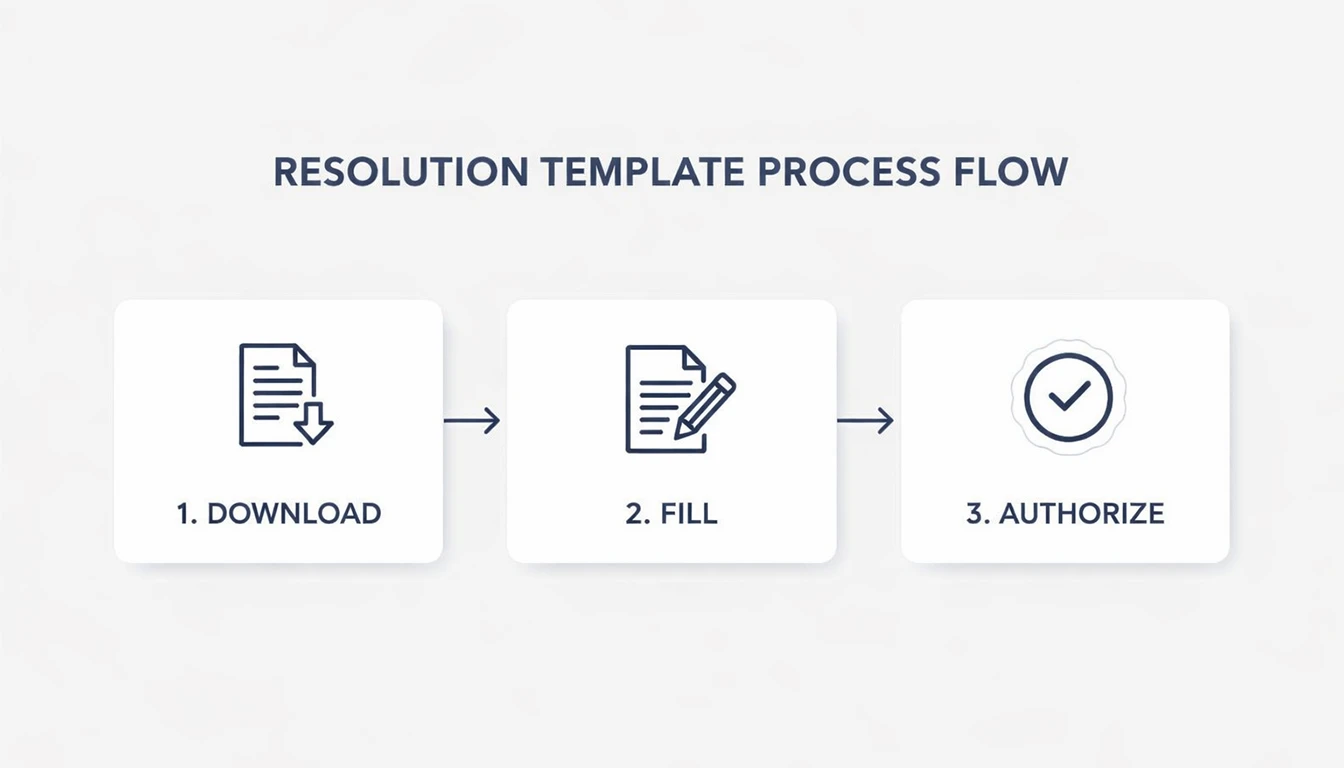
Decision, corporate record, certification and Trade Registry filing are separate layers; not every resolution needs every layer.
Board Resolution Decision Matrix
| Action |
Likely first question |
Do not assume |
| Bank account / banking authority |
What exact resolution/authority wording does the bank require? |
One generic bank template works everywhere |
| New board/representation arrangement |
Which competent body decides and what must be registered? |
Notary alone creates authority |
| Registered-address change |
Which company body has authority under the company type/articles? |
Every address move uses the same board resolution |
| Capital increase |
Which corporate body/statutory procedure applies? |
A simple board decision alone is always sufficient |
| Major commercial contract |
Does the articles/internal authority matrix require board approval? |
Every large contract must be registered |
| General assembly call |
What board/call procedure applies? |
The resulting general-assembly decision is itself a board decision |
Seven Checks Before Using a Board Resolution Template
- Confirm the company is an A.Ş. and the board is the competent body for this decision.
- Read the current articles of association.
- Confirm meeting/written-decision quorum and voting rules.
- Draft the decision around the exact transaction, not a generic “full authority” clause.
- Determine whether notarial/certified evidence is required by the recipient.
- Determine whether the decision or resulting corporate change must be registered/published.
- Record the decision in the company’s applicable physical/electronic corporate book system.

Workon coordinates corporate-change documentation and registry workflows according to the agreed scope.
How Workon Coordinates Corporate Resolutions
Workon supports foreign founders and overseas companies with business setup and corporate-change coordination in Türkiye. Depending on the agreed scope, this can include identifying the required corporate document, foreign-parent resolution sequencing, translation/notary coordination, MERSİS/Trade Registry workflow and connected bank-document preparation.
The legal validity, drafting and interpretation of company resolutions where legal professional judgment is required are handled with appropriately qualified Turkish legal professionals. Notaries, banks and Trade Registry Directorates retain their own formal requirements.
Review Workon’s company registration and operational coordination service.
Official Reference Points
Last reviewed: 17 September 2026. The correct resolution, quorum and filing requirements depend on the company type, articles and corporate action; this guide does not replace case-specific legal advice.
Frequently Asked Questions
It is a formal decision of the board of directors of an A.Ş. for a matter within board authority. The correct decision-maker, quorum, wording, corporate record and any registration or certification requirement depend on the specific action and the company’s articles.
Not automatically. A Turkish LLC uses its own manager and general-assembly decision framework depending on the matter. First identify the company type and the corporate body legally authorised to decide.
No. There is no universal rule that every A.Ş. board resolution must be notarised for internal legal effect. A particular Trade Registry filing, bank, notary or authority can require a certified or notarised copy for its own use.
No. Internal management decisions may remain corporate records, while decisions that change registered information, representation or another legally registrable matter can require filing and publication. The consequence of the specific decision controls.
Yes, where the Turkish Commercial Code, articles and applicable procedure allow it. Qualifying written or circulation decisions can be taken under the statutory route, and MERSİS provides an electronic Board Resolution Module for supported e-signature decisions.
No universal rule requires every internal resolution everywhere to originate in Turkish. A document submitted to a Turkish Trade Registry, notary, bank or authority must satisfy that recipient’s Turkish-language and translation requirements, while foreign parent-company resolutions follow their home-law decision process before Turkish legalisation and translation where required.