
Quick answer: A Turkish limited liability company (LLC / Ltd. Şti.) is governed through two core bodies: the General Assembly of shareholders and one or more managers (müdür). The General Assembly controls shareholder matters reserved by law or the Articles; managers control management and representation outside those reserved matters. At least one shareholder must hold management and representation authority, but share ownership, manager office and signing authority are separate governance questions.
This guide explains the LLC governance framework: who decides what, how shareholder and manager roles differ, how representation should be designed, and which governance controls matter to foreign owners. For annual meeting procedure and deadlines, use Turkish LLC Annual General Assembly.
Turkish LLC Governance at a Glance
| Governance layer |
Main role |
Examples |
| General Assembly |
Shareholder-level decisions reserved by law or articles |
Amending articles, appointing/removing managers, approving annual financials, deciding profit distribution, approving share transfers where required |
| Manager / managers |
Management and representation |
Running the business, implementing shareholder decisions, representing the company, maintaining required corporate processes |
| Articles of Association |
Registered constitutional framework |
Management structure, representation, share rights and company-specific rules within mandatory law |
| Shareholders’ agreement |
Private contractual layer between shareholders |
Deadlock, exit, transfer, reserved matters and commercial arrangements, subject to Turkish law and enforceability limits |
Governance rule: Do not treat share ownership, management office and signing authority as the same thing. They should be designed separately.
The General Assembly: What Shareholders Control
Article 616 of the Turkish Commercial Code reserves important matters to the General Assembly. These include, among others:
- amending the Articles of Association;
- appointing and removing managers;
- approving annual financial statements and the annual activity report;
- deciding profit distribution;
- determining manager remuneration and release where applicable;
- approving share transfers where the law/articles require approval;
- deciding on dissolution;
- other matters assigned to the General Assembly by law or the Articles.
A single-shareholder LLC still has a General Assembly function. The sole shareholder exercises the General Assembly powers, and TCC Article 616/3 requires the sole shareholder’s General Assembly decisions to be documented in writing.
Single-Shareholder LLCs: Two Different Writing Rules
Do not confuse a written General Assembly decision with a contract between the sole shareholder and the company. Under TCC Article 629/2, a contract between a single-shareholder LLC and its sole shareholder is generally subject to a separate written-form rule, except for daily, insignificant and ordinary transactions made on market terms. The purpose and legal basis of the two writing requirements are different.
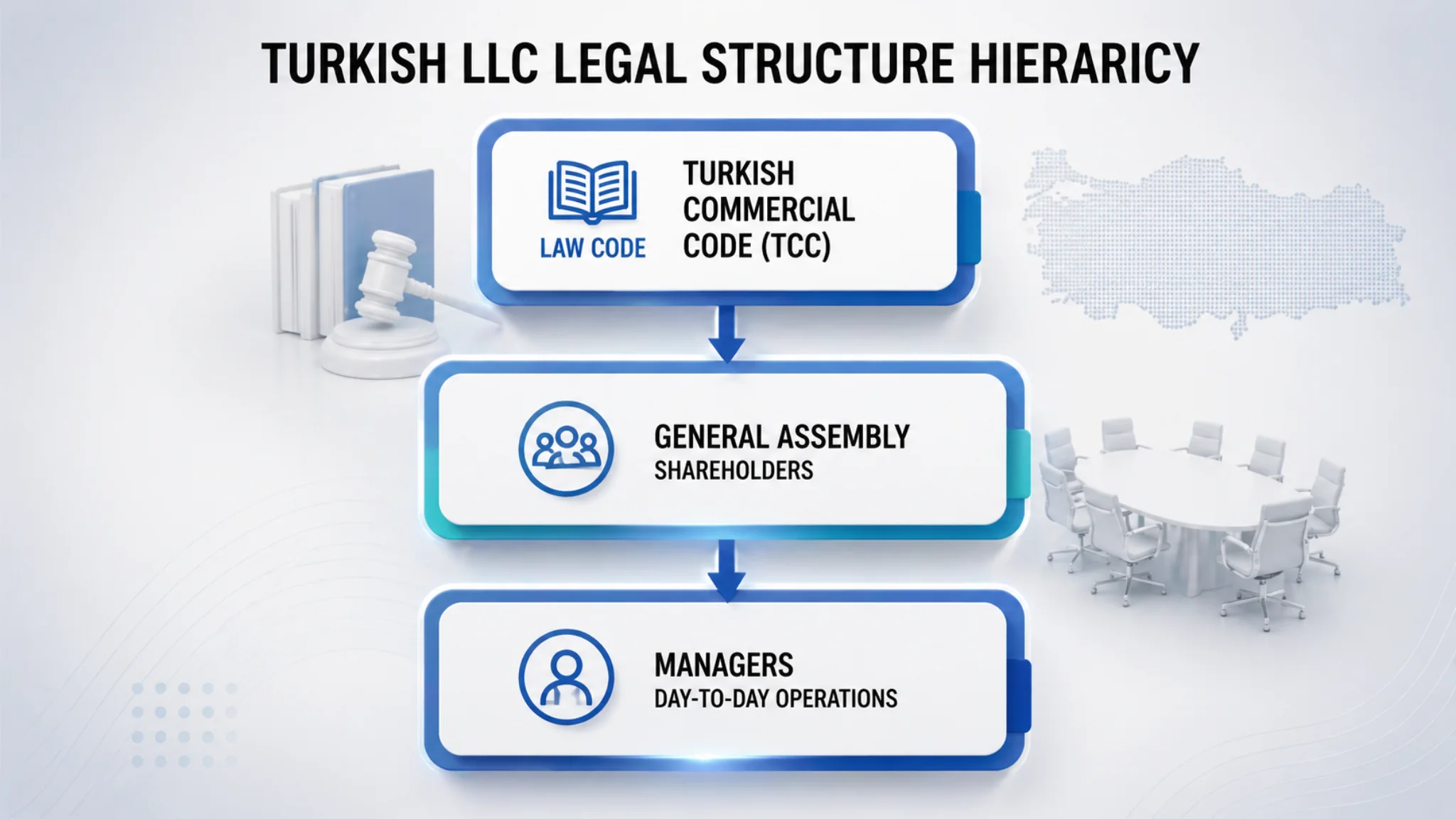
A Turkish LLC separates shareholder-level decisions from management and representation.
Managers: Who Runs and Represents the LLC?
Under Article 623, management and representation are regulated by the company’s Articles of Association. Management can be given to one or more shareholders, all shareholders or third parties acting as managers. However, at least one shareholder must have management and representation authority.
There is no general requirement that an LLC manager be a Turkish citizen or resident in Türkiye. Foreign management is therefore possible, subject to separate work-permit, sector and practical operating considerations.
For the foreign-management question, see Foreign Sole Director in Turkey.
One Manager or Several Managers?
An LLC can have a single manager. If there are several managers, one is appointed chair of the board of managers. The governance design should reflect the real operating model rather than adding managers merely for appearance.
| Model |
Potential advantage |
Main control question |
| One manager |
Simple authority chain |
Is sole-signature authority appropriate for the company’s risk profile? |
| Several managers, sole signature |
Operational flexibility |
Can each manager bind the company independently? |
| Several managers, joint signature |
Additional control over commitments |
Will joint-signature rules slow daily operations? |
If there is more than one manager, the General Assembly appoints one as chair of the board of managers. Under the current default rule, manager decisions are taken by majority; if the votes are tied, the chair’s vote prevails. The Articles and the exact decision should still be checked for any applicable special rule.
Which Manager Duties Cannot Be Delegated?
TCC Article 625 gives LLC managers a set of duties and powers that cannot simply be delegated away or waived. These include the company’s high-level management and management organisation; establishing the accounting, financial-control and financial-planning structure where required; supervising persons to whom management functions are delegated; preparing the financial statements and annual activity report; preparing the General Assembly and implementing its resolutions; and notifying the competent court when the statutory over-indebtedness trigger is met.
The Articles can require specified manager decisions to be submitted to the General Assembly for approval, but Article 625/2 states that this approval does not eliminate or limit the managers’ responsibility. Managers must also comply with the Article 626 duties of care and loyalty, and Article 627 requires equal treatment of shareholders under equal conditions.
Representation Authority: Where Governance Becomes Operational
A governance chart is not enough. The company must also define who can bind it toward third parties.
Questions to resolve before registration or a management change include:
- Who signs contracts?
- Is signature authority individual or joint?
- Who can operate bank accounts?
- Who can sign employment, lease and supplier documents?
- Which internal approvals should exist before a manager signs?
Internal approval limits and external representation are not automatically the same thing. Under TCC Article 629, the relevant representation rules for joint-stock companies apply to LLC managers by analogy. As a general rule, a restriction on representation does not bind a good-faith third party; registered restrictions limiting authority to the affairs of the head office or a branch, or requiring joint exercise of representation, can have external effect under the statutory framework. A private shareholder instruction such as “manager cannot sign above EUR X” should therefore be treated as an internal approval control unless it is implemented through a legally supported registered representation structure. The Code also provides a separate registered route for specified limited-authority commercial representatives employed by the company.
Articles of Association vs Shareholders’ Agreement
Foreign founders often try to put every commercial arrangement into one document. A better approach is to understand the function of each layer.
| Document |
Function |
Typical use |
| Articles of Association |
Registered company constitution |
Management, representation, capital, share structure and registered governance rules |
| Shareholders’ agreement |
Private agreement among shareholders |
Deadlock, reserved matters, transfer arrangements, funding obligations and exit mechanics |
A shareholders’ agreement cannot simply override mandatory Turkish company law or create an externally effective restriction that the registered company structure does not support. Important governance terms should therefore be designed with the Articles and the private agreement together.
Shareholder Rights: Think in Categories, Not Percentages Alone
Shareholder rights include voting, participation in General Assembly decisions, information and inspection rights, and economic rights such as profit distribution when validly resolved. Minority and special rights depend on the Turkish Commercial Code, the Articles and the specific decision involved.
TCC Article 614 gives each shareholder the right to request information from the managers about the company’s affairs and accounts and to inspect specific matters. Managers may restrict access only to the extent there is a risk that the information will be used to the company’s detriment; the shareholder can bring that restriction to the General Assembly, and an unjustified General Assembly refusal can be taken to court under the statutory procedure.
Avoid generic statements such as “10% shareholders can block major decisions” or “1% shareholders have no protection.” Voting, information, transfer, exit and special-protection rights have different thresholds, procedures and conflict rules.
When Can an LLC Shareholder Be Barred from Voting?
Share ownership does not create an unrestricted right to vote on every decision. Under TCC Article 619, a person who participated in company management cannot vote on a resolution releasing managers from liability; a shareholder transferring a capital share to the company cannot vote on the company’s acquisition of that share; and a shareholder cannot vote on a resolution approving that shareholder’s conduct that conflicts with the loyalty duty or non-compete restriction.
Manager duties are a separate control layer. TCC Article 626 requires managers and persons entrusted with management to act with due care and protect the company’s interests in good faith. Unless the Articles provide otherwise or the other shareholders give the required written permission, managers are also restricted from competing with the company. A General Assembly approval requirement can be built into the Articles, but shareholder approval of a manager decision does not automatically remove the manager’s statutory responsibility.
These conflict rules should be checked before counting votes or drafting a resolution. The practical question is not only “how many votes does this shareholder have?” but also “is this shareholder entitled to vote on this specific matter?”
Annual General Assembly: Governance Calendar, Not the Whole Governance System
The ordinary General Assembly is generally held within three months after the end of the financial year. Its agenda commonly includes annual financial statements, profit distribution and manager-related decisions.
That annual meeting is one part of governance. A company also needs to document important shareholder and manager decisions during the year and register changes that affect the public commercial record.
For meeting notice, agenda, voting and documentation detail, see Turkish LLC Annual General Assembly Guide.
MERSİS Can Support Circular General Assembly Decisions
The Ministry of Trade’s MERSİS guidance notes that LLC shareholders can use the electronic circular General Assembly decision module in qualifying cases. Under TCC Article 617/4, a circulation-type General Assembly decision requires that no shareholder request oral deliberation and that the same proposal be submitted to all shareholders. Where all shareholders are natural persons with e-signatures, a draft decision can be circulated and signed electronically through MERSİS under the relevant procedure.
This can be especially useful for companies with shareholders in different locations, but it does not eliminate the need to check whether the particular decision is suitable for the electronic route and whether other registry/notarial formalities apply.

Workon coordinates company formation and corporate-change workflows for foreign-owned Turkish companies.
Which Changes Need Trade Registry Attention?
Not every internal business decision changes the public record. But registered corporate information should remain accurate. Typical transactions that can require MERSİS/Trade Registry action include:
- registered address changes;
- manager appointments or removals;
- representation/signature changes;
- capital increases or reductions;
- share transfers where registration is required;
- amendments to the Articles;
- company title or other registered-data changes.
For ownership changes, use Share Transfer in Turkish LLCs.
Governance and Tax / Statutory Compliance Are Separate Layers
Corporate governance should not be turned into a generic tax checklist. Tax declarations, payroll, e-invoicing, e-ledger and statutory reporting or bookkeeping obligations are separate compliance layers handled through a licensed SMMM/CPA according to the company’s actual obligations.
Likewise, the fact that some company books or corporate records can move into electronic systems does not justify a blanket statement that every LLC must maintain every record as a physical notarised book forever. For companies whose incorporation is registered from 1 January 2026, the share ledger and General Assembly meeting and negotiation book are kept through ETDS. An LLC may also keep a separate managers’ board resolution book; if it does not, managers’ decisions are recorded in the General Assembly meeting and negotiation book under the applicable framework. The record medium does not replace the substantive decision, representation or registration rules.
See Turkish CPA Requirement and Turkey Company Compliance Checklist.
Governance Mistakes Foreign Shareholders Should Avoid
| Mistake |
Why it matters |
Better approach |
| Giving equity because a Turkish partner is assumed mandatory |
Ownership is changed for the wrong reason |
Separate legal requirement from commercial partnership strategy |
| Using a broad manager appointment without designing representation |
The company may be bound more broadly than shareholders intended |
Design registered authority and internal approval controls together |
| Relying only on verbal agreements |
Expectations are difficult to enforce and may conflict with registered governance |
Document material rights in the appropriate legal instrument |
| Assuming shareholders’ agreement overrides the Articles |
Private rights and registered corporate effect are different |
Align both documents with mandatory Turkish law |
| Failing to register corporate changes |
Public records no longer reflect the actual governance |
Map every management/ownership change to its filing requirements |
Governance Checklist for a Foreign-Owned Turkish LLC
- Identify shareholders and beneficial owners.
- Decide who will be manager and ensure at least one shareholder has management/representation authority.
- Choose sole or joint representation deliberately.
- Align Articles of Association and any shareholders’ agreement.
- Document reserved shareholder matters and internal approval rules.
- Maintain a calendar for annual and event-driven corporate decisions.
- Register management, address, capital and other record changes when required.
- Keep governance, banking, tax / licensed SMMM-CPA and work-permit processes as separate compliance layers.
How Workon Fits Into LLC Governance
Workon coordinates company formation and corporate-change workflows for foreign founders and overseas companies operating in Türkiye. Depending on the agreed scope, this can include MERSİS/Trade Registry coordination for manager changes, share transfers, address changes, capital changes and connected document workflows.
A practical governance control is to reconcile the Articles, the relevant shareholder/manager decision, the Trade Registry representation record and the company’s operational mandates before the change is treated as complete. A private approval matrix or bank mandate should not be assumed to change registered corporate representation by itself.
Where the workflow requires legal drafting, shareholder-agreement advice or dispute work, Workon coordinates the relevant work with appropriately licensed Turkish lawyers. Tax, bookkeeping and statutory-compliance work is coordinated with licensed SMMM/CPA professionals.
Review Workon’s company registration and operational coordination service.
Official Sources
Last reviewed: 17 September 2026. This guide provides general governance information and does not replace case-specific legal or tax advice.
Frequently Asked Questions
It is the framework that separates shareholder-level General Assembly powers from manager-level management and representation, and coordinates the Articles, registered authority, internal approvals and private shareholder arrangements.
One or more managers manage and represent the company under the Articles and registered authority structure. Non-shareholders can be appointed as managers, but at least one shareholder must hold management and representation authority. TCC Article 625 also leaves specified high-level governance duties with the managers as non-delegable duties, and General Assembly approval of a manager decision does not automatically remove the manager's statutory responsibility.
Yes. The ordinary General Assembly is generally held within three months after the end of the financial year. The exact notice, voting, proxy, circulation and post-meeting filing rules belong to the annual General Assembly procedure and depend on the agenda and Articles.
Yes, where TCC Article 617\/4 and the applicable procedure allow it. A circulation decision requires that no shareholder request oral deliberation and that the same proposal be submitted to all shareholders. For qualifying LLCs whose shareholders are all natural persons with e-signatures, MERSIS provides an electronic General Assembly Decision Module.
Internal approval rules and external representation are different. Under the representation rules applied to LLCs through TCC Article 629, restrictions generally do not bind good-faith third parties; registered limits to head-office or branch affairs and registered joint-signature structures are among the statutory exceptions. A private monetary approval cap should therefore be treated as an internal control unless it is implemented through a legally supported registered representation structure.
No. TCC Article 619 creates voting exclusions for specified conflict situations, including certain manager-release decisions, a company acquisition of a shareholder's capital share, and approval of conduct by that shareholder that conflicts with the loyalty duty or non-compete restriction. Voting entitlement should therefore be checked for the specific resolution, not inferred only from the shareholder's ownership percentage.