Quick answer: A transfer of shares in a Turkish limited liability company (Ltd. Şti.) is governed primarily by Articles 595–598 of the Turkish Commercial Code. The transfer obligation must be documented in writing and the parties’ signatures must be notarised. Unless the articles of association provide otherwise, the shareholders’ general assembly must approve the transfer. After approval, the company must complete the applicable share-ledger and Trade Registry/MERSİS steps.
This guide explains the detailed Turkish LLC share-transfer process. If the first question is whether the newcomer should buy existing shares or inject new funds into the company, begin with How to Add a Partner to a Turkish Company. If the company should issue new capital rather than transfer an existing stake, use the separate Capital Increase in Turkey guide.
The Four Legal Layers of an LLC Share Transfer
| Layer |
Core question |
Main control |
| Transfer agreement |
What share is transferred, by whom, to whom and on what terms? |
Written form and notarised signatures under TCC Article 595 |
| Company approval |
Does the company consent to the incoming shareholder? |
General-assembly approval by default, subject to the articles |
| Company and registry records |
Do the share ledger, MERSİS and Trade Registry file reflect the approved change? |
Article 598 filing duty and current registry requirements |
| Operational closing |
Have UBO, bank KYC, management, authority and foreign-investment records been updated? |
Trigger-based post-closing checklist |
A transfer can fail operationally even where the parties agree commercially. Treat the contract, company consent, registry file and post-closing controls as connected but legally distinct layers.
A Turkish LLC share transfer combines a notarised agreement, company approval and record updates.
Step 1: Confirm That Share Transfer Is the Correct Route
In a share transfer, an existing shareholder transfers all or part of an existing capital share. The purchase price normally belongs to the seller; it does not automatically become funding for the company. The company’s registered capital remains unchanged.
If the commercial goal is to place new equity into the company, a capital increase may be the correct route. A transaction can also combine a partial founder sale with a capital increase, but the two money flows and legal procedures should be documented separately.
Before drafting, state the intended result in one sentence:
- which current shareholder is transferring which capital share;
- the nominal value and resulting ownership percentages;
- whether the transfer is full or partial;
- whether the incoming person will also become a manager or signatory; and
- whether any separate funding will enter the company.
Important: A person does not become a manager, authorised signatory, employee or work-permit holder merely by acquiring an LLC share. Handle each additional status through its own legal and operational process.
Step 2: Audit the Company Before Signing
Use the company’s current records—not an old draft or informal cap table. Reconcile:
- the latest registered articles of association;
- the current Trade Registry/Gazette record and share ledger;
- the nominal value, ownership percentage and payment status of the shares;
- any pledge, attachment, usufruct or other restriction affecting the stake;
- additional-payment and ancillary-performance obligations;
- pre-emption, call, put, buy-back or right-of-first-offer provisions;
- transfer restrictions in the articles or a shareholder agreement;
- the company’s current managers and representation rules; and
- regulated-sector, licence, finance or material-contract change-of-control requirements.
For the broader corporate-document file, see Limited Company Documents in Turkey. A share purchase should also use transaction-appropriate financial, tax and legal due diligence rather than relying only on registry records.
Step 3: Draft the Share-Transfer Agreement
Article 595 requires the transaction creating the obligation to transfer an LLC capital share to be made in writing, with the parties’ signatures notarised. The statutory form should not be confused with a generic internet template.
The agreement should be tailored to the company and transaction. Relevant subjects commonly include:
| Subject |
What to define |
Why it matters |
| Parties and authority |
Correct names, identity/company data and signing capacity |
Prevents mismatch across notary and registry records |
| Transferred share |
Nominal value, percentage and whether the transfer is full or partial |
Must reconcile with the registered capital and post-closing cap table |
| Price and payment |
Amount, currency, timing, account and evidence |
Separates purchase consideration from company capital |
| Approval and closing |
General-assembly consent, document readiness and other conditions |
Prevents payment and ownership steps from becoming unsynchronised |
| Share-linked obligations |
Additional payments, ancillary duties and relevant restrictions |
Article 595 specifically requires attention to these matters |
| Seller protections and buyer protections |
Title, encumbrances, liabilities, disclosures, warranties and remedies |
Allocates transaction risk beyond the registry filing |
| Post-closing work |
Records, bank KYC, UBO, management and access changes |
Turns legal closing into operational readiness |
Material warranties, indemnities, disclosure arrangements, escrow, deferred consideration or restrictive covenants require transaction-specific legal drafting. A notary’s authentication of signatures does not replace legal and financial due diligence or guarantee the commercial terms.
Step 4: Obtain the Correct Company Approval
Unless the articles of association provide otherwise, TCC Article 595 makes shareholders’ general-assembly approval the default requirement and ties the transfer’s validity to that approval. It is therefore incorrect to describe an LLC “board of managers” as the automatic approval body for every transfer.
The articles must be checked because they may:
- change the default approval position;
- restrict or prohibit transfer;
- create company-specific eligibility or consent conditions;
- include additional-payment or ancillary obligations; or
- interact with contractual pre-emption and option rights.
Where approval is required, the resolution and transfer agreement should use identical party names, nominal values, percentages and transaction references. The meeting, decision threshold, conflict/participation questions and certification format should be checked for the actual company rather than copied from a generic resolution.
Article 595 also provides a deemed-approval mechanism where the general assembly does not reject the application within three months. Do not use that rule as a substitute for a planned closing file: uncertainty over the application date, articles, corporate records or connected conditions can still create disputes and operational delay.
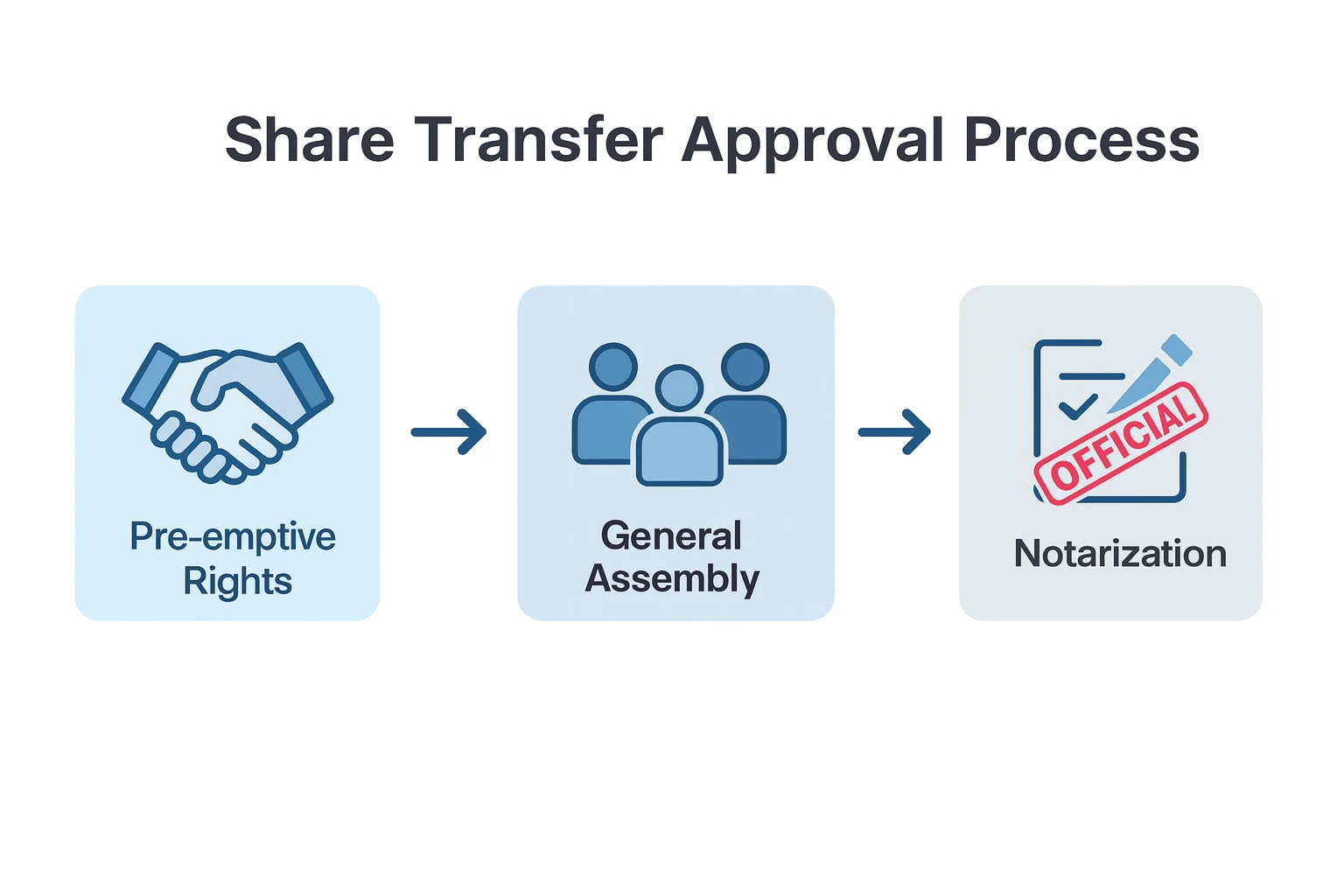
The articles of association and Article 595 determine the company-consent path.
Step 5: Complete the MERSİS and Trade Registry File
TCC Article 598 directs the company’s managers to apply for registration of the capital-share transfer within 30 days following approval. This filing rule should not be rewritten as a generic statement that “registration alone makes the transfer valid”; Article 595 separately addresses the agreement and company approval.
The operational sequence normally includes:
- prepare the applicable MERSİS change application;
- assemble the current petition, transfer agreement, company decision and party evidence required by the competent Trade Registry;
- resolve discrepancies in names, tax numbers, nominal values or percentages;
- complete registration and Gazette publication steps where applicable; and
- reconcile the company’s share ledger and internal records with the completed filing.
Registry document lists and electronic submission practices can change. Check the current page of the competent Trade Registry and the live MERSİS workflow before signing. For the system’s role in corporate changes, see MERSİS Company Registration in Turkey. For checking published company history, use Trade Registry Gazette Search in Turkey.

After approval, reconcile the notarised agreement, company records and MERSİS/Trade Registry filing.
Foreign Buyers, Sellers and Corporate Shareholders
Türkiye’s foreign-investment framework is based on equal treatment, subject to special legislation and sector-specific restrictions. A foreign individual or foreign company can therefore acquire an interest in a Turkish LLC without adding a Turkish co-shareholder merely because of nationality.
The documents differ by party type. A foreign individual and a foreign legal entity should not be given the same checklist. Depending on the transaction and receiving institution, the file may require:
- passport/identity and address evidence;
- a potential Turkish tax number;
- a current foreign-company status or activity document;
- a competent-organ resolution approving the acquisition;
- evidence showing the foreign entity’s signatories and ownership;
- transaction-specific power of attorney; and
- accepted authentication and Turkish translation.
Not every foreign document follows one universal apostille path. The route depends on the issuing country, the document, any treaty or practice exemption and the Turkish receiving authority. Check the Apostille for Turkey Documents guide and Sworn Translation in Turkey guide before finalising the document route.
Can an LLC Share Transfer Be Completed by Power of Attorney?
A properly authorised representative may be able to complete specified signing, notary and registry steps. Remote completion is nevertheless document- and institution-specific; it should never be promised solely because a power of attorney exists.
The power should identify the company and transaction, define the shares and permitted acts, address payment or receipt authority only where intentionally granted, and control delegation, conflicts, document collection and close-out. Foreign-issued powers may require authentication and accepted Turkish translation.
Use Power of Attorney in Turkey: Scope & Signing Guide as a drafting brief. A power of attorney does not compel a bank to accept remote KYC or make every regulatory step delegable.
Tax, Stamp Duty and Transaction Costs
Do not budget an LLC share transfer using an obsolete universal stamp-duty percentage or a generic “tax-free after two years” statement.
The seller’s tax position can depend on whether the seller is an individual or company, residence, acquisition history, company and instrument type, treaty position, transaction value and the law applicable in the sale period. An LLC capital share should not automatically be treated like a qualifying A.Ş. share certificate for an individual’s holding-period analysis.
A corporate seller may have a different participation-share regime. The Turkish Revenue Administration’s current 2026 guide explains the corporate-tax and VAT conditions for participation-share disposals, including holding-period and other statutory tests. Eligibility must be calculated for the actual seller and transaction.
Document-level stamp-tax exemptions may also be relevant, but they do not eliminate every cost. The file may still involve:
- notary charges;
- translation and authentication costs;
- Trade Registry and Gazette charges;
- legal due diligence and drafting fees;
- licensed CPA/SMMM tax analysis and filing work; and
- bank, valuation or transaction-administration costs where applicable.
Confirm the tax and cost treatment before fixing the purchase price, payment mechanics and cost allocation in the agreement.
Official 2026 SMMM professional-fee reference
The 2026 SMMM professional-fee tariff lists TRY 5,330 for share-transfer professional work. This is a minimum/professional SMMM tariff reference; it is not the purchase price, notary fee, Trade Registry/Gazette charge, legal due-diligence fee, tax liability or Workon coordination fee.
The actual professional scope can differ with the seller and buyer, foreign-party documents, tax analysis, management changes and post-closing filings. For future annual updates, verify the current year through the İSMMMO Professional Fee Tariffs archive and the corresponding TÜRMOB / Official Gazette tariff.
Post-Closing Compliance Checklist
- Share ledger: Record the approved ownership position and retain the supporting documents.
- Registry records: Verify that MERSİS, Trade Registry and Gazette outputs match the transaction.
- Beneficial ownership: Recalculate direct, indirect and other control and complete any triggered update. See Beneficial Owner Declaration in Turkey.
- Foreign-investment reporting: Determine whether the foreign share acquisition triggers an E-TUYS FDI Share Transfer Data Form or related update.
- Bank KYC: Submit the ownership/control and source-of-funds evidence required by the bank. Registry completion does not guarantee bank acceptance.
- Management and signatures: Complete separate decisions and registry/notary steps if a manager or representation arrangement changes.
- Licences and contracts: Check ownership-change notifications, consents and sector approvals.
- Access control: Update online banking, e-signature, KEP, tax-portal and internal permissions without sharing personal credentials.
How Long Does an LLC Share Transfer Take?
There is no reliable universal “three to seven business day” promise. The timeline depends on commercial agreement, due diligence, the articles, corporate approval, foreign-document readiness, notary scheduling, registry corrections, sector approvals and whether management or bank-KYC changes are included.
Plan the transaction through separate gates:
- ownership and restriction audit;
- commercial agreement and due diligence;
- document, authentication and translation readiness;
- notarised signing and company approval;
- MERSİS/Trade Registry completion; and
- post-closing compliance and operational access.
Estimate each gate only after the company record and participants are known.
Common LLC Share-Transfer Errors
| Error |
Why it fails |
Control |
| Using a JSC checklist for an LLC |
The statutory form and approval framework differ |
Start with TCC Articles 595–598 |
| Treating a private payment as company capital |
Purchase price and equity contribution have different functions |
Separate transfer and capital-increase money flows |
| Assuming managers automatically approve the transfer |
General-assembly approval is the Article 595 default |
Read the articles and use the correct company organ |
| Ignoring share-linked obligations |
The incoming shareholder may acquire more than economic rights |
Review additional-payment, ancillary and contractual obligations |
| Using one foreign-document checklist for every country |
Authentication and translation routes differ |
Verify origin, document type and receiving authority |
| Promising a fixed tax exemption |
Seller and instrument facts change the result |
Obtain transaction-specific licensed tax advice |
| Stopping after registry filing |
UBO, bank KYC, E-TUYS and access records may remain stale |
Run the post-closing checklist |
How Workon Coordinates an LLC Share Transfer
Workon coordinates the operational workstream for foreign founders, investors and overseas companies involved in Turkish corporate changes. Depending on the agreed scope, this can include company-record review, document sequencing, MERSİS/Trade Registry coordination, notary and sworn-translation coordination, foreign-document tracking, registered-address continuity, bank-file preparation and post-closing task management.
Legal due diligence, legal opinions and transaction agreements are handled by appropriately authorised lawyers. Tax analysis, declarations and professional accountancy work are handled by the company’s licensed CPA/SMMM. The notary, Trade Registry, bank and public authorities retain their own acceptance and decision powers.

Workon coordinates Turkish company-registration and related corporate-change workflows according to the agreed scope.
Review Workon’s business setup and operational coordination services.
Official Sources
Last reviewed: 17 September 2026. The exact file depends on the LLC’s articles, registered records, transferred share, parties and transaction documents.
Frequently Asked Questions
The transfer obligation must be documented in writing and the parties’ signatures notarised under Turkish Commercial Code Article 595. Unless the articles provide otherwise, the shareholders’ general assembly must approve the transfer. The company then completes the applicable share-ledger, MERSİS and Trade Registry updates.
No. In a share transfer, the purchase price normally goes to the selling shareholder and the company’s registered capital remains unchanged. If the commercial goal is to inject new equity into the company, a capital increase is a separate route and can be combined with a share transfer where appropriate.
No. General-assembly approval is the default under Article 595 unless the articles of association provide otherwise. The articles and any shareholder or contractual transfer restrictions should be reviewed before signing.
Generally yes, subject to sector-specific restrictions or approvals. The transaction can require foreign identity or corporate-authority documents, authentication, Turkish translation and other evidence depending on the investor and issuing jurisdiction.
No. Share ownership, management authority, signing authority, employment and work authorisation are separate legal and operational statuses and must each be handled through their own applicable process.
There is no reliable universal three-to-seven-business-day promise. Timing depends on due diligence, the articles, company approval, foreign-document readiness, notary scheduling, Trade Registry corrections, sector approvals and whether management, UBO or bank-KYC changes are part of the closing.
No blanket rule should be used. Tax treatment depends on the seller, residence, acquisition history, company and instrument type, treaty position and the law applicable to the transaction. An LLC capital share should not automatically be treated like a qualifying JSC share certificate.