Quick answer: A sworn translation in Turkey (yeminli tercüme) is prepared and signed by a translator whose competence and oath have been accepted in the Turkish notarial framework. It is not automatically the same as a notarised translation (noter onaylı tercüme). Whether you need the translator’s signed translation alone, additional notary certification, an apostille or consular legalisation depends on the document and the authority receiving it.
Ask for the acceptance level, not just “an official translation.” Before ordering, obtain the receiving authority’s current wording: certified translation, sworn translation, notarised Turkish translation, apostilled document, consularly legalised document—or a combination.
Last reviewed: 17 September 2026. Notary tariffs, administrative checklists and accepted electronic formats can change, so obtain a current quote and confirm the receiving authority’s format before submission.
Sworn Translation vs Notarised Translation in Turkey
| Term |
What it means |
What it does not prove |
| Standard translation |
A translation without a Turkish sworn-translator or notarial certification layer |
It does not by itself satisfy an authority asking for yeminli or noter onaylı translation |
Sworn translation
(yeminli tercüme) |
A translation signed by a translator accepted and sworn within the notarial framework |
It is not automatically notarised and does not authenticate the foreign source document |
Notarised translation
(noter onaylı tercüme) |
A translation completed through the formal notarial translation/certification process |
It does not confirm that the source document’s substantive statements are true |
| Apostilled or legalised document |
A source document whose relevant public signature, capacity and seal/stamp have passed the applicable international authentication route |
Authentication does not replace translation or guarantee acceptance for a particular filing |
The distinction matters. A bank may accept an English document or a provider-certified translation for one review, while a Trade Registry filing may expressly require a notarised Turkish translation. Another authority may accept a multilingual public form without translation. There is no safe rule that every foreign document in every Turkish procedure must pass through the same three steps.

The required translation level follows the receiving authority, document type and authentication status.
Who Is a Sworn Translator in Turkey?
Under Turkey’s notarial framework, a notary who does not personally know the relevant language or script may have the document translated by an interpreter. Article 96 of the Notary Law Regulation requires the notary to be satisfied—through diplomas, other documents or other means—that the translator knows the language or script correctly. The translator’s oath and the notarial record support the formal process.
This is not best understood as a single worldwide or nationwide translation certificate that every office must accept. Before ordering a notarised translation, confirm:
- the exact language pair and direction;
- which notary can process that translator’s work and oath/signature record;
- whether the notary needs the original, a certified copy or an electronically verifiable source;
- whether the apostille or legalisation pages must also be translated; and
- how names, seals, stamps, handwritten notes and unreadable sections will be shown.
A translator’s stamp or signature alone should not be described as making every source document “legally valid.” The translation records the content in another language; the source document’s authenticity, legal effect and suitability remain separate questions.
What Does the Turkish Notary Do?
Article 103 of the Notary Law governs notarial translation from one language to another or from one script to another. When a translator is used, the notarial endorsement identifies the formal translation act and the translator. The notary does not become the Turkish authority deciding the merits of a company, residence, banking or court application.
In practice, “notarised translation” can involve review of the source presented, the translator’s signed text, the notarial endorsement, copies and the way pages are attached or referenced. The exact packet can differ by document and office. Ask for a sample endorsement or written scope when the file will be used in a sensitive cross-border transaction.
The Correct Workflow for a Foreign Document
1. Identify the receiving authority and purpose
Start with the Trade Registry, notary, bank, ministry, university, court, immigration office or other body that will receive the document. Request its current checklist and ask what language and certification level it accepts.
2. Confirm the correct source document
Ask whether the authority needs the original, an official extract, a certified copy or a particular form. Confirm any freshness requirement. Translating the wrong version accurately still produces the wrong filing document.
3. Complete source-document authentication where required
If a foreign public document needs an apostille or consular legalisation, that step normally belongs to the document’s country of origin. It must be completed before the final Turkish translation packet is prepared, because the authentication certificate and attached pages may also need translation.
Use Apostille for Turkey Documents to choose between apostille, consular legalisation and any applicable exemption. That guide explains authentication; this guide explains translation and notarial acceptance.
4. Confirm the translator–notary route
Send a clear scan for quotation and pre-check, but ask whether the original must be presented for the actual notarial act. Confirm the notary before translation starts, especially for a less common language or a document containing a second language, handwritten text or complex seals.
5. Translate the complete final package
Include all pages the receiving authority needs: source text, reverse-side entries, apostille or legalisation certificate, allonge, stamps, seals and relevant annotations. A translation should mark illegible text or blank sections honestly rather than invent content.
6. Complete notary certification only if required
Do not assume that a sworn translation always needs a notary stamp, or that a translator stamp alone is enough. Use the receiving authority’s stated requirement. Check the final notarial packet for consistent names, page count, document date and attachment references before leaving the office.
7. Submit in the accepted format
A PDF scan is useful for review but is not automatically equivalent to an original, certified copy or securely electronically signed document. Equally, a blanket claim that an official translation can never be electronic is unsafe. Ask whether the receiving authority accepts paper originals, certified copies, qualified electronic signatures or a verifiable digital record.
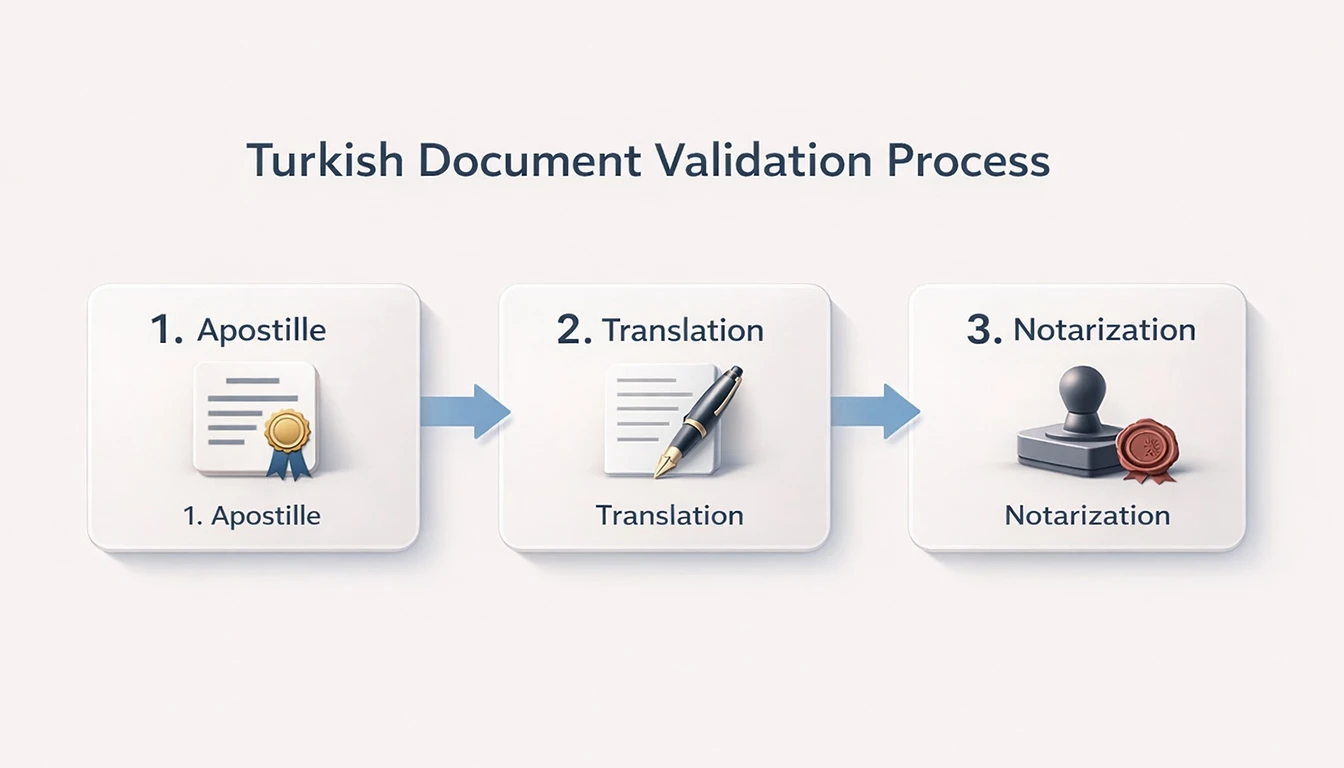
Authentication, translation, notarial certification and substantive acceptance are separate controls.
Company Formation: What Istanbul Trade Registry Currently Requires
Current Istanbul Chamber of Commerce guidance gives concrete examples for limited-company registration:
- the passport of a foreign individual shareholder is submitted as a notarised Turkish translation copy;
- specified records for a foreign legal-entity manager or shareholder must be certified by the Turkish consulate in the home jurisdiction or under the Apostille Convention and accompanied by a notarised Turkish translation; and
- foreign signature declarations and authority evidence can carry their own authentication and translation requirements.
These are useful filing examples, not a universal list for every Turkish registry transaction. The package changes with the company type, shareholder type, manager appointments, remote signing and the nature of the corporate decision.
| Foreign-founder item |
Translation control |
Separate control |
| Passport |
Confirm which pages and name/script treatment the registry requires |
Identity number/tax number and residence evidence are separate where applicable |
| Foreign company registry record |
Translate the final authenticated record and all relevant certification pages |
Check currency/freshness and whether it proves current status and representation |
| Foreign corporate decision |
Preserve names, titles, resolutions, voting and signature details |
Check whether the decision grants the powers the Turkish filing needs |
| Power of attorney |
Translate the signed, authenticated final instrument |
Approve transaction-specific powers before signing abroad |
| Constitutional document |
Translate the required sections or complete document as instructed |
Confirm whether the registry needs the current consolidated text |
For the broader LLC package, see Limited Company Documents in Turkey. For authority wording and remote signing, see Power of Attorney for Turkey.
Other Procedures: Translation Requirements Are File-Specific
| Procedure |
Documents that may raise a translation issue |
What to confirm |
| Residence or family-status filing |
Passport, birth, marriage, custody or other civil-status evidence |
Exact document, authentication/exemption, translation language, notary requirement and freshness |
| Work or regulated-profession filing |
Diploma, qualification, licence, employment or corporate evidence |
Whether translation, equivalency/recognition or another substantive approval is required |
| Bank compliance |
Identity, address, ownership, source-of-funds and corporate authority records |
The bank’s own KYC format; do not assume every bank accepts the same certification level |
| Court or contractual use |
Pleadings, judgments, contracts, correspondence and evidence |
Court/procedural rules and counsel instructions; ordinary business translation may be insufficient |
| Turkish document for use abroad |
Registry extract, activity certificate, resolution, notarial act or civil-status record |
The foreign receiving authority’s translation language and whether the Turkish original or notarial act must be apostilled |
Statements such as “a criminal record is always required for a residence permit” or “all banks require a notarised proof-of-address translation” are too broad. The purpose of this guide is to select the right translation layer after the actual application checklist is known.
Name, Number and Layout Controls
For corporate and identity documents, a translation can be linguistically sound and still fail operationally because identifiers do not match. Use a consistency sheet for:
- full name, former surname and name order;
- Latin transliteration of non-Latin scripts;
- passport, identity, tax and company registration numbers;
- company legal name, suffix and jurisdiction;
- dates written in an unambiguous format;
- titles and signing capacity;
- addresses and place names; and
- stamps, seals, QR codes and verification references.
Ask the translator not to “improve” or silently reconcile a discrepancy. If two source documents spell a name differently, resolve or explain that mismatch with the filing professional.
Rare Languages and Bridge Translation
A direct sworn translator may not be readily available for every language pair. A bridge translation through another language may be possible in some workflows, but it adds another chain of signatures, versions and possible meaning loss. Obtain advance confirmation from the notary and receiving authority before commissioning two translations. Do not assume that an English intermediary version will automatically be accepted.
Sworn Translation Costs in Turkey in 2026
The total normally has separate layers:
- Translator/service fee: a market price affected by language pair, volume, complexity, formatting, handwriting, urgency and project management.
- Notarial charges: statutory tariff items that depend on the notarial act, pages/lines, copies and related charges.
- Authentication and logistics: apostille or consular steps, certified copies, courier and return delivery where applicable.
The 2026 Notary Fee Tariff lists a translation charge of TRY 667.67 per page for papers translated or commissioned for translation by the notary under Article 103; a page with ten or fewer lines is charged at half that item. This is not the whole customer invoice and it is not the private translator’s market fee. Other notarial, writing, comparison, copy, tax or service items may apply. The August 2026 amendment changed the tariff’s travel-expense provision, not this translation item.
Request an itemised quote showing the translator fee, notary estimate, number of originals/copies, authentication, tax and courier separately. Do not rely on old TRY ranges or a universal rush surcharge.

A useful quote separates translation, notarial, authentication, copy and delivery costs.
How Long Does Sworn Translation Take?
There is no universal 24-hour or two-to-three-day promise. Timing depends on document length and legibility, language availability, notary coordination, authentication status, original-document delivery, correction cycles and the receiving authority’s schedule.
For a realistic plan, ask for four dates:
- scan pre-check completed;
- translation draft ready;
- notarial step available, if required; and
- original/certified packet ready for collection or dispatch.
Build extra time for name discrepancies and replacement source documents. Public holidays matter only as part of the actual authority and notary calendar; they do not justify a generic delay estimate.
Does a Sworn Translation Expire?
There is no single general expiry period for every sworn or notarised translation. The practical issue is usually the underlying source document or the receiving authority’s freshness rule. If a new registry extract or criminal record is required, the old translation may no longer correspond to the accepted source record and must be updated.
Confirm document freshness before ordering. Do not use a generic three-month or six-month rule across company, immigration, banking and court procedures.
Common Mistakes to Avoid
- Buying the wrong certification level: “certified,” “sworn” and “notarised” are not interchangeable labels.
- Translating before authentication: the final apostille or legalisation pages may also need translation.
- Assuming authentication is included: a notarised translation does not automatically apostille the foreign source document.
- Ignoring the notary workflow: confirm that the selected notary can process the selected translator’s work.
- Using a partial scan: missing reverse pages, stamps or allonges can invalidate the packet.
- Changing names for style: transliteration and company-name mismatches can break identity and authority checks.
- Treating a PDF scan as an original: acceptance depends on the source and receiver’s electronic-document rules.
- Relying on a fixed price or deadline: obtain a current itemised quote tied to the actual document.
How Workon Supports the Translation Workflow
For Workon-managed company-formation and corporate-document projects, Workon can coordinate the receiving-authority checklist, source-document pre-check, translator/notary sequence and delivery of the filing packet. The translator is responsible for translation work; the notary performs the notarial act; apostilles are issued by designated public authorities; legal opinions and regulated professional work remain with the appropriate licensed professional.
For the full incorporation sequence, continue to Company Formation in Turkey: 2026 Guide.

Confirm the accepted format before translating, notarising or shipping the original document.
Official Sources
Frequently Asked Questions
A sworn translation is prepared and signed by a translator whose language competence and oath have been accepted within the Turkish notarial framework. It is not automatically the same as a notarised translation, and the translation itself does not authenticate the foreign source document.
No. The required level depends on the receiving authority, document type, issuing country, treaty position and transaction. Some procedures require a notarised Turkish translation, some can accept another certified or multilingual format, and banks or other institutions can set their own document rules.
Potentially, depending on the receiving authority and the authentication or certification route. Do not assume foreign translations are universally rejected or accepted. Confirm the destination authority's current format before paying for translation, apostille or legalisation.
An apostille authenticates specified elements of a qualifying public document for international use under the Apostille Convention. A notarised translation is a Turkish notarial translation or certification process. Authentication and translation are separate layers, and the correct order depends on the source document and receiving authority.
There is no safe universal TRY price for every document. The total can include the translator's market fee, statutory notarial charges, copies, authentication, tax and courier. The guide notes the 2026 notary tariff's translation item of TRY 667.67 per page for the notarial translation service under Article 103, but this is not the whole customer invoice.
There is no universal same-day or two-to-three-day promise. Timing depends on language availability, document length and legibility, authentication status, notary coordination, original-document delivery and any correction needed. Confirm separate dates for pre-check, translation, notarial processing and final packet availability.