Quick answer: An apostille is the authentication certificate used for qualifying public documents moving between countries covered by the 1961 Hague Apostille Convention. For a foreign document to be used in Turkey, obtain the apostille from the competent authority in the country where the document originated, keep it attached to the document, and then complete any Turkish translation or notarial step required by the receiving authority. If the Convention does not apply between the two countries, use the relevant consular legalisation route instead.
Do not apostille by nationality alone. The correct route depends on the country that issued the document, the document type, the country where it will be presented and the receiving authority’s current checklist. Confirm all four before paying for authentication or translation.
Last reviewed: 17 September 2026. Country participation changes. The official HCCH status table—not an old country list—should be checked for every transaction.
Apostille for Turkey Documents: The Three-Route Test
| Route |
When it normally applies |
What to verify |
| Apostille |
The document is a public document covered by the Convention, and the Convention is in force between the issuing country and Turkey |
Current HCCH status, any objection affecting the country pair, document scope and the issuing country’s competent authority |
| Consular legalisation |
The Convention does not apply between the issuing country and Turkey |
The issuing country’s authentication chain and the instructions of the Turkish embassy or consulate with jurisdiction |
| Exemption or simplified route |
A treaty, domestic rule or receiving-authority practice removes or simplifies authentication |
The exact agreement or written checklist that applies to the specific document and procedure |
Turkey has been bound by the Apostille Convention since 29 September 1985. The Convention replaces diplomatic or consular legalisation only for documents within its scope. It does not mean that every foreign document automatically needs an apostille, or that an apostille guarantees acceptance.
What an Apostille Proves—and What It Does Not
Under the Convention, an apostille authenticates:
- the signature on the public document;
- the capacity in which the signer acted; and
- where applicable, the identity of the seal or stamp on the document.
An apostille does not certify that every statement in the document is true. It also does not decide whether the Turkish Trade Registry, a bank, a notary, a court or an immigration authority will accept that document for a particular transaction. The receiving authority can still require a specific form, a recent issue date, an original or certified copy, a Turkish translation or additional supporting records.
The Convention covers defined categories of public documents, including judicial documents, administrative documents, notarial acts and official certificates attached to privately signed documents. A privately prepared power of attorney or board resolution may therefore need a notarial or other official certification before it becomes capable of receiving an apostille. A civil-status record issued directly by a public authority may follow a different route. Notarisation is not a universal first step for every document.
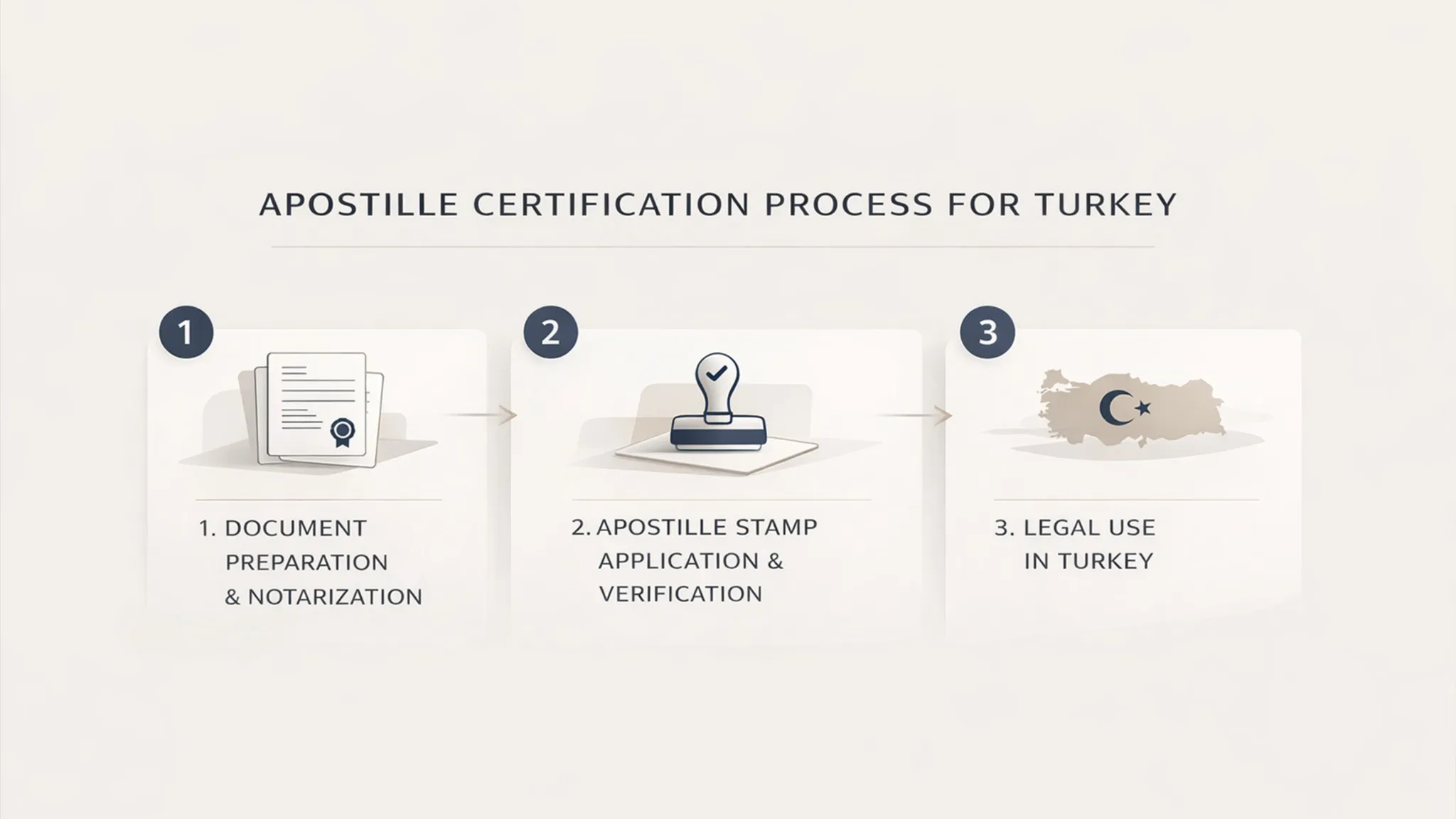
Start with the receiving authority and the exact document; the authentication route follows from those facts.
Foreign Documents for Use in Turkey: Step-by-Step
1. Ask the Turkish receiving authority for the exact document
Identify the transaction owner first: Trade Registry, notary, bank, tax office, court, university, immigration authority or another body. Ask whether it requires an original, an official extract, a certified copy or a particular form. Also confirm any issue-date requirement. Apostilling the wrong version only authenticates the wrong version.
2. Check whether the Apostille Convention applies now
Use the official HCCH Apostille Convention status table. Confirm both the entry-into-force date and whether an objection affects application between the issuing country and Turkey. A country appearing on the table does not always mean that the Convention applies immediately or in every bilateral relationship.
Why a live check matters: Canada entered the Convention on 11 January 2024, and Saudi Arabia entered it on 7 December 2022. Any guide that still automatically sends Canadian or Saudi documents through a non-Hague route is outdated.
3. Identify the correct competent authority
The apostille must come from an authority designated by the country where the document originated. The competent authority can vary by country, region and document type. Use the country entry linked from the HCCH status table or the issuing government’s official site. A general notary, municipality or document agent cannot issue a valid apostille unless that body is officially designated for the relevant document.
4. Complete any required pre-certification
Government-issued records may be eligible for apostille directly. Privately signed instruments may first need notarisation or another official certification. Some jurisdictions require an intermediate county, court or ministry certification before their designated apostille authority can act. Follow the issuing authority’s instructions for that document type rather than a universal online checklist.
5. Obtain the apostille and keep the package intact
The certificate is placed on the document or on an attached page known as an allonge. Do not detach pages, remove staples, replace an attachment or alter an electronic file after issuance. Check names, dates, document references, seals and verification details before sending the package to Turkey.
6. Complete the Turkish-language acceptance step
Authentication and translation are separate questions. Istanbul Trade Registry guidance, for example, requires certain foreign corporate records to be authenticated through the relevant Turkish consulate or under the Apostille Convention and accompanied by a notarised Turkish translation. The precise translation and notarial treatment still depends on the receiving office and document.
For the translation workflow, continue to Sworn Translation in Turkey. That guide explains translator selection, notarial certification and translation-document consistency; this guide explains the international authentication route.
Which Company-Formation Documents May Need Authentication?
There is no responsible rule saying that every foreign founder must apostille the same package. Build the list from the shareholder type, management structure, signing method and registry transaction.
| Situation |
Possible foreign-origin evidence |
Main control question |
| Foreign individual shareholder |
Passport copy, power of attorney or other identity/authority evidence |
Which items require only a Turkish notarised translation, and which privately signed instruments need authentication? |
| Foreign corporate shareholder or manager |
Current registry extract, good-standing/status evidence, constitutional records and authorised-body decision |
Does the Trade Registry require apostille or Turkish-consular certification for each corporate record? |
| Remote company formation |
Transaction-specific power of attorney |
Is the text acceptable to the Turkish professional and notary before it is signed abroad? |
| Foreign parent opening a Turkish branch |
Parent-company registration, constitutional and decision/authority records |
What does the relevant Trade Registry’s current branch checklist require from the parent jurisdiction? |
| Bank, tender or regulated filing |
Ownership, authority, status or compliance evidence |
Does that institution impose its own form, recency, translation or verification standard? |
Istanbul Chamber of Commerce guidance is explicit for some foreign legal-entity documents: the records must be certified by the Turkish consulate in the entity’s home jurisdiction or under the Apostille Convention, with a notarised Turkish translation. That is strong evidence for those listed Trade Registry filings, but it should not be stretched into a claim that the same package applies to every bank, permit or authority.
Use Limited Company Documents in Turkey for the LLC formation checklist. For a foreign parent’s branch, use How to Register a Branch Office in Turkey.
Power of Attorney: Approve the Text Before Apostilling It
A power of attorney signed abroad is a common source of wasted authentication work. The apostille authenticates the relevant public signature or notarial act; it does not repair missing powers, an incorrect principal name, an unsuitable signing arrangement or wording that the Turkish transaction cannot use.
- Ask the Turkish lawyer, notary or filing coordinator for transaction-specific wording.
- Confirm the principal’s name and entity details exactly as shown in the supporting records.
- Confirm whether the person will sign personally or for a legal entity and what authority evidence is required.
- Only then complete the issuing country’s notarisation and apostille or legalisation sequence.
- Keep the original authentication package intact for translation and use in Turkey.
For scope, signing and remote-use issues, see Power of Attorney for Turkey. A generic template should not replace transaction-specific review.
Apostille vs Consular Legalisation
| Issue |
Apostille route |
Consular legalisation route |
| Legal basis |
1961 Hague Apostille Convention |
Domestic authentication rules and Turkish consular requirements |
| When used |
Convention applies between origin and destination and covers the document |
Convention does not apply, subject to any treaty exemption or simplified route |
| Final foreign-authentication step |
Apostille issued by the origin country’s designated competent authority |
Sequence specified for that jurisdiction, commonly ending with Turkish consular certification |
| Number of steps |
Document-specific; sometimes direct, sometimes preceded by notarisation or certification |
Jurisdiction-specific and often multi-stage |
| Turkish translation |
Separate receiving-authority requirement |
Separate receiving-authority requirement |
Do not estimate the non-Hague chain from another country’s example. The ministry, regional authority and consular sequence can differ. Use the Turkish mission with jurisdiction over the place of issuance and the issuing country’s official authentication guidance.
Translation Timing: Avoid the Wrong Sequence
The document and its apostille normally need to remain a single verifiable package. If the Turkish authority requires a Turkish translation of both, the translator needs the final authenticated package, not an earlier draft. In practical terms:
- finalise the required source document;
- complete any source-country notarisation or pre-certification;
- obtain the apostille or complete consular legalisation;
- then translate the final document and authentication certificate as required in Turkey; and
- complete Turkish notarial certification only where the receiving authority requires it.
Before shipping originals, ask how the Turkish notary or receiving body requires the authenticated document to be submitted: paper original, verifiable electronic document or an additional certified copy. Under the Apostille Convention, a valid e-Apostille cannot be refused merely because it was issued electronically; however, the receiving authority can still prescribe the submission format and evidence required for the underlying document. A scan can be useful for pre-checking, but it is not automatically a substitute for the required original or verifiable electronic record.

Most rejections begin before the apostille is issued: wrong document, wrong authority, wrong sequence or a mismatch in names and attachments.
How to Apostille Turkish Documents for Use Abroad
The same route test works in reverse. First ask the foreign receiving authority which Turkish document and format it accepts. Then confirm that the destination is covered by the Convention in relation to Turkey and identify the competent Turkish authority by document category.
| Turkish document category |
Designated authority in Turkey |
Practical point |
| Administrative documents |
Designated governorate/provincial and district authorities |
The correct office can depend on the document and the authority or official whose signature is being verified |
| Judicial documents |
Presidencies of Judicial Commissions where high criminal courts exist |
Use the judicial route rather than assuming a governorate handles every document |
| Eligible electronic records |
Electronic route made available through Turkey’s e-Apostille services |
Confirm that the specific record is currently supported and that the receiving authority can verify and accept it |
The HCCH listing identifies Turkey’s competent-authority categories. Office-level jurisdiction and submission details should be confirmed with the authority that issued or certified the Turkish document. The HCCH listing records no charge for apostilles issued by Turkey’s designated competent authorities, but that should not be read as a universal zero-cost statement for every delivery channel: Turkey’s live e-Apostille service currently charges document-specific service fees. Notary, translation, copy, courier and other processing costs can also arise.
Turkey’s E-Apostille System in 2026
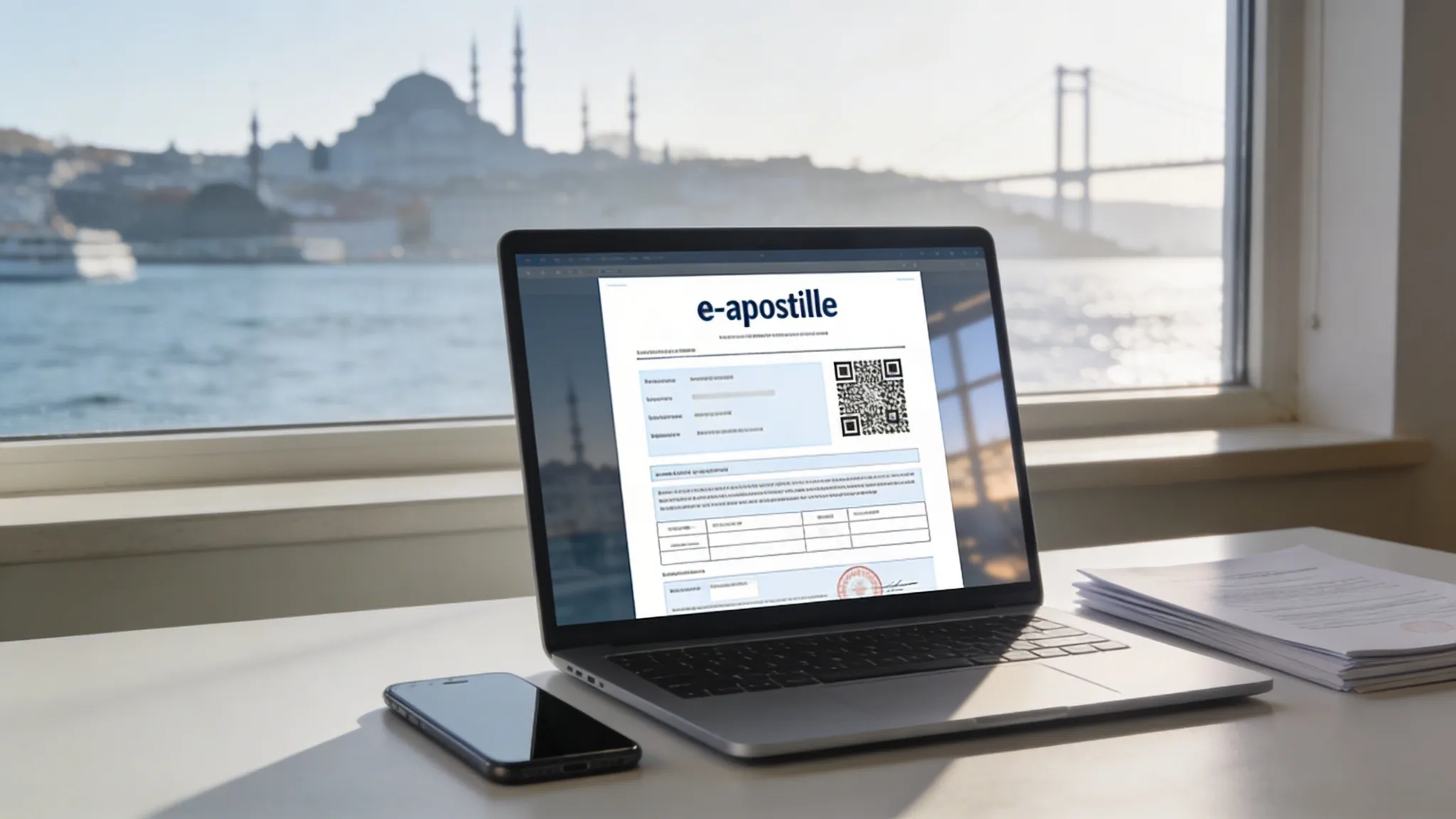
Electronic availability is document-specific; it is not a digital route for every Turkish record.
Turkey began issuing e-Apostilles in 2019. Current official consular information states that electronic applications are available for supported records including:
- criminal record documents;
- court decisions;
- population registry extracts; and
- multilingual birth, marriage and death registration forms (Form A, Form B and Form C).
Depending on the document, access is available through Turkey’s official e-Apostille portal and connected e-Government services. Do not promise instant issuance. Processing, identity access, payment or delivery mechanics and destination-side acceptance can vary. Company records such as every Trade Registry extract or signature circular should not be described as e-Apostille eligible unless the live service specifically offers that document.
Does an Apostille Expire?
The Convention does not create a universal expiry date for the apostille certificate. However, the underlying document can become outdated or the receiving authority can require recently issued evidence. A company-status certificate, criminal record, address evidence or registry extract may therefore be rejected as too old even though the apostille itself has no printed expiry rule.
Ask for the receiving authority’s freshness requirement before ordering the source document. Do not rely on a generic three-month or six-month rule across all Turkish procedures.
How Long Does It Take and What Does It Cost?
There is no reliable universal timeline or per-document price. The total depends on:
- how quickly the issuing authority can produce the correct source record;
- whether notarisation or intermediate certification is required;
- the competent authority’s current processing method;
- whether the route is apostille, consular legalisation or an exemption;
- paper shipping or electronic verification;
- translation length, notarial treatment and the number of copies; and
- the receiving authority’s appointment and review schedule.
Build the timeline backwards from the Turkish filing date and leave room for correction. Get written, date-stamped quotes from the actual authority or service provider rather than relying on an old fixed range.
Pre-Submission Checklist
- Receiving authority: Who will use the document, and what does its current checklist say?
- Correct record: Is this the required original, official extract or certified copy?
- Freshness: Is there a transaction-specific issue-date limit?
- Country relationship: Does the Convention apply between the issuing country and Turkey on the planned submission date?
- Competent authority: Is the apostille issuer designated for this document category?
- Names and authority: Do names, company numbers, titles and signing powers match across every record?
- Package integrity: Are the document, apostille and attachments intact and verifiable?
- Translation: Does the Turkish receiving body require a sworn translation and notarial certification?
- Delivery: Is the original required, or is a verifiable electronic document accepted?
- Final pre-check: Has the Turkish filing professional reviewed scans before originals are shipped?
Common Apostille Mistakes
- Using an old country list: Convention participation and entry-into-force dates change.
- Confusing nationality with origin: The issuing country of the document—not simply the holder’s passport—drives the authentication route.
- Apostilling a plain photocopy: An unauthenticated copy may have no official signature or seal for the apostille to certify.
- Notarising everything: Some public records can be apostilled directly; unnecessary notarisation can create the wrong document chain.
- Translating too early: The final apostille or legalisation certificate may also need translation.
- Assuming content approval: Authentication does not cure missing powers or guarantee substantive acceptance.
- Breaking the attachment: Detached, altered or incomplete packages can fail verification.
- Ignoring destination rules: A valid apostille does not override a bank’s, registry’s or authority’s document-format and freshness requirements.
How Workon Supports the Document Sequence
Workon can coordinate a Turkey-side pre-check for company-formation and corporate filings: identify the intended receiving authority, map the document list, review scans for visible inconsistencies, coordinate sworn translation/notarial steps and keep the authentication package aligned with the filing sequence. Apostilles are issued only by designated public authorities, and legal opinions or regulated professional work remain with the appropriately licensed professional.
For the wider registration workflow, see Company Formation in Turkey: 2026 Guide.

Have the Turkey-side document list checked before you authenticate and ship originals.
Official Sources
An apostille authenticates the signature, the capacity of the signer and, where applicable, the seal or stamp on a qualifying public document. It does not certify that every statement in the document is true or guarantee that a Turkish authority will accept the document for a particular transaction.
No. The correct route depends on the issuing country, document type, destination, applicable treaty and the receiving authority’s current requirements. The route may be apostille, consular legalisation or an exemption or simplified procedure.
Not universally. Authentication and translation are separate requirements. Some Turkish filings require a sworn or notarised Turkish translation of the authenticated document, while the exact treatment depends on the receiving authority and document.
The relevant consular legalisation route generally applies unless a treaty or other rule provides an exemption or simplified procedure. The exact authentication chain should be checked with the issuing-country authorities and the Turkish mission with jurisdiction.
Yes, for supported electronic public documents. Availability is document-specific, so do not assume every Turkish Trade Registry, corporate or notarial document is eligible. Check the live official e-Apostille service for the exact record.
The Apostille Convention does not create one universal expiry period for the certificate. However, the underlying document can become stale and a receiving authority can require recently issued evidence, so check the document-freshness rule before ordering and authenticating it.