Quick answer: A power of attorney in Turkey (vekâletname) lets a named representative perform only the acts covered by the authority granted. For a foreign founder, the safest sequence is to define the exact transaction first, have Turkish counsel or the receiving institution approve the scope, choose the correct signing route, complete any apostille/legalisation and Turkish translation, and then verify what the Trade Registry, bank, notary or other authority will actually accept.
This page is a drafting brief, not a copy-and-sign legal form. A generic template can omit a power the transaction needs or grant a power you never intended. The operative text should be prepared or reviewed for the named principal, agent, institution and transaction before signature.
Last reviewed: 17 September 2026. Consular, notarial, bank and registry requirements can change by jurisdiction and transaction.
What a Power of Attorney Does in Turkey
A power of attorney creates authority for an agent to act for the principal. It does not make the agent a shareholder, director or manager unless a separate valid corporate step creates that role. It also does not remove an institution’s right to require personal appearance, enhanced identity checks, a particular form or additional evidence.
For a remote founder, a correctly scoped POA may support parts of company formation and post-registration administration. Current Istanbul Chamber of Commerce guidance confirms that a limited-company agreement may be signed by proxy when the original or a notarised copy of the power of attorney is presented. That does not mean every formation step—or every bank’s onboarding—can always be delegated.

Map the authority to the real procedure before the principal signs abroad.
General vs Special Power of Attorney: Scope Matters More Than the Label
“General” and “special” are useful shorthand, but the legal and operational effect comes from the actual wording, the form required for the act and the applicable law. A document called a general POA is not automatically limitless; a document called a special POA is not automatically safe.
| Approach |
Potential benefit |
Main risk |
| Broad, open-ended authority |
May reduce the need for repeated documents across genuinely related tasks |
Unnecessary banking, disposal, borrowing, settlement, delegation or contract powers may create avoidable exposure |
| Transaction-specific authority |
Connects each power to a defined company, filing, bank, property or contract |
Overly narrow wording may omit an essential procedural act and require a new POA |
| Staged authority |
Uses one limited POA for formation and a later document for ongoing operations |
Requires disciplined handover and clear end dates or revocation steps |
Turkish Code of Obligations Article 504 says that the mandate’s scope is determined by the agreement or, if not clearly stated, by the nature of the work. It also identifies acts for which specific authority is required, including bringing proceedings, settlement, arbitration, certain insolvency applications, negotiable-instrument commitments, gifts, suretyship, and transfer or encumbrance of real estate. The old claim that the Turkish Civil Code universally requires a “special POA” to establish any company is not an accurate statement of this rule.
Power-of-Attorney Scope Matrix for Foreign Founders
| Task |
Possible authority to discuss |
Control to add |
| Company formation |
Sign the company agreement by proxy, submit or receive specified registry records, pay defined filing charges |
Name the intended company type and formation purpose; align wording with the current Trade Registry route |
| Tax administration |
Obtain identifiers, receive notices or complete identified administrative steps |
Separate administrative representation from tax returns or professional work reserved for a licensed SMMM |
| Registered address or lease |
Sign a named service or lease agreement |
State address, duration, price/limit and whether amendment or termination is allowed |
| Banking |
Submit onboarding documents or perform specifically accepted account steps |
Confirm the bank’s POA wording and personal-appearance/KYC rules; exclude borrowing, transfers, cards and digital credentials unless deliberately required |
| Corporate records |
Collect specified registry certificates, Gazette records or notarised copies |
Limit receipt and use to the defined transaction; require return or secure delivery |
| Ongoing contracts |
Sign only named contract types within value and term limits |
Add counterparty, amount, term, renewal and termination controls |
| Litigation, settlement or arbitration |
Only powers approved by Turkish counsel for the dispute |
Use the specific authority required by procedural and professional rules |
| Real estate or security |
Transaction-specific acquisition, disposal or encumbrance authority |
Obtain specialist advice on explicit powers, form, photographs and land-registry requirements |
A POA for company formation should not silently become authority to sell shares, borrow, guarantee third-party debt, transfer money, sell property, receive sale proceeds or settle disputes. Include those powers only when they are knowingly required and appropriately controlled.
Power of Attorney Drafting Brief
Give the drafting lawyer or notary a structured brief rather than copying clauses from the internet:
- Principal: individual or legal entity, full legal name, identification/registration number, address and signing capacity.
- Agent: full legal name, Turkish identity or other accepted identifier, address and professional details where relevant.
- Purpose: one clearly described transaction or operational phase.
- Institutions: the named Trade Registry, tax office, bank, notary, municipality or other body where possible.
- Positive powers: each signature, filing, payment, collection or representation act actually needed.
- Excluded powers: borrowing, guarantees, asset disposal, self-dealing, receipt of money, digital credentials or other high-risk acts not intended.
- Limits: company, address, counterparty, maximum amount, contract term, account or other transaction boundary.
- Delegation: whether substitution is prohibited, allowed only to named professionals or allowed for specified administrative acts.
- Duration: fixed date, completion event or review date.
- Reporting and records: approval thresholds, copies, receipts, status updates and return or destruction of originals.
Do not translate a draft before Turkish-side scope review. Authentication and translation do not repair an inadequate mandate.
Where to Sign a Power of Attorney for Use in Turkey
Route 1: Sign before a Turkish notary
If the principal is in Turkey, a Turkish notary can establish the document through the applicable notarial process. The required evidence is transaction-specific. The notary may ask for an original passport or other accepted ID, Turkish tax/foreign identity number where relevant, principal or company authority records, agent details, photographs for certain categories, and an interpreter when the principal cannot understand the procedure in Turkish.
Do not arrive with a universal checklist copied from another transaction. For example, official Turkish consular guidance expressly associates photographs with certain real-estate, divorce and vehicle POAs; that does not make “two passport photos” a universal company-formation requirement. Ask the chosen notary what the exact POA category requires.
Route 2: Use a Turkish consular notarial service abroad
Turkish missions offer notarial appointments through the official Consular Procedures portal. A POA prepared through a Turkish consular notarial service can simplify Turkish-language and domestic-use issues.
Availability depends on citizenship/status, the mission, the transaction and personal-appearance rules. Foreign private individuals may be able to use Turkish consular notarial services, subject to the mission and transaction. However, the Ministry of Foreign Affairs’ current consular FAQ states that Turkish consulates do not issue powers of attorney on behalf of companies incorporated under foreign law. A foreign corporate principal should therefore confirm the accepted foreign-notary/authentication route and the Turkish receiving institution’s requirements instead of assuming consular execution is available. Confirm jurisdiction, eligibility, appointment method, interpreter, identification, photographs, corporate-authority documents, draft format, fee and delivery before relying on this route.
Where the consular system supports it, a representative in Turkey may be able to obtain a notarial copy through the connected notary system instead of waiting for the paper original. This is service- and document-specific; make sure copy-retrieval authority is included where required.
Route 3: Sign before a foreign notary
A foreign-notary route normally requires four separate decisions:
- Does the text grant the exact powers needed in Turkey?
- What form and identity/authority evidence does the foreign notary require?
- Does the document use an apostille, consular legalisation or an exemption?
- What Turkish sworn/notarised translation will the receiving institution require?
Authentication does not cure the wrong notarial form. The Ministry of Foreign Affairs’ current consular FAQ distinguishes foreign-notary powers of attorney made in an onaylama (signature-certification) form from powers that Turkish law requires in a düzenleme (instrument-drawn-up) form. The FAQ states that the latter form is handled through Turkish representation/notarial channels rather than treated as an ordinary foreign-notary certification. Before using the foreign-notary route for real estate or another act with a special form requirement, have the Turkish receiving authority or counsel confirm that the selected execution form is legally sufficient. An apostille or legalisation authenticates the foreign public document; it does not expand the authority granted or convert an insufficient form into the required Turkish form.
The apostille route is driven by the issuing country and the Convention’s current bilateral application—not simply by the principal’s nationality. Use Apostille for Turkey Documents: 2026 Process Guide for that decision.
For the Turkish-language acceptance layer, use Sworn Translation in Turkey: 2026 Process & Costs. Translate the final authenticated package, including relevant apostille/legalisation pages, unless the receiving authority approves a different sequence.
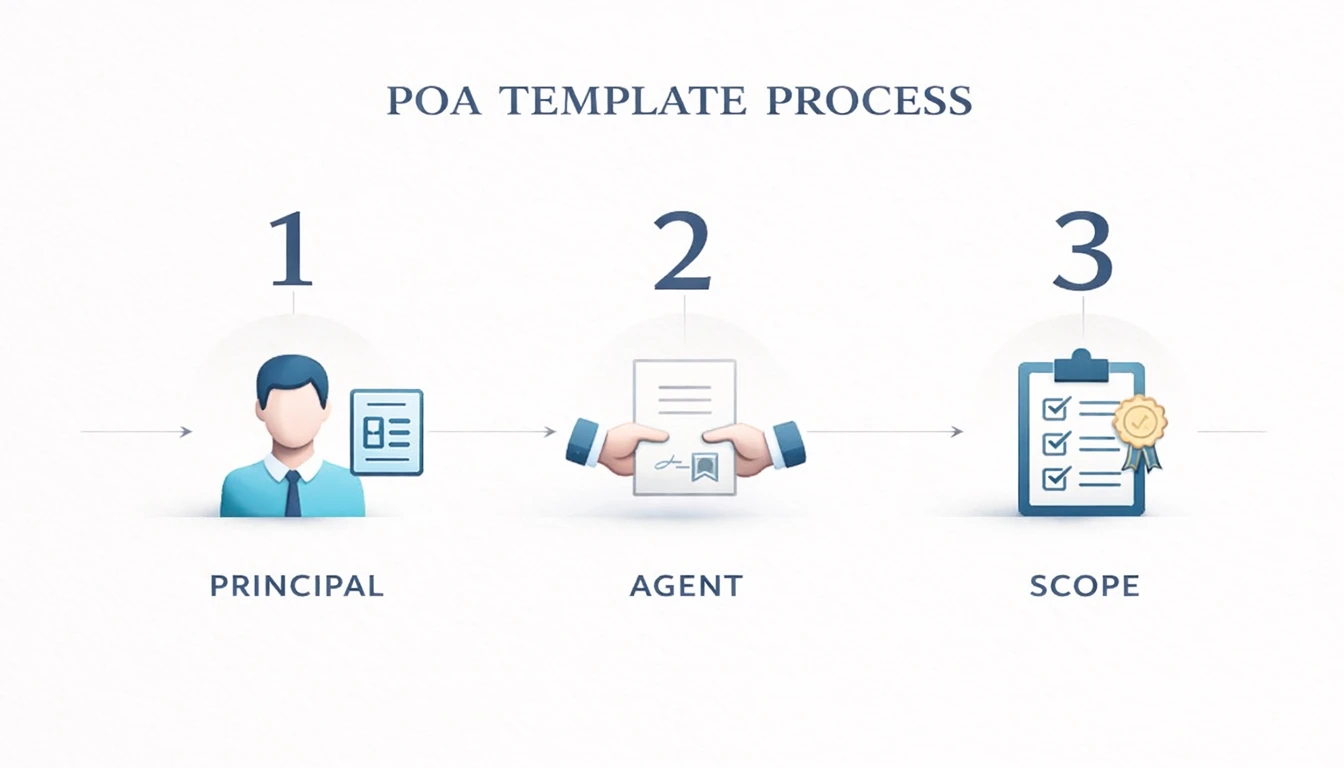
The same authority wording can require different execution and authentication steps depending on where it is signed.
Company Formation by Proxy: What Can and Cannot Be Promised
Current Istanbul Trade Registry guidance supports signing a limited-company agreement by proxy when the required POA evidence is presented. A correctly scoped representative may also coordinate filings and collect specified records. However:
- the registry can require transaction-specific wording, originals, notarised copies and authenticated foreign records;
- a foreign legal-entity principal must prove the signatory’s corporate authority;
- company managers or other representatives may face separate signature-declaration rules;
- a bank can impose its own KYC, beneficial-owner and personal-appearance requirements;
- tax and accounting filings may require a licensed professional and separate authorisation; and
- sector licences and regulated activities can add non-delegable or institution-specific steps.
A POA can reduce travel, but it should not be marketed as eliminating every physical or identity-verification step. For the end-to-end process, see Company Formation in Turkey: 2026 Guide.

Have the scope approved before signing, authentication and international courier work begin.
Banking Powers Need a Separate Decision
“Open and operate all bank accounts” is not a harmless company-formation clause. Separate at least these questions:
- May the agent only submit documents or also open the account?
- May the agent deposit capital but not withdraw it?
- May the agent make transfers, and if so within what amount and purpose?
- May the agent obtain cards, cheques, tokens or online-banking credentials?
- May the agent borrow, pledge assets or give guarantees?
- Does the named bank accept any of these acts by proxy?
Get the bank’s approved wording before execution. The POA cannot force a bank to onboard a customer or waive its compliance controls. For the bank-side process, see How to Open a Business Bank Account in Turkey.
Delegation and Substitution
A clause allowing the agent to appoint another person can be operationally useful, but it also widens the trust boundary. Turkish Code of Obligations Article 506 starts from personal performance, with substitution possible when authorised or justified by necessity or custom.
If delegation is genuinely needed, consider limiting it by:
- naming the substitute or permitted professional group;
- restricting delegation to filing, collection or another administrative category;
- excluding banking, borrowing, asset disposal and settlement;
- requiring written notice or approval; and
- stating when the substitute authority ends.
Do not insert a substitution clause merely because it appears in a template.
Conflicts, Self-Dealing and Money Controls
Ask the drafter how the document handles transactions where the agent, an affiliate or a related person may be on both sides. Consider express rules for:
- contracting with the agent or the agent’s affiliate;
- receiving sale proceeds, refunds or company money;
- changing bank contact information or digital access;
- disposing of shares, intellectual property or physical assets;
- settling claims or waiving rights; and
- retaining originals, seals and access credentials.
These controls are more useful than generic promises that a “special POA” is automatically secure.

Scope, limits, reporting, delegation and termination should be designed together.
How to Revoke or Limit a Power of Attorney
Turkish Code of Obligations Article 42 generally allows the principal to limit or withdraw authority created by a legal act; advance waiver of that right is not valid. Rights arising from an underlying service, mandate or partnership relationship remain separate. Notice is critical: if authority was communicated to third parties, failure to communicate its withdrawal can affect the position of good-faith third parties.
For a notarial POA, obtain advice on a formal revocation instrument (azilname) and the appropriate notarial or consular route. Then:
- identify the original POA by notary/mission, date and record number;
- notify the agent with evidence of delivery;
- notify every bank, registry, counterparty or authority that received or relied on the POA;
- recover originals, certified copies, cards, seals, tokens and credentials where applicable; and
- check whether corporate registrations, bank mandates or separate contracts also need amendment or termination.
Revocation of the authority and termination of the underlying service contract are related but not identical acts. Use Turkish counsel for a live dispute or high-value authority.
How Long Is a Turkish Power of Attorney Valid?
Do not treat every POA as valid forever. Duration can be affected by an express expiry date, completion of the authorised task, revocation or limitation, the underlying relationship, death, loss of capacity, insolvency or termination of a legal entity, subject to the document, law and nature of the work. Turkish Code of Obligations Article 513 contains default termination rules for a mandate relationship and exceptions where the agreement or nature of the work indicates otherwise.
For a one-off formation project, use a fixed date or completion event where legally and operationally suitable, then perform a documented close-out. An open-ended instrument should be a conscious decision, not the default from a downloaded template.
Cost and Timeline
There is no reliable universal price range. The total can include:
- legal drafting or review;
- notary or consular charges based on document type and length;
- interpreter or sworn-translation fees;
- apostille, authentication or legalisation steps;
- certified copies, photographs and supporting corporate records; and
- courier or notarial-copy retrieval.
Timing depends on scope approval, appointment availability, identity and corporate-authority evidence, authentication, translation and the receiving institution. Ask for a stage-by-stage estimate rather than a guaranteed completion date.
Final Review Checklist
- Is the correct person or legal entity named as principal?
- Does the signatory have authority to bind a corporate principal?
- Is the agent identified exactly and independently verified?
- Is every necessary power included—and every unnecessary high-risk power excluded?
- Are transaction, value, counterparty, duration and delegation limits clear?
- Has each receiving institution approved the relevant wording or format?
- Is the signing route available to this principal at this notary or mission?
- Are apostille/legalisation and Turkish translation steps correct for the origin country?
- Are names and numbers consistent across passport, corporate and translated records?
- Is there a documented reporting, close-out and revocation plan?
How Workon Supports the Process
Workon can coordinate the operational document sequence for a Workon-managed company-formation or corporate filing: gather the intended acts, identify the receiving institutions, arrange Turkish-side pre-checks, coordinate translation/notarial steps and track the filing packet. Legal drafting and advice are handled by the appropriate licensed lawyer; notarial acts by the competent notary or consular officer; authentication by designated authorities; accounting and tax filings by the licensed professional responsible for them.
Official Sources
Frequently Asked Questions
It authorises the named representative to carry out only the acts covered by the document, subject to the form and institution rules that apply to those acts. A POA does not automatically make the representative a shareholder, director or manager and does not waive identity, KYC or professional-authority requirements.
Use a generic template only as a drafting brief. Have Turkish counsel and the receiving institution check the exact principal, representative, powers, exclusions and required form before signature. A downloaded form can omit a necessary power or silently grant unwanted banking, borrowing, settlement, delegation or asset-disposal powers.
The actual scope and legally required form matter more than the label. Define the acts needed and consider transaction, amount, duration and delegation limits. Specific authority is required for certain acts, so neither the word general nor special by itself proves that the document is sufficient or safe.
A foreign private individual can use a Turkish consular notarial route where the mission and transaction support it; the document is in Turkish and an interpreter is required when the principal does not understand Turkish. The Ministry of Foreign Affairs states that Turkish consulates do not issue powers of attorney on behalf of companies incorporated under foreign law, so a foreign corporate principal must use the accepted foreign-document route and satisfy the Turkish receiving institution’s authority, authentication and translation requirements.
No. Apostille or legalisation authenticates the foreign public document but does not expand the authority or cure the wrong legal form. The Ministry of Foreign Affairs distinguishes foreign-notary signature-certification form from Turkish transactions that require an instrument-drawn-up form. Check the receiving authority or Turkish counsel before signing, especially for real estate or another transaction with a special form requirement.
No. Ask the selected bank which acts it accepts by proxy, what wording it requires and whether personal appearance or further verification is necessary. Company-formation authority should not silently include account operation, borrowing, transfers, cards, tokens or access credentials.
There is no universal price or guaranteed timeline. Total cost can include drafting, notary or consular processing, interpretation, translation, authentication, copies and courier. Timing depends on scope approval, appointments, supporting records and the receiving institution.