
Quick answer: A capital increase in Turkey changes the registered share capital of an existing company and normally requires a corporate decision, an amendment to the capital clause, source-specific financial evidence, a MERSİS filing and Trade Registry registration. The correct route depends on whether the company is a limited liability company (Ltd. Şti.) or a joint-stock company (A.Ş.) and whether the increase uses cash, eligible internal resources, an in-kind asset or a shareholder receivable.
2026 deadline: Existing companies whose registered capital remains below the statutory minimum generally have until 31 December 2026 to comply under Turkish Commercial Code Provisional Article 15, unless the period is officially extended. The current minimum is TRY 50,000 for an LLC and TRY 250,000 for a JSC. Because registration gives legal effect to the increase, companies affected by the deadline should not leave the corporate, accounting and registry work until the final days of December.
Most important distinction: an LLC does not follow the JSC rule requiring at least 25% of newly subscribed cash capital before registration. For an LLC, the newly committed cash amount may generally be paid within 24 months after registration. Existing unpaid capital and the selected funding route must still be checked before the new increase is approved.
Capital Increase in Turkey at a Glance
| Decision point |
What it changes |
Main evidence |
| Cash subscription |
Shareholders commit new money to registered capital |
Corporate decision, amended capital clause, financial report and bank evidence where payment is made |
| Internal resources |
An eligible equity account is transferred into registered capital |
SMMM/YMM or auditor findings confirming the source exists and can be capitalised |
| In-kind contribution |
An eligible non-cash asset becomes capital |
Court-appointed expert valuation and asset-registry evidence |
| Shareholder receivable |
A genuine debt owed by the company is contributed or offset |
Evidence depends on the receivable’s origin; a cash-loan receivable is treated differently from other receivables |
| New investor subscribes |
Registered capital and potentially ownership percentages change |
Subscription, pre-emptive-right and foreign-investor documents as applicable |
This guide explains the process for increasing the capital of an existing Turkish company. It is not the incorporation-capital guide and it is not a substitute for a share transfer. For the initial setup process, use Company Formation in Turkey: 2026 Guide. If an investor will buy an existing shareholder’s interest rather than subscribe for newly issued capital, see Share Transfer in a Turkish LLC.

A workable capital increase begins with the company type, funding source, current equity position and intended ownership outcome.
Is the Capital Increase Mandatory or Voluntary in 2026?
Minimum-capital compliance by 31 December 2026
The statutory minimums have applied to newly incorporated companies since 1 January 2024. Turkish Commercial Code Provisional Article 15 subsequently created a transition period for existing companies below those amounts.
| Company position |
Current threshold |
Current transition result |
| Existing LLC below the minimum |
TRY 50,000 |
Increase and register the capital by 31 December 2026; otherwise the company is deemed dissolved under the current provision |
| Existing JSC below the minimum |
TRY 250,000 |
Increase and register the capital by 31 December 2026; otherwise the company is deemed dissolved under the current provision |
| Non-public JSC using the registered-capital system |
Separate TRY 500,000 starting-capital requirement |
Check both starting and issued capital; failure to meet the system-specific condition can result in deemed exit from that system |
| Company already at or above its applicable threshold |
Company-specific |
No transition increase solely because of the general minimum; sector-specific capital rules may still be higher |
An increase made only to reach the statutory minimum has a special transition voting rule: no meeting quorum is required, the decision is taken by the majority of votes present and privileges cannot be exercised against that decision. Notice, representation, pre-emptive rights, documentation and registration requirements still need to be handled correctly.
Check for a formal extension before relying on the deadline. This article reflects the law and official sources reviewed on 2 September 2026.
Voluntary capital increases
A company may also increase capital voluntarily to fund operations, finance expansion, improve its equity position, admit a new investor or convert an eligible shareholder receivable. A larger registered-capital figure does not by itself guarantee a bank facility, tender award, investment or stronger credit rating. The commercial benefit depends on the company’s full financial position and how the funds are actually used.
Capital Increase Is Not the Same as a Shareholder Loan or Share Transfer
| Transaction |
Registered capital changes? |
Ownership can change? |
Core point |
| Capital increase |
Yes |
Yes, if subscriptions are not proportionate or a new investor enters |
Requires corporate and registry steps |
| Shareholder loan |
No |
No |
Creates or increases company debt; accounting, tax and transfer-pricing effects remain separate |
| Share transfer |
No |
Yes |
Existing shares move between parties; it does not inject new registered capital by itself |
| Shareholder receivable converted to capital |
Yes |
Potentially |
The debt and its origin must be proven under the applicable evidence route |
This distinction matters for foreign groups. A bank transfer labelled as a loan should not later be treated as capital without reconciling the agreement, bank trail, ledger, foreign-exchange treatment and corporate decision.
Choose the Funding Source Before Drafting the Resolution
1. Cash capital increase
In a cash subscription, one or more shareholders commit money in return for newly created capital shares. Before using this route, verify whether the company’s existing cash capital commitments have been fully paid. Under the rules applied to capital increases, a new cash-subscription increase generally cannot proceed while earlier cash commitments remain unpaid, except for the separate internal-resources route.
Payment timing differs by company type:
- LLC: the new cash commitment may generally be paid within 24 months after registration. If all or part has already been paid, the Trade Registry file includes the corresponding bank letter.
- JSC: at least one quarter of the nominal value of newly subscribed cash shares is generally paid before registration, with the balance due within 24 months. The bank letter identifies the subscribers and amounts paid.
For practical banking preparation, see How to Open a Business Bank Account in Turkey.
2. Increase from internal resources
An internal-resources increase moves an eligible amount already present within the company’s equity into registered capital. Depending on the company’s records and applicable accounting and tax rules, a possible source may include retained earnings, eligible reserves or another capitalisable equity item.
An account balance is not automatically available for capitalisation. The licensed SMMM/YMM or, where applicable, the auditor must identify the source, confirm that it genuinely exists within the company and reconcile it with a sufficiently current balance sheet. Accumulated losses, restricted reserves and inflation-accounting entries can materially change the conclusion.
3. In-kind contribution
An eligible non-cash asset can be contributed only if it satisfies the statutory conditions. The asset must be transferable and capable of monetary valuation; restrictions, attachments or limited real rights can prevent it from being used.
The file can require:
- a Commercial Court appointment of the expert;
- the court-appointed expert’s valuation report;
- the court decision approving the report where required;
- confirmation from the relevant asset registry that no disqualifying restriction exists; and
- evidence that the intended capital contribution has been annotated in the registry where the asset is recorded.
Real estate, registered intellectual-property rights, machinery or another asset should not be assumed eligible merely because it has economic value. Confirm the exact asset and evidence route before the corporate decision is signed.
4. Converting a shareholder receivable into capital
A shareholder receivable can be used only when the debt is genuine, identifiable and supported by the company’s accounting and transaction records. It is inaccurate to say every debt-to-equity conversion automatically follows one identical in-kind valuation route.
Under the current Istanbul Trade Registry checklist:
- if the shareholder receivable arose from documented cash lending, the SMMM/YMM report must state that origin clearly; and
- if the receivable did not arise from cash lending, a court-appointed expert report and the related appointment documentation may be required.
Conversion does not erase tax or accounting effects already produced by the loan. Interest, withholding, transfer pricing, thin-capitalisation, foreign-exchange differences and prior-period entries should be reviewed separately by the licensed professionals handling the file.
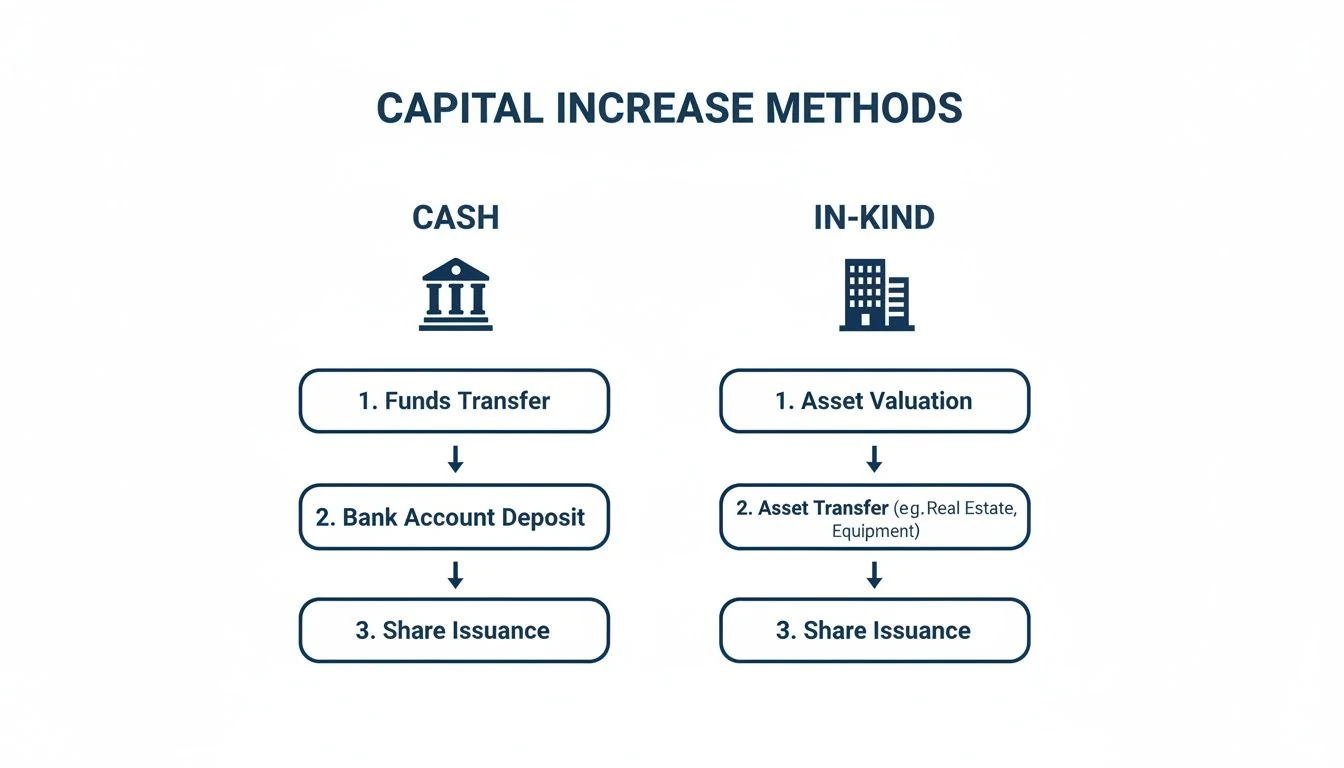
Cash, internal resources, in-kind assets and shareholder receivables use different evidence paths; choose the source before drafting.
LLC vs JSC: Do Not Use One Checklist for Both
| Issue |
LLC (Ltd. Şti.) |
JSC (A.Ş.) |
| Decision-maker |
General Assembly amends the capital clause |
General Assembly in the fixed-capital system; board may act within valid authority in the registered-capital system |
| Ordinary decision threshold |
Capital increase is an important decision; check TCC Article 621 and the Articles |
Check the applicable TCC and Articles threshold, share classes and any special approvals |
| Pre-registration cash payment |
No general 25% rule for the newly committed cash amount |
At least 25% of newly subscribed cash share value generally paid before registration |
| Remaining cash payment |
Generally within 24 months after registration |
Generally within 24 months after registration |
| Pre-emptive right |
TCC Article 591 framework |
TCC Article 461 framework |
| Registration timing |
Istanbul checklist requires filing within 30 days of the decision |
If not registered within three months of the competent decision, the decision and any permission obtained become invalid under TCC Article 456/3 |
| Extra meeting/approval layer |
Depends on company and representation facts |
Ministerial representative, privileged-shareholder approval or prior authority permission may apply in specified cases |
For annual and extraordinary LLC decision mechanics, use Turkish LLC General Assembly Guide. For the broader allocation of shareholder and manager powers, see Turkey LLC Corporate Governance.
Step-by-Step Capital Increase Process
Step 1: Confirm the company’s baseline
Check the company type, registered capital, paid-capital status, current Articles, shareholder register, balance sheet, any privileged shares, regulated-sector permissions and whether the company falls within the 2026 minimum-capital transition. If TCC Article 376 capital-loss or insolvency indicators exist, do not treat the transaction as a routine growth increase.
Step 2: Fix the target structure
Set the new total capital, funding source, amount subscribed by each shareholder, nominal share values, payment terms and resulting ownership percentages. If a new investor is entering, distinguish the new-share subscription from any parallel transfer of existing shares.
Step 3: Map pre-emptive rights and dilution
Existing shareholders generally have a right to subscribe in proportion to their holdings. A shareholder who does not participate may be diluted. Any restriction or removal of that right requires the relevant legal basis and decision threshold.
If all shareholders do not participate in the decision, the company may also need a managers’ or board decision describing how the right will be exercised and giving shareholders at least 15 days. The current Istanbul checklist requires the relevant decision to be announced before the capital increase is registered.
Step 4: Prepare the financial and source evidence
The licensed SMMM/YMM prepares the findings required by the selected route. The report can address payment of the existing capital, whether capital is protected within equity for the TCC Article 376 assessment, the amount of equity, the existence of an internal source or the cash-loan origin of a shareholder receivable. A company subject to statutory audit may use an auditor’s report where the applicable rules permit it.
Step 5: Adopt the correct corporate decision
The resolution and amended capital clause should agree on the old capital, increase amount, new total, source, nominal shares, shareholder allocations and payment terms. The correct meeting, notice, representation and voting rules depend on the company type, Articles and transaction.
Step 6: File through MERSİS and the competent Trade Registry
The amendment is entered in MERSİS, an application number is obtained and the source-specific registration pack is filed with the Trade Registry. The MERSİS guide explains the system’s role, but the competent registry’s current document list controls the filing.
Step 7: Complete payment and evidence steps
Handle any required bank payment, asset-registry annotation and Competition Authority contribution before registration. The Competition Authority share is four ten-thousandths of the increased amount, equal to 0.04%. It applies to the increased portion; registry, Gazette, notary, translation, valuation and professional costs are separate.
Step 8: Reconcile the company after registration
After registration and Gazette announcement, update the statutory books and share records, accounting ledgers, bank KYC file, internal corporate records and any beneficial-owner information affected by the new ownership structure. See Beneficial Owner Declaration in Turkey.
Practical Document Checklist
The exact pack depends on the competent registry, company type and funding route. A working file commonly includes:
- MERSİS application and registration petition;
- General Assembly or board decision, as applicable;
- amended capital clause and subscription details;
- attendance list and meeting documents where required;
- SMMM/YMM report, activity certificate and supporting financial records;
- bank letter for cash paid or required before registration;
- internal-resource schedules, shareholder-loan evidence or court-expert documents according to the source;
- Competition Authority payment receipt;
- asset-registry letters and annotations for in-kind contributions;
- pre-emptive-right decision and announcement evidence where applicable;
- prior authority approval for a regulated company or protected amendment where required; and
- foreign shareholder or representative documents where triggered.

The registration pack should reconcile the resolution, amended capital clause, financial report, payment evidence and foreign authority documents.
Foreign Shareholders: Can the Process Be Coordinated Remotely?
Foreign ownership does not create a separate capital-increase system, and a shareholder may be represented where the company documents and applicable rules permit it. Remote execution, however, depends on who signs and which foreign documents enter the Turkish filing.
A foreign-issued power of attorney, foreign corporate registry extract or parent-company authority document may require apostille or consular legalisation according to the issuing country and document type, followed by the required Turkish translation and notarisation. Do not apostille every document by default; first confirm the exact filing pack and legalisation route.
If an existing foreign corporate shareholder is subscribing for more capital, the required pack may differ from a case in which a new foreign legal entity enters the company. For authority-document planning, see Power of Attorney for Turkey.
Capital Loss and Insolvency Require a Separate Analysis
Accounting losses do not automatically reduce the registered-capital figure shown in the Trade Registry. TCC Article 376 instead creates governance duties when specified capital-loss thresholds or indications of insolvency arise.
A capital increase may form part of a remediation plan, but it is not the only possible response and should not be described as automatically mandatory in every loss-making company. Depending on the balance sheet, the lawful route may involve loss coverage, a decrease and simultaneous increase, shareholder measures or another restructuring step. The board/managers, licensed accountant and qualified Turkish legal counsel should assess the live financial facts before a resolution is drafted.
How Long Does a Capital Increase Take?
There is no responsible universal fixed-duration promise. The actual duration depends on:
- the company type and meeting/notice rules;
- whether every shareholder cooperates;
- the funding source and financial-report readiness;
- foreign corporate approvals, legalisation and translation;
- pre-emptive-right procedure;
- court valuation and asset-registry work for in-kind assets;
- prior permission for a regulated company; and
- the competent registry’s review or correction request.
The statutory filing windows should not be confused with a guaranteed completion time. An Istanbul LLC filing is submitted within 30 days of the decision. For a JSC, the relevant capital-increase decision and any permission become invalid if registration is not completed within the three-month period stated in TCC Article 456/3.
Cost Layers to Budget
| Cost layer |
When it arises |
| Competition Authority share |
0.04% of the increased amount |
| Trade Registry and Gazette |
Registration, service and announcement charges |
| SMMM/YMM or auditor work |
Financial findings and source evidence |
| Court expert and asset records |
In-kind assets or a receivable route requiring expert evidence |
| Notary, translation and legalisation |
Only for the documents and foreign route that require them |
| Legal and operational coordination |
Depends on company type, shareholders, source and filing complexity |
Do not estimate the professional fee from the increase amount alone. A modest increase involving a foreign corporate shareholder and an in-kind asset can require more work than a larger, unanimous cash increase.
Official 2026 SMMM professional-fee references
The 2026 SMMM professional-fee tariff lists TRY 18,170 for a limited-company capital increase and TRY 22,460 for a joint-stock-company capital increase. Where the applicable file requires a professional determination report for matters such as paid capital, equity/internal resources or a shareholder receivable, the relevant 2026 report row is TRY 12,570. For an in-kind capital increase, the tariff applies the relevant capital-increase professional fee with a 50% addition.
These amounts are minimum/professional SMMM tariff references, not the total transaction cost. Trade Registry/Gazette charges, Competition Authority payment, court-appointed expert work, notary/translation/legalisation, legal advice and Workon coordination are separate where applicable. A report row should be used only when that report is actually required; do not automatically add every tariff item to every capital increase.
For future annual updates, verify the current year through the İSMMMO Professional Fee Tariffs archive and the corresponding TÜRMOB / Official Gazette tariff.
Common Errors to Prevent Before Signing
- using a JSC 25% payment rule for an LLC;
- starting a new cash increase before confirming the existing capital is fully paid;
- calling every shareholder-receivable conversion an identical in-kind process;
- confusing a new-share subscription with a transfer of existing shares;
- ignoring dilution and pre-emptive rights;
- using different amounts or shareholder allocations in the resolution, report, bank evidence and MERSİS application;
- treating every foreign document as if it needs the same apostille route;
- using a private appraisal where court-appointed valuation is required;
- missing the applicable 30-day or three-month registration window; and
- assuming registration alone resolves bank, tax, UBO and accounting updates.

Workon coordinates company setup and post-registration operational workflows for foreign founders in Turkey.
How Workon Coordinates a Capital Increase
Workon can coordinate the transaction sequence for foreign-owned Turkish companies: document mapping, shareholder and power-of-attorney preparation, licensed SMMM/YMM report coordination, sworn translation and legalisation workflow, MERSİS and Trade Registry preparation, and post-registration operational follow-up.
Regulated legal advice and drafting are handled by appropriately licensed Turkish lawyers. Statutory accounting, tax analysis and financial reports are handled by licensed SMMM/YMM professionals. Court, bank, registry and public-authority steps are coordinated under the relevant institution’s current procedure.
Review Workon’s company setup and operational coordination services.
Official Reference Points
Note: Last reviewed 17 September 2026. This article provides general operational information on capital increases in Türkiye. Workon coordinates the transaction workflow with the relevant Trade Registry, licensed SMMM/YMM and authorised legal professionals according to the company and funding route.
Frequently Asked Questions
Timing depends on the company type, shareholder decisions, funding source, financial reports and registry review. An in-kind contribution can add court and asset-registry steps. Obtain a timetable for the actual transaction rather than treating a few weeks as a guaranteed duration.
The pack depends on the company and funding route. It can include the competent corporate decision, amended capital clause, MERSİS application, financial reports, payment evidence where applicable and valuation or asset-registry documents for in-kind contributions.
Representation may be possible where the company documents and applicable procedure permit it. Confirm who must sign and which authority documents are needed. Foreign records may require apostille, consular legalisation or another accepted route and Turkish translation; one authentication route does not apply to every case.
Cash subscriptions involve a money commitment; payment timing and evidence depend on the company type. In-kind contributions use eligible assets and can require court-appointed valuation and registry evidence. Existing unpaid commitments and the company's financial position must be checked before selecting the route.
Yes. Coordinate the corporate decision, amended capital clause and supporting evidence with the applicable MERSİS and Trade Registry procedure. Do not treat transferring funds to the company or signing a resolution alone as completion of the registered increase.