
Quick answer: A new shareholder can usually enter an existing Turkish company through a share transfer, a capital increase, or a transaction combining both. The correct route depends on whether the payment should go to an existing shareholder or into the company, whether the company is a limited liability company (Ltd. Şti.) or joint-stock company (A.Ş.), and what its articles of association and shareholder arrangements permit.
This guide explains the entry-route decision for adding a partner to an existing Turkish company. Detailed limited-company transfer mechanics belong to our Turkish LLC share-transfer guide, while the separate corporate procedure for issuing new capital is covered in Capital Increase in Turkey.
Share Transfer or Capital Increase: Which Route Adds the Partner?
| Route |
Where the money goes |
Effect on company capital |
Typical objective |
| Share transfer |
Normally to the selling shareholder |
Unchanged |
A founder exits, reduces a holding or sells part of an existing stake |
| Capital increase |
Into the company as the agreed capital contribution |
Increases after the required corporate and registry steps |
The company raises new funding and the incoming investor subscribes for new shares |
| Combined transaction |
Part to a seller and part to the company |
Existing ownership changes and capital may also increase |
The parties want both shareholder liquidity and fresh company funding |
The commercial label used by the parties does not determine the legal route. A payment described informally as an “investment” may actually be a purchase price paid to a founder, while a true capital subscription requires the company-level procedure applicable to the relevant legal form.
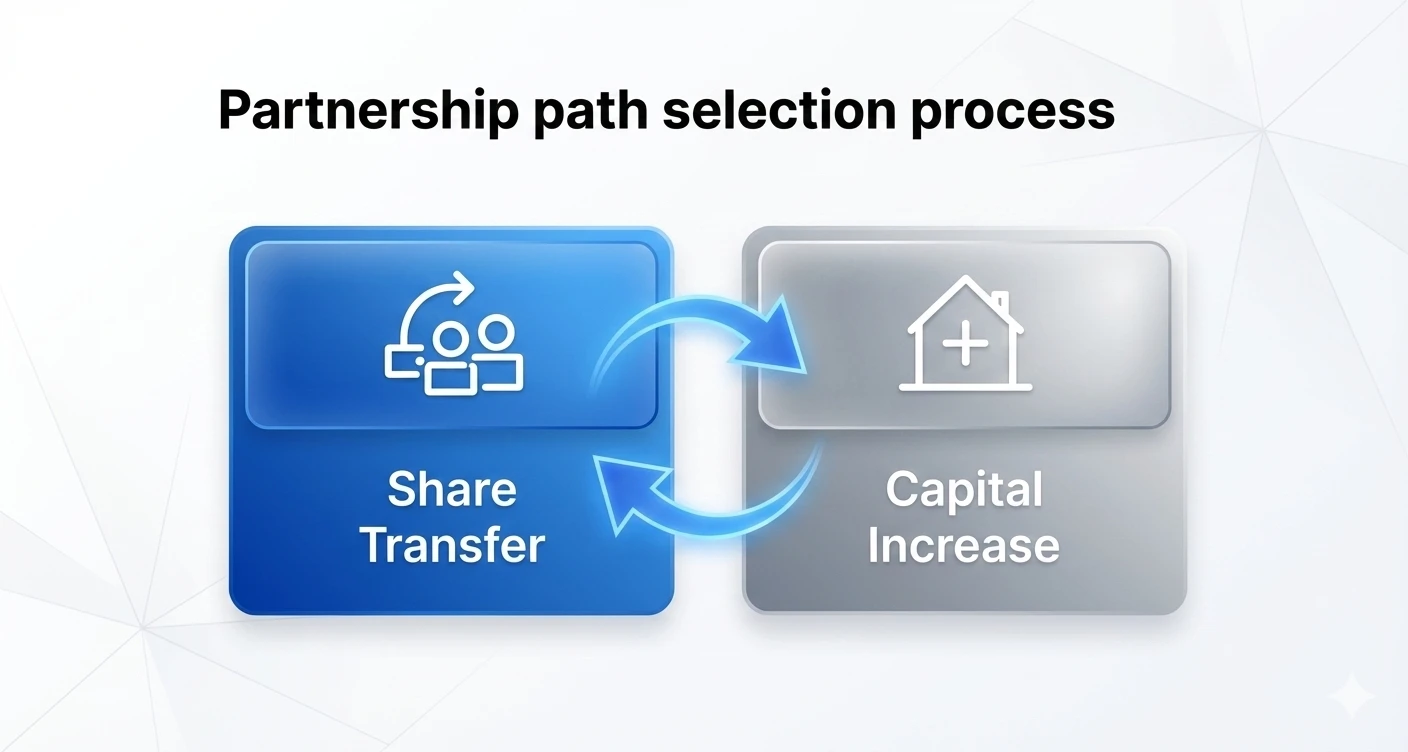
Determine whether the transaction changes ownership, injects new capital, or does both before preparing documents.
Start with the Company’s Existing Rules
Before negotiating final percentages or signing a term sheet, review the records that already govern the company. At minimum, reconcile:
- the current articles of association;
- the Trade Registry and share-ledger position;
- any shareholder agreement, transfer restriction, pre-emption or option right;
- the current capital, unpaid capital commitments and shareholder receivables;
- pledges, attachments or other restrictions affecting the shares;
- regulated-sector approvals or ownership limits;
- management and signature-authority changes expected at closing; and
- bank, finance, licence and material-contract change-of-control clauses.
This review prevents the parties from preparing a transfer when the real objective requires a capital increase, or completing an ownership change without addressing a connected management, bank-KYC or regulatory step.
Adding a Partner to a Turkish Limited Company
For a Turkish limited liability company, Article 595 of the Turkish Commercial Code provides the core share-transfer framework. A transaction creating the obligation to transfer an LLC capital share must be in writing and the parties’ signatures must be notarised. Unless the articles of association provide otherwise, the transfer also requires the approval of the shareholders’ general assembly and becomes effective with that approval.
The general assembly—not an automatically assumed “board of managers”—is therefore the default approval body for an LLC share transfer. The articles may modify the approval position, impose conditions or restrict transfer, so the company document must be checked rather than replaced with a generic template.
The transfer agreement should also be reviewed for company-specific obligations attached to the share. Article 595 expressly contemplates matters such as additional-payment or ancillary-performance obligations and contractual transfer rights. A short form that records only a price and percentage may therefore be insufficient for a particular company.
After approval, the company must align its share ledger, MERSİS/Trade Registry filing and supporting corporate records as required for the transaction. The exact registry package should be checked against the current requirements of the competent Trade Registry because the necessary evidence depends on the company record and the parties involved.
Adding a Shareholder to a Turkish Joint-Stock Company
A joint-stock company should not be processed using the LLC checklist. Under the Turkish Commercial Code, registered shares are transferable in principle unless the law or articles impose a restriction. The execution and company-recognition steps then depend on factors including whether the shares are registered or bearer shares, whether certificates have been issued, applicable restrictions and the company’s share-ledger or Central Securities Depository obligations.
Consequently, it is unsafe to state that every A.Ş. share transfer requires a notarised agreement, general-assembly approval or Trade Registry registration. The articles, share type, issuance status, sector and any connected management or registered-data change must be reviewed transaction by transaction.
If the newcomer is entering through an A.Ş. capital increase instead of purchasing existing shares, the company must follow the applicable capital-increase, subscription, pre-emptive-right and registration process. That is a company financing transaction, not merely a private sale between two shareholders.
A Decision Framework for the Incoming Partner
| Question |
If the answer is “yes” |
Likely route to examine first |
| Should an existing shareholder receive the purchase price? |
The deal reallocates an existing stake |
Share transfer |
| Should the company receive fresh equity funding? |
New shares and dilution may be intended |
Capital increase |
| Does a founder need partial liquidity while the company also needs funding? |
Two different money flows exist |
Combined transfer and capital increase |
| Will the newcomer also become a manager, director or signatory? |
Ownership and representation must be handled separately |
Selected ownership route plus separate corporate decisions |
| Is the target in a regulated sector? |
Prior approval, notification or ownership limitations may apply |
Sector review before signing or closing |
Key distinction: Becoming a shareholder does not automatically make the person a manager, director, authorised signatory, employee or work-permit holder. Each status must be created and documented under its own rules.
Documents Should Be Built Around the Selected Route
There is no single universal “add partner” document pack. The file is assembled after the legal form, entry route, incoming shareholder type and signing method are known.
| File component |
Why it may be needed |
Important control |
| Current articles and registry records |
Confirm capital, shareholders, restrictions and approval rules |
Use the latest verified version |
| Share-transfer or subscription documentation |
Record the selected transaction and consideration |
Do not use transfer wording for a capital subscription |
| General-assembly, board or manager decisions |
Approve the matters assigned to the relevant company organ |
Choose the correct organ and decision threshold |
| Identity and authority evidence |
Establish who is signing and in what capacity |
Match names and authority across every document |
| Foreign corporate records |
Show status, ownership and signatory authority of a foreign entity |
Check source-country and receiving-authority requirements |
| Power of attorney |
Allow an authorised representative to complete specified steps |
Grant transaction-specific authority; do not assume bank acceptance |
| MERSİS/Trade Registry forms |
Record registrable company changes |
Reconcile percentages, nominal values and personal data |
| Post-closing compliance records |
Update UBO, bank KYC and other triggered records |
Do not treat registration as the end of the operational process |
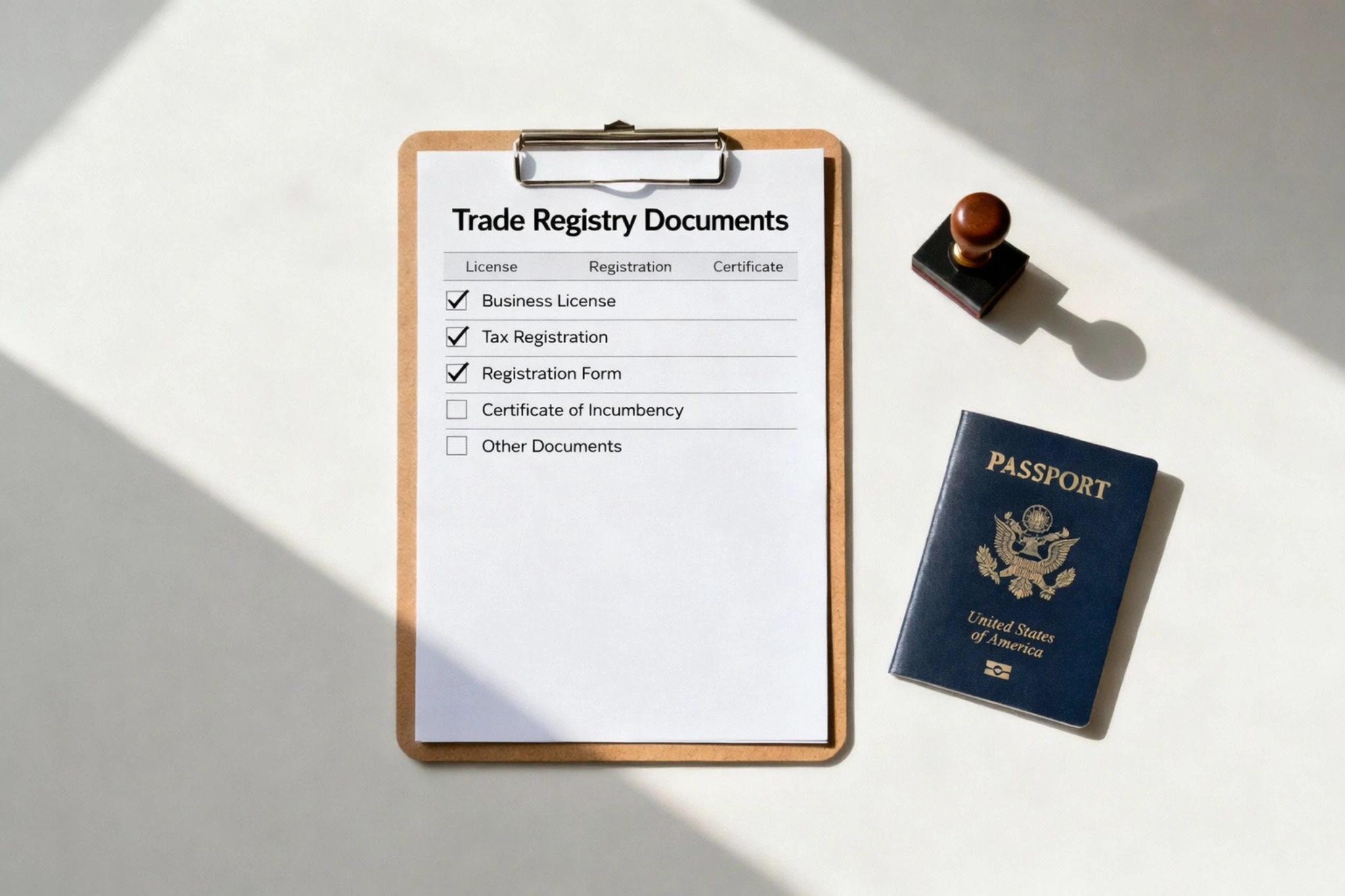
The document package should follow the company type, transaction route and signatory structure.
Foreign Individuals and Foreign Corporate Shareholders
Türkiye’s foreign-investment framework is based on equal treatment: international investors may acquire shares under the same general framework as domestic investors, subject to special legislation and sector-specific limitations. A foreign shareholder does not need a Turkish co-shareholder merely because of nationality. See Do Foreigners Need a Turkish Partner? for the separate nationality question.
Foreign participation nevertheless adds document and operational checks. An individual and a foreign legal entity do not use the same evidence. Depending on the person, transaction and registry file, the parties may need translated identity documents, a potential tax number, a current foreign-company status document, a competent-organ resolution and proof of signatory authority.
Do not apply a blanket “apostille every document” rule. The correct authentication route depends on the issuing country, document type, applicable treaty or exemption and the Turkish receiving authority. Use the Apostille for Turkey Documents guide to select the authentication route and the Sworn Translation in Turkey guide to determine the required translation/notarial level.

Foreign individual and corporate shareholders require different identity, status and authority evidence.
Can the Transaction Be Completed Remotely?
Some ownership-change steps may be completed through a properly authorised representative, but remote completion is not automatic. The power must cover the actual route and documents, and the notary, registry, bank and other institutions retain their own identity and acceptance controls.
A foreign-issued power of attorney may require apostille or consular legalisation and accepted Turkish translation, depending on its origin and intended use. It should define the authorised transaction, shares or capital action, company, signing powers, limits and any authority to delegate. The Power of Attorney in Turkey guide explains the scope-design and signing-route controls.
Due Diligence Before the New Partner Enters
Registry formality is not a substitute for transaction due diligence. Before closing, the buyer, seller and company should allocate responsibility for reviewing:
- ownership history and any encumbrance over the shares;
- paid and unpaid capital obligations;
- tax and social-security compliance status;
- shareholder loans and related-party balances;
- material contracts, borrowing arrangements and change-of-control clauses;
- licences, permits, intellectual property and data-access rights;
- pending disputes, enforcement and contingent liabilities;
- management, reserved matters, voting, dividend and exit rights; and
- how warranties, indemnities and closing conditions will be documented.
The level of review should reflect the value, risk and structure of the transaction. Workon coordinates the operational file; legal due diligence and transaction drafting are performed by the appropriately authorised legal professionals, while tax treatment and filings are assessed by the company’s licensed CPA/SMMM.
Tax and Cost Questions Require Transaction-Specific Review
Do not rely on a universal “two-year exemption,” fixed stamp-duty percentage or standard tax result. The treatment of a share sale can change according to whether the seller is an individual or entity, tax residence, company type, holding period, whether share certificates exist, acquisition history, treaty position and the final agreement.
A capital contribution and a purchase price also have different legal and financial functions. Before signing, obtain route-specific advice on direct taxes, VAT and stamp-tax treatment, valuation, withholding, transfer pricing where relevant, and the evidence needed for the movement of funds.
Official 2026 SMMM professional-fee references by entry route
| Entry route |
2026 SMMM tariff reference |
Important qualification |
| Share transfer |
TRY 5,330 |
Professional SMMM fee reference only; not the share purchase price or total transaction cost |
| LLC capital increase |
TRY 18,170 |
Professional fee for the capital-increase work; reports/other services may be separate only when applicable |
| JSC capital increase |
TRY 22,460 |
Professional fee reference; does not include public, legal, document or funding costs |
A combined partner-entry transaction can involve both a transfer and a capital increase, but tariff rows should not be mechanically added without confirming the actual professional engagement and required work. These figures are not Workon prices, government charges or statutory capital.
For future annual updates, verify the current year through the İSMMMO Professional Fee Tariffs archive and the corresponding TÜRMOB / Official Gazette tariff.
Post-Closing Actions That Are Easy to Miss
- Reconcile company records: Update the share ledger and complete the applicable MERSİS/Trade Registry and Gazette steps.
- Separate management changes: Register or document any new manager, director or signature authority through the correct company-organ process.
- Update bank KYC: Give the bank the new ownership, control and signatory information it requires; a registry change does not compel immediate bank acceptance.
- Review beneficial-owner reporting: Recalculate direct, indirect and other control, then make the required updates. See Beneficial Owner Declaration in Turkey.
- Check foreign-investment reporting: Where foreign capital is involved, determine whether an E-TUYS foreign-direct-investment/share-transfer submission is triggered.
- Update operational permissions: Review online banking, e-signature, KEP, tax-portal, contract and internal approval access without sharing personal credentials.
How Long Does Adding a Partner Take?
There is no responsible universal promise such as “three to seven business days.” Timing depends on the route, company type, articles, party agreement, foreign-document readiness, corporate approvals, notary availability, registry corrections, regulated-sector checks and whether management or banking changes are included.
A more useful schedule separates the transaction into four gates:
- commercial terms and due diligence;
- document, authentication and translation readiness;
- corporate approval and signing; and
- registry plus post-closing operational updates.
Estimate each gate after the actual company record and incoming shareholder have been reviewed.
How Workon Coordinates the Partner-Entry Process
Workon supports foreign founders, investors and overseas companies with the operational coordination required to change a Turkish company’s ownership structure. Depending on the agreed scope, this can include route and document planning, foreign-document sequencing, MERSİS/Trade Registry coordination, notary and sworn-translation coordination, registered-address continuity, bank-application file preparation and post-closing workflow tracking.
Legal opinions, transaction agreements and regulated legal work are handled by authorised lawyers. Tax analysis, declarations and professional accountancy work are handled by the company’s licensed CPA/SMMM. Bank, registry, notary and public-authority decisions remain with the relevant institution.

Workon coordinates company-registration and related operational files for foreign founders according to the agreed scope.
Review Workon’s business setup and operational coordination services.
Official Sources
Last reviewed: 17 September 2026. The correct procedure depends on the company’s legal form, articles, share type, incoming shareholder and transaction documents.
Frequently Asked Questions
The main routes are a transfer of existing shares, a capital increase in which the incoming investor subscribes for new shares, or a transaction combining both. The correct route depends on whether the money should go to an existing shareholder, into the company, or both.
In a share transfer, the purchase price normally goes to the selling shareholder and the company's registered capital does not increase. In a capital increase, the incoming investor contributes new capital to the company and the ownership percentages can change through the issuance or subscription of new shares.
No. For an LLC, the transfer obligation generally requires a written agreement with notarised signatures and, unless the articles provide otherwise, general-assembly approval. A JSC follows different rules depending on share type, certificates, articles, restrictions and the transaction, so the LLC checklist should not be copied automatically.
No. Ownership, management, board or manager appointment, representation authority, employment and work-permit status are separate. Any management or signing change should be created through the correct corporate decision and registration process.
Generally yes, subject to sector-specific restrictions. Foreign individual and corporate investors require different identity, current-status and authority evidence, and the correct authentication and translation route depends on the issuing country, document type and receiving authority.
There is no reliable universal three-to-seven-day promise. Timing depends on the entry route, company type, articles, due diligence, foreign-document readiness, approvals, signing and notary steps, Trade Registry corrections, regulated-sector requirements and any connected management or banking updates.