


















Short answer: Customs clearance in Turkey is the controlled process that places goods under the correct customs procedure, verifies the 12-digit GTIP classification, customs value and origin, checks product-specific restrictions, accepts the declaration, assesses any duties and taxes, and releases the goods when the legal conditions are met. It is not a single form or a guaranteed delivery-time window.
Last verified: 17 September 2026 against current Republic of Türkiye Ministry of Trade guidance and legislation. The Ministry’s customs-brokerage guidance still confirms that appointing a customs broker is not universally mandatory, while the May 2026 express-shipment guidance contains separate simplified categories that should not be confused with standard commercial customs clearance. This guide covers the decision architecture for commercial imports and exports. For the shipment-level workflow and hand-offs, use our step-by-step Turkey customs clearance guide for importers.
Customs Clearance in Turkey at a Glance
A reliable customs file begins before the cargo moves. Six decisions determine most of the result:
| Control point | Question to settle before shipment | Why it matters |
|---|---|---|
| Customs procedure | Free circulation, export, transit, warehousing, inward processing, temporary admission or another procedure? | The procedure determines the declaration, conditions, guarantees and how the goods may be used. |
| GTIP classification | What is the complete 12-digit Turkish tariff code? | Classification drives duties, trade-policy measures, permits and many product controls. |
| Origin and status | What is the non-preferential origin, and is preferential treatment or free-circulation status claimed? | Origin and free-circulation status are different concepts and require the correct evidence. |
| Customs value | Which price, freight, insurance, assists, royalties or other additions belong in the customs value? | The invoice total alone is not always the customs value used for assessment. |
| Product compliance | Is the product prohibited, restricted, licensed or subject to TAREKS or another authority? | A customs-ready invoice cannot replace a missing conformity, health, safety or sector approval. |
| Declarant and evidence | Who will make the declaration, under which authority, and which records support every data element? | The declarant remains responsible for the accuracy and completeness of the filing. |
Practical rule: do not request a freight quote and treat customs as a later paperwork task. First approve the product, transaction and importer/exporter model; then align the commercial documents and logistics instructions with that model.
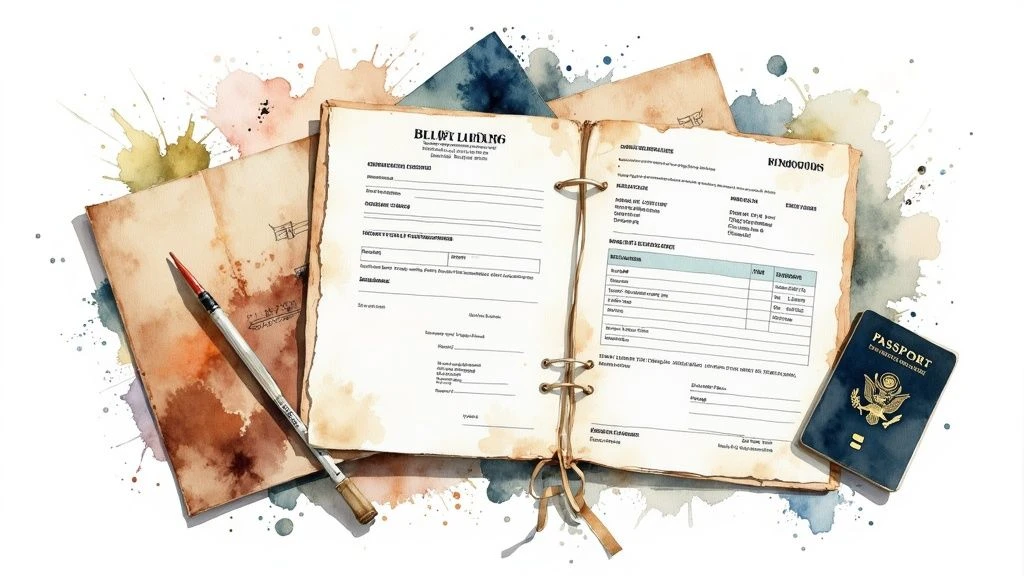
A customs file should support the declaration consistently; the required documents depend on the goods and transaction.
Who Can Make a Customs Declaration in Turkey?
The person entitled to dispose of the goods may act directly where the legal and system conditions are met or may appoint a representative. The Ministry of Trade states that appointing a customs broker is not universally mandatory: a person may handle its own customs transactions or authorize a licensed customs broker, generally through a notarized power of attorney. A customs broker is a private-sector professional certified by the Ministry, not a customs official. See the Ministry’s official customs brokerage FAQ.
In practice, international businesses usually involve a licensed broker because classification, valuation, origin, permits and electronic customs systems are technical and interconnected. Outsourcing the filing does not make weak source data safe. The importer or exporter should still approve the product description, quantity, value, Incoterm, origin claim, licence status and supporting evidence before declaration.
A foreign company should confirm its Turkish declarant, representation, tax and operational model before dispatch. The right answer depends on the transaction and customs procedure; a Turkish company is not automatically required for every movement, and forming one does not automatically make a restricted product importable. Workon is not a customs broker; it coordinates business, document and provider handoffs, while regulated customs-brokerage work is handled by the appropriately licensed professional where required. Where a local trading operation is commercially appropriate, see how to set up an import-export company in Turkey.

When a Turkish operating entity is part of the trade model, align company, tax, banking and customs-readiness work before the first shipment.
The Eight Control Points in Turkish Customs Clearance
1. Select the correct customs procedure
“Import” is not sufficiently precise. Goods may be released for free circulation, placed under customs warehousing, moved in transit, admitted temporarily or entered under inward processing. Each procedure has different conditions and consequences. The intended use of the goods after arrival must match the declared procedure.
Exports also require the correct export declaration and may face product, destination, sanctions, licensing or commercial-quality controls. Exporter-union registration is transaction-specific rather than a universal export licence; our separate guide explains exporter registration in Turkey.
2. Classify the product under the 12-digit GTIP
Turkey uses a 12-digit Customs Tariff Statistics Position, or GTIP. The first six digits correspond to the international HS structure, but the complete Turkish code is needed for national measures. Marketing names, supplier codes and a foreign country’s tariff code are useful evidence, not a substitute for Turkish classification.
Build the classification file from composition, function, operating principle, technical drawings, catalogues and intended use. Start with the Ministry’s Tariff Search application and official tariff guidance. If classification remains genuinely uncertain and material, consider whether Binding Tariff Information is appropriate before recurring shipments.
3. Separate origin from free-circulation status
Origin is the economic nationality of the goods. It can affect duties, trade-policy measures, quotas and origin marking. Preferential origin may allow a tariff benefit only when the relevant agreement’s rules and evidence are satisfied.
An A.TR movement certificate generally evidences free-circulation status for covered EU–Türkiye Customs Union trade; it is not proof of origin. EUR.1, an origin declaration or another proof serves a different legal function where the applicable arrangement allows it. The Ministry explains the distinction in its origin guidance. For scope and exclusions, read our EU–Türkiye Customs Union guide.
4. Establish the customs value
The transaction value is tested first where its conditions are met, but the customs value may require additions. Depending on the facts, these can include freight and insurance to the place of entry, packing, certain assists, royalties or proceeds that accrue to the seller. Post-entry transport and separately identified items may be treated differently under the valuation rules.
Incoterms allocate costs and risks between buyer and seller; they do not by themselves determine the customs value. Keep the sales contract, commercial invoice, freight and insurance evidence, payment trail, related-party analysis and any royalty or tooling information consistent. The Ministry’s customs-value guidance summarizes the valuation methods and additions.
5. Screen restrictions and product controls
Before shipment, test the complete GTIP against the current import/export regime, product-safety communiqués and rules of the competent authority. Depending on the product, controls may involve TAREKS and the Ministry of Trade or another authority responsible for agriculture, health, environment, energy or sector regulation.
The 2026 Product Safety and Inspection Communiqués cover numerous product groups and are updated annually. The Ministry’s 2026 official announcement confirms that requirements differ by product and communiqué. Never infer permission from a prior shipment or from a similar-looking code. Food businesses should also use our product-specific guide on exporting food products from Turkey.
6. Build a declaration-ready evidence set
The declaration is a data set supported by records, not a stack of documents assembled independently. Product descriptions, quantities, weights, currency, Incoterm, transport references, origin and value must reconcile across the invoice, packing information, transport document, licences and broker instructions.
The Ministry’s Customs Information Bank publishes the current customs-declaration instructions and code lists. Use the version in force on the filing date; do not copy an old declaration or annual tariff table without rechecking it.
7. Submit the declaration and respond to risk controls
Electronic acceptance does not itself mean release. Risk analysis may result in document control, physical examination, sampling, laboratory analysis or referral to another authority. The control route is assigned by the administration; it should not be promised in advance or treated as a service level.
If customs asks a question, respond with evidence tied to the declaration field under review. Unstructured email chains and new explanations that conflict with the original documents usually increase risk rather than resolve it.
8. Pay, obtain release and retain the file
Release follows only after the declaration’s conditions are met, required controls are complete, and duties, taxes or guarantees are handled. Logistics release, terminal release and customs release are separate milestones; confirm which one a status message refers to.
Keep the final declaration, assessment/payment records, licences, inspection results and all supporting commercial evidence in a searchable transaction file. Customs control can continue after the goods leave the border, so post-clearance governance is part of clearance rather than an optional archive task.
Which Documents Are Required?
There is no accurate universal checklist for every Turkish customs declaration. The document set depends on the customs procedure, GTIP, product, origin claim, value structure, transport mode and competent authority. Use this matrix as a scoping tool:
| Evidence | Typical role | When it becomes conditional |
|---|---|---|
| Commercial invoice | Supports seller, buyer, goods, price, currency and transaction terms | Its detail and form must match the transaction and any sector rule. |
| Transport document | Connects the goods to the carriage and arrival/export movement | The document differs for sea, air, road, rail, courier and multimodal transport. |
| Packing information | Reconciles packages, net/gross weight, marks and contents | The required granularity depends on the cargo and inspection needs. |
| Origin or movement evidence | Supports non-preferential origin, preferential origin or free-circulation status | Use only the document permitted by the relevant rule; a certificate of origin is not automatically required for every shipment. |
| Licence, certificate or conformity record | Supports permission, product safety, health or technical compliance | Required only where the current GTIP/product/use/regime falls within the relevant measure. |
| Value evidence | Supports freight, insurance, payment, assists, royalties and related-party facts | Scope depends on the valuation method and transaction structure. |
| Power of attorney | Authorizes indirect or direct representation as applicable | Needed when a representative is appointed in the form required for the task. |
Customs Duties, Import VAT and Landed Cost
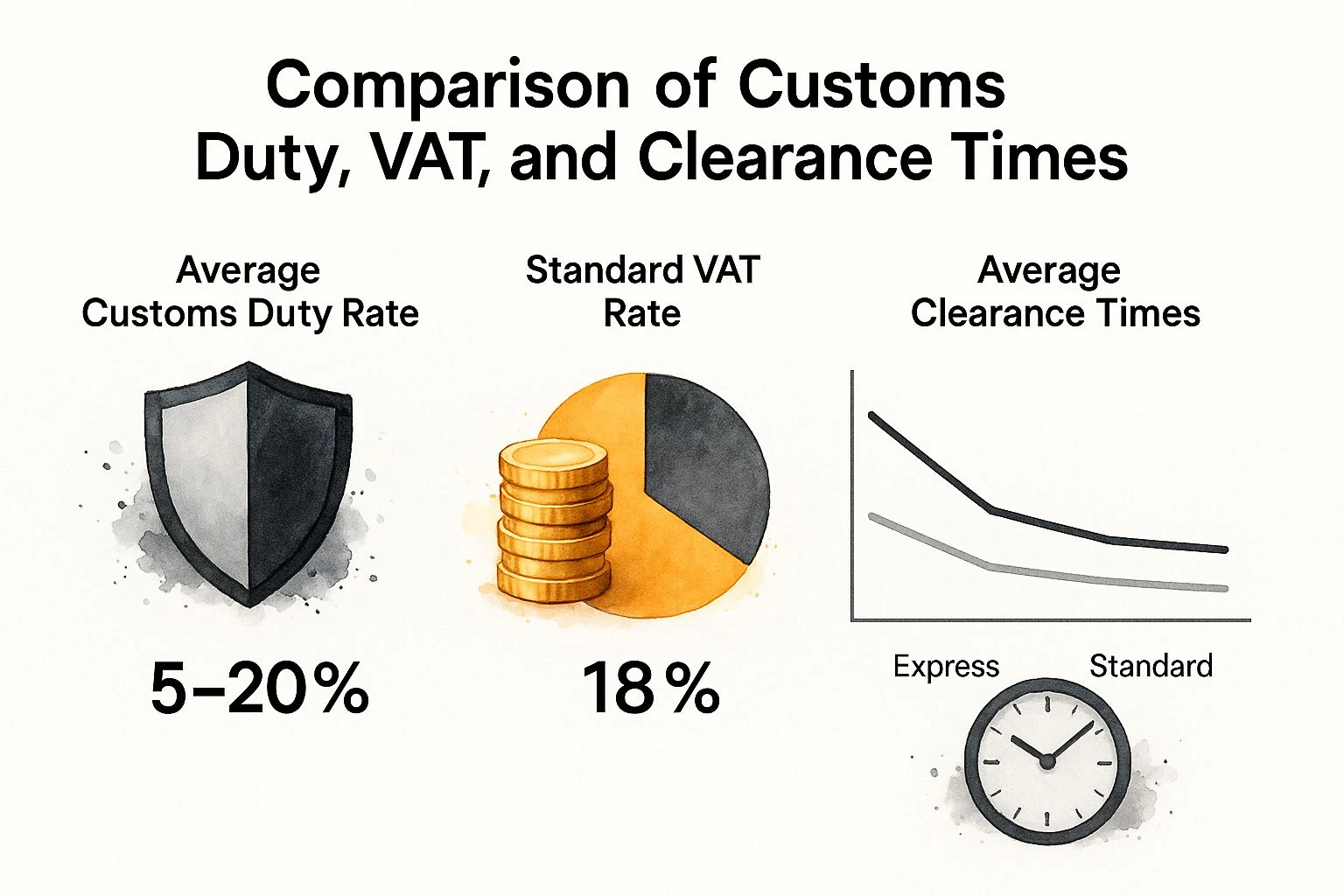
Do not use generic category percentages for landed-cost approval; calculate against the exact GTIP, origin, value and measures in force.
A defensible landed-cost model should be transaction-specific. Depending on the goods and facts, border cash requirements may include customs duty, import VAT, special consumption tax, additional customs duty, trade-remedy measures and other product- or payment-specific charges. A preferential document can reduce a qualifying customs duty but does not automatically eliminate import VAT or unrelated measures.
For import VAT, the taxable base is governed by Article 21 of the Value Added Tax Law No. 3065; it is not necessarily the commercial invoice amount. Rates and exemptions must be checked for the exact goods and declaration date. Avoid reusable tables that state a fixed duty rate for “electronics,” “textiles” or another broad sector: products within the same sector can have different GTIPs and measures.
Before approving a purchase order, request a written calculation that states the GTIP, origin treatment, customs value bridge, applicable measures, tax bases, currency/exchange-rate assumption, brokerage and terminal costs, and the owner of any inspection or storage risk.
What Does “Customs Clearance in Progress” Mean?
“Customs clearance in progress” is usually a carrier or tracking-platform label, not one official legal status in Turkey. It can mean that the goods have arrived and await a declaration, that documents are being reviewed, that product-control approval is pending, that customs selected a control, that a value or classification question is open, or that payment/release messages have not completed.
Ask the carrier or broker for four concrete facts:
- Has a customs declaration been registered, and what is its reference?
- Which customs or product-control milestone is currently open?
- What exact document, payment, inspection or decision is pending?
- Who owns the next action, and when was it submitted or requested?
This converts a vague tracking message into an actionable clearance status.
What Commonly Delays Turkish Customs Clearance?

Documentary review, physical examination, sampling or another authority’s control can extend the release timeline.
| Delay trigger | First corrective action |
|---|---|
| Generic or disputed GTIP | Provide technical evidence and the classification rationale; do not rely only on a supplier code. |
| Value inconsistency | Reconcile invoice, freight, insurance, payment, related-party and royalty/assist records. |
| Unsupported origin or preference claim | Identify whether the issue is origin, preference or free circulation and provide the legally correct evidence. |
| Missing product approval | Identify the competent authority and current communiqué before attempting a replacement document. |
| Cross-document mismatch | Create one reconciliation of descriptions, quantities, weights, currency, Incoterm and transport references. |
| Inspection or laboratory referral | Confirm sampling/control scope, responsible authority, requested evidence and the next formal milestone. |
| Unpaid amount or missing guarantee | Separate customs assessment, payment, guarantee, terminal and carrier release requirements. |
How Long Does Customs Clearance Take in Turkey?
There is no responsible universal promise such as “one to three days.” A complete low-risk filing may progress quickly, while product controls, physical examination, laboratory analysis, valuation or classification questions, missing permits, holidays, port operations and document corrections can extend the timeline.
Measure the process by milestones: arrival/summary declaration, declaration registration, control assignment, external-authority approval, assessment/payment, customs release and physical delivery. This makes the true bottleneck visible and prevents customs delay from being confused with carrier or terminal delay.
Special Procedures Are Not Generic Exemptions
Customs warehousing can defer the release-for-free-circulation stage while goods remain under customs control. Inward processing may suspend or relieve certain import charges when authorization, processing, export and discharge conditions are met. Temporary admission, transit, outward processing and free-zone movements have separate eligibility and closure rules.
Do not select a procedure solely because it appears to defer tax. Model the commercial use, record-keeping, guarantee exposure, time limits and exit/closure evidence first. Failure to discharge a special procedure correctly can create duties, interest, penalties or operational restrictions.
Pre-Shipment Customs Readiness Checklist
- Confirm the importer/exporter, declarant and representation authority.
- Approve the intended customs procedure and post-clearance use.
- Validate the 12-digit GTIP using current Turkish sources.
- Document non-preferential origin and any separate preference/free-circulation claim.
- Build the customs-value bridge from the contract, Incoterm and cost evidence.
- Screen prohibitions, licences, product safety, TAREKS and competent-authority controls.
- Reconcile invoice, packing, transport and permit data before cargo departure.
- Calculate duties, import taxes, trade measures and non-customs border costs.
- Define who answers customs queries and who funds inspections, storage or guarantees.
- Create a post-clearance retention file and review recurring classifications annually or when the product/rules change.
How Workon Supports International Businesses
Only an authorized customs actor can execute the relevant customs formalities. Workon supports the surrounding business-readiness work: selecting an operating model, coordinating document and compliance inputs, identifying questions for the licensed customs broker, and aligning company, tax and trade processes. We do not present advisory coordination as customs brokerage.
For a scoped review before your first or next shipment, see Workon’s Customs Process Advisory Services in Turkey.
Disclaimer: This article provides general information and does not constitute legal, tax, customs brokerage, tariff-classification or product-compliance advice. Turkish customs, tax and product-control requirements can change and depend on the exact GTIP, origin, value, procedure, goods and declaration date. Before shipping or declaring goods, verify the current rules with the competent authorities and obtain transaction-specific advice from a licensed customs broker and, where appropriate, qualified legal or tax advisers. Workon provides advisory coordination and does not execute customs declarations or customs clearance.