


















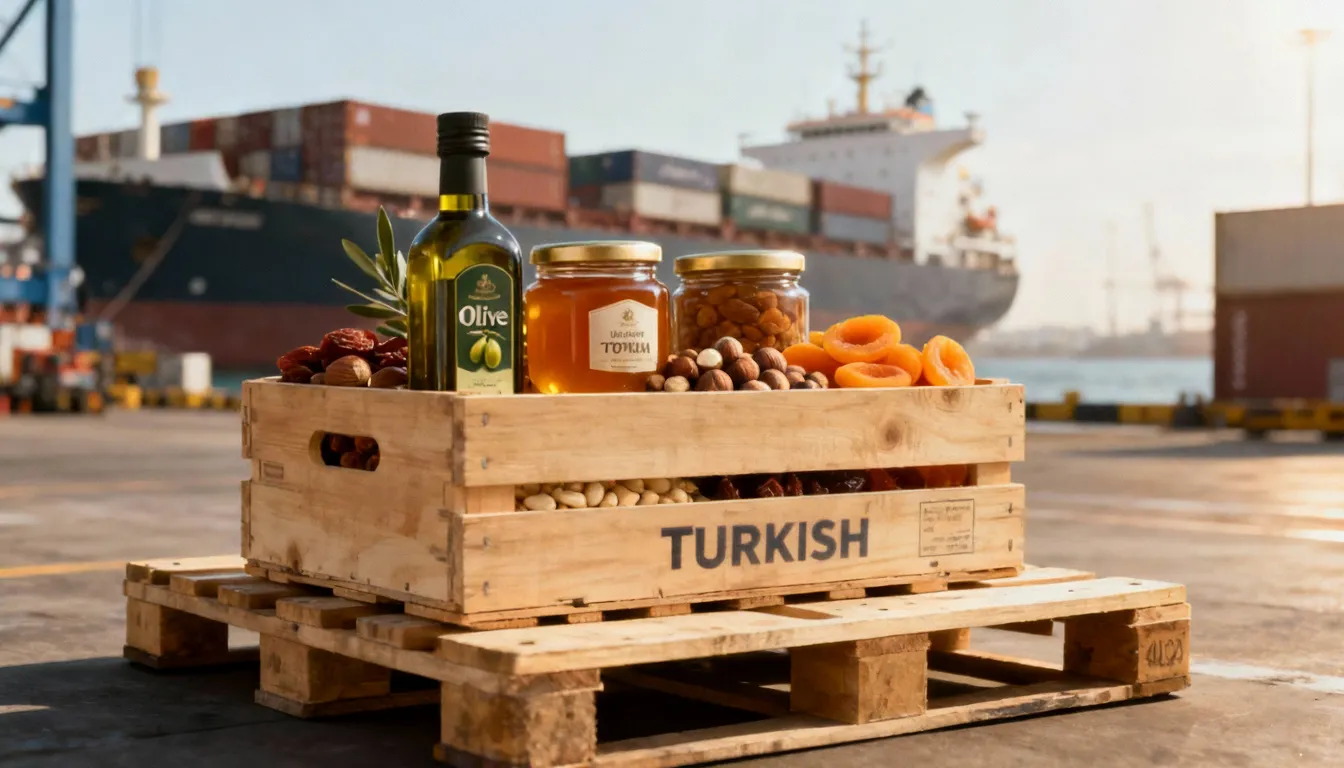
Short answer: To export food products from Turkey, first identify the exact product and destination rule—not a generic “food export licence.” Confirm the exporter’s eligibility, the producer’s registration or approval, destination-country access, the correct health, veterinary or phytosanitary evidence when applicable, compliant labels and packaging, customs classification and origin, and a logistics plan that protects shelf life. Do not manufacture or ship until the importer and competent authorities agree on the required route.
Last verified: 17 September 2026 against current Republic of Türkiye Ministry of Trade and Ministry of Agriculture and Forestry sources, together with official EU, Great Britain and US import portals. Requirements can change by product, ingredient, process, destination, buyer and shipment.
Food Export from Turkey: The Process in One View
| Gate | Decision or evidence | Stop condition |
|---|---|---|
| 1. Product | GTIP/HS code, ingredients, process, intended use, storage and shelf life | The product cannot be placed in the correct regulatory stream. |
| 2. Market | Destination import conditions, importer, tariff, quota and official-control route | The country, establishment or product is not eligible. |
| 3. Business | Eligible exporter and registered or approved producing establishment | The legal entity, manufacturer or authority record is incomplete. |
| 4. Product compliance | Formula, residue/contaminant limits, label, packaging, claims and traceability | The final production specification is not accepted for the destination. |
| 5. Certification | Only the applicable health, veterinary, phytosanitary, origin or analysis evidence | A required certificate cannot be issued for the lot or establishment. |
| 6. Shipment | Reconciled commercial/customs file, temperature plan, transport booking and release controls | Document data, cargo or arrival conditions do not match. |
The sequence is deliberate. A buyer’s request for “all export documents” is not a usable specification. Ask for the destination authority, product code, legal basis, certificate model, establishment-listing requirement, language and original/electronic format before accepting the order.

A viable export plan begins with one defined product, one destination and one evidence matrix.
Who May Export, and Who Must Hold the Food Approval?
The Ministry of Trade’s official Export Regime FAQ recognises eligible legal persons, natural persons and joint ventures with a tax identification number and exporters’ association membership as exporters. TİM’s current guidance clarifies that membership in at least one TİM-affiliated exporters’ association is the general membership rule; a separate association membership is not automatically required for each additional product field. This is not a universal licence for every product. Prohibited, restricted, quota-controlled or sector-regulated goods remain subject to their own rules.
The exporter and manufacturer do not have to be the same business. The producing establishment, however, must have the registration or approval required for its activity under Turkish food law. Certain animal-origin operations require approval; other food businesses may operate under registration. For the official routes, use the Ministry of Agriculture and Forestry’s current food-business registration guidance.
If you need a Turkish trading entity, compare the structure and operational stack in our import-export company setup guide. For exporters’ association membership and the no-universal-licence boundary, see our exporter registration guide.
Put the Product in the Correct Control Stream
| Product stream | Likely Turkish control question | What not to assume |
|---|---|---|
| Shelf-stable plant-origin food: olive oil, confectionery, pasta, canned or dried products | Food-business status and whether the destination requests a plant-origin food health certificate, analysis or special model | That every plant-origin processed food needs a phytosanitary certificate |
| Fresh fruit, vegetables, seeds, plants or other regulated plant material | Plant-quarantine inspection, destination phytosanitary conditions and phytosanitary certification where required | That an ordinary food health certificate covers plant-health requirements |
| Meat, dairy, fish, eggs, honey or other animal-origin food | Veterinary controls, approved establishment/country status, destination certificate model and possible export approval | That Turkish domestic approval guarantees access to every country |
| Composite food containing processed animal and plant ingredients | Destination definition, ingredient treatment, exemptions and certificate route | That the finished product follows only the majority ingredient |
| Organic, halal, kosher, geographical-indication or other claimed food | Applicable legal scheme, accredited certification, claim substantiation and buyer standard | That a private certificate replaces government import controls |
The Ministry’s plant-origin food instruction explains that a health certificate can be issued for plant-origin food and feed under its procedure, taking the receiving country’s requirements into account. That is a food/feed safety document. A phytosanitary certificate belongs to the plant-health system and applies to covered plants, plant products and other regulated articles. Türkiye’s new Plant Quarantine Regulation was published on 6 May 2026 and entered into force after its 90-day transition period; current plant, plant-product and other regulated-article exports should therefore be checked against that updated framework.
For animal-origin products, the Ministry’s current Export Controls page confirms that receiving-country demands govern official controls. Depending on the product and destination, the route can include prior export approval, establishment inspection, document and identity checks, physical checks, sampling and an agreed veterinary health certificate or additional declaration.
Build the Destination Rule Before the Turkish File
Food admissibility is determined at both ends. Ask the buyer or importer to provide a written import-condition sheet from the competent authority. Independently verify it on the destination’s official portal.
| Destination | Official starting point | Questions to resolve before production |
|---|---|---|
| European Union | European Commission Access2Markets and food-control resources | CN code, SPS conditions, eligible country/establishment, certificate model, TRACES/CHED, border control post, residues, labelling and tariff/origin |
| Great Britain | GOV.UK IPAFFS guidance | Whether the product is POAO, composite, high-risk food of non-animal origin or a controlled plant; risk category, notification, certificate, border route and importer duties. Northern Ireland may follow a different route. |
| United States | FDA Imported Food hub | Food-facility registration if applicable, US agent, prior notice, FSVP importer, process filing where relevant, label and any FDA/USDA commodity control |
| Another market | Customs, food/veterinary/plant authority and tariff portal of that country | Import licence, facility listing, certificate language/model, testing, shelf-life-at-arrival, label, religious certification, quota and importer registration |
Do not copy an EU certificate model into a Great Britain shipment or treat “UK” as one undifferentiated route. Do not assume the buyer’s private quality manual is the law, or that satisfying the law guarantees buyer acceptance. Keep legal, official-certificate and commercial-standard requirements in separate columns.
Which Certificates and Documents Are Actually Needed?
| Document family | Function | Trigger |
|---|---|---|
| Commercial invoice and packing data | Transaction value, parties, goods, packages, weights and terms | Core commercial/customs file, adapted to the shipment |
| Export customs declaration and transport document | Customs exit and carriage record | Procedure and transport mode |
| Health or veterinary health certificate | Official food, feed or animal-health statements | Product stream and receiving-country requirement; not universal |
| Phytosanitary certificate | Official plant-health statements | Covered plant/plant product and destination phytosanitary condition |
| Certificate or proof of origin | Preferential or non-preferential origin | Trade agreement, tariff claim or destination measure |
| A.TR movement certificate | Free-circulation status for covered Customs Union trade | Only where the EU–Türkiye Customs Union scope and status conditions are met; it is not proof of origin |
| Laboratory report or certificate of analysis | Lot-specific test results | Authority, risk plan, product specification or buyer contract |
| ISO, BRCGS, IFS, halal, kosher or organic evidence | Management-system, buyer, religious or regulated-claim assurance | Applicable scheme or contract; none is a universal Turkish food-export permit |
Agricultural products do not automatically receive the same treatment as industrial goods under the EU–Türkiye Customs Union. Separate the free-circulation, preferential-origin and food-control questions using our Turkey-EU Customs Union guide.
Ten Steps from Product Specification to Export Closeout
- Freeze the product master. Record recipe, allergen profile, processing method, additives, package sizes, storage, shelf life, production site and GTIP/HS rationale.
- Confirm market access. Check whether Türkiye, the establishment and the product are eligible and whether a quota, prohibition, surveillance measure or importer authorization applies.
- Name the responsible parties. Identify exporter, producer, destination importer, customs representatives, certificate applicant, freight forwarder and authority contacts.
- Approve the destination specification. Reconcile composition, contaminants/residues, microbiology, nutrition, allergens, claims, language, date coding and packaging rules.
- Validate the facility. Confirm the Turkish registration/approval and any destination listing, audit or buyer certification before assigning the lot.
- Plan official certification. Use the applicable Ministry pre-notification/application path and agreed certificate model. Make the goods available for inspection or sampling before dispatch.
- Reconcile the file. Buyer/seller identity, product description, GTIP, lot, quantity, weights, value, Incoterm, origin, certificate and transport data must tell one story.
- File the export procedure. Review the declaration with the customs professional, present required evidence and preserve exit confirmation. Use the import and export customs guide for procedure, declaration and exit-evidence controls, together with the food-specific certificate requirements above.
- Protect the product in transit. Validate packaging, palletisation, seals, temperature range, logger placement, ventilation, humidity and remaining shelf life for the actual route.
- Close the shipment. Collect final declaration/exit, certificate, transport, temperature and delivery records; investigate deviations and retain a lot-level recall trail.
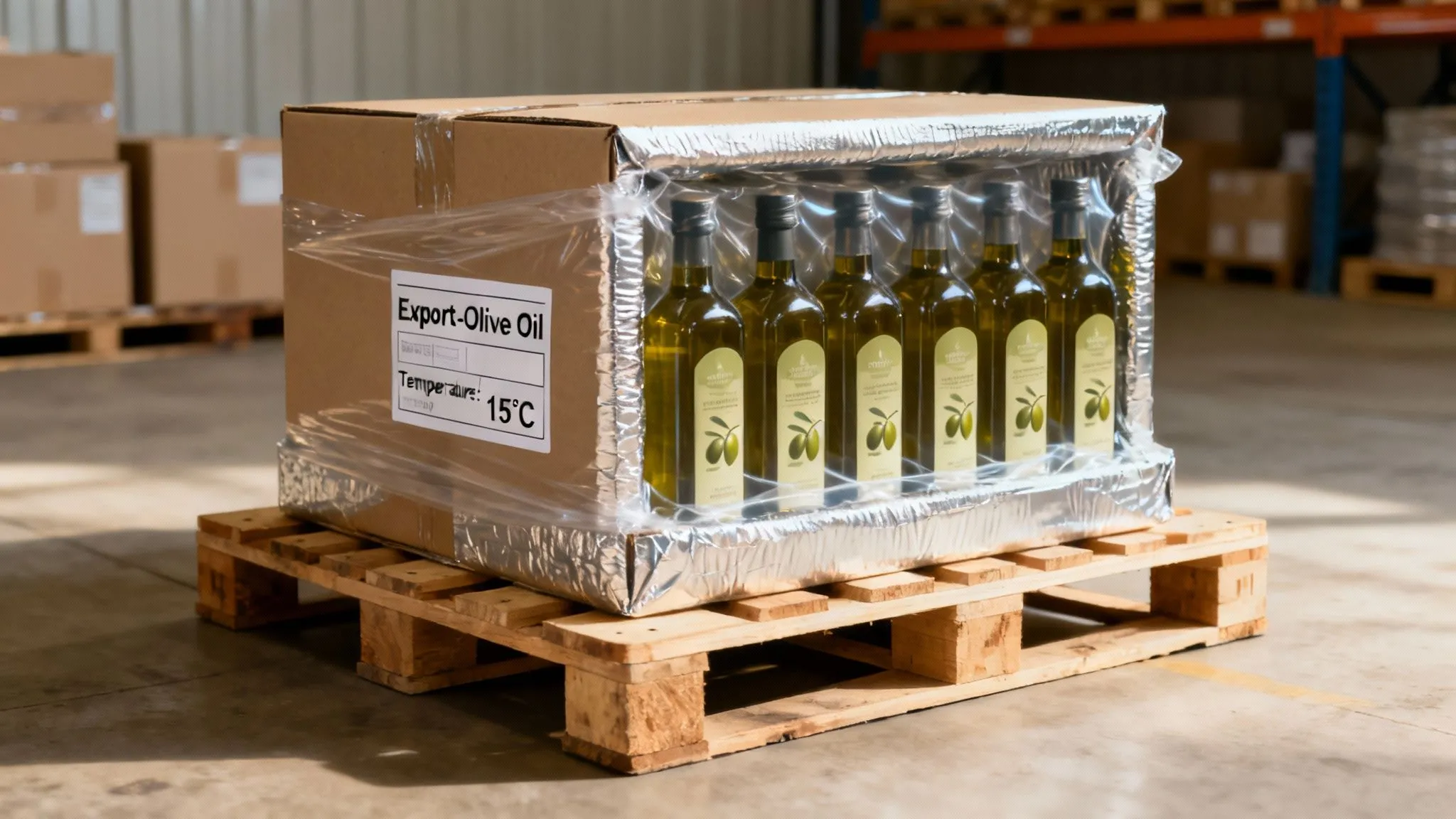
Transport mode follows product risk, shelf-life and arrival conditions—not a generic promise about speed or cost.
Two Product-and-Destination Examples
Olive oil from Turkey to the United States
Start with the exact olive-oil HS code, producer and packer facility, FDA registration status where applicable, US agent, the US importer’s FSVP responsibility, prior notice, product/label specification and customs/origin file. Establish whether any Turkish official health or analysis document is requested for the transaction; do not assume a phytosanitary certificate applies simply because olives are plants. The importer should confirm all current FDA, Customs and Border Protection and any relevant USDA requirements before production.
Food or beverage products from Turkey to Great Britain
First classify the product as animal-origin, composite, high-risk non-animal-origin, plant/plant product or ordinary shelf-stable food under the current British rules. That classification determines whether an approved establishment, export health certificate, phytosanitary certificate, IPAFFS notification or entry through a designated border control post is required. The GB importer owns key pre-notification and import duties; document that allocation rather than leaving it to the carrier.
Can an Artisan Food Producer Export?
Small scale does not remove food-safety, establishment, traceability, label or destination rules. An artisan producer can use its own compliant registered/approved establishment or contract with a qualified manufacturer or packer. In a contract-manufacturing model, define who owns the formula, raw-material approval, batch release, label, certificates, samples, complaints, recalls and destination listing.
Before promising “authentic Turkish” or geographical, organic, natural, traditional or health claims, confirm the legal definition and evidence accepted in the destination. A compelling brand story cannot cure a non-compliant claim.
Commercial and Buyer Controls
- Approve a signed product specification and label artwork before production.
- State the Incoterm with named place/version, but separately allocate importer-of-record, certification, inspection and recall duties.
- Define minimum shelf life at dispatch and arrival, temperature excursions and rejection evidence.
- Agree sampling method, laboratory, tolerances and which result controls a dispute.
- Set payment security, credit limit, currency and sanctions/KYC checks before release.
- Allocate demurrage, storage, destruction, return and re-export costs when documents or goods fail.
How Workon Supports a Türkiye Food-Export Setup
Workon supports the business framework around the shipment: Turkish company and branch setup, corporate and tax-document readiness, process coordination and a structured question set for the manufacturer, importer, licensed customs broker, laboratories and competent authorities. Where food-safety, veterinary, phytosanitary, customs or legal expertise is required, Workon can coordinate the relevant authorised specialists while the competent authorities and licensed professionals retain responsibility for certificates, inspections, customs declarations and market-access decisions.

Establish a local entity only after the product, destination and operating responsibilities are defined.
For coordinated customs-readiness planning, see Workon’s Customs Process Advisory Services in Türkiye.
Disclaimer: This article provides general information and does not constitute food-safety, veterinary, phytosanitary, legal, tax, customs brokerage, tariff-classification, origin, laboratory or destination-market advice. Requirements depend on the exact product, ingredients, process, establishment, lot, destination, buyer, transport conditions and shipment date. Before manufacturing, labelling, certifying or dispatching goods, verify current rules with the Turkish and destination competent authorities and obtain transaction-specific advice from licensed customs, food/veterinary/plant-health and legal professionals. Workon provides advisory coordination and does not issue official certificates or execute customs declarations.