To register a branch office in Türkiye, a foreign parent company must authorize the branch, appoint an authorized representative for the Turkish branch, prepare the parent-company documents for valid use in Türkiye, and complete the MERSİS/Trade Registry filing. A Turkish branch is not a separate legal entity; it is a commercial extension of the foreign parent company.
Last reviewed: 17 September 2026. The current Republic of Türkiye Investment Office establishment guide provides the official framework for foreign-company branch registration. Use that framework to build the file before ordering apostilles, translations or powers of attorney; otherwise a correctly legalized document can still be the wrong document for the registry application.
Think of Branch Registration as Four Connected Files
A foreign-company branch project is easier to control when it is split into four layers: (1) parent-company approval and current-status evidence, (2) legalization and Turkish translation, (3) MERSİS/Trade Registry and Chamber filing, and (4) post-registration operational readiness. A delay in any one layer can stop the next, so the practical goal is not simply to collect documents but to make sure each document proves the exact fact the Turkish file requires.
| Layer |
Main question |
Typical risk |
| Parent-company authority |
Has the competent foreign corporate body validly approved the Turkish branch and representative? |
Resolution or signatory evidence does not match the Turkish filing need |
| Legalization / translation |
Can each foreign document be validly used in Türkiye? |
Wrong apostille/consular route or inconsistent translated names and titles |
| Trade Registry filing |
Are the branch title, address, activity, representative and local forms complete? |
MERSİS or Registry corrections delay registration |
| Operational readiness |
Can the branch actually bank, hire, invoice and operate after registration? |
Tax, CPA, SGK, banking or permit steps were not planned in advance |

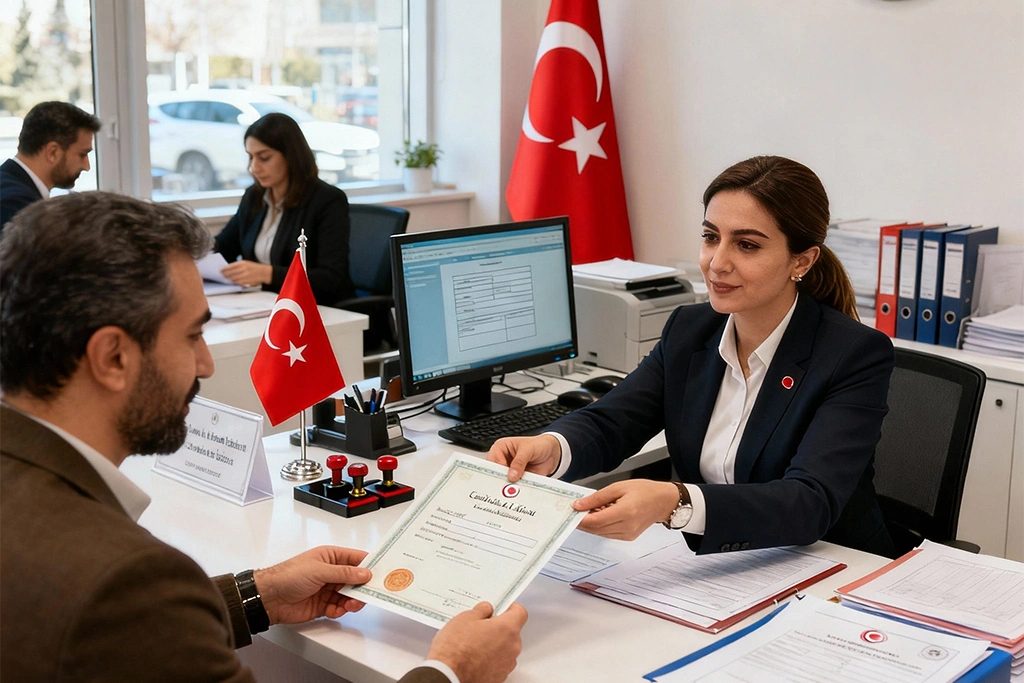
Branch registration starts with the foreign parent company’s legal documents and authorization.
Before Registering: Confirm That a Branch Is the Right Structure
A branch can conduct commercial activity in Turkey, but it must remain within the purposes of the foreign parent company. It has no shareholders of its own and no separate legal personality. The foreign parent therefore remains directly connected to the branch’s obligations.
If you need a separate Turkish legal entity, compare a branch with a subsidiary first: Branch Office vs Subsidiary in Turkey.
Branch Office Registration in Turkey: Step-by-Step
1. Approve the Turkish branch at parent-company level
The foreign parent company must formally decide to establish the Turkish branch. The exact corporate approval document depends on the parent company’s jurisdiction and governance structure, but the Turkish filing needs to show that the branch has been validly authorized.
The approval should clearly address the branch title, Turkish address, intended activity, representative and the authority granted to that representative.
2. Appoint the branch representative
The branch file must identify an authorized resident representative for the Turkish branch. Current official guidance does not impose a Turkish-nationality requirement, so a foreign national can be appointed; the registry file and passport/identification route must be prepared accordingly.
Residence/representation for Trade Registry purposes and permission to work in Türkiye are separate questions. If a foreign representative will actively work in Türkiye, their work-permit position must be assessed separately rather than assumed from the branch appointment. The representative’s powers should also be drafted carefully because the official branch file expects authority to represent the parent company in relation to the Turkish branch.
3. Prepare the foreign parent-company documents
The foreign-parent side of the file commonly includes:
- the parent company’s articles of association or equivalent constitutional document;
- certificate of activity, registry extract or equivalent evidence of current legal status;
- the competent parent-company resolution authorizing the Turkish branch;
- authority documents for the resident branch representative;
- passport or identification documents for the representative;
- power of attorney where another authorized person handles the filing.
What the complete Trade Registry file should cover
The official branch-registration framework is broader than the foreign corporate documents alone. Depending on the case and registry implementation, the file also covers the local application layer, including the registry petition, establishment declaration forms, representative signature declarations, Chamber Registry Declaration and the other undertakings/forms requested for the branch filing.
| File layer |
What it proves |
| Parent current-status documents |
The foreign company legally exists and remains active |
| Parent corporate resolution |
The competent body validly approved the Turkish branch |
| Representative authority |
Who may represent the branch and with what powers |
| Turkish branch details |
Branch title, address, activity and registry information |
| Local registry forms/declarations |
The application data, signatures and Chamber/Trade Registry declarations required for registration |
Practical document rule: first map each Turkish requirement to the exact record available in the parent company’s home jurisdiction. Only after that mapping is confirmed should legalization and translation begin.

The exact document pack depends on the parent company’s home jurisdiction and how each corporate record is issued.
4. Legalize and Translate the Documents for Turkish Use
Current official guidance states that the necessary documents issued or executed outside Türkiye must be prepared for Turkish official use through the applicable route: notarization and apostille, or ratification through the competent Turkish consular channel where applicable, followed by official Turkish translation and notarial formalities.
Do not treat “get everything apostilled” as the document strategy. First confirm which record proves current status, which record proves signatory/representative authority and which corporate resolution contains the branch decision. The legalization route then depends on the issuing jurisdiction and document type.
5. Create the branch registration filing
The branch registration application is created and processed through the Turkish commercial-registry workflow. The Ministry of Trade’s current MERSİS system is the central electronic system used for commercial-registry establishment and change processes, while the relevant Trade Registry/Chamber reviews the filing.
The branch address should be finalized before submission because it becomes part of the official registry record. Confirm both the right to use the address and whether the premises suit the planned activity before the file reaches the registration stage.
6. Complete representative signature and registry formalities
The branch representative must complete the required signature declarations and other Trade Registry formalities. Official guidance lists signature declarations under the branch title and the Chamber Registry Declaration among the branch-registration documents.
7. Trade Registry registration and Gazette publication
Once the branch file is accepted, the branch is registered and the relevant registration is published through the Turkish Trade Registry Gazette system. There is no useful universal promise such as “two weeks” or “20–30 days” for the complete project because the official registry review is only one part of the timeline.
Where Branch Registration Delays Usually Occur
| Stage |
Typical source of delay |
How to reduce it |
| Parent-company documents |
The home-country record does not show current status, authority or the data the Turkish file needs |
Map Turkish requirements to exact home-jurisdiction documents before ordering them |
| Corporate resolution / POA |
Branch title, address, activity or representative powers are incomplete or inconsistent |
Draft the Turkish-use requirements before signatures/legalization |
| Legalization |
Wrong apostille/consular route or the wrong document was legalized |
Confirm document type and issuing jurisdiction first |
| Translation / notary |
Names, titles, dates or authority wording do not match across records |
Cross-check the complete pack before filing |
| Address / activity |
Address documentation or premises use does not match the planned activity |
Resolve address suitability before the MERSİS application |
| Trade Registry review |
Missing forms, declarations or corrections requested by the registry |
Prepare both foreign-parent and local-registry layers as one file |
The main planning lesson: document readiness usually matters more than advertising a fixed registration duration. A well-prepared file can move efficiently; an incomplete foreign-company file can be delayed before the formal registry review even begins.

Workon coordinates foreign-company setup and operational readiness in Turkey.
Is There a Minimum Capital Requirement for a Branch?
Official Turkish investment guidance states that a branch office has no statutory minimum share-capital requirement. This is because a branch is not a separate company with its own shareholders.
That does not mean the branch should be created without financial planning. The parent company should allocate a realistic operating budget for rent, staff, tax, suppliers, professional services and other Turkish costs.
Does a Branch Need a Turkish Shareholder or Turkish Manager?
No Turkish shareholder exists because a branch has no shareholders of its own. The branch is part of the foreign parent company.
The branch must appoint an authorized representative, but official guidance does not impose a Turkish-nationality requirement on that representative. If the representative is foreign and will actively work in Turkey, their work-permit position must be addressed separately.
What Does the 2026 SMMM Tariff Say About Branch-Opening Work?
The 2026 SMMM professional-fee tariff contains a separate branch-opening professional-service row. In the Istanbul/highest band, the reference is TRY 2,740 for a branch within the same province and TRY 5,540 for a branch outside the province.
These figures are minimum/professional SMMM tariff references, not the total cost of registering a foreign-company branch. More importantly, a Turkish branch of a foreign parent has a heavier foreign-document and corporate-authority file than an ordinary domestic branch opening. The licensed SMMM should therefore confirm whether this branch-opening row, a foreign-capital/company-establishment row or another professional scope applies to the actual engagement; do not assume one tariff line controls every foreign-branch file.
Trade Registry/chamber/Gazette charges, foreign corporate records, apostille/consular legalisation, translation/notary, legal work, registered address and Workon coordination are separate where applicable. For future annual updates, verify the current year through the İSMMMO Professional Fee Tariffs archive and the corresponding TÜRMOB / Official Gazette tariff.
Post-Registration: What Comes Next?
Trade Registry registration establishes the branch, but it does not by itself complete operational readiness. Depending on the planned activity, the next steps can include:
- tax-office and taxpayer onboarding;
- E-TUYS foreign-investment reporting: companies and branches within the Foreign Direct Investment Law framework must complete the applicable E-TUYS user/record setup and submit the EK-1 activity information electronically each year by the end of May, together with the separate event-based updates required by the current Regulation when applicable;
- CPA/accounting coordination and statutory bookkeeping;
- registered-address and mail handling;
- corporate bank-account/KYC application;
- SGK employer registration if employees will be hired;
- work permits for foreign staff where required;
- e-signature, KEP or other digital compliance tools;
- sector-specific permits, licenses or customs requirements.
For banking preparation after registration, see How to Open a Business Bank Account in Turkey.
Common Branch Registration Mistakes
- Using incomplete parent-company approvals: the Turkish branch decision does not clearly authorize the branch or representative.
- Assuming every foreign document only needs an apostille: legalization depends on the issuing jurisdiction and document type.
- Choosing branch activities outside the parent company’s purpose: a branch must stay within the parent’s activity scope.
- Confusing registration with work authorization: appointing a foreign representative does not automatically grant a Turkish work permit.
- Leaving the address decision until the end: the registered address and supporting documents should be ready for the Trade Registry file.
- Assuming the bank account is automatically approved after registration: Turkish banks conduct their own KYC and risk review.
Branch Registration Checklist
| Stage |
Key question |
| Structure |
Is a branch preferable to a separate Turkish subsidiary? |
| Parent approval |
Has the branch been validly authorized under the parent’s corporate rules? |
| Representative |
Who will represent the branch and what authority will they hold? |
| Documents |
Which parent-company records are required and how will they be legalized? |
| Address |
Is the Turkish branch address finalized and suitable for the activity? |
| Registry |
Is the MERSİS/Trade Registry file complete? |
| Operations |
Are tax, CPA, banking, SGK and permit steps planned after registration? |
How Workon Supports Branch Setup
Workon coordinates branch-registration and market-entry workflows for foreign companies, including document sequencing, registered-address and workspace solutions, Trade Registry preparation, bank-account application support, tax/CPA onboarding coordination and post-registration operational steps. Where legal or tax professional services are required, the work is handled with the appropriately licensed professionals involved.
If you are still deciding between a branch, subsidiary and liaison office, start with Subsidiary, Branch or Liaison Office in Turkey before preparing the parent-company file.
No. A branch is a commercial extension of the foreign parent and has no separate legal personality or shareholders of its own. The branch's activities must remain within the foreign parent's purpose and the parent remains directly connected to the branch's obligations.
The project generally requires valid parent-company approval, appointment and authority of the Turkish branch representative, preparation and legalisation of the foreign corporate documents, Turkish translation where required, MERSİS and Trade Registry filing, registration and Gazette publication, followed by the applicable tax, accounting, banking and operational steps.
Current official guidance does not impose a universal Turkish-nationality requirement, but the branch must have the required authorised resident representative. If a foreign representative will actively work in Turkey, work authorisation must be assessed separately from the Trade Registry appointment.
No general statutory minimum share capital applies to a branch because it is not a separate shareholding company. The parent should still provide a realistic operating budget for the Turkish activity.
No. First identify the exact home-country record that proves current status, corporate authority and the branch decision. The authentication route then depends on the issuing jurisdiction, document type and applicable treaty and can involve apostille or consular legalisation plus the required Turkish translation and notarial formalities.
Not necessarily. Tax and CPA onboarding, banking and KYC, SGK if employees will be hired, foreign-worker authorisation, e-signature or KEP and sector-specific licences or customs requirements can remain after registration.