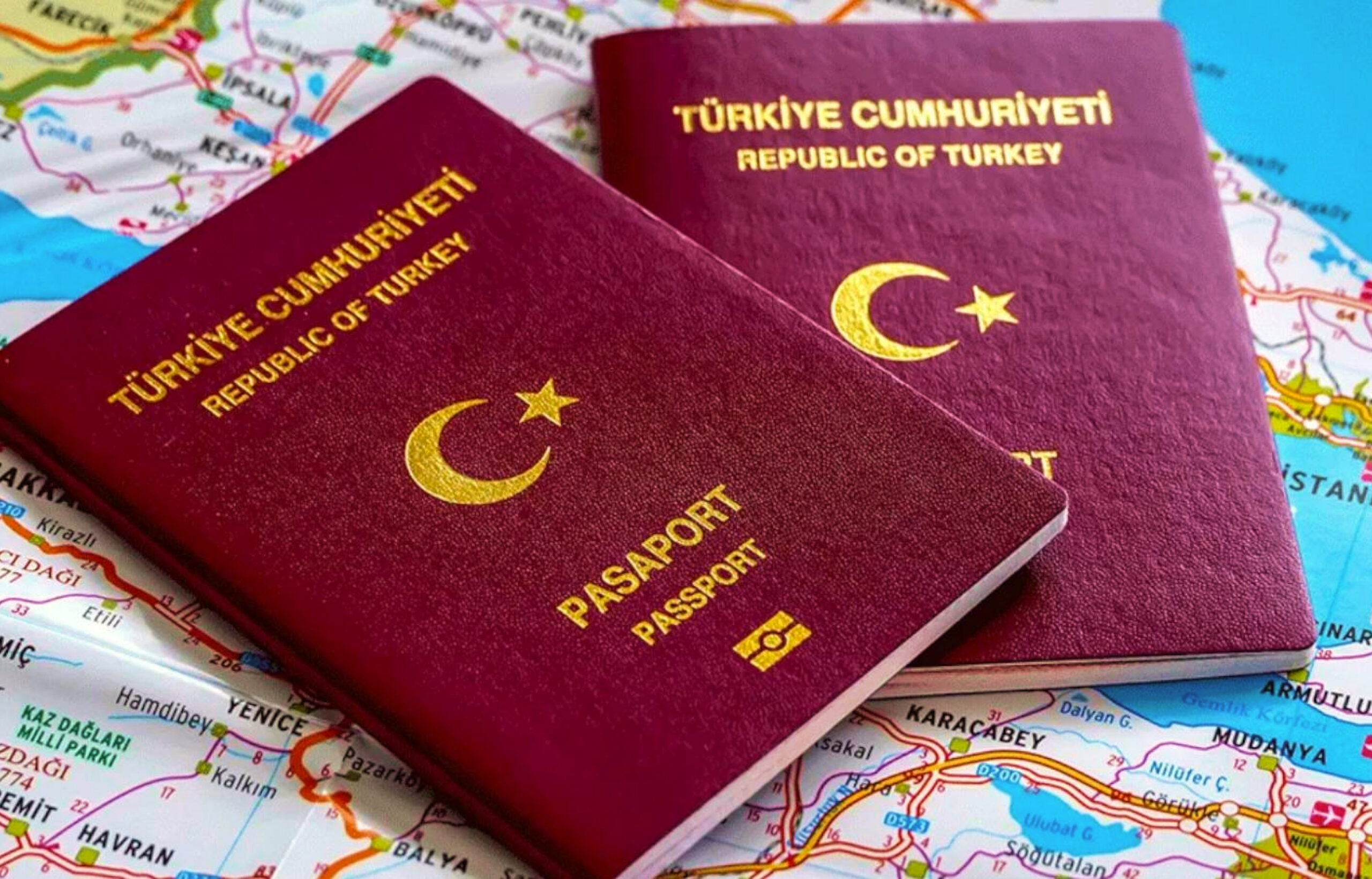
Quick answer: For a foreign company entering Türkiye, choose an international or cross-border legal team by first defining which work requires Turkish-law advice, which issues involve foreign or international law, and who will actually own each workstream. Verify the Turkish lawyers through official bar records, test the team’s experience with your sector and cross-border structure, and compare scope, staffing, conflicts, data-transfer capability and fees before signing an engagement.
This guide helps foreign companies entering Türkiye select and verify a legal team for international and cross-border matters. If you are comparing an Istanbul law-firm team more generally, use How to Choose a Law Firm in Istanbul. If you are verifying and choosing one individual English-speaking lawyer anywhere in Türkiye, use How to Choose an English-Speaking Lawyer in Turkey.
Foreign founders often lose time when legal decisions and administrative execution are planned in isolation. A Turkish-law structure, contract or regulatory conclusion may need to be translated into Trade Registry filings, notary steps, tax and licensed-SMMM coordination, banking documentation, permits or other operational actions. Workon is not a law firm and does not provide regulated legal advice or legal representation. The useful model is therefore clear professional ownership plus coordinated execution: licensed lawyers own regulated legal advice and representation, while Workon coordinates the wider business-setup and operational workflow within its service scope.
Your First Step into the Turkish Market
Before asking a law firm to “set up a company,” define the market-entry model. Will the Turkish entity sell, hire, import, hold assets, process customer data, receive investment or carry on a regulated activity? Will managers or specialists relocate to Türkiye? These facts determine whether the legal brief is limited to corporate setup or also needs contracts, employment, privacy/data-transfer, licensing, immigration or other specialist work.
Do not treat an “international” label, a global affiliation or a prestigious address as proof that the team can own every Turkish-law issue. Start with professional status and scope. Verify the responsible Turkish lawyers through the Türkiye Barolar Birliği lawyer register or the relevant local bar, such as the Istanbul Bar register.
A further cross-border distinction matters. Under Article 44 of the Turkish Attorneys Act, foreign attorney partnerships operating in Türkiye under the applicable framework may provide consultancy only on foreign laws and international law. That statutory scope is different from Turkish-law advice and representation. For a multi-jurisdiction mandate, ask explicitly which Turkish-registered lawyers own Turkish-law questions and which foreign or international-law issues are handled by the cross-border team.

Entering the Turkish market requires coordinated legal planning, compliance checks and administrative preparation.
For a foreign company, the useful advantage of a cross-border legal team is not size by itself. It is the ability to connect Turkish-law work with foreign-law assumptions, group governance, financing, contracts, data flows and other multi-jurisdiction dependencies without losing clear responsibility for each legal question.
If you’re still at the planning stage, it helps to pair legal thinking with an operational setup map. A useful starting point is this guide on who handles each company-establishment stage in Turkey, because the fundamental question isn’t only “which lawyer should I hire?” It’s “what needs to happen, in what order, and who owns each step?”
Setting up a business in Turkey to develop a market rapidly is not a matter of bypassing the necessary formalities but rather of organizing everything, including the administrative and formal stages, correctly. As mentioned above, founders need to define the roles of the individuals involved and decide what needs to be done and by whom.
What an International Law Firm in Turkey Actually Does
For a foreign company, incorporation may be only the first legal workstream. A cross-border legal mandate can also cover governance, shareholder arrangements, commercial contracts, financing, regulatory questions, employment, data, transactions or disputes. The correct scope depends on the operating model; the phrase “international law firm” does not define the work by itself.
It is not the same as local-only document support
The right legal team depends on the mandate. A lawyer who regularly handles routine corporate filings may or may not have the cross-border transaction, governance or sector-regulatory depth needed for a complex shareholders’ agreement or multi-jurisdiction structure. For those matters, ask who will analyse the Turkish-law consequences, how foreign-law assumptions will be reconciled, who will draft or revise the documents, and how unresolved issues will be escalated across jurisdictions.
A useful first meeting should expose the facts that change the legal analysis. The team should ask about group structure, contracts, data flows, regulated activities, people, financing and decision rights before offering a fixed legal conclusion.
- Who controls the group structure: Is the Turkish company a standalone vehicle or part of a wider holding structure?
- Where will contracts be signed and performed: This matters for enforceability, tax positioning, and practical execution.
- Will sensitive data move across borders: If yes, the legal work can’t stay limited to incorporation.
- Are investors expecting governance rights: Board structure, veto mechanics, transfer restrictions, and local implementation all need alignment.
The core service pillars that matter
Law firms often present a very long list of all practice areas they offer. But these are hardly ever relevant for foreign companies entering a market. Common are only a few core service areas that a foreign founder needs in Turkey.
Corporate setup and governance comes first. This includes entity selection, shareholder arrangements, constitutional documents, signatory powers, and internal authority rules. If more than one founder or investor is involved, this work is not a formality.
Commercial contracting becomes urgent almost immediately. Distribution agreements, service agreements, SaaS terms, employment contracts, supplier contracts, and local compliance wording all need Turkish law review or Turkish-compatible drafting.
Regulatory and licensing is the area many founders underestimate. If your business touches payments, digital platforms, consumer-facing operations, or sensitive data, “we’ll handle that after launch” is usually the wrong approach.
Transactions and investment support matters when a Turkish entry is tied to acquisition, a joint venture, or an investor-led expansion. Due diligence and deal execution in Turkey are technical enough that local depth and cross-border communication both matter.
Practical rule: If the business will have material post-incorporation legal dependencies, test whether the proposed team can identify them before you sign the engagement—not after launch.
What good counsel changes in real life
Good counsel should improve execution as well as legal risk control. The advice should identify assumptions that finance, operations, product or sales teams need to change and should make clear which decisions must be resolved before contracts, customer promises or launch dates are fixed.
Using several specialists is not a problem by itself. The risk appears when nobody owns the interfaces between them. If corporate, privacy, employment, tax or regulatory advisers are separate, define who consolidates assumptions, tracks conflicts between advice and owns the final issue list.
The objective is a consistent legal position and a visible responsibility map, whether the specialists sit inside one firm or across several coordinated providers.
Navigating Key Legal Hurdles for Market Entry
Most serious mistakes are made early on. Founders can commit to a business structure, sign commercial contracts and even register a company before discovering serious legal issues. Incorporation in itself is not the major problem.

Foreign businesses must align corporate structure, regulatory compliance and documentation before entering the Turkish market.
Entity choice is a strategy decision
Entity choice should follow the operating and ownership plan rather than a simplistic “small company versus large company” rule. For a Turkish limited liability company (Ltd. Şti.) or joint stock company (A.Ş.), the relevant comparison can include shareholder structure, governance, representation, capital, future share transfers, investor entry, financing plans, regulated-activity requirements and exit scenarios.
Before incorporating, ask the legal team which of those factors actually changes the recommendation for your case and which differences are only administrative. For a broader legal-form comparison, use LLC vs Joint Stock Company in Turkey.
Entity choice also affects the execution map. Legal counsel may advise on structure, governance and authority; Trade Registry/MERSİS filings, notary steps, tax onboarding, licensed-SMMM work and other operational tasks then need their own clearly assigned owners. Delays often come from unclear dependencies, missing documents or inconsistent instructions rather than from one profession alone.
For founders mapping those obligations, this overview of legal requirements to start a business in Turkey is a useful companion to legal advice because it shows how the formal obligations translate into actual setup tasks.
Incorporation is only the front door
For a digital or technology business, incorporation is only one layer. The legal brief can also involve personal-data processing, cross-border data transfers, consumer and e-commerce rules, employment, intellectual property, sector licensing, payments or AML obligations depending on the actual product and revenue flow.
Cross-border data should be mapped before launch. Türkiye’s current KVKK Article 9 framework for transfers abroad has applied since 1 June 2024 and recognises mechanisms including adequacy decisions, appropriate safeguards such as standard contracts and binding corporate rules, and limited exceptional transfer grounds where their conditions are met. If a standard contract is used as the appropriate-safeguard route, the signed contract must be notified to the Personal Data Protection Authority within five business days. Use the KVKK Authority’s cross-border transfer guidance for the current framework.
The practical point is not that every foreign company needs the same privacy document. It is that servers, cloud vendors, group-company access, CRM systems, support teams and other data flows should be mapped early enough for Turkish counsel and privacy specialists to identify the correct route before the operating model is locked.
That’s the part many foreign founders miss. If you’re entering Turkey with a digital model, the legal perimeter widens fast.
- Customer data issue: If you collect user information, privacy work starts early.
- Cross-border systems issue: If your servers, CRM, or support stack involve transfers, legal design matters from day one.
- Payments issue: If money movement sits inside the product model, licensing analysis can’t wait.
- AML issue: If your activity touches financial controls, internal procedures matter before scale.
A company can be properly incorporated and still be badly prepared to operate.
Before the first legal meeting, prepare a one-page map of the business model, ownership, countries involved, regulated activities, data flows, payment flows and target launch date. That gives the legal team enough context to identify the real cross-border dependencies instead of starting from generic incorporation questions.
Where foreign founders usually slip
Generally, foreign founders first set up a company and then realize too late that the way they intend to operate the business could cause problems with issues related to privacy of customers, protection of consumers, payment of money and AML (anti-money laundering) issues.
The better sequence is this:
- Define the revenue model
- Map data flows
- Check whether the activity is regulated
- Choose the entity and governance structure
- Only then lock the launch timetable
That sequence reduces rework and gives a cross-border legal team a concrete operating model to test rather than a generic request to “set up a company.”
How to Choose the Right Law Firm: A Practical Checklist
Referrals and brand recognition can help build a shortlist, but they do not prove matter fit. Use the referral as a starting point, then verify the responsible lawyers, conflicts, sector experience, staffing, scope and delivery model against your actual brief.
Start with your real scope, not the firm’s brochure
Be able to clearly describe your business needs in everyday language before approaching law firms. This will save a lot of time and help you find the right law firm for your needs.
A company with a basic trading activity (in which no sensitive information is involved) with no special licenses to operate in a sector will have a different scope than a company that will offer a SaaS product in the market and has users in Turkey, crossing borders with customer information and hiring a mix of local and foreign staff in different locations around the globe.
Do not use a polished website or a broad “full service” label as a proxy for current capability. Ask the firm to identify the specific Turkish-law and regulatory gates that apply to your business model, the assumptions that could change its answer, and which specialist will own each issue. For a digital business, that may include KVKK/data transfers, consumer and e-commerce rules, employment, payment regulation or other sector-specific requirements; for a conventional trading business, the legal perimeter may be much narrower.
The most useful test is a real scenario from your own launch plan. A capable team should be able to separate what is legally required, what depends on missing facts, which authority or professional owns the next decision, and what should be completed before incorporation versus before commercial launch.
Ask questions that expose depth
A firm interview should feel a bit uncomfortable. If every answer sounds broad and polished, keep pushing.
Ask things like:
- How do you handle a market entry where incorporation, privacy, and employment questions overlap?
- Who will lead the file day to day?
- Have you advised foreign founders whose managers are based outside Turkey?
- How do you coordinate with accountants and admin providers during setup?
- What do you see clients miss after incorporation?
- If my business includes remote workers or digital nomad founders, what issues do you want to check first?
Strong teams explain advice through scenarios, assumptions and dependencies. They should also be clear about where legal work ends and where the client, a licensed SMMM/YMM, another authorised professional or an operational coordinator owns the next step.
Interview filter: If the partner only talks about the sale of the engagement and all the practical issues you brought up are sidestepped then you will encounter communication problems further down the line.
Compare How Each Team Will Handle the Cross-Border File
Give shortlisted teams the same countries, entities, transaction and target milestones. Ask them to explain how the Turkish and overseas work will fit together, rather than comparing an international affiliation alone.
| Coordination question |
Evidence to request |
Gap to resolve |
| Who advises on each jurisdiction? |
Named Turkish-law and overseas advisers, their scopes and the lead contact |
An international brand is named but responsibility for one country’s law is unclear |
| Which entity is the client? |
The engagement’s client identity and the parties included in conflict checks |
The parent, subsidiary and individual founders assume the same advice protects all of them |
| Who reconciles conflicting advice? |
A shared issue list with assumptions, decisions needed and escalation responsibility |
Separate advisers give recommendations based on different facts |
| How will documents move between countries? |
Draft ownership, language review, signing and authentication sequence |
A document is signed abroad before its intended Turkish use has been checked |
| How will the cross-border budget be controlled? |
Included local counsel, translations, travel, specialist input and approval of additional work |
The lead firm’s quote leaves the overseas or Turkish work unpriced |
| Who controls completion and handoff? |
Country-specific deliverables, unresolved conditions and final records supplied to the client |
One jurisdiction is complete while the connected filing or operating step remains unresolved |
For the general firm-selection checks on staffing, responsiveness and engagement terms, use the Istanbul law-firm selection guide. This comparison adds the coordination questions created by a multi-jurisdiction matter.
What to prioritise by business type
Startup / scale-up: Prioritise clear senior ownership, fast issue triage, governance that can support future investment, and regulatory depth where the product touches data, payments, platforms or another regulated activity.
SME / trading business: Prioritise commercial contracts, signatory and representation rules, distribution or sales terms, employment, tax/SMMM coordination and any sector licence that can delay launch.
Investor / acquisition: Prioritise due diligence, transaction structure, approvals, financing, warranties/indemnities, closing mechanics and a documented post-closing compliance plan. The team should explain which findings change valuation, deal terms, conditions precedent or the integration plan.
Across all business types, the useful selection question is not “Which firm is biggest?” but “Which team can define the legal workstream for this exact operating model, explain the assumptions and dependencies, and coordinate cleanly with the client’s other advisers?”
Understanding Legal Fees and Service Models in Turkey
A lower initial quote is not necessarily better or worse; it may simply cover a narrower scope. Compare proposals only after normalising what each firm includes: legal analysis, documents, negotiations, filings, meetings, revisions, specialist input, third-party costs and post-completion support. The objective is to avoid scope surprises, not to assume that one fee model is inherently superior.

Law firms in Turkey commonly offer hourly billing, fixed-fee services and monthly retainers depending on the scope of work.
The three fee models you’ll usually see
Hourly billing can fit open-ended negotiations, investigations, transactions or regulatory work where the workload is difficult to predict. Ask for the billing rates, staffing assumptions, estimate or budget range, reporting cadence and approval threshold for material overruns.
Fixed or capped fees can work well for a clearly defined deliverable or phase. The important control is not the label; it is whether the engagement states the assumptions, included revisions or meetings, exclusions and what happens if the facts or scope change.
A retainer can suit an operating business that needs recurring commercial, employment, governance or compliance support. Confirm the included work, service levels, unused-capacity treatment, excluded projects and the process for matters that fall outside the retainer.
The transparency problem is real
Legal proposals are often difficult to compare because the scopes, staffing assumptions and third-party costs differ. Instead of relying on headline price, ask each firm to state the work included, the responsible team, the billing model, major exclusions, third-party disbursements, approval rules for additional work and the handoff at the end of the matter.
Also check the current Türkiye Barolar Birliği Attorney Minimum Fee Tariff (AAÜT) at the engagement date. The tariff is a professional minimum-fee framework; it is not a market price list and does not tell you what a particular cross-border matter will cost.
That means you need to force clarity yourself.
- Ask for exclusions in writing: Don’t just ask what is included.
- Request phased proposals: One phase for incorporation, one for contracts, one for compliance.
- Test bundled options: Sometimes formation plus core admin support is easier to manage than separate vendors.
- Check bilingual delivery: If your decision-makers work in English, ask which documents and calls can be handled in English.
A practical reference point for the non-legal side is this page on services and costs required to establish a company in Turkey. It helps founders separate legal fees from setup and administrative costs, which are often mixed together in early conversations.
Fee comparison rule: A lower quote can be perfectly appropriate when the scope is genuinely narrower. Compare like-for-like scope, staffing, exclusions and deliverables before drawing conclusions from price.
What works better in practice
For a foreign founder, legal and administrative scopes should be separated clearly rather than bundled into one vague promise. Legal advice, legal drafting, negotiation and representation should remain with appropriately licensed lawyers. Company-formation coordination, registered-address/workspace, bank-application support, permit-process coordination and other operational workstreams can then be organised around that legal design according to the actual service scope.
Workon’s role is this business-setup and operational coordination layer. Where regulated legal advice or representation is required, Workon coordinates with appropriately licensed Turkish lawyers rather than presenting itself as the law firm or the source of the legal opinion.
Sector-Specific Legal Tips for Investors
Sector risk can sit outside the corporate-formation file. A company may be correctly incorporated while its premises, product, data flow, employment model, consumer terms, payment flow or sector licence is still not ready for lawful operation. Use the operating model—not the incorporation checklist—to decide which legal specialists the project needs.
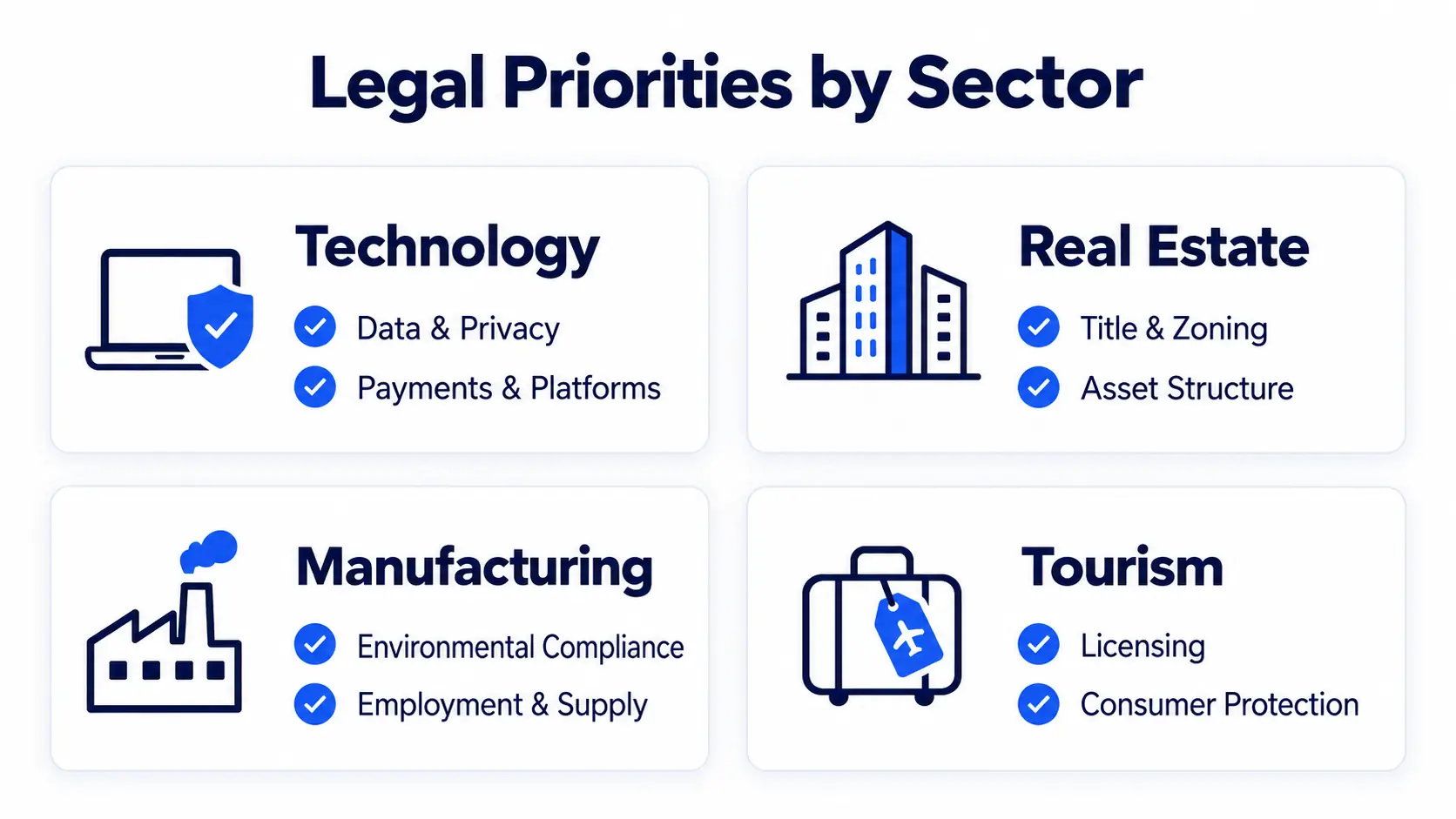
Technology, real estate, manufacturing and tourism investments each involve different legal and regulatory priorities in Turkey.
Technology and digital products
Technology is one of the clearest areas where a general corporate practice may be insufficient. The relevant question is not whether a firm appears in a directory; it is whether the team can identify and coordinate the legal owners for the actual product workflow. Depending on the model, that can require Turkish corporate/commercial counsel plus specialists in privacy and data transfers, consumer/e-commerce rules, telecommunications, payments, competition, intellectual property or employment.
Ask the team to walk through your user journey, payment flow, data architecture and contracting chain. That exercise reveals much more about practical sector depth than a generic technology-law practice label.
For a foreign tech entrant, the practical lesson is simple:
- SaaS businesses should review data processing terms, hosting logic, and customer-facing clauses before onboarding Turkish users.
- E-commerce operators need to align platform terms, consumer-facing notices, and product flow with Turkish rules.
- Fintech or payment-adjacent models should not assume they can “regularise later”.
If your product handles data, payments, or platform interactions, legal review should start with the workflow, not just the company documents.
Real estate and asset-based investment
Real estate / asset-based investment: Align title and encumbrance review, zoning and permitted use, transaction structure, lease or acquisition terms, financing and any operational licence that depends on the property. The legal team should connect the asset due diligence to the intended business use rather than review title documents in isolation.
A commercial summary is not a substitute for legal due diligence. Ask which findings can prevent the intended use, require a condition before closing, change the transaction documents or create a post-closing remediation obligation.
Manufacturing and operational businesses
Manufacturing / operational business: The legal work can span corporate structure, site and lease/use rights, employment, environmental obligations, supply and customer contracts, product or sector regulation, permits and internal authority. The key control is to test the selected premises and planned production activity before irreversible lease, fit-out or equipment commitments.
For the non-legal premises and licence decision layer, cross-check the legal advice with the current municipal/sector process and the relevant authorised professionals. A lease that is commercially attractive can still be a poor operating choice if the intended activity cannot satisfy the location or licence conditions.
Tourism and customer-facing services
Tourism / customer-facing services: Test the exact activity classification and licence route, premises requirements, customer-facing terms, cancellation/refund rules, advertising/marketing obligations and any conditional permissions before launch.
The administrative sequence should then implement the legal design: company and address records, authority filings, licence applications, operational documents and ongoing compliance should point to the same business model rather than being handled as disconnected tasks.
Final Decision: Legal Ownership + Coordinated Execution
For a foreign company, the best operating model is not “one adviser does everything.” It is clear ownership of each professional decision plus a coordinated execution plan. Turkish-law advice and representation should stay with appropriately licensed lawyers; tax and statutory accounting work should stay with the relevant licensed professionals; banks and authorities retain their own decision-making powers; and administrative coordination should connect those workstreams without blurring their professional boundaries.
When those roles are defined early, legal structure, filings, tax/CPA coordination, banking, licences, employment and operational setup can move in the right sequence with fewer ownership gaps and fewer contradictory instructions.
The practical takeaways are straightforward:
- Choose for fit, not reputation alone. Your business model matters more than a firm’s brand story.
- Decide the operating model before incorporation. That’s where many avoidable mistakes begin.
- Ask hard questions about scope and exclusions. Fee clarity matters as much as legal quality.
- Match the firm to the sector. Tech, real estate, manufacturing, and tourism each create different legal pressure points.
- Coordinate law and administration from day one. That’s how you reduce delays and rework.
If you’re entering Turkey now, don’t start by asking only who can register a company. Ask who can help you build a setup that will still make sense once you hire, contract, invoice, store data, and start operating at speed.
If you are comparing advisers and mapping the full setup process, Workon’s company-registration and market-entry coordination service can organise the business-setup and operational workstreams around the legal advice. Where the project requires regulated legal advice, drafting, negotiation or representation, that work remains with appropriately licensed Turkish lawyers.
Official Verification Sources
Last reviewed: 18 September 2026.
Frequently Asked Questions
Start by defining which questions require Turkish-law advice, which involve foreign or international law, and who will own each workstream. Verify the responsible Turkish lawyers through the Türkiye Barolar Birliği or relevant local bar register, then compare sector experience, cross-border coordination, conflicts, staffing, scope and fee terms.
Under Article 44 of the Turkish Attorneys Act, a foreign attorney partnership operating in Türkiye under the applicable framework may provide consultancy only on foreign laws and international law. For a cross-border mandate, confirm which appropriately licensed Turkish lawyers are responsible for Turkish-law advice and representation.
Use the official Türkiye Barolar Birliği Baro Levhası \/ Avukat Arama or the relevant local bar register, such as the Istanbul Bar register. Registration verifies professional status; you should still assess practice fit, conflicts, communication, staffing and engagement terms for your specific matter.
Review data flows before the operating model is locked if Turkish personal data may be accessed, hosted or processed abroad. The current KVKK Article 9 regime includes mechanisms such as standard contracts and binding corporate rules where their conditions apply; if the standard-contract route is used, the signed contract must be notified to the Personal Data Protection Authority within five business days.
Normalize the scope before comparing price: included work, responsible team, billing model, revisions or meetings, exclusions, third-party disbursements, approval rules for extra work and handoff. Check the current Türkiye Barolar Birliği Attorney Minimum Fee Tariff at the engagement date, but do not treat the tariff as a market price list for a cross-border matter.
Workon coordinates company formation, registered-address\/workspace, bank-application support, permit-process coordination and other business-setup or operational workstreams within its service scope. Where legal advice, drafting, negotiation or representation is required, Workon coordinates with appropriately licensed Turkish lawyers; the regulated legal work remains with those lawyers.
Important: This guide provides general information about selecting cross-border legal counsel in Türkiye. It is not legal advice and does not rank or recommend any law firm. Verify professional status, scope, conflicts, engagement terms and matter-specific legal requirements with appropriately licensed counsel.