A Turkish IBAN is a 26-character account identifier that points to one specific account. It does not, by itself, tell you whether the account is personal or corporate, and it does not guarantee that a TRY, EUR or USD transfer will be handled in a particular way.
For foreign founders and international companies, the practical questions are simpler: how is a Turkish IBAN structured, which account does it belong to, which currency is that account designed to receive, and when do you also need SWIFT/BIC or other beneficiary details?
Reviewed: 17 September 2026. IBAN structure is based on TCMB Communiqué No. 2008/6 as amended, including Communiqué No. 2021/5; bank- and payment-service-provider-specific account and transfer behaviour should still be confirmed with the relevant institution.
Turkish IBAN Structure: The 26-Character Format
Under TCMB Communiqué No. 2008/6 as amended by Communiqué No. 2021/5, a Turkish IBAN is generated in the form TR + 2 check digits + 5-digit payment service provider code + 1 reserved digit + 16-character account number. The IBAN refers to one specific account.
Official sources: TCMB IBAN framework and the 2021/5 amendment, which updated the five-digit field from bank code to payment service provider code and extended the framework to payment service providers covered by Law No. 6493.
What Each IBAN Segment Means
- Country code: TR.
- Check digits: two numeric characters used to validate the IBAN.
- Payment service provider code: five numeric characters. This is the current TCMB terminology.
- Reserved field: one numeric character; TCMB states that zero is used until further notice.
- Account number: the final 16 alphanumeric characters.

Turkish IBAN structure: country code, check digits, payment service provider code, reserved field and 16-character account number.
The Anatomy of a Turkish IBAN
The table below shows what each component of a standard Turkish IBAN identifies.
| Component |
Length |
What it identifies |
| Country code |
2 |
TR identifies Türkiye. |
| Check digits |
2 |
Used to validate the IBAN under the MOD 97-10 method. |
| Payment service provider code |
5 |
The TCMB-assigned provider code in the Turkish IBAN structure. |
| Reserved field |
1 |
Zero is used until further notice under the current communiqué. |
| Account number |
16 |
The provider-specific account number component. |
TCMB also publishes the check-digit calculation and validation method. A valid check-digit result helps detect malformed IBANs, but it does not prove that the beneficiary name, account currency or payment purpose is correct.
Does a Turkish IBAN Show Whether an Account Is Personal or Corporate?
No. The IBAN structure identifies the account; it does not contain a visible field that labels the account as personal or corporate. The account type is determined by the underlying relationship with the bank or payment service provider.
For a Turkish company, business income and payments should be handled through the company’s own banking relationship rather than assuming that a personal IBAN can substitute for a corporate account. The exact accounting, tax and legal treatment depends on the entity and transaction.
Personal Account IBAN
A personal IBAN belongs to an account held by an individual. It can be used for the transactions and currencies supported by that account and bank relationship. For foreign individuals, the account-opening requirements are separate from the IBAN mechanics; see our Turkish bank account guide for foreigners.
Corporate Account IBAN
A corporate IBAN belongs to an account held in the company’s name. For a foreign-owned Turkish company, the bank separately verifies the legal entity, authorised signatories, ownership/UBO information, business purpose and other KYC elements. The IBAN itself does not encode those facts.
For the account-opening process, see how to open a business bank account in Turkey.

Turkish corporate bank account setup with business IBAN, cards, and official financial documents
IBANs and Multi-Currency Accounts
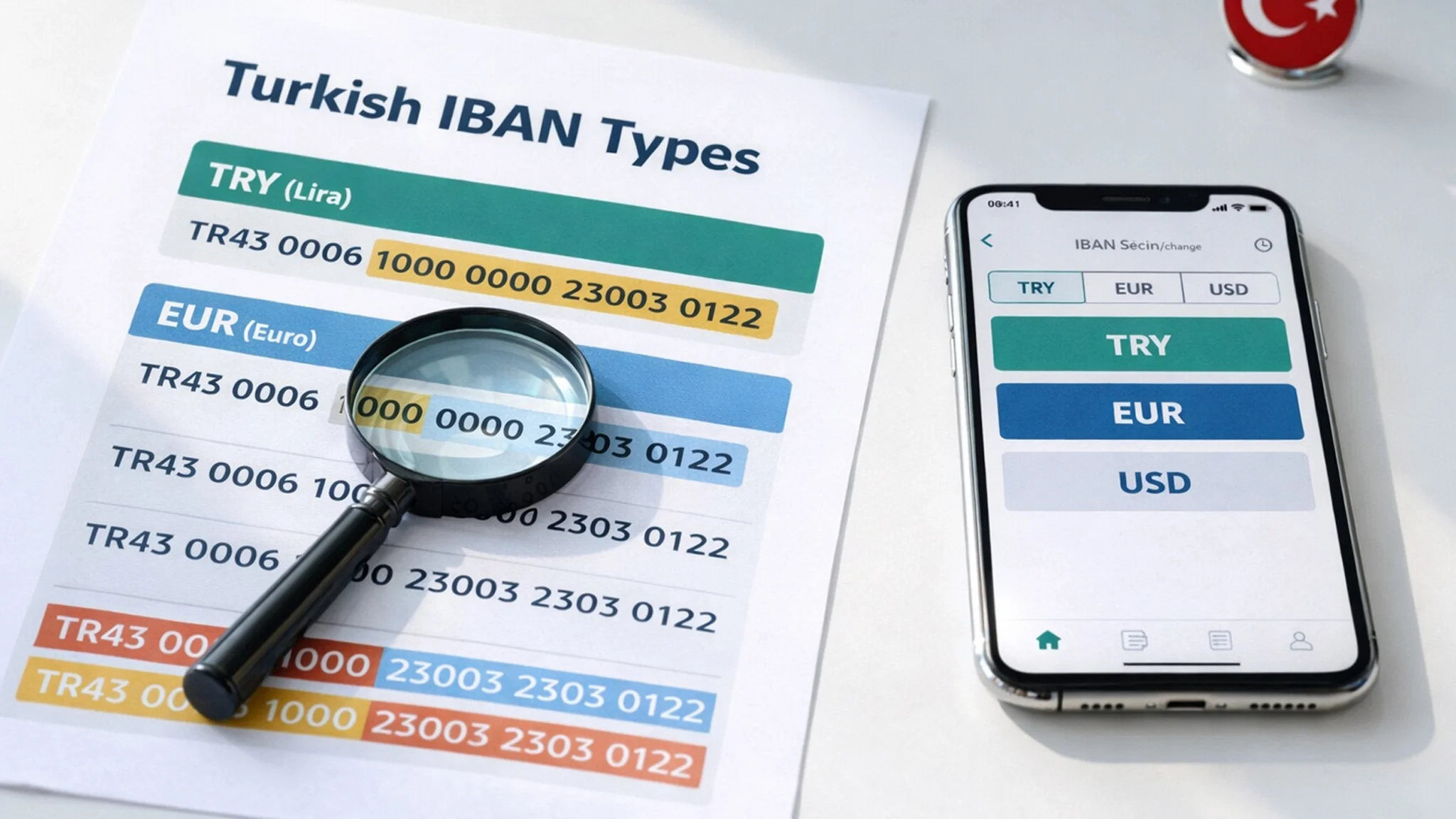
A Turkish bank can open separate TRY and foreign-currency accounts under the same customer relationship, and each account can have its own IBAN. But this is a bank- and account-specific setup; do not assume every customer automatically receives TRY, EUR and USD IBANs on account opening.
For currency-account strategy, fees and FX/SWIFT considerations, see our multi-currency business account guide. This page focuses only on how the IBAN relates to the specific account receiving the transfer.
Match the Transfer Currency to the Actual Account
If a company has separate EUR, USD and TRY accounts, use the IBAN and beneficiary details for the account intended to receive that currency. Do not assume that using an IBAN alone guarantees same-currency crediting or prevents conversion; the sending route and receiving bank’s account rules still matter.
For an international payment, confirm the beneficiary name, account currency, IBAN and any SWIFT/BIC or correspondent-bank instructions supplied by the receiving bank.
What to Confirm Before Sharing an IBAN
- Account holder: confirm the legal beneficiary name.
- Account currency: confirm whether the receiving account is TRY, EUR, USD or another supported currency.
- Transfer rail: determine whether the payment is domestic TRY, international SWIFT or another bank-supported route.
- Additional routing details: use the SWIFT/BIC and any correspondent instructions supplied by the bank when required.
These checks reduce avoidable routing and reconciliation problems. They do not guarantee that an international transfer will avoid FX conversion, intermediary fees or compliance review.

A customer may hold separate currency accounts under one banking relationship; the available accounts and IBANs depend on the bank and product.
Why Separate Currency Accounts Can Help
Separate currency accounts can make it easier to keep receipts and payments in the currency in which the business actually trades. The benefit is operational clarity—not a guarantee of lower fees, better exchange rates or faster settlement.
- Clearer reconciliation: match incoming and outgoing payments to the account currency.
- FX control: avoid an unnecessary conversion only when the payment is credited to an account that can receive and hold that currency under the bank’s rules.
- Cleaner payment instructions: give counterparties the beneficiary details for the correct account instead of relying on one generic bank instruction.
Which Account Details Should You Give a Counterparty?
| Payment situation |
What to confirm |
Why it matters |
| Domestic TRY payment |
TRY account IBAN and beneficiary name |
Uses the local account intended for Turkish-lira settlement. |
| International EUR payment |
EUR account details, IBAN, beneficiary name and bank routing instructions |
Helps the sender route the payment to the account intended to receive EUR. |
| International USD payment |
USD account details plus the bank’s SWIFT/BIC and any correspondent instructions |
USD transfers can involve correspondent banking and should follow the receiving bank’s current instructions. |
| Unsure which account to use |
Ask the receiving bank/account holder for the exact currency-specific beneficiary instructions |
Do not infer the account currency from the IBAN format alone. |
How a Foreigner Gets a Turkish IBAN
You receive a Turkish IBAN by opening an eligible account with a bank or another payment service provider that assigns IBANs. Under the 2021/5 amendment, payment service providers other than banks may also generate IBANs for customer accounts subject to money transfer; unlike banks, they are not universally required to do so unless the applicable payment-system rules require it. The account-opening requirements—not the IBAN format—determine whether a foreign individual or foreign-owned company can obtain one.
For personal accounts, see how foreigners can open a bank account in Turkey. For a Turkish company, see the business bank account opening guide. Those guides explain the KYC, tax or foreigner-ID, address, branch or remote-route and document requirements for opening the underlying account.
Once an account is approved, use the bank’s own account screen or official account document to copy the IBAN. Do not infer that the bank has automatically opened additional currency accounts; confirm each account and its currency separately.

Simplify your business setup with Workon’s all-in-one company registration service in Turkey.
Common Turkish IBAN Transfer Problems
An IBAN can pass a format check and still be the wrong destination for the payment. Before sending funds, confirm the beneficiary, account currency and transfer route in addition to the IBAN itself.
Whenever possible, copy the IBAN from an official bank/account document rather than typing it manually. A validation check confirms format and check digits; it does not confirm the commercial purpose or beneficiary identity.

Checking IBAN accuracy to prevent rejected or delayed international transfers
Currency Mismatch
Do not assume that a transfer in the wrong currency will always be automatically rejected. Depending on the bank and payment route, it may be rejected, returned, held for review or converted under the bank’s rules.
Before sending, confirm the expected currency and the account details intended to receive that currency. This is especially important for international payments where FX and correspondent-bank handling can also affect the outcome.
International Transfers Need More Than an IBAN
For an international transfer, the receiving bank may also require its SWIFT/BIC, beneficiary information and, in some routes, correspondent-bank instructions. The exact fields and fee allocation depend on the sending and receiving banks.
IBAN and BIC identify different things. The IBAN identifies the specific account. A BIC is an ISO 9362 institution identifier: the core BIC has 8 characters and an optional 3-character branch identifier can extend it to 11. Do not confuse the five-digit payment service provider code embedded in a Turkish IBAN with the bank’s SWIFT/BIC; they are different identifiers used for different purposes. See SWIFT’s BIC standard overview.
For correspondent charges, OUR/SHA/BEN and SWIFT cost reduction, see our 2026 guide to reducing SWIFT fees in Turkey.
Turkish IBAN Checklist Before a Transfer
- Check the format: a Turkish IBAN contains 26 alphanumeric characters and starts with TR.
- Confirm the beneficiary: an IBAN format check does not confirm the account holder’s identity.
- Confirm the account currency: the IBAN itself does not tell you whether the underlying account is TRY, EUR, USD or another currency.
- Confirm the payment route: international transfers may also require SWIFT/BIC and bank-specific routing instructions.
- Use official account details: copy the IBAN from the bank/account documentation rather than relying on an old email or manually retyping it.
Transfer Limits and Compliance Checks Are Bank-Specific
Do not rely on generic daily limits such as “USD 50,000 for individuals” or “USD 100,000 for companies.” Transfer limits can depend on the bank, channel, account permissions, user authorities and compliance controls.
For material or unusual payments, keep the underlying invoice, contract and commercial-purpose evidence available if the bank requests it. Supporting documents do not guarantee faster processing or approval.
If a Transfer Is Delayed or Returned
| Check |
What to verify |
| IBAN |
Was the exact IBAN copied from the current beneficiary instructions? |
| Currency |
Was the transfer sent to the account intended to receive that currency? |
| Routing |
Were the required SWIFT/BIC or correspondent instructions used? |
| Beneficiary |
Do the beneficiary details match the bank’s payment instructions? |
| Bank review |
Has the sending or receiving bank requested transaction-purpose or KYC evidence? |
If the transfer is delayed or returned, use the transfer reference and contact the relevant bank(s) for the actual status rather than assuming the cause from the IBAN alone.
Where Workon Fits
Workon helps foreign founders and international companies establish and operate businesses in Turkey. In banking workflows, that can include coordinating company/KYC documents, corporate bank-account applications and the operational information needed to set up the correct account structure.
Workon does not issue IBANs or control bank transfer decisions. If you need help opening the underlying company account, see Workon’s business bank account application support.
Frequently Asked Questions
A Turkish IBAN has 26 characters: TR, two check digits, a five-digit payment service provider code, one reserved digit and a 16-character account-number component. It identifies a specific account but does not by itself describe the account holder or currency.
No. The IBAN structure does not contain a visible personal-versus-corporate field. The account type is determined by the underlying relationship with the bank or payment service provider.
A foreigner can receive a Turkish IBAN after a bank or eligible provider approves and opens the underlying account. The KYC, identity, tax or foreigner-ID, address and onboarding requirements are separate from the IBAN format and depend on the applicant and institution.
No. A bank can open separate currency accounts and each can have its own IBAN, but available currencies and account structure are bank- and customer-specific. Confirm each account and its currency rather than inferring it from the IBAN.
Not always. An IBAN identifies the specific account, while a SWIFT\/BIC identifies the financial institution and optionally a branch. International payments can also require beneficiary details and correspondent-bank instructions. The five-digit payment service provider code inside a Turkish IBAN is not the same identifier as the bank's SWIFT\/BIC.
Check the exact IBAN, beneficiary, currency and routing instructions and use the transfer reference to contact the relevant bank. A valid IBAN format does not prove that the account currency, beneficiary or payment purpose was correct.
Disclaimer: This guide provides general banking and payment-routing information, not legal, tax, investment or financial advice. IBAN assignment, account type, supported currencies, transfer routing, limits, fees and customer requirements depend on the selected bank or payment service provider and the transaction. Confirm material payment instructions directly with the relevant institution before sending funds.