Foreign bank-account applications in Turkey are not rejected for one universal reason. Banks make case-specific customer-acceptance decisions after reviewing identity, residency, ownership, source of funds, expected transactions, countries involved, sanctions/PEP exposure and whether the file fits the bank’s current risk policy.
Being a foreign national or foreign-owned company does not automatically mean rejection. It can, however, create additional KYC questions when the bank must verify information across countries, ownership layers or financial systems. A complete file reduces avoidable delays, but no adviser can guarantee that a bank will accept the customer.
Quick answer for 2026: most preventable problems come from inconsistent identity/address information, unclear source of funds or wealth, incomplete ownership/UBO evidence, a business or transaction profile that is not sufficiently explained, missing documents, or a mismatch between the application and the bank’s current customer-acceptance policy.
If the account has already been opened but payments or access are restricted, use the company bank-account restriction guide. This article addresses rejection, escalation and missing evidence during an account application.
Why a Foreign Account Application Can Receive Additional Review
Banks are required to understand who the customer is, why the account is needed, how it is expected to be used and whether the information provided is reliable. A foreign or cross-border profile can require more verification because identity, address, ownership, income, counterparties or source-of-funds evidence may come from more than one jurisdiction. That does not make rejection automatic.
For a foreign individual, the bank may focus on identity, residency/address, occupation, tax-identification information, account purpose, expected countries/currencies and source of funds. For a foreign-owned Turkish company, the review normally adds company records, signatories, shareholders, ultimate beneficial owners (UBOs), business activity and expected transaction flows.
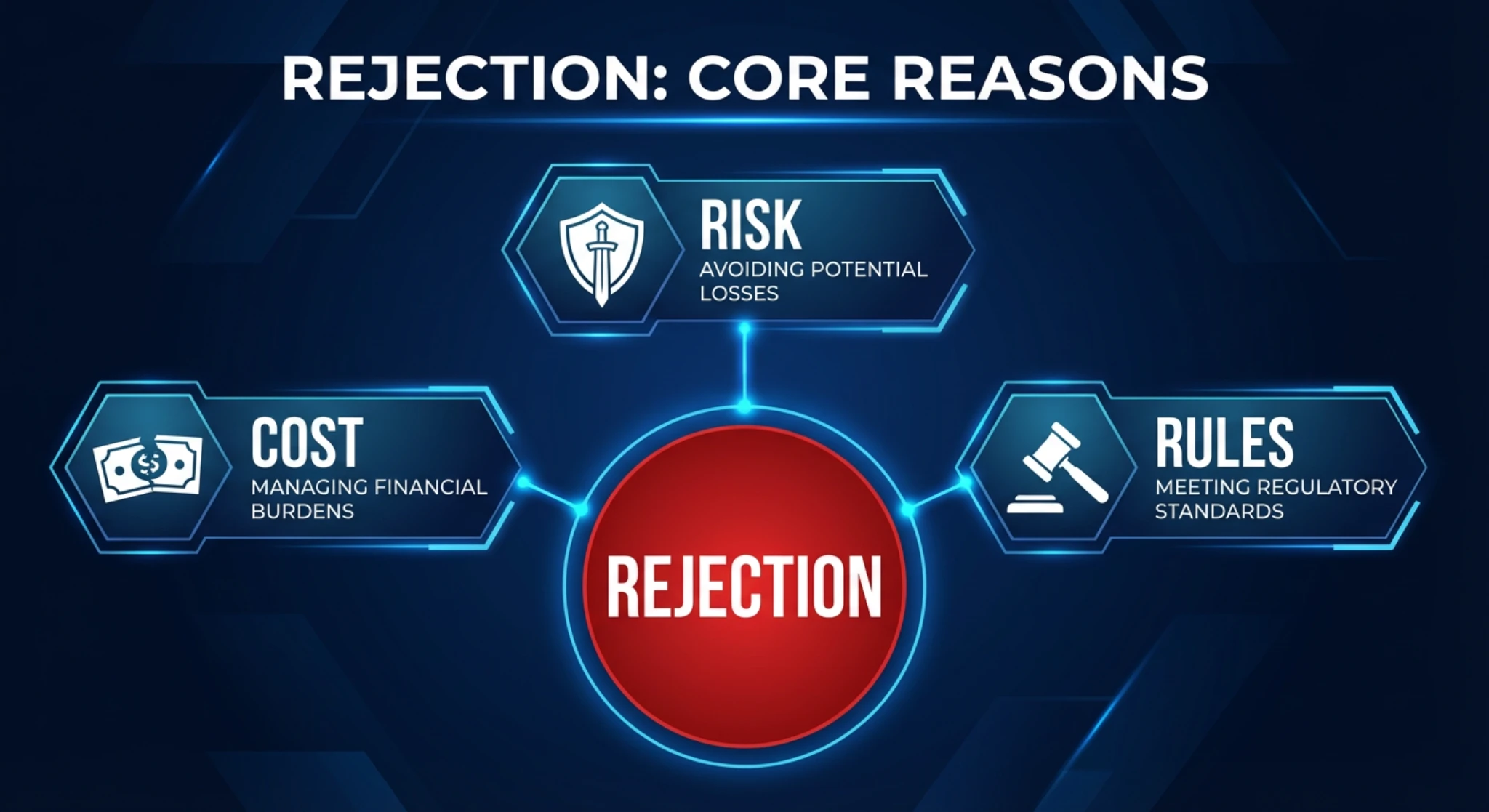
Common Reasons a File Is Rejected, Escalated or Sent Back for More Evidence
Review area
Typical problem
Practical consequence
Identity and address
Name, address, date or identification details are missing, inconsistent or cannot be verified through the route the bank accepts.
The bank may request a corrected document, another form of evidence, a different identification route or may decline the file.
Source of funds / wealth
The origin of the money is vague, unsupported or does not fit the applicant’s stated background.
Additional statements, contracts, sale documents, income evidence or an explanation may be required.
Ownership and UBOs
A company’s ownership chain, controlling persons or foreign corporate shareholders are not sufficiently documented.
The review may pause until the bank can trace the structure to the relevant natural persons.
Business purpose
The activity described in the application, website, contracts or company records does not tell a consistent commercial story.
The bank may ask for contracts, invoices, a company presentation, licences or a clearer activity explanation.
Expected transactions
Countries, currencies, counterparties, volumes or payment patterns are unclear or inconsistent with the stated purpose.
The compliance team may ask for a more detailed transaction profile or supporting evidence.
Jurisdiction, sanctions and PEP exposure
The customer, UBO, counterparty or country profile requires enhanced screening under applicable rules or the bank’s policy.
The file may receive enhanced due diligence, management review, restrictions or rejection depending on the facts.
Bank-specific customer policy
The file is lawful and documented but does not fit that bank’s current sector, geography, product or risk appetite.
Another bank may assess the same profile differently; approval is never transferable or guaranteed.
KYC, AML and the Risk-Based Approach
Turkish banks operate within customer-identification and anti-money-laundering obligations. MASAK guidance requires customer identity to be established and, for a continuous business relationship, the declared address to be verified using accepted evidence before the relationship is established under the current framework. For trade-registry legal persons in an ongoing relationship, the beneficial-owner layer is also separate: obliged institutions identify natural-person shareholders holding more than 25%, then move to ultimate control if that does not identify the true beneficial owner, and use the highest executive authority only as the fallback. Banks can apply additional risk-based controls depending on the customer and relationship.
International country-risk information should also be interpreted carefully. FATF states that jurisdictions under increased monitoring—the so-called grey list—should be taken into account in risk analysis, but FATF does not call for blanket enhanced due diligence or cutting off entire classes of customers solely because of grey-list status. Its standard is a risk-based approach. The June 2026 call-for-action list is a different category: FATF calls for countermeasures in relation to DPRK and Iran, while Myanmar is subject to enhanced due diligence measures proportionate to the risks rather than countermeasures under the June 2026 statement.
Identity, source-of-funds, jurisdiction and transaction-profile checks can all affect a foreign account application.
What Does Not Automatically Mean Rejection?
Foreign nationality or foreign ownership: these can create additional verification work, but they are not by themselves proof that an account must be refused.
Being a politically exposed person (PEP): PEP status is a risk factor that can require enhanced due diligence; it is not the same thing as appearing on a sanctions list.
Connection to a FATF grey-list jurisdiction: the relationship can affect the risk assessment, but FATF itself does not call for blanket de-risking of all customers from those jurisdictions.
A large initial balance: amount alone does not determine acceptance. The bank will be more interested in whether the source, purpose and expected use are credible and supported.
One document inconsistency: depending on the issue and bank policy, it may result in a correction or additional-document request rather than an automatic rejection.
Prepare a Consistent File, Not a Generic Checklist
A bank application is stronger when the documents and the explanation describe the same customer and the same expected use of the account. The exact document set varies by bank, applicant type, nationality/residency profile, ownership structure and identification route.
A consistent identity, address and KYC file helps the bank complete its review without avoidable contradictions.
Common Document Layers
File layer
Examples
What varies
Identity
Valid passport and, where applicable, residence or other identification documents
The accepted document, remaining validity and whether branch, video or another identification route is required
Address
Residence record, utility/phone bill, official document or another form of evidence accepted by the bank
Document age, issuing country, language and whether a Turkish address is required for the selected route
Tax / identification number
Turkish foreigner number or potential tax identification number where applicable; other tax-residency information where requested
Which identifier the bank accepts for the applicant and how tax-residency reporting is completed
Funds and financial background
Bank statements, salary/income evidence, contracts, sale documents, dividends, financial statements or other lawful-source records
The evidence should match the source, amount, timing and expected use of the account
Company and ownership
Turkish company documents, signatory records, shareholders, UBOs, foreign-parent documents and group chart
Depth of the ownership chain, issuing country and legalization/translation requirements
MASAK’s published guidance provides examples for verifying an address in a continuous business relationship, including a residence certificate and certain recent utility/phone bills. That does not mean every bank must accept every example for every foreign applicant or remote route. The bank can apply its own operational requirements within the applicable framework.
If the bank account will belong to a Turkish company, the corporate KYC file begins with the company and ownership records.
Do Foreign Documents Always Need Translation, Notarisation or Apostille?
No single rule should be applied to every bank document. A foreign-issued document may need sworn translation, notarisation, apostille or consular legalization depending on the document, issuing country, bank and purpose. Other documents may be accepted in the original language or in a simpler format. Confirm the bank-specific requirement before paying for legalization or sending originals.
Source of Funds and Source of Wealth Are Different Questions
Source of Funds (SoF): where the particular money entering the account comes from—for example salary, a property sale, company revenue, savings or a dividend.
Source of Wealth (SoW): how the customer accumulated their broader financial position over time—for example business ownership, professional income, investments or inheritance.
The depth of evidence depends on the profile. A large or unusual transaction does not automatically mean rejection, but an amount or pattern that is not consistent with the stated background can lead to more questions. The useful objective is traceability and consistency, not a particular account balance.
How Banks Assess the Overall Risk Profile
Banks use internal customer-acceptance and compliance models, but those models are not public formulas that an applicant can calculate in advance. The practical approach is to understand the factors that commonly affect the review and make sure the file explains them consistently.
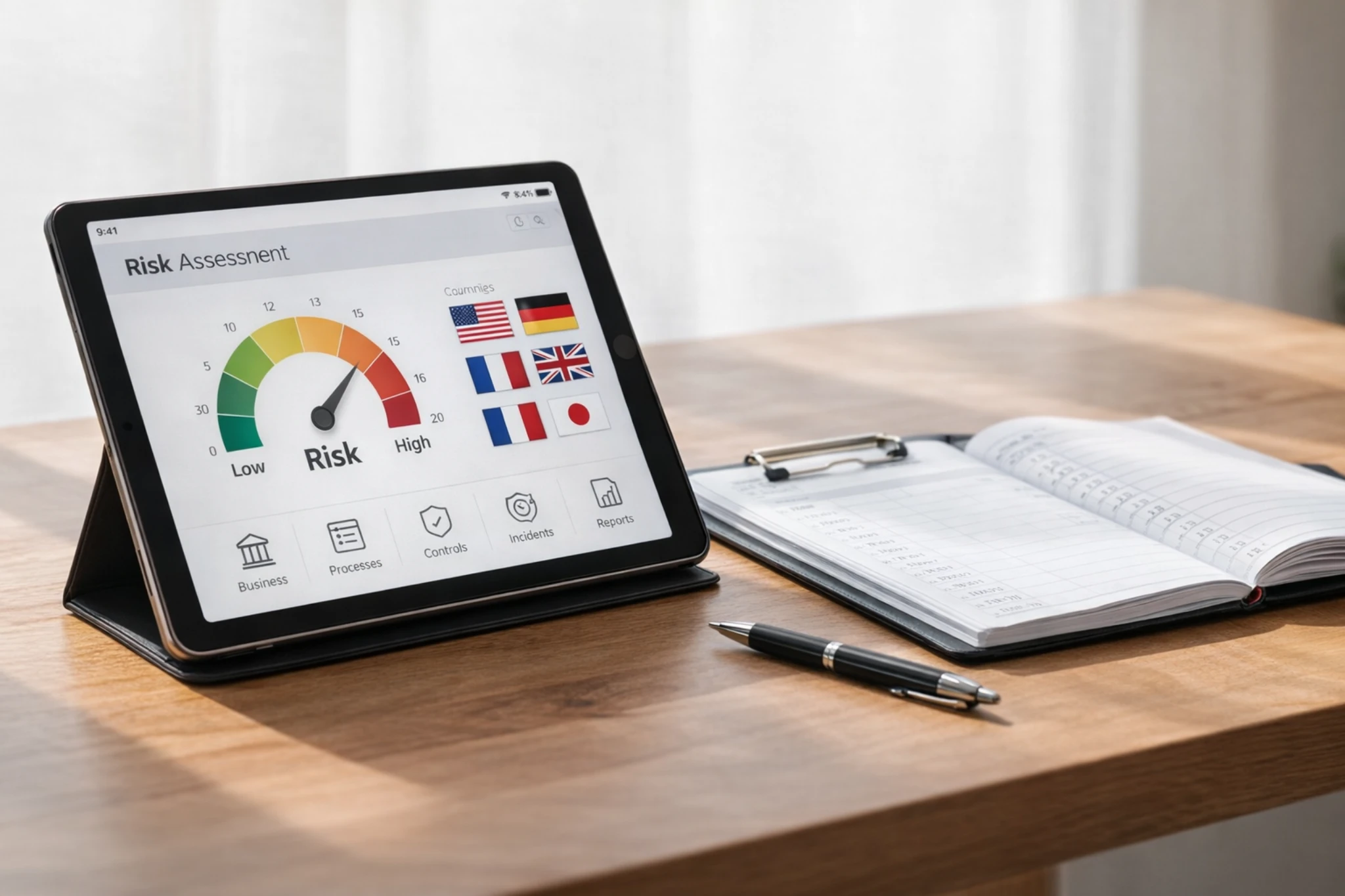
Country exposure, customer type, ownership, expected transactions and source of funds are assessed together rather than through one universal score.
Factors Commonly Considered Together
Identity, nationality and residency: where the customer lives, which identification route can be completed and whether the information can be verified.
Ownership and control: for companies, who owns and controls the entity and whether the ownership chain can be traced to the relevant UBOs.
Business activity: whether the stated activity is clear, lawful and consistent with the company records, website, contracts and requested banking products.
Countries and counterparties: where funds are expected to originate and be sent, including exposure to higher-risk or sanctioned jurisdictions.
Source of funds and wealth: whether the financial background and supporting evidence make the expected account activity credible.
PEP, sanctions and adverse-information screening: whether enhanced review or other controls are required.
Requested products: an operating account, card, online banking, international transfer functionality or other services may carry different operational and risk controls.
These factors are cumulative. A cross-border business with large international transfers is not automatically unacceptable, but it usually needs a clearer explanation and stronger supporting evidence than a simple local-use account. Conversely, a complete document list does not guarantee acceptance if the bank’s current customer policy does not fit the profile.
What to Do After a Bank Rejects the Application
A rejection should not be treated as proof that no Turkish bank will assess the profile. It also should not trigger an immediate copy-and-paste application to several banks. First determine which part of the file can realistically be improved and which part may simply reflect that bank’s current policy.
Ask what the bank can disclose. The bank may not provide a detailed compliance rationale, but it may confirm a missing document, identification issue, product limitation or whether the file can be reconsidered.
Check identity and address consistency. Compare names, addresses, dates, transliterations and document validity across every form and supporting record.
Rebuild the KYC narrative. Make sure occupation or business activity, account purpose, expected countries, currencies, turnover and counterparties are described consistently.
Trace the ownership structure. For a company, confirm that shareholder, parent-company and UBO information is current and that the bank can follow the ownership chain.
Strengthen source-of-funds evidence. Match the specific funds and expected transaction profile to supporting statements, contracts, invoices, sale records, financials or other relevant evidence.
Confirm the route before reapplying. A branch, remote, power-of-attorney or courier step that worked in another case may not be available for this applicant or bank.
Decide whether to reapply or use a different bank. If the problem was curable, a corrected file may be worth reconsidering. If the bank’s customer policy does not fit the profile, another institution may be more appropriate—but its approval is still independent.
Do Not Change the Story to Fit the Bank
The goal is not to make the customer appear “low risk” by omitting inconvenient facts. The application should be accurate, complete and internally consistent. Misstating ownership, source of funds, expected activity or countries can create a more serious compliance problem than the original rejection.
Reapplication Timing Is Case-Specific
There is no reliable universal rule that a rejected applicant should wait a fixed number of weeks or months. The right timing depends on what changed: a corrected document can be addressed quickly, while a bank-policy or risk-appetite issue may not be cured by waiting. Obtain case-specific confirmation before resubmitting the same file.
How Workon Can Coordinate a Stronger Banking File
Workon does not decide whether a bank accepts a customer and does not promise that a rejection can be reversed. The useful role is operational: identify what the bank is trying to verify, organize the customer and company records, coordinate the KYC narrative and ownership information, clarify the available branch or bank-approved remote route, and follow the agreed signing, courier and activation steps.
For a personal account, support can include applicant/profile review, identity and address document checks, source-of-funds preparation, bank communication and a branch or currently available bank-approved remote route where suitable.
For a Turkish company account, the file is separate and can include company documents, signatories, shareholders/UBOs, foreign-parent records, activity and transaction explanations, wet-signature/courier checks and online-banking authority preparation. Some eligible corporate files can be coordinated through a bank-approved remote process; other cases may require physical attendance. The bank retains the final decision in every route.
Reviewed on 17 September 2026. Bank customer-acceptance, identification, nationality/residency, document, product and remote-onboarding policies can change. Confirm the current route for the selected bank and applicant before acting.
Frequently Asked Questions
Common reasons include inconsistent identity or address information, unclear source of funds or wealth, incomplete ownership or UBO evidence, an insufficiently explained business or transaction profile, missing documents, sanctions or PEP review, or a mismatch with that bank’s current customer-acceptance policy.
No. Foreign nationality or foreign ownership can require additional cross-border verification, but it does not by itself mean an account must be rejected. Banks apply a case-specific, risk-based review.
Under the current MASAK customer-due-diligence framework, obliged institutions identify natural-person shareholders holding more than 25%. If that does not identify the true beneficial owner, they assess ultimate control by other means; if that still does not identify a person, the highest executive authority is used as the fallback. Banks may also request evidence for legal-entity shareholders and the wider ownership chain.
No. Account size does not guarantee acceptance, and a large amount that is not consistent with the applicant’s documented financial background can create additional questions. Traceable source, purpose and expected use matter more than a particular balance.
Use consistent identity and address data, explain the account purpose and expected countries, currencies and counterparties, document source of funds or wealth appropriately and, for companies, provide a clear current ownership and UBO chain that matches the business narrative.
No. FATF’s June 2026 increased-monitoring statement does not call for blanket enhanced due diligence or de-risking solely because a jurisdiction is on the grey list; it calls for a risk-based approach. This is different from FATF’s separate high-risk call-for-action category.
First identify any issue the bank can disclose, reconcile identity and address data, rebuild the KYC narrative, ownership and source-of-funds evidence and confirm the correct onboarding route. A corrected file may be reconsidered, while a bank-policy mismatch may justify approaching another institution; neither route guarantees approval.
Disclaimer: This article provides general information about Turkish bank-account KYC, AML review and customer-acceptance practices as of September 2026 and is not legal, banking, compliance or financial advice. Banks apply their own current policies and risk assessments, and requirements can vary by applicant, ownership structure, source of funds, countries, products and transaction profile. Confirm the current route and document requirements directly with the selected bank before acting.
Subscribe to Newsletter
Be notified of the latest news in the business world quickly