
Opening a consultancy firm in Turkey usually starts like any other Turkish service company—but the word consultancy is too broad to decide the legal route by itself. The first step is to define exactly what advice or service the company will sell, choose the correct activity/NACE scope, and check whether any part of that service is reserved to a licensed profession or regulated institution.
The practical 2026 sequence is: define the consulting service → regulated-profession check → choose legal form → draft activity scope → register the company → set up registered address, SMMM/CPA and bank workflow → configure invoicing/VAT/e-documents → contract and data-protection controls → work-permit/employment layer where needed → launch.
Last reviewed: 17 September 2026. The company-formation and foreign-investor framework below was rechecked against current official sources; regulated-profession boundaries must still be confirmed for the exact service sold.
Quick Answer: Does a Consultancy Need a Special Licence in Turkey?
There is no single universal “consultancy licence” for every advisory company. Ordinary management, strategy, operations, technology, market-research or business-process consulting can generally be organised through an ordinary Turkish company when the activity itself is not regulated.
However, changing the label to “consultancy” does not remove professional licensing rules. Before incorporation, classify the service:
| Planned service |
First regulatory question |
Route |
| Management / strategy / operations consulting |
Is the firm giving ordinary commercial advice rather than a reserved professional service? |
Usually ordinary company + correct activity scope. |
| IT / digital transformation / software consulting |
Is it advisory/development work, or does it trigger a regulated telecom, cybersecurity or data-processing role? |
Ordinary company unless sector rules apply. |
| Market-entry / business-development consulting |
Are deliverables research/coordination, or is the firm actually performing regulated legal, customs, accounting or brokerage work? |
Ordinary consulting + licensed-professional handoffs where required. |
| Legal advice / legal opinions |
Does the activity fall within legal services reserved under the Attorneys’ Law? |
Licensed-lawyer route; do not sell it as generic business consulting. |
| Accounting / tax / financial-legislation consultancy |
Does the service fall within the professional scope governed by Law No. 3568? |
SMMM/YMM professional framework where applicable. |
| Investment advice on capital-market instruments |
Is the firm providing investment advisory as a regular commercial/professional activity? |
SPK-regulated investment-service route. |
| Real-estate brokerage |
Is the company intermediating property transactions for others? |
TTBS / real-estate-authorisation route. |
| Customs representation |
Is the firm merely advising on trade processes or performing regulated customs-broker functions? |
Licensed customs-professional boundary applies. |
The safest incorporation question is not “Can I open a consultancy?” but “What exactly will appear in our proposal, contract and invoice?”

Define the real consulting deliverable before choosing activity codes, contracts and company structure.
1. Define the Deliverable Before Choosing the NACE / Activity Scope
Write a one-page service map before MERSIS drafting. For each service, state:
- what the client buys;
- what the consultant delivers;
- whether the output is advisory, implementation, representation, certification, brokerage or regulated professional work;
- whether client money/assets are handled;
- whether the consultant signs or files anything before a public authority;
- whether a professional title is being used;
- whether personal/financial/health or other sensitive data are processed;
- whether the service is performed from Turkey or cross-border.
This map drives the correct company purpose, NACE/activity code, invoice wording, insurance needs and specialist handoffs.
2. Keep Ordinary Business Consulting Separate From Regulated Professions
Legal services
Turkey’s Attorneys’ Law and Turkish Bar Association practice reserve core legal-professional functions such as giving legal opinions on legal matters and handling specified legal work to registered lawyers. A management consultant can discuss commercial operations, but should not create a “legal advisory department” staffed by non-lawyers and sell reserved legal opinions under another label.
Accounting / financial-legislation professional services
Law No. 3568 regulates the SMMM/YMM professions and includes bookkeeping, financial statements/declarations and professional consultancy concerning accounting systems, business, accounting, finance and fiscal legislation within that professional framework. A strategy consultancy should not promise statutory accounting/tax-professional services merely by adding “financial consultancy” to its website.
Capital-markets investment advisory
The Capital Markets Board (SPK) identifies investment advisory among regulated investment services/activities and requires the applicable authorisation when such activity is carried out regularly as a commercial or professional activity. General corporate strategy or valuation work should not drift into regulated recommendations concerning capital-market instruments without checking the SPK boundary.
Use licensed professionals for regulated work and keep each party’s role visible in the engagement letter, invoice and customer communication.
3. Choose Ltd. Şti. vs A.Ş. From Governance and Growth Needs
Most consulting businesses use either a Limited Liability Company (Ltd. Şti.) or Joint Stock Company (A.Ş.). There is no special company form reserved for consultants.
| Decision factor |
Ltd. Şti. may fit when… |
A.Ş. may fit when… |
| Founder group |
Closely held solo/small partner team. |
Broader investor/shareholder plan. |
| Governance |
Simple management structure is preferred. |
Board-level governance / institutional controls are useful. |
| Future investment |
External equity is not a near-term priority. |
Future equity rounds or sophisticated share structure may matter. |
| Share-transfer / exit |
Closely controlled ownership is acceptable. |
Share-transfer flexibility is strategically important. |
| Regulated activity |
Activity permits the Ltd. form. |
A sector rule or financing/governance plan requires/prefers A.Ş. |
Do not select a form only from a headline “minimum capital” figure. Current capital rules can change and sector-specific activities can impose their own capital or form requirements. Use LLC vs Joint Stock Company in Turkey: 2026 Guide for the full comparison.
4. Foreign Founders Can Own an Ordinary Consultancy
Turkey generally applies equal treatment to foreign investors in ordinary company establishment, subject to sector-specific restrictions. A Turkish partner is not required merely because the shareholder is foreign.
But ownership and the right to work physically in Turkey are separate. A foreign shareholder/manager can own the company without that ownership automatically granting a work permit or unrestricted residence status.
If the founder will actively work from Turkey, review the current Turkish Work Permit: 2026 Guide.
5. Company Formation: Use the Ordinary MERSIS / Trade Registry Route
Once the activity and professional boundaries are clear, ordinary consultancy incorporation follows the general Turkish company process. Current official Invest in Türkiye guidance places Trade Registry filings through MERSIS and the competent Trade Registry Directorate.
The exact file depends on legal form and shareholder/manager profile, but the workstream commonly includes:
- shareholder/director tax-number and foreign-document readiness;
- trade name and activity/NACE selection;
- articles of association in Turkish;
- MERSIS preparation;
- Trade Registry signing/registration route;
- Competition Authority contribution and other official steps where applicable;
- signature/representation setup;
- tax-office and post-registration readiness.
Do not use an old blanket “everything must first be notarised” checklist. The exact signature/notary/registry process depends on the current filing and whether foreign documents or powers of attorney are used.
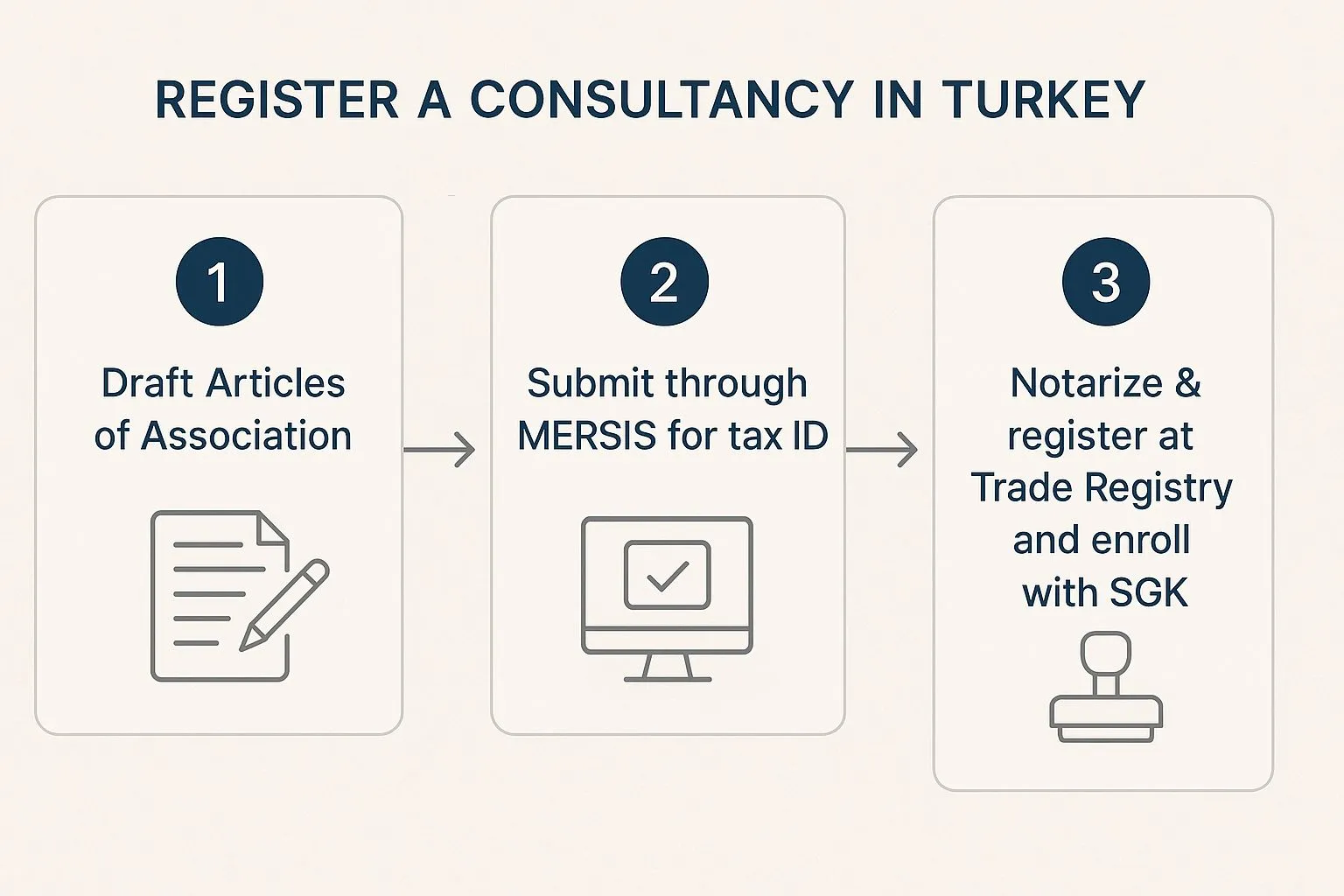
After the activity and regulated-role check, the company uses the ordinary MERSIS and Trade Registry establishment framework.
6. Registered Address: Match the Premises to the Actual Activity
Every Turkish company needs a valid registered address. For a desk-based consultancy with no activity-specific premises requirement, a compliant virtual office or serviced office may be practical. But a virtual office should not be presented as a universal solution for activities requiring specialist premises, customer facilities, regulated archives, equipment or sector inspection.
For a normal consulting firm, compare:
- virtual office: registered address + mail/meeting-room needs without a permanent private room;
- coworking: regular workspace for founders/team;
- serviced/private office: confidential calls, employees, frequent client meetings or operating substance;
- traditional lease: custom fit-out or larger team.
See Virtual Office in Turkey for Foreigners.
7. Set Up the SMMM / Accounting Workflow Immediately
Do not confuse the consultancy’s own business advice with statutory accounting/compliance. A Turkish company needs a proper bookkeeping and tax-compliance process from the start, coordinated with an appropriately licensed SMMM/CPA.
Build the monthly document flow around:
- sales invoices / e-document routing;
- supplier invoices and expenses;
- corporate bank statements;
- employee/payroll information;
- contracts and withholding/VAT implications;
- foreign-currency transactions;
- intercompany/related-party transactions;
- expense substantiation;
- period-end closing and tax declarations.
Use Bookkeeping in Turkey: 2026 Small-Business Guide and Turkish CPA / SMMM Requirement.
8. Tax and VAT: Map the Client and Service Flow
Consultancies often serve both Turkish and foreign clients. The tax/VAT outcome should be based on the actual service and customer, not the phrase “international consultancy.”
Map:
- where the customer is established;
- where the service is used/performed;
- whether the customer is a business or consumer;
- whether a VAT exemption/export-of-services condition is actually met;
- whether withholding applies to the contract/payment;
- foreign-currency invoice/payment treatment;
- transfer pricing / related parties;
- permanent-establishment issues if staff work abroad.
Turkey’s general corporate tax rate and VAT rules have special categories/exemptions; do not reduce the forecast to one headline percentage. Use the dedicated VAT in Turkey: 2026 Guide and current SMMM/tax advice.
9. Bank Account: Approval Is a KYC Decision, Not an Incorporation Right
A corporate bank account is operationally important, but company registration does not guarantee approval by a particular Turkish bank. Banks apply their own KYC/AML/risk policies.
A consulting business should be ready to explain:
- exact consulting services;
- founder backgrounds;
- customer countries and sectors;
- expected contract values and currencies;
- source of capital/funds;
- website / commercial evidence;
- related companies;
- whether high-risk jurisdictions or regulated clients are involved.
For the bank workflow, see Business Bank Account in Turkey.

A consultancy becomes operational only after its banking, accounting, invoicing and contract processes work together.
10. Client Contracts: Define Scope Before “Scope Creep” Starts
Consulting contracts should make the commercial boundary explicit. At minimum, align:
- deliverables and exclusions;
- timeline and client dependencies;
- fee, currency, VAT/withholding allocation and payment terms;
- change-request / out-of-scope procedure;
- confidentiality;
- IP ownership/licensing;
- data protection;
- subcontractors / licensed-professional handoffs;
- liability and professional-risk allocation;
- termination;
- governing law/dispute resolution.
If the engagement touches legal, tax, accounting, investment, customs or other regulated advice, the contract should accurately identify who is providing that regulated professional service.
11. KVKK / Data Protection Can Matter Even for a Small Consultancy
A consultancy can hold substantial client data: employee files, customer databases, financial information, strategic plans, CVs, CRM exports and due-diligence material. Map what personal data enters the firm, why it is processed, where it is stored, who receives it and whether it is transferred abroad.
Do not assume a small firm is “outside KVKK.” Compliance obligations depend on the processing activity and the specific rule/exemption at issue.
12. Hiring: SGK and Work Permits Depend on the Person and Role
Do not state that “every managing director must automatically pay the same SGK premium.” Social-security treatment depends on shareholder/manager/employee status and other facts. Set it up with the SMMM/payroll professional.
For employees:
- employment contract;
- SGK employer/employee registration;
- payroll and withholding;
- occupational health/safety where applicable;
- foreign-employee work authorisation;
- leave/working-time/termination compliance.
13. Remote Formation Is Possible, But Do Not Promise “Zero Presence” for Every Dependency
Foreign shareholders can often coordinate incorporation through properly prepared powers of attorney and foreign-document formalities. But bank onboarding, sector licensing, work permits, signatures, tax inspection or other operational steps can have their own attendance/identity requirements.
Describe remote setup as a process design question, not a universal promise that the founder will never need to visit Turkey.
14. Consultancy Pricing and Market Opportunity: Use Your Own Evidence
Set your consultancy’s pricing against the actual service, buyer and delivery model rather than a generic market average. Niche, seniority, client profile, liability, project length and deliverables can change both the fee and the cost of delivering the work.
For your own commercial plan, benchmark:
- day/hour/project pricing in the exact niche;
- local vs international clients;
- retainer vs project fees;
- sales-cycle length;
- utilisation/billable hours;
- subcontractor costs;
- professional liability/technology costs;
- payment collection risk;
- FX exposure.
Market opportunity should support the business plan; it should not replace the legal/regulatory activity check.

Choose the niche from evidence and expertise, then verify whether the chosen service crosses a regulated-profession boundary.
15. Pre-Launch GO / FIX / STOP Test
| Status |
Meaning |
| GO |
Service deliverables are defined; activity/NACE fits; no unaddressed regulated-profession issue; company form, address, SMMM, bank, contract and invoicing flows are mapped. |
| FIX |
Business is viable but service wording, licensed-professional handoff, work permit, KVKK, bank/KYC or premises needs resolution before launch. |
| STOP / RECLASSIFY |
The proposed “consultancy” is actually regulated legal/accounting/investment/brokerage/customs activity that the planned company is not authorised to perform. |

For an ordinary consulting business, Workon can coordinate the entity, address, bank-application and operational-readiness workstreams.
How Workon Can Support a Consultancy Setup
Workon can coordinate Turkish company formation, foreign shareholder documents, registered-address/workspace, bank-account application support and operational setup. Where the consulting model touches regulated legal, SMMM/YMM, investment, customs, real-estate or other professional services, Workon can coordinate the appropriate licensed-professional handoff rather than presenting those services as unregulated consultancy.
Key Takeaways
- There is no universal consultancy licence; classify the exact service first.
- Ordinary management/business/IT consultancy must be separated from regulated professional services.
- Legal opinions, SMMM/YMM professional work and SPK investment advisory have their own professional/regulatory frameworks.
- Ltd. Şti. and A.Ş. are ordinary company-form choices; choose from governance/funding/exit and sector needs.
- Foreign ownership does not automatically create work/residence rights.
- Use the current MERSIS/Trade Registry process rather than old notary-only checklists.
- Registered address, SMMM/bookkeeping, bank KYC, VAT/invoicing and client contracts are all operational-readiness layers.
- Do not use “consultancy” as a label to bypass licensing rules.
No. There is no single universal consultancy licence. Ordinary management, strategy, operations, technology or market-research consulting can generally use an ordinary company structure when the actual activity is not reserved to a licensed profession or regulated institution.
No. The real deliverable controls. Legal opinions, statutory accounting or tax professional work, regulated investment advice, real-estate brokerage and customs representation can fall within separate professional or regulatory frameworks even if the contract uses the word consultancy.
Generally yes, subject to sector-specific restrictions. Foreign ownership does not by itself require a Turkish shareholder, but a foreign founder who will actively work in Turkey should assess the applicable work-permit or exemption route separately.
Potentially yes, where the registered-address arrangement and actual activity do not require specialist operating premises. A virtual office should not be treated as a universal solution for regulated services or activities that need customer facilities, archives, equipment or other site-specific requirements.
No. Banks apply their own KYC, AML and customer-acceptance rules and can review the founders, UBOs, services, customer countries, expected transactions and source of funds. Bank approval remains separate from incorporation.
Many incorporation steps can often be coordinated through properly prepared powers of attorney and foreign documents, but banking, licensing, work permits, signatures, inspections or other institution-controlled procedures can have their own attendance requirements. Remote setup should be planned case by case.
Current-rule note — 17 September 2026: Whether a consulting service requires a professional licence, regulated entity, special activity code, premises, work permit or another approval depends on the actual deliverable and the rules in force when the service is offered. Workon coordinates company setup and operational readiness and, where the model touches regulated legal, SMMM/YMM, investment, customs, real-estate or other professional work, can coordinate the relevant workstream with appropriately licensed professionals. Final professional or regulatory requirements remain subject to the competent authority and the facts of the case.