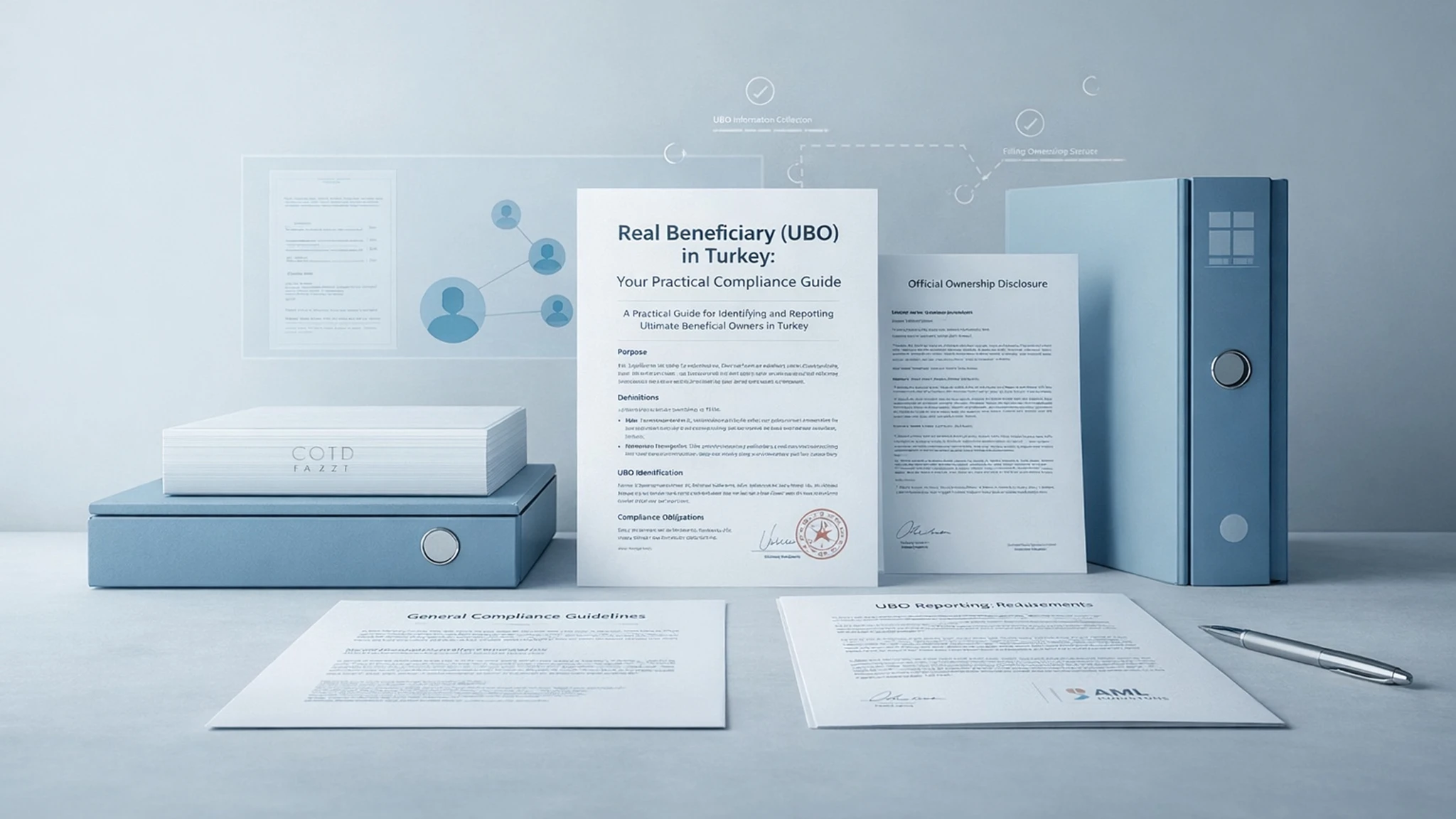
Identifying the ultimate beneficial owner (UBO) of a Turkish company means tracing the ownership and control chain until the relevant natural person or persons are found. Direct share percentage is only the first test. Complex foreign-parent structures, indirect ownership, veto or appointment rights, nominee arrangements and fragmented shareholdings can require a deeper control analysis.
This guide explains how to identify a UBO and document the ownership and control chain. Once that analysis is complete, use the beneficial-owner declaration guide for GİB reporting routes and deadlines. Bank KYC remains a separate process and may request broader evidence.
| Step |
Question |
Output |
| 1. Direct ownership |
Which natural persons directly own more than 25%? |
Initial ownership candidates |
| 2. Indirect ownership |
Which natural persons own the Turkish entity through one or more companies? |
Calculated indirect interests |
| 3. Control beyond shares |
Does anyone ultimately control the entity through governance or other rights? |
Control-based UBO candidates |
| 4. Fallback |
If ownership/control does not identify a UBO, who has the highest executive authority? |
Senior-executive fallback analysis |
| 5. Evidence |
Can the conclusion be supported consistently across corporate and KYC records? |
Ownership chart + source documents |
Core rule: The analysis ultimately looks for natural persons. A company can appear in the ownership chain, but a corporate shareholder is not itself the final human UBO.

For foreign-owned companies, map the ownership chain before company, tax and bank files are finalised.
1. Start With the More-Than-25% Ownership Test
Turkey’s Tax Procedure Law General Communiqué No. 529 uses a more than 25% ownership test as the first step for legal entities. That wording matters: exactly 25% is not the same as more than 25%.
Start by listing every direct shareholder, the percentage owned and whether the shareholder is a natural person or a legal entity. If a direct shareholder is another company, do not stop the analysis there.
2. Trace Foreign Corporate Shareholders to Natural Persons
A Turkish company may be owned by a UK Ltd, German GmbH, UAE company, US corporation, holding company or another foreign legal entity. The ownership map should continue through each corporate layer until the relevant natural persons are identified.
For each layer, record:
- legal entity name and jurisdiction;
- shareholders/owners and percentages;
- voting or control rights where different from economic ownership;
- intermediate holding companies;
- ultimate natural persons;
- the source document supporting each link in the chain.
For company-formation document planning where a foreign corporate shareholder is involved, use the foreign-shareholder company document guide.
3. Calculate Indirect Ownership Correctly
Indirect ownership is generally calculated by multiplying the interests through the ownership chain.
| Structure |
Calculation |
Result |
| Person A owns 60% of Foreign HoldCo; HoldCo owns 70% of Turkish Co |
60% × 70% |
42% indirect economic ownership |
| Person B owns 40% of HoldCo; HoldCo owns 50% of Turkish Co |
40% × 50% |
20% indirect economic ownership; continue to control test if relevant |
| Person C owns 30% directly and another 10% indirectly |
Review combined direct/indirect position under the actual structure |
Do not analyse each path in isolation if they belong to the same natural person |
The arithmetic is only part of the analysis. Multiplying percentages through a chain is a practical way to estimate a natural person’s indirect economic interest, but it is not a standalone statutory safe harbor or a complete UBO conclusion. Ownership documents must support the percentages, direct and indirect paths belonging to the same person must be considered coherently, and ultimate-control rights can produce a different conclusion from economic ownership alone.
4. Look Beyond Share Percentage to Ultimate Control
If no natural person is identified under the ownership threshold, or if the apparent shareholder may not be the person who ultimately controls the entity, the analysis moves to control by other means.
Depending on the structure, relevant evidence can include rights to:
- appoint or remove key governing-body members;
- exercise decisive voting or veto rights;
- control material financing or governance decisions;
- direct the entity through contractual arrangements;
- exercise ultimate influence that is not visible from the share register alone.
Do not assume that every minority-protection or ordinary reserved-matter right automatically creates UBO status. The actual rights and overall control structure should be assessed on their facts.
5. Use the Senior-Executive Fallback Only After the First Tests
If the ownership and ultimate-control tests do not identify a beneficial owner, Communiqué No. 529 provides for a senior-executive fallback. This should not be treated as a shortcut for avoiding ownership analysis.
Document that the ownership chain and control rights were reviewed first, then record why the highest-executive-authority fallback applies to the specific structure.
6. Nominee and Intermediary Structures Do Not End the Analysis
A nominee, custodian or intermediary may appear as a legal shareholder without being the natural person who ultimately owns or controls the interest. The ownership file should identify the underlying arrangement and the person for whose benefit or control the interest is held where applicable.
Do not rely on labels alone. Review the contracts, declarations, governance rights and source corporate records that explain the real relationship.
7. Build an Evidence-Based Ownership Chart
A good UBO chart is more than a PowerPoint diagram. Each line in the structure should be traceable to evidence.
| Layer |
Evidence to consider |
Control question |
| Turkish company |
Trade Registry records, articles, share ledger/corporate records |
Who are the direct legal owners? |
| Foreign corporate shareholder |
Current registry extract, shareholder register, constitutional documents |
Who owns or controls this shareholder? |
| Intermediate holding entity |
Ownership/current-status records, shareholder agreements where relevant |
Does the chain continue to another entity or person? |
| Natural person |
Identity and address evidence appropriate to the receiving institution |
What ownership/control basis links this person to the Turkish company? |
| Governance/control overlay |
Shareholders agreement, board appointment/veto or equivalent rights |
Does control differ from economic ownership? |
8. Keep Identity Data Consistent Across Systems
UBO information can appear in several workflows: GİB reporting, bank KYC, company records, corporate onboarding and due diligence. These systems serve different legal purposes, but inconsistent identity data can create avoidable reconciliation questions.
Check spelling, transliteration, nationality, passport/identity data, residential address and ownership percentages against the source documents before submission to any institution.
9. UBO Mapping and GİB Reporting Are Related but Different
The ownership map answers who ultimately owns or controls the structure and why. The GİB compliance process answers how and when required beneficial-owner information is reported under the tax framework.
Do not repeat a generic “every Turkish company files the same standalone August form” rule. Corporate taxpayers and other covered categories can have different reporting routes. Use the dedicated Beneficial Owner Declaration in Turkey page for current reporting mechanics.
10. UBO Mapping and Bank KYC Are Also Different
A tax-compliant UBO file does not force a bank to approve an account or accept the same evidence set. Banks conduct their own risk-based customer due diligence and may request ownership charts, passports, proof of address, corporate documents, source of funds, source of wealth, contracts and explanations of transaction flows.
Under the current MASAK framework for trade-registry legal persons in a continuing business relationship, obliged institutions identify natural-person shareholders holding more than 25%; where that does not identify the true beneficial owner, they assess the natural person or persons who ultimately control the entity, and if that still does not identify a person, they use the highest executive authority as the fallback. MASAK also requires identification of legal-entity shareholders above the relevant 25% threshold in this CDD layer. Keep that institution-specific identification step separate from the GİB tax-reporting route.
For bank onboarding, use How to Open a Business Bank Account in Turkey. For rejection/KYC risk factors, use Why Turkish Banks Reject Foreign Account Applications.
11. Re-run the Ownership Map After Corporate Changes
A UBO conclusion can change after:
- share transfer;
- capital increase or dilution;
- new investor entry;
- upstream foreign-parent restructuring;
- changes in governance or veto rights;
- merger or acquisition;
- change in the senior executive used under the fallback test.
After a material corporate change, rebuild the ownership percentages and control analysis rather than assuming the previous UBO conclusion remains valid.
UBO Identification Quality-Control Checklist
- List every direct shareholder and percentage.
- Separate natural persons from legal entities.
- Trace each legal-entity shareholder through every ownership layer.
- Calculate indirect ownership consistently.
- Review control rights beyond percentages.
- Use the executive fallback only when ownership/control tests do not identify a UBO.
- Attach source evidence to each link in the ownership chain.
- Reconcile names, identity data and addresses across documents.
- Keep the tax-reporting owner separate from the bank-KYC owner.
- Re-run the map after ownership/control changes.
Last reviewed: 17 September 2026.
How Workon Fits Into the Ownership-Mapping Workflow
Workon can coordinate collection and organisation of foreign shareholder documents, company-formation records, ownership charts and the handoff to the relevant licensed professionals and institutions. Where tax reporting is required, the statutory analysis and filing is handled by an appropriately licensed SMMM/CPA or other authorised tax professional under the applicable engagement.
Workon does not guarantee bank approval, prevent account restrictions or replace regulated tax/legal advice.
Official Reference Points
Frequently Asked Questions
Start with natural persons who directly own more than 25%, then trace indirect ownership through every corporate layer. If that does not identify the beneficial owner, assess ultimate control through governance or other rights. Use the senior-executive fallback only after the ownership and control tests have been completed.
No. The Turkish tax framework described in this guide uses a 'more than 25%' ownership threshold for the first test. Exactly 25% is not the same as more than 25%, although control rights or other ownership paths can still require further analysis.
Multiplying percentages through the ownership chain is a practical way to estimate indirect economic ownership, and paths belonging to the same natural person should be reviewed together where relevant. That arithmetic is not a standalone statutory safe harbor or complete UBO conclusion: current ownership evidence and ultimate-control rights must still be assessed.
Do not jump immediately to the senior executive. First assess whether any natural person ultimately controls the entity through voting, appointment, veto, contractual or other decisive rights. Only if the ownership and control tests do not identify a beneficial owner should the senior-executive fallback be considered.
No. UBO mapping establishes who ultimately owns or controls the structure and on what basis. GİB reporting is a separate compliance process with its own taxpayer categories, routes and timing. Do not use a generic annual August deadline or one-month rule for every entity without checking the current reporting framework.
No. Banks conduct their own risk-based due diligence. Under the MASAK customer-due-diligence framework, obliged institutions apply their own more-than-25% natural-person ownership test, ultimate-control review and senior-executive fallback and may request broader ownership, identity, source-of-funds, source-of-wealth and transaction-flow evidence.
Disclaimer: This article explains general UBO identification and ownership-mapping concepts for Türkiye and is not legal, tax, AML or banking advice. Beneficial-owner conclusions can depend on the exact ownership chain, governance rights, legal arrangements and current rules. Confirm statutory reporting and institution-specific requirements with the relevant authority and appropriately licensed professionals.