
When a Turkish company will use a virtual or serviced office, settle the registered-address file before the final MERSİS/company-formation documents are built around it. The sequence matters because the same headquarters needs to remain traceable across the address agreement, incorporation file and later tax records.
The formation address file should establish three things: the exact official premises, the company’s genuine right to use them, and compatibility between the premises model and the company’s actual activity.
This guide explains the address-document sequence inside company formation. For the underlying document checklist by premises type, use the registered-address document checklist. For a broader remote incorporation workflow, use the separate remote company formation guide.
The Address-Document Sequence at a Glance
| Stage |
Address control |
| 1. Define activity |
Confirm whether the business can use an administrative/virtual headquarters or needs dedicated/additional operating premises. |
| 2. Confirm exact premises |
Select the official address and unit that will enter the company file. |
| 3. Validate right of use |
Review the agreement and provider/owner authority supporting the company’s use of the exact premises. |
| 4. Freeze the master address |
Use one approved address version for MERSİS, the company documents and supporting file. |
| 5. Complete formation execution |
Coordinate the address with shareholder/signatory documents, signatures, translations and representation route required for the case. |
| 6. Register the company |
Keep the submitted address and supporting documents aligned throughout the Trade Registry process. |
| 7. Hand the same file into tax/post-registration |
Do not create a new headquarters version after registration; preserve the address agreement for tax and later company workflows. |
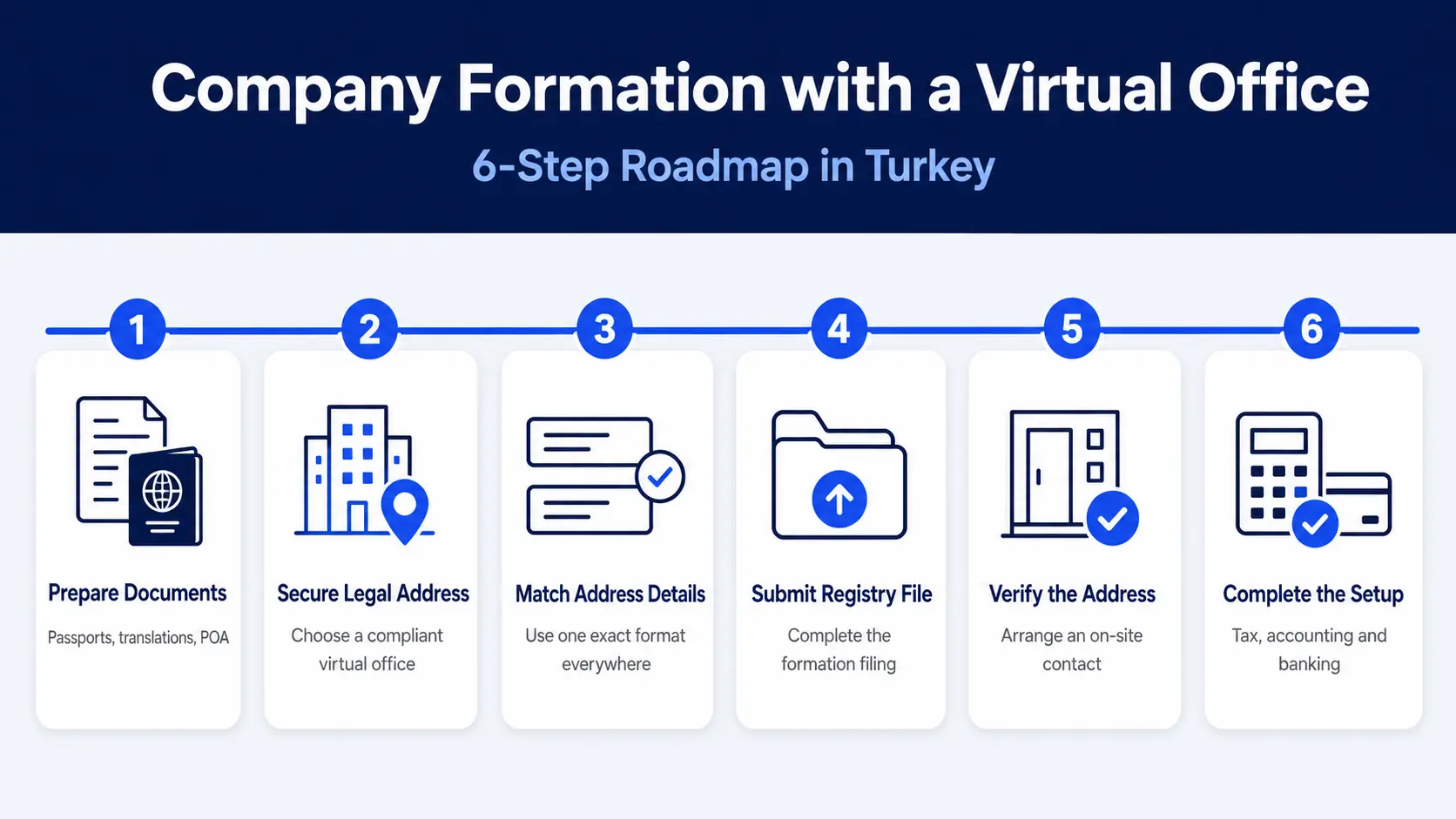
Confirm the registered address before the formation file is finalised, then carry the same headquarters into registry and tax records.
Step 1 — Check Activity and Premises Suitability
Do not purchase an address package before checking what the company will actually do. A remote service business can have a very different premises profile from a warehouse, clinic, workshop, restaurant, customer-facing retail operation or another activity with premises-linked licensing.
If the business needs employees, customers, stock, production, regulated equipment or another specific operating site, the virtual-office address may be only the headquarters layer and additional premises may be required.
For the full address-model decision, use the registered business address options guide.
Step 2 — Confirm the Exact Official Address
For MERSİS-based incorporation, the headquarters should correspond to official address data used by the Ministry of Trade’s MERSİS system and the National Address Database (UAVT).
Confirm the exact neighbourhood, street, building and independent-unit details before finalising the formation documents. Do not copy an address from a website footer, sales email or informal message if the provider’s actual address-use file identifies the premises differently.

The formation team should validate the exact official premises and right-to-use file before the headquarters enters MERSİS.
Step 3 — Validate the Company’s Right to Use the Premises
The address file can differ by premises model. Do not assume that every virtual-office formation requires one universally named certificate, notarised taahhütname or identical lease package.
Depending on the arrangement, the file can involve:
- a lease, serviced-office or registered-address agreement;
- ownership or provider-side premises evidence;
- documents showing the authority of the person granting the use; and
- case-specific consent, representation, notarisation or other supporting evidence where required.
The address file should answer one question clearly: why is this company entitled to use this exact premises as its registered headquarters?
Step 4 — Freeze One Master Address Before Final Drafting
Once the premises and right-to-use file are confirmed, create one approved Turkish master address and use it throughout the formation workflow.
- Use the same underlying address and independent unit in MERSİS.
- Keep the address-use agreement traceable to the same premises.
- Do not allow different advisers to create competing suite/unit descriptions.
- Where an English translation is needed, preserve the same underlying official location rather than creating a second address.
Avoid statements that every formatting difference automatically causes rejection. The important control is that all records unambiguously refer to the same official premises and that filing-specific requirements are followed.
Step 5 — Coordinate the Address With Foreign-Founder Documents
The address file is only one part of the formation package. Foreign shareholders, managers, corporate shareholders or representatives can introduce separate identity, authentication, translation and representation requirements.
Before setting a filing date, make sure the address sequence is coordinated with any applicable:
- passport/identity documents;
- foreign corporate shareholder documents;
- apostille or consular legalisation;
- sworn Turkish translations;
- power-of-attorney documents; and
- signature or representation formalities.
Those documents should not be presented as universal address requirements. Their exact form depends on the parties and execution route.
Step 6 — Use the Final Address in the MERSİS/Trade Registry File
Once the address is frozen, use it in the applicable company-formation documents and filing. Do not change the premises, provider or unit number casually after the company documents have already been prepared.
The wider company-formation sequence can vary by legal form, shareholder structure and execution method. This article intentionally limits itself to the address control inside that process.
For the broader MERSİS workflow, use the MERSİS company registration guide.
Step 7 — Hand the Same Address File Into Tax Follow-Up
Company registration and tax-office yoklama are separate processes. After taxpayer status is established, keep the final registered headquarters, right-to-use documents and activity information accessible for the tax file.
Current GİB guidance states that commencement-of-business yoklama is to be concluded within a maximum 15-day administrative period after taxpayer status is established. That is not a guarantee of a particular visit date or outcome.
For the verification process and preparation, use the tax-office yoklama and virtual-office verification guide.
Formation-File Control: What the Address Provider Should Support

For formation, provider quality is measured by the clarity of the exact address-use file and post-registration handover.
| File element |
Pre-filing control |
| Official premises |
Exact address and unit are identifiable and ready for consistent use in the company file. |
| Registered-address right |
The agreement supports the company’s intended use of the exact premises. |
| Provider/owner authority |
The person granting the use can substantiate its authority over the premises where required. |
| Company/party details |
Names and relevant party information are consistent with the formation structure. |
| Post-registration handover |
The final address agreement and company details can pass into tax and official-mail workflows without creating a new address version. |
Common Sequence Errors
- finalising company documents before the headquarters is confirmed;
- using a sales-page or informal address instead of the final official premises details;
- changing the unit or provider after the formation documents are already built;
- assuming one certificate, commitment letter or notarisation step is universal;
- mixing foreign-founder identity documents into the address checklist without separating their purpose;
- treating tax-office yoklama as a standard Trade Registry site inspection; and
- discarding the address-use file after registration even though later tax, bank and company workflows may need it.
Do Not Confuse Address Timing With Formation Timing
An address agreement may sometimes be prepared quickly once the parties and documents are ready. That does not mean company formation, tax-office follow-up or banking will finish on the same timetable.
The overall setup timeline depends on the complete shareholder/signatory file, foreign-document authentication, execution route, registry process and later workstreams. Use the company formation timeline guide for that separate question.

Workon coordinates company registration, registered-address and related operational setup for foreign founders.
If a virtual or serviced address fits the company’s activity, review Workon’s virtual office service in Turkey. Current package pricing belongs on that live commercial page rather than in this formation-sequence guide.
Frequently Asked Questions
It can be suitable where the company's actual activity and premises requirements allow an administrative or virtual headquarters. The address must be genuine and supportable, while activities requiring a clinic, warehouse, workshop, restaurant, retail site or other licensed physical premises need separate assessment.
Finalise the exact official premises and the company's right-to-use file before the final MERSİS and company-formation documents are built around the headquarters. This reduces address inconsistencies between the agreement, registry file and later tax records.
It should clearly establish the exact official premises, the company's genuine right to use that premises as its registered headquarters and the suitability of the address model for the actual activity. The supporting documents can vary by premises and provider structure.
No. Depending on the arrangement, the file can involve a lease, serviced-office or registered-address agreement, ownership or provider-side evidence and case-specific consent, representation, notarisation or other support. There is no single universally named document for every model.
Yes in substance. Use one approved master address tied to the same official premises and independent unit throughout the formation file. Minor formatting conventions can vary, but the records should unambiguously identify the same headquarters.
No. The same address and right-to-use file should remain available for tax-office follow-up, official correspondence, banking and later company workflows. Tax-office yoklama is a separate process and should not be confused with Trade Registry registration.
General information only. Company-formation documents, registered-address evidence, authentication, Trade Registry procedure and tax-office verification depend on the company, parties, premises and current rules. Confirm regulated legal and tax matters with the relevant authorities and appropriately licensed professionals.