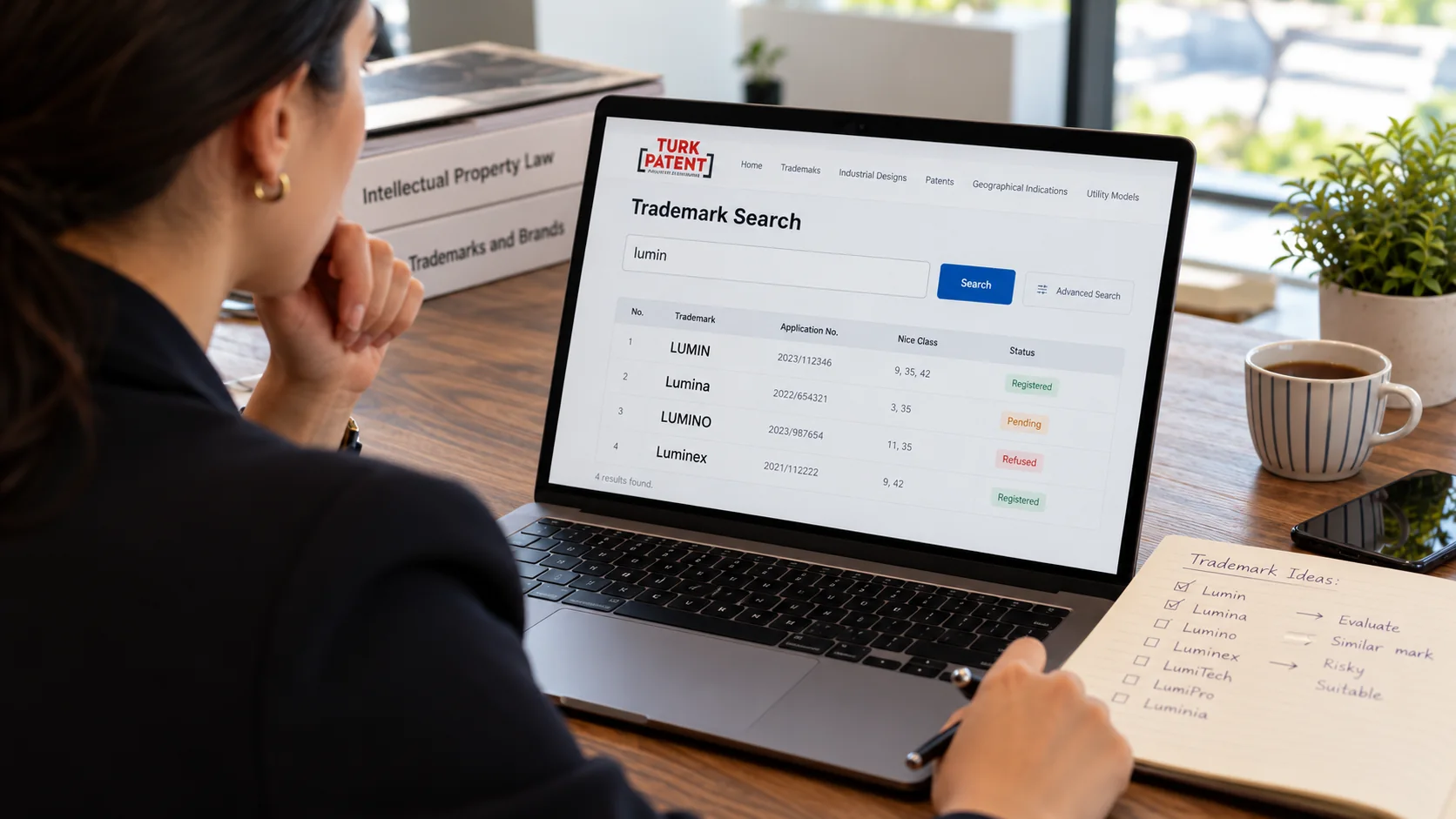
A foreign founder can spend an afternoon checking a brand on Google and TÜRKPATENT, find no identical result, and assume the name is available. The problem often appears later, when a similar Turkish spelling, a neighbouring Nice class, a pending application, or an established market user turns the filing into an opposition or a costly rebrand.
A reliable trademark search in Turkey is therefore a clearance exercise, not a single database lookup. This guide shows how to search TÜRKPATENT, test Turkish and English variants, assess related classes, check international and commercial records, and decide when a local professional should review the file. For company-name issues that sit alongside trademark clearance, a separate Turkey company name check can help identify conflicts before incorporation.
Why a Quick Name Check Is Not Enough
Illustrative scenario: A SaaS founder checks only the exact spelling of a proposed brand and finds no identical result. A broader search could reveal a similar earlier mark or pending application. Whether that creates an objection risk depends on the signs, the relevant goods or services, distinctiveness and the applicable legal grounds; a different Nice class does not by itself establish either safety or infringement.
The example illustrates a narrow limitation: an exact-match search only checks whether the same string appears in the searched field. It doesn’t answer whether a Turkish consumer could confuse your mark with another one, whether the same sign appears in a logo, or whether an earlier applicant has filed a close variant that hasn’t registered yet.
Similarity is broader than spelling
Industrial Property Law No. 6769 supports an assessment of visual, phonetic and conceptual similarity. A mark can create risk because it looks alike, sounds alike when pronounced by a Turkish speaker, or conveys a similar idea. Searching only the English spelling leaves gaps, particularly where Turkish characters or local pronunciation change the way a foreign word is understood.
Test variants involving ç, ğ, ı, ö, ş and ü, together with sensible Turkish equivalents and transliterations. A foreign word may be written in several ways in Turkey, and one of those versions may already have a strong presence in the market.
Registration records aren’t the whole market
TÜRKPATENT covers registered and pending records. It doesn’t replace an open-web search, domain review, company-name search, or investigation of businesses already trading under the sign. Earlier unregistered use can still matter, especially where the owner can show a protectable earlier right or bad-faith filing.
Practical rule: Treat an exact-match search as the starting filter. Don’t treat it as a clearance opinion.
Türkiye is a highly active trademark market. WIPO’s 2024 country profile for Türkiye reports 400,318 trademark filings, ranking the country 7th globally, and shows 1,307,126 trademarks in force. Those figures point to a dense register where close comparison matters more than a quick keyword result.
The Legal Landscape Every Searcher Should Understand
The legal framework matters because it defines what your search is trying to detect. Industrial Property Law No. 6769 entered into force on 10 January 2017, replacing Decree-Law No. 556, which had governed trademarks since 1995. The reform modernised the system, shortened the opposition period from three months to two months, expanded registrable subject matter to include sound and colour marks, and confirmed a protection term of 10 years from the application date, renewable in successive 10-year periods. These points are reflected in WIPO’s Türkiye country profile.
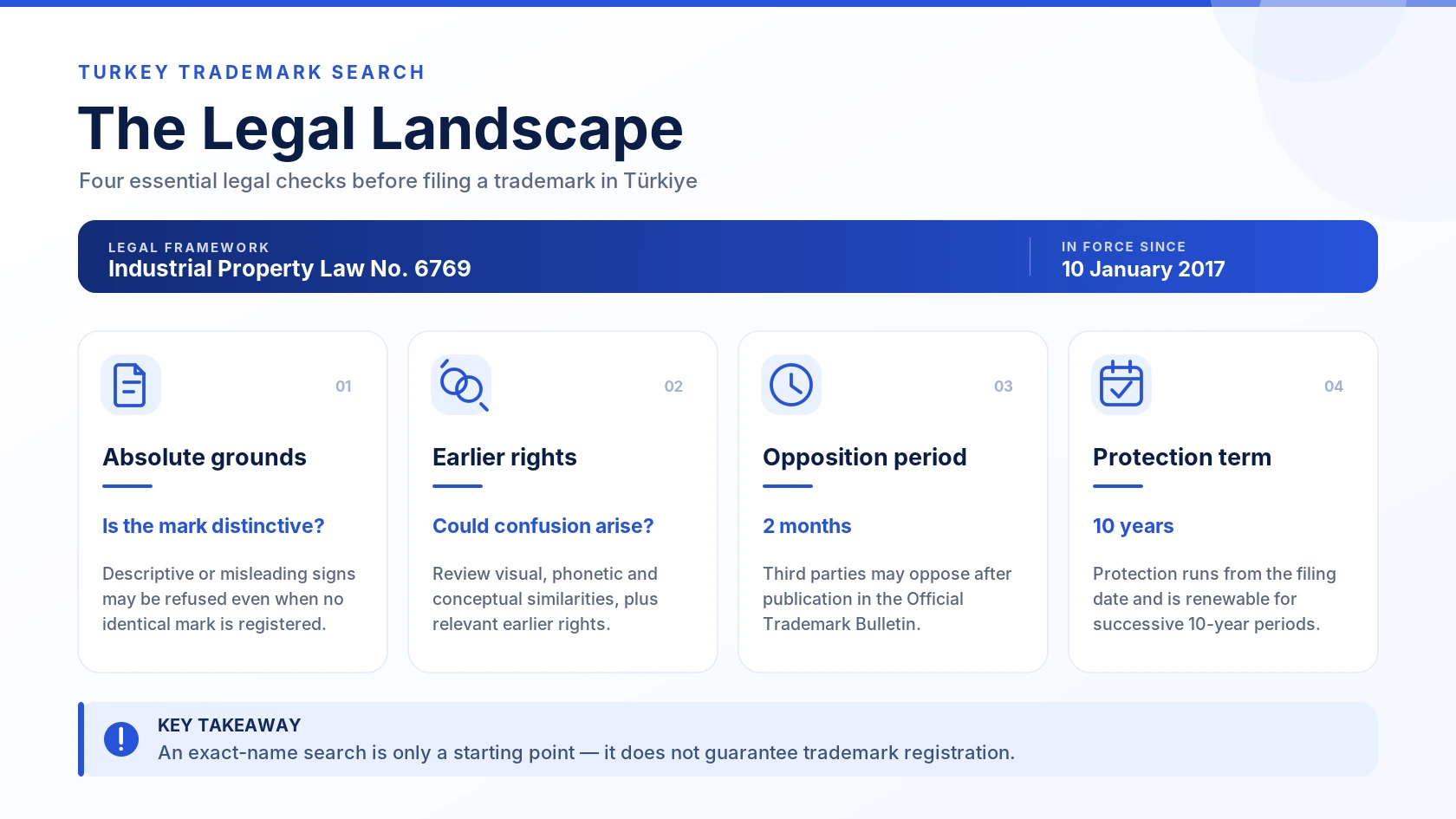
Key legal factors to review when assessing trademark availability and filing risk in Turkey.
Two refusal questions apply
A search should test both absolute grounds and relative grounds.
- Absolute grounds: Is the sign distinctive, or does it describe the goods or services? Could it mislead the public or conflict with protected symbols?
- Relative grounds: Does an earlier mark create a likelihood of confusion because of visual, phonetic, conceptual or commercial similarity?
- Earlier rights: Could a third party rely on prior use, a well-known mark, a company name, a domain name or bad-faith conduct?
A clean database result doesn’t remove the first category of risk. If a name means “fast delivery” in Turkish and you’re offering delivery services, the sign may face a distinctiveness problem even if no one has registered the exact phrase.
Publication creates a live opposition risk
After TÜRKPATENT examines the application, an accepted mark is published in the Official Trademark Bulletin. Third parties then have a strict, non-extendable two-month opposition period under Article 18 of Law No. 6769, as explained in this analysis of Turkish trademark opposition deadlines.
If an opposition arrives, the applicant typically has one month to respond, with guidance indicating that an additional month may be available in some cases, according to the World Trademark Review Turkey guide. A proper search doesn’t guarantee registration. It helps you decide whether the filing is defensible and whether you have evidence ready for a challenge.
Running a Clearance Search on TÜRKPATENT
A trademark search in Turkey requires more than a single database lookup. Start with the official TÜRKPATENT research system, then preserve each search as a working record rather than treating visits as isolated checks. Note the query, date, result, status, applicant, classes and your assessment. This file helps explain a later filing choice and gives you a clearer record if the application is opposed.

A thorough TÜRKPATENT search should review name variants, relevant Nice classes and the status of existing and pending trademark applications.
Build the query set before opening the database
Prepare the search terms first:
- Write the exact sign. Include the word mark, slogan, logo wording and any dominant verbal element.
- Create spelling variants. Remove spaces, test common vowel changes, search singular and plural forms, and include likely abbreviations.
- Add Turkish-character variants. Search versions with ç, ğ, ı, ö, ş and ü, then test the plain Latin spelling.
- Check pronunciation. Say the name as a Turkish customer might. Search terms with a similar sound, even where the spelling changes.
- Translate meaning. For an English word or phrase, check its Turkish equivalent and search both versions.
TÜRKPATENT allows searches by trademark name, applicant, class, type, bulletin number and file-tracking information. Run exact-match and contains searches separately. If the interface offers wildcards or Boolean functions, use them to narrow or widen the results, then review the records manually. A query can miss a relevant record if you rely on one spelling, one language or one search field.
Search by class, then search around the class
Map the proposed goods and services to the Nice Classification, using the 11th edition headings and accepted wording. Search the core class first, then review nearby classes where customers, distribution channels or planned extensions overlap.
A clothing brand may need both its product class and retail services. A software business may need entries for software, hosting, consultancy, training or downloadable applications. Search the classes that reflect the business model, not only broad labels such as “technology” or “retail”.
Read status and applicant history
Review Pending, Published and Opposed records before dismissing them. Abandoned records can also expose repeated filings by the same applicant. For a concerning result, search the applicant name separately and inspect related marks, filing history and class choices.
Priority makes pending applications relevant. If an application reaches registration, its position generally relates back to the filing date. The FAQ on conducting a trademark search also points to exact, contains, phonetic, visual, Turkish and English-equivalent searches.
Beyond TÜRKPATENT Other Databases Worth Checking
A layered search uses different sources for different questions. No single database shows the complete commercial risk, so the order matters: start with rights, then look for market identity and ownership signals.
| Database |
What it covers |
Search tactic |
Gap if skipped |
| TÜRKPATENT |
Turkish national applications and registrations |
Exact, contains, applicant, class, status and variant searches |
You may miss national conflicts and pending priority |
| WIPO Global Brand Database |
International records and Madrid-related signals |
Search the mark, stem, owner and Turkish designation |
An international filing may not be visible in a basic national search |
| EUIPO EUTM database |
European Union Trade Mark records using Nice classes |
Search exact terms, stems, figurative elements and class overlap |
Parallel international activity and broader brand families can remain hidden |
| nic.tr and .com.tr WHOIS |
Turkish domain-name registrations and ownership clues |
Check exact names, prefixes, suffixes and transliterations |
A domain holder may have an earlier commercial identity |
| MERSİS and Ticaret Sicil Gazetesi |
Company names and published corporate records |
Search the name, stems and related applicant identities |
A company-name conflict may surface after you invest in incorporation and branding |
Use WIPO and EUIPO as signal systems
The WIPO Global Brand Database is useful for spotting international filings and owner portfolios. Search both the complete mark and its stem, then review the designated territories and relevant classes. It doesn’t replace TÜRKPATENT, but it can reveal an applicant’s broader strategy.
The EUIPO eSearch plus database gives another view of marks covering the European Union. Nice classes are a useful common language, but don’t copy an EU specification blindly into a Turkish filing. Compare the actual goods and services, channels and consumers.
Search commercial identity separately
For domains, check nic.tr and the .com.tr WHOIS service for exact names and meaningful prefixes. A domain isn’t automatically a trademark right, but it can identify an earlier operator, distributor or brand owner worth investigating.
For company records, use MERSİS and the Ticaret Sicil Gazetesi. Company names and trademarks aren’t interchangeable, yet a close company name can create practical confusion, especially when you later open a bank account, register with a tax office, approach a technopark or build a Turkish-facing website.
Common Pitfalls That Trip Up Foreign Applicants
The most expensive mistakes usually happen before the official application fee is paid. Foreign applicants often search from the perspective of their home market, while TÜRKPATENT and Turkish consumers encounter the mark through local pronunciation, Turkish meaning and Turkish commercial context.
Phonetics can defeat a clean Latin search
Take “Carma” and “Karma”. The spellings differ, but a Turkish speaker may hear them as effectively the same in ordinary use. Search both versions, along with Turkish-character adaptations and likely pronunciation variants. A similar issue can arise when an English word is written with Turkish letters or when a founder removes accents for an international domain.
Class boundaries aren’t business boundaries
Nice classification organises goods and services, but customers don’t experience classes in isolation. A clothing company that searches only Class 25 may miss retail or marketplace activity in Class 35. A software business may overlook consultancy, hosting, training or hardware connections that bring it closer to an earlier mark.
TÜRKPATENT’s own public dashboard identifies Istanbul as the leading province for trademark applications, and its 2021 annual activity report records 12,553 appeals against trademark decisions in 2021, compared with 11,686 in 2020 and 12,015 in 2019. These figures don’t predict the result of a particular filing, but they show why a search should document opposition risk rather than promise certainty.
Pending marks and translated meanings need separate checks
A published or pending application can matter before registration. Also translate the mark into Turkish and ask what a normal customer would understand. “Hızlı Kargo” for delivery services describes the service directly, which creates a different problem from a collision with an earlier owner.
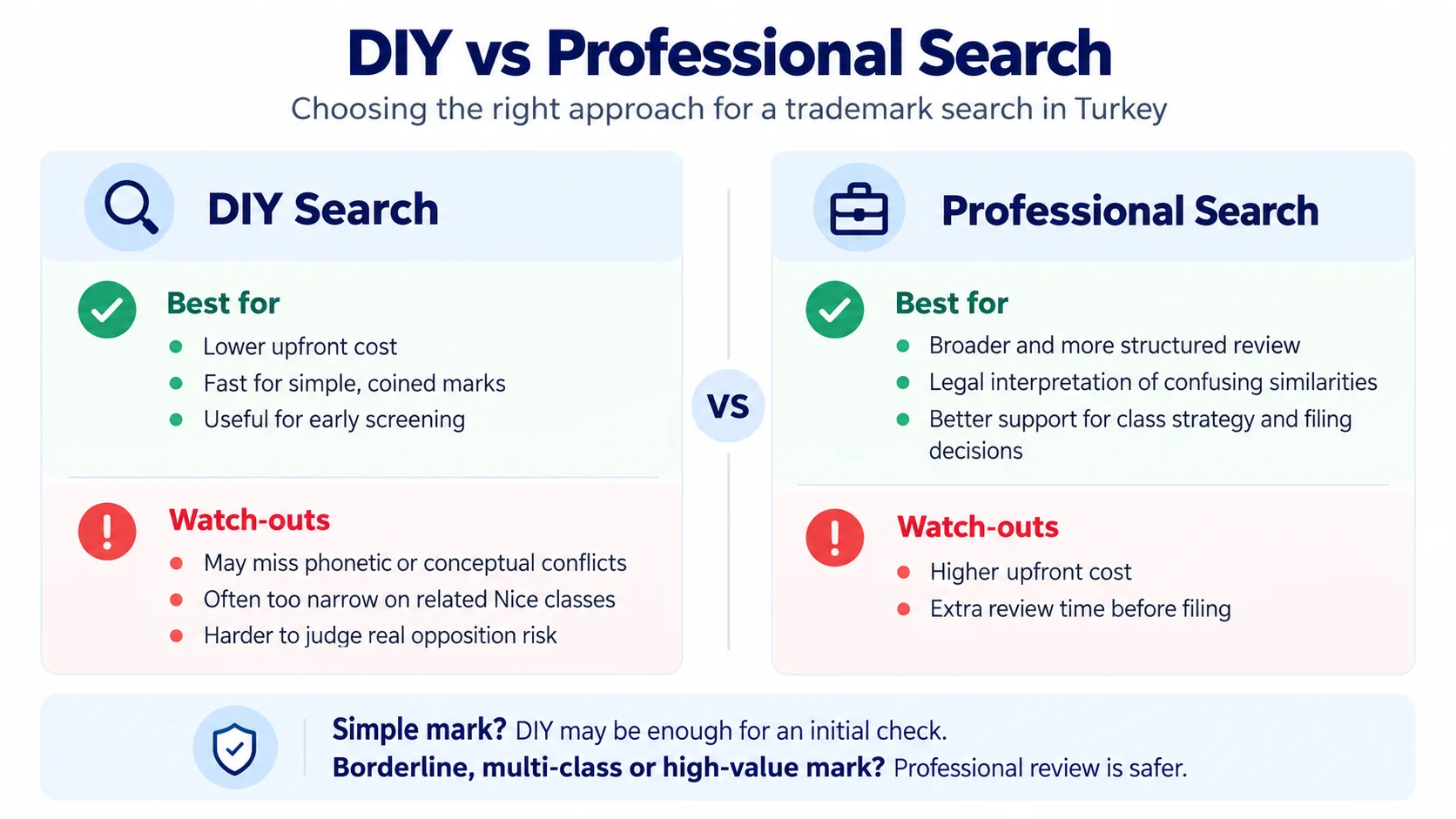
A DIY search can help with initial screening, while complex, multi-class or borderline trademarks may require professional review before filing in Turkey.
Before spending on packaging, software development or incorporation, confirm:
- Variants: Have you searched Turkish letters, plain Latin spellings and likely pronunciations?
- Classes: Have you covered goods, services and commercially adjacent activities?
- Status: Have you reviewed pending, published and opposed records?
- Ownership: Have you searched related applicants, domains and company names?
- Meaning: Is the sign distinctive and acceptable in Turkish?
When DIY Ends and Professional Help Begins
DIY research is reasonable for a coined word with a narrow business scope. If you have one to three classes, no close phonetic results, and a clean sweep across TÜRKPATENT, WIPO, EUIPO and domains, you may have enough information to make an informed filing decision. You should still preserve the search record and avoid describing the result as a guarantee.
Professional review becomes more valuable when the sign carries a Turkish meaning, the business will cover five or more Nice classes, or the search produces a borderline result. The same applies where the mark will enter Turkey through the Madrid System, where a provisional refusal or opposition may require local procedural handling.
Compare the real trade-off
The DIY route saves professional fees and works well for simple, invented marks. Its weakness is interpretation. A database can show a result, but it won’t reliably tell a founder whether two marks are conceptually close, whether a class is commercially adjacent, or how strong an opposition argument might be.
A local Turkish trademark attorney can assess those issues, refine the specification and prepare for correspondence in Turkish. That support costs more upfront, but a short review may be less expensive than changing a name after launch.
Typical service estimates supplied for this market include TRY 3,000 to TRY 6,000 for a basic attorney clearance opinion and TRY 8,000 to TRY 12,000 for a full filing in a single class, plus official fees. Those are quoted service ranges, not guaranteed prices, and the scope should be confirmed in writing. A typical opinion may take three to five working days, while registration may take two to four months, depending on examination and opposition events.
Workon offers a fixed-fee workflow combining clearance, filing and renewals for foreign founders who prefer one service provider rather than coordinating separate vendors. If you need local-language support across connected company and IP matters, an English-speaking lawyer in Turkey can also help you decide whether the issue needs a formal legal opinion.
From Clearance to Filing Your Next Move
A sensible filing file should contain more than a screenshot showing no identical mark. Before instructing anyone, assemble the following:
- The sign: Final word mark, logo, colour treatment and any slogan.
- The variants: Turkish-character forms, plain Latin forms, translations and phonetic neighbours.
- The classes: Confirmed Nice class coverage, including commercially related services.
- The searches: TÜRKPATENT, WIPO, EUIPO, domain records and company-name databases.
- The evidence: Search dates, queries, concerning results and reasons for accepting or rejecting each risk.
- The route: Direct national filing or Madrid designation, with representation decided before a deadline arises.
A practical filing sequence
Use the next 30 days to turn research into an organised application. Finalise the specimen first, lock the goods and services list, instruct a Turkish trademark attorney or a suitable filing service, prepare the power of attorney, pay the official TÜRKPATENT fee and monitor publication in the Official Trademark Bulletin. If your business is also being incorporated in Istanbul or Ankara, align the trademark decision with the company-name search, tax-office work, bank documentation and any KOSGEB or technopark application that will display the brand.
The guide to registering a trademark in Turkey can help you map the administrative sequence, but the clearance decision should come before public launch and printed materials.
Keep three points in view:
- Clearance is multi-database. TÜRKPATENT is essential, but it doesn’t show every commercial signal.
- Class selection is strategic. Describe the business you operate now, while considering realistic channels and extensions.
- Local representation has practical value. Once an opposition or office action appears, language, deadlines and Turkish practice become part of the risk.
Open a filing file now, attach your variant list and search results, and obtain a written assessment for any borderline mark before you commit to the brand.
Workon helps foreign founders coordinate Turkish trademark clearance, filing and renewals within a structured business-support workflow. Visit Workon to review the available support and start preparing your Turkey trademark file.
Start with TÜRKPATENT’s official trademark search system. Search the exact name and alternative spellings, then review relevant records, including their goods and services and current status. Check pending applications as well as registered trademarks.
Yes. You can carry out a basic search for free using TÜRKPATENT’s public trademark database. A professional clearance opinion is a separate service that assesses similar marks and potential conflicts in more detail.
Start with the Nice classes covering your products or services, then review commercially related activities. Compare the actual goods and services listed in relevant records, because a useful search needs to consider how those activities overlap.
Not necessarily. An earlier trademark with a similar name may still create a conflict, particularly where the goods or services overlap. Search spelling and pronunciation variants, and assess potentially conflicting results before committing to the name.
You can conduct a preliminary search yourself. Professional review is useful when similar marks appear, Turkish wording or pronunciation complicates the assessment, or your business covers several related activities. An attorney can help interpret the results before you file.