Quick answer: In Turkey, “business phone answering” can mean two different things: a virtual PBX/IVR system that routes calls automatically, or a live virtual receptionist who answers in your company name. They are different services, with different pricing and data-processing implications. Workon’s own phone solution is the first model—number assignment, a virtual phone system, voicemail and IVR through a solution partner—not a human-operated call-center, receptionist or secretarial answering service.
For a foreign founder, the right setup depends on who calls, which languages you need, whether calls must be transferred live, whether calls are recorded, and how caller data enters your CRM or other systems. This guide explains how to compare the models, normalize provider quotes, and avoid treating a virtual office, PBX/IVR system and live receptionist as the same product.
The Hidden Cost of Missed Calls in a New Market
A common situation looks like this. A company launches from abroad, uses a general mobile number, and relies on voicemail when the team is sleeping or in meetings. A buyer in Istanbul calls during local business hours, hears a generic recording in English, and hangs up. They don’t file a complaint. They just call the next supplier.
That loss is hard to track because it rarely shows up as a visible failure. It shows up as fewer demos, fewer dealer conversations, fewer procurement follow-ups, and weaker early momentum.
This is why phone answering in Turkey shouldn’t be treated as a cosmetic add-on. It sits close to revenue. For a new entrant, especially one without a full local office, the first live phone interaction often does more trust-building than a polished landing page.
Start with the operating model, not a market-size headline
Turkey has both telecom/PBX providers and specialist outsourced reception or contact-centre providers, but “phone answering” is not one standardized product. The useful first question is whether you need automated call routing or human call handling. Only after that should you compare languages, coverage hours, integrations, call recording, message handling and price.
This distinction also prevents a common procurement mistake: comparing a low-cost virtual PBX/IVR quote with a staffed receptionist quote as if they include the same work.
What new entrants usually get wrong
The mistake isn’t only “we missed a call”. The bigger mistake is using a phone setup that doesn’t match the business they’re trying to present.
A foreign company entering Turkey usually needs three things from the phone setup:
- Local reachability: a published number and greeting that make it clear how Turkish callers can reach the business.
- Predictable routing: calls should reach the right person, extension, voicemail or queue without depending on one founder’s mobile phone.
- A repeatable process: greetings, routing rules, after-hours treatment and escalation should be defined before the number is promoted.
Practical rule: Do not buy “phone answering” until the quote states whether the work is automated routing, human answering, or both.
For some companies, PBX/IVR plus voicemail and forwarding is enough. Others genuinely need a staffed receptionist. Choosing the model first avoids paying for the wrong layer.
Choose the Model First: Virtual PBX/IVR vs Live Receptionist
The phrase business phone answering service in Turkey covers at least two operating models. A virtual PBX/IVR system handles the call flow with menus, extensions, forwarding, voicemail and routing rules. A live receptionist adds a human layer that can answer in the company name, take structured messages, qualify calls or perform approved front-desk tasks.
| Feature |
Virtual PBX / IVR |
Live virtual receptionist |
| Human answers every call |
No |
Usually yes during contracted coverage |
| IVR menu and extensions |
Core function |
May sit before or behind the receptionist |
| Call forwarding and voicemail |
Core function |
Usually available through the underlying phone system |
| Appointment booking / lead qualification |
Only through separate integrations or your own team |
Possible if included in the provider’s scope and script |
| Main price drivers |
Number, platform, minutes, extensions and features |
Coverage hours, call volume, languages, agent time and task scope |
| Workon’s current scope |
Virtual phone system, voicemail and IVR via a solution partner |
Not a Workon-provided human call-center, receptionist or secretarial service |
When a live receptionist makes sense
A staffed service can be useful when callers genuinely need human triage: for example, appointment requests, basic lead qualification, supplier messages or escalation to the right team. The provider should work from approved scripts and clear boundaries; technical advice, contract negotiation and regulated or specialist questions should move to the responsible person rather than being improvised at reception.
When PBX/IVR is enough
For many lean foreign-owned businesses, the main need is simpler: publish a business number, play a professional greeting, route callers by department or language, forward calls to the right person, and capture voicemail when nobody is available. In that case, paying for a staffed receptionist may add cost without solving an actual workflow problem.
Decision test: If your requirement can be expressed as “press, route, forward, record a voicemail or ring an extension,” start with PBX/IVR. If it requires a person to listen, interpret, ask questions or perform a task, evaluate a live receptionist provider separately.
Why a Structured Phone Setup Matters for Foreign Businesses

Professional local communication helps foreign businesses build trust and operate more effectively in Turkey.
The value of a business phone setup is not the label on the package. It is whether callers can reach the company predictably and whether the internal team knows what happens next.
Local reachability without depending on one mobile phone
A company number with a clear greeting and routing logic can give customers, suppliers and partners a stable contact point even when the founders or managers work across countries and time zones. PBX/IVR can handle much of that routing without a human receptionist.
Less interruption for the core team
Extensions, forwarding rules, department menus and voicemail can stop every routine call from landing on the founder or one bilingual employee. If a live receptionist is genuinely needed, the same routing map becomes the script for deciding which calls are handled, transferred or escalated.
A cleaner path from launch to scale
Start with the lightest model that solves the actual problem. A company can begin with PBX/IVR and add staffed handling later if call volume or task complexity justifies it. That makes the decision reversible and avoids treating a receptionist as a prerequisite for market entry.
Consistency is the real operating benefit
The same company name, greeting, department logic, after-hours rule and escalation path should apply on every call. That consistency is useful whether the first layer is automated or human.
A professional phone presence is a defined workflow—not proof that a person must answer every call.
Navigating Turkish Legal and Local Nuances
Consider a hypothetical setup: a company forwards its public number to an outsourced receptionist before agreeing how caller notes, recordings and escalations will be handled. The line may work technically while responsibilities remain unclear. This is an illustrative risk scenario, not a reported Workon client case.
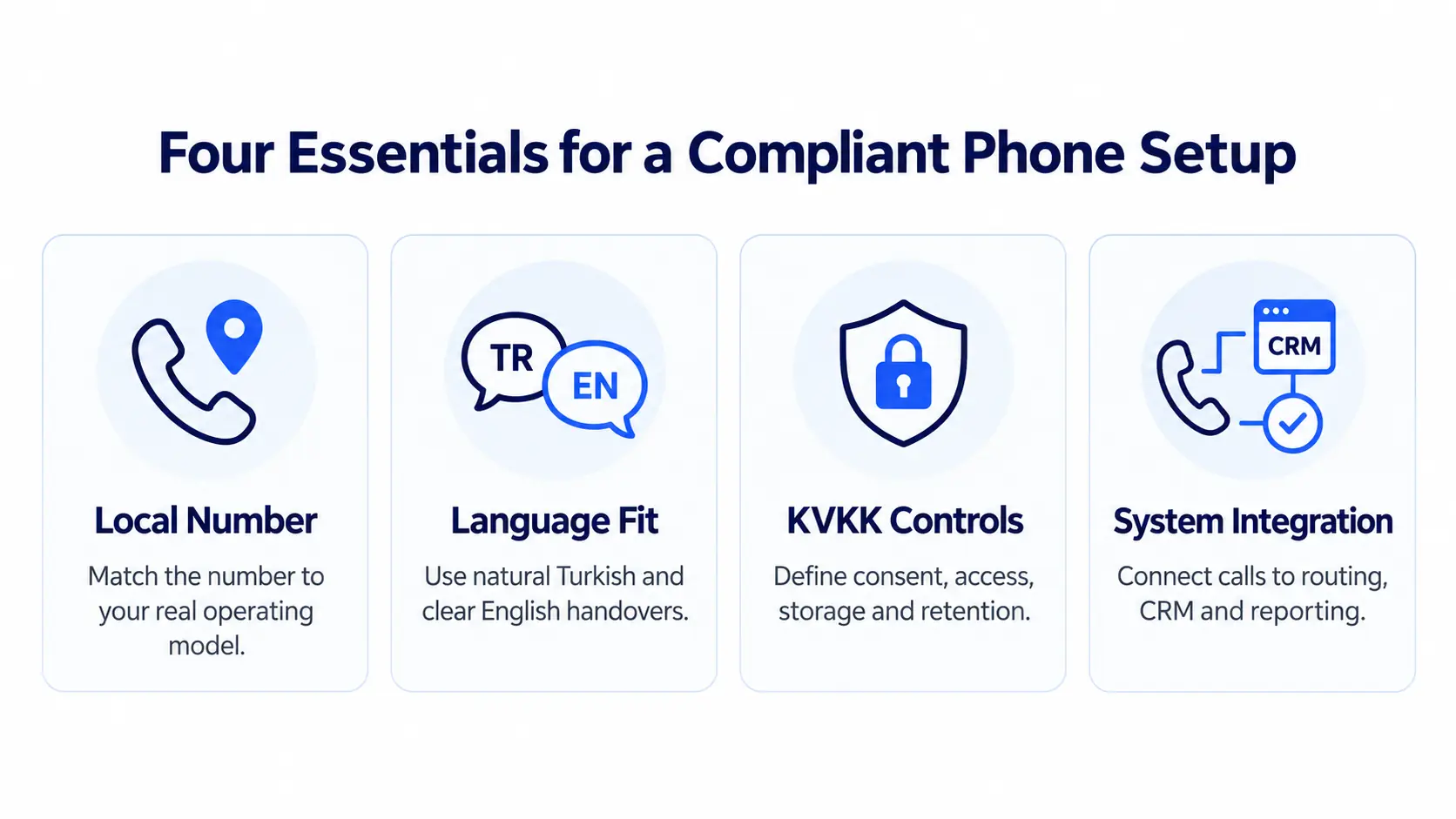
A compliant phone setup in Turkey combines a suitable local number, bilingual communication, KVKK controls, and system integration.
The gap is usually operational, not technical. A provider may answer calls well enough, but the real test is whether the service fits the way your Turkish entity is registered, where your team works, how customer data is handled, and what local callers expect from a legitimate business presence.
Choose the number type for the operating model
A Turkish +90 business number can make domestic reachability clearer, but there is no useful blanket rule that every answering setup must use one particular number type. Availability and suitability depend on the telecom/provider offer and how the business intends to use the line.
Compare the options by function rather than prestige:
- Geographic/local number: useful when a city-linked business identity is relevant and the provider can supply the appropriate number.
- Non-geographic business number: useful when calls should represent a broader Turkey-wide operation rather than one local office.
- Toll-free or specialist ranges: consider only when the customer-service model actually needs them.
Review the phone setup alongside company formation and office planning, especially when the business uses a virtual office. The published phone presence should support the real operating model rather than imply services or staffing that do not exist. For communication norms, see Workon’s guide to Turkish business culture.
Language requirements depend on the model
For PBX/IVR, bilingual support usually means professionally written and recorded Turkish/English prompts plus routing that sends callers to the right language path. For a live receptionist, it means something more demanding: the agent must understand the caller, capture accurate notes and escalate in the correct language.
If you are buying staffed handling, check:
- Natural Turkish on first contact
- Clear English for internal handover
- Accurate bilingual note-taking
- Familiarity with the terms callers actually use in your sector
Also define coverage hours explicitly. “Bilingual” does not tell you whether both languages are available at the same hours, after hours, on holidays or only through callback.
Map the KVKK roles before collecting or recording caller data
Phone systems can process personal data through caller IDs, message notes, CRM entries, voicemail and—if enabled—call recordings. Under KVKK, the legal role of each party depends on who determines the purposes and means of the processing and what the provider actually does. The provider contract does not make those questions disappear.
The Personal Data Protection Authority’s guidance on data-security obligations explains that data controllers must take appropriate technical and administrative measures and also addresses situations where another person processes data on the controller’s behalf.
Before launch, document at least:
- what data is collected from callers and for which purpose;
- whether calls are recorded, when recording starts and how the required transparency/notice is handled;
- who can access call logs, recordings, voicemail and message notes;
- retention and deletion rules for each data type;
- where data is stored or transferred, including CRM or other systems outside Turkey where relevant; and
- which party is responsible for each control under the actual service arrangement.
For a material recording, cross-border-transfer or sector-specific issue, have the exact workflow reviewed rather than assuming that a generic “KVKK-compliant” label on a phone package settles the analysis.
Compliance depends on the workflow, not the brochure
A provider can sound professional while the underlying process remains poorly controlled. Treat the phone system as part of the company’s information flow and document how calls move from the public number into people, voicemail, CRM records or other systems.
Useful controls include:
- a written routing map showing which calls are forwarded, logged, recorded or sent to voicemail;
- approved wording for greetings, recording notices and escalation where relevant;
- role-based access to call logs, recordings and notes;
- retention/deletion rules matched to the actual purpose; and
- contract terms that describe the provider’s responsibilities and data flows.
This is especially important when the company also uses a virtual office: the registered address, mail workflow and phone workflow are separate operational layers. They should work together, but one does not automatically include or legally substitute for the others.

Simplify your business setup with Workon’s all-in-one company registration service in Turkey.
How to Compare Features and Costs
Do not compare phone-service quotes by monthly headline price alone. First place each quote in the same model—PBX/IVR, live receptionist, or a hybrid—and then normalize what is included.
Features to compare for PBX/IVR
- Number and activation: what number is supplied, whether there is a setup charge, and whether the number can be retained or ported under the provider’s terms.
- Included usage: minutes, concurrent calls, extensions and any overage charges.
- Routing: IVR menus, time-of-day rules, forwarding, voicemail and department/extension logic.
- Language: whether Turkish and English prompts are included and who prepares or records them.
- Administration: who can change routing, greetings and extensions, and how quickly changes take effect.
Additional features to compare for a live receptionist
- Coverage: business hours, after-hours, weekends and holidays.
- Billing unit: per call, per minute, agent time, monthly allowance or a hybrid.
- Task scope: message taking, transfer, lead qualification, appointment booking and escalation.
- Language coverage: which languages are staffed at which times.
- Data flow: call notes, recordings, CRM access, retention and reporting.
If you’re also deciding how your office footprint should work, review Workon’s virtual versus traditional office comparison. The phone layer and the workplace/address layer should be coordinated, but they are separate purchase decisions.
A better way to normalize provider quotes
| Cost line |
PBX / IVR quote |
Live receptionist quote |
| Setup / activation |
Check number and system activation |
Check onboarding, script and training/setup |
| Recurring base fee |
Platform/number plan |
Retainer or coverage plan |
| Included usage |
Minutes, extensions or call capacity |
Calls, minutes or agent time |
| Overage |
Extra telecom/usage units |
Extra calls, minutes or time |
| Optional extras |
Recording, extra numbers, advanced routing |
Bilingual staffing, after-hours, booking, CRM tasks |
Cost rule: A quote is not comparable until the billing unit, included usage, overage, VAT treatment and optional features are all clear.
Workon does not present its PBX/IVR solution as a staffed receptionist package. If you are evaluating Workon’s phone option, confirm the current virtual-phone-system scope separately from any third-party live answering service you may need.
Step-by-Step Setup Checklist
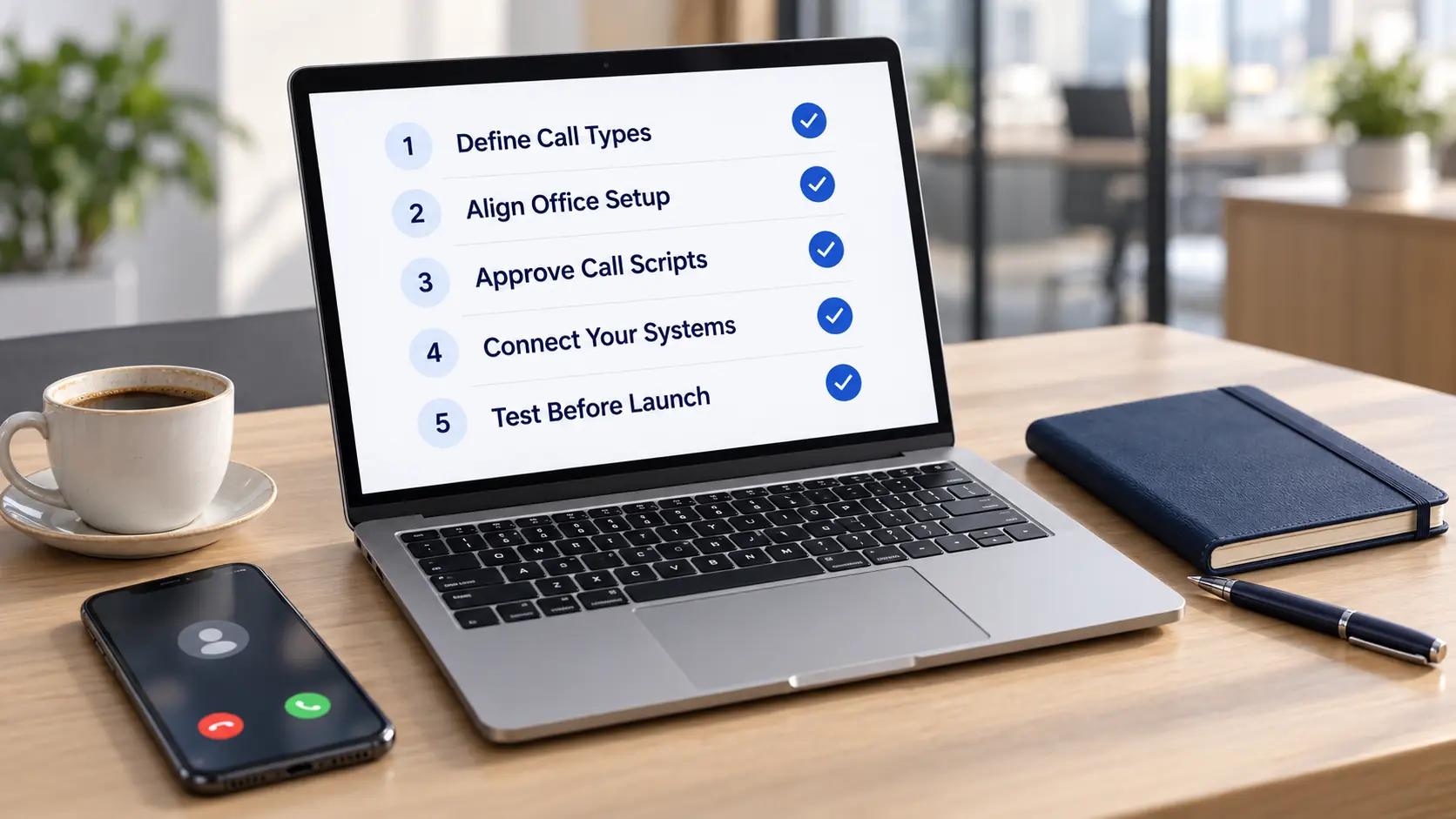
A structured checklist helps businesses configure call types, scripts, systems, and testing before launching their phone answering service.
1. Define the job of the line
Write down who is expected to call, why they call, which calls should be transferred, which can go to voicemail or callback, which languages are required and what caller information may be collected. This determines whether PBX/IVR is sufficient or whether human handling is justified.
2. Build the routing map
Define the greeting, language choices, departments/extensions, forwarding destinations, business-hours and after-hours rules, voicemail and escalation. If a live receptionist is involved, use the same map to define what the agent may answer, what must be transferred and what must only be logged for callback.
3. Align the phone layer with the address and office model
Phone service, virtual office, registered address and mail handling are separate functions. Review them together so callers receive consistent information, but do not assume one package automatically includes the others. Workon’s guide to virtual office and legal-address requirements in Turkey explains the address side separately.
4. Map systems and personal-data flows
Decide where voicemail, call logs, receptionist notes, recordings and leads go after the call. Limit access to the people who need it, define retention/deletion, and check any transfer into CRM, calendar or overseas systems before launch.
5. Test before publishing the number widely
Run test calls in every supported language and during each relevant time window. Test at least a new sales enquiry, an existing-customer issue, a supplier request, an after-hours call and a call that should be escalated rather than answered.
For PBX/IVR, verify menu choices, forwarding, voicemail and fallback behavior. For live reception, also verify greeting accuracy, note quality, transfer rules and whether the agent stays within the approved scope.
Go-live gate: publish the number broadly only after the routing, fallback and data-handling paths work as designed.
Which Model Should You Choose?
Choose PBX/IVR when the requirement is mainly a business number, professional greeting, extensions, routing, forwarding and voicemail. Choose a live receptionist when a person must interpret the caller’s request, ask questions, take structured messages or perform approved front-desk tasks.
If the business also needs a registered address or workspace, coordinate the layers but keep the contracts and scopes distinct. Workon can support the virtual PBX/IVR route through a solution partner alongside its business-setup, virtual-office and workspace services; it does not represent that solution as a Workon-operated human call-center, receptionist or secretarial answering service.
For the current Workon scope or to discuss how the phone layer fits your Turkey setup, contact Workon.
The term can describe two different models: a virtual PBX\/IVR system that routes calls automatically, or a live receptionist who answers and performs approved front-desk tasks. Compare them separately because the scope and pricing drivers are different.
No. Workon’s current phone solution is a virtual phone system, voicemail and IVR provided through a solution partner. It is not a Workon-operated human call-center, receptionist or secretarial answering service.
There is no useful blanket rule that every setup must use one specific Turkish number type. A +90 business number can make local reachability clearer, but the suitable range and availability depend on the provider and your operating model.
PBX\/IVR quotes are commonly driven by the number, platform, included usage, extensions and features. Live receptionist quotes may instead depend on coverage hours, call or agent time, languages and task scope, so compare billing units, included usage, overage, VAT treatment and extras.
Yes, but the meaning differs by model. PBX\/IVR may use bilingual prompts and routing, while a live receptionist service requires agents who can handle, document and escalate calls accurately in the contracted languages and hours.
Map what caller data is collected, whether calls are recorded, who can access logs or recordings, retention and deletion rules, and any transfer into CRM or overseas systems. The parties’ KVKK roles and obligations depend on the actual processing arrangement, so material recording or cross-border-transfer questions should be reviewed for the specific workflow.