
Quick answer: e-Invoice registration in Turkey is not triggered by one turnover test alone. The general e-Fatura threshold is TRY 3 million or more in gross sales for 2022 and later accounting periods, but lower thresholds, regulated activities, licence-based rules and direct Revenue Administration notices can require an earlier transition. Eligible businesses may also join voluntarily. First identify the legal trigger and deadline; then choose one of the three official use methods: the GIB Portal, a GIB-approved private integrator or direct integration with GIB.

A reliable e-Fatura project starts with the mandate and transition date, not with a software package.
Turkey’s e-Fatura system is an electronic invoice application administered by the Revenue Administration (Gelir İdaresi Başkanlığı, or GIB). It is part of the tax-document framework, so a valid setup must connect the taxpayer’s identity, mandate, application method, accounting process and evidence trail. Foreign ownership does not create a separate e-Fatura category: a foreign-owned Turkish company is tested under the rules that apply to its taxpayer type and actual activities.
e-Fatura or e-Arşiv: Which System Owns the Invoice?
The two names are related but not interchangeable. An e-Fatura registered user generally issues e-Fatura to another recipient registered in the e-Fatura system. Under the current e-document framework, taxpayers that enter e-Fatura mandatorily or voluntarily generally also enter the e-Arşiv Fatura application from the e-Fatura transition date, subject to the specific exception for activities that issue other documents replacing an invoice. For recipients that are not registered in e-Fatura, the applicable invoice is therefore generally issued through the e-Arşiv framework rather than treated as an optional second system.
| Recipient status |
Document route |
Operational check |
| Recipient is registered in e-Fatura |
Issue e-Fatura through the selected official method |
Check the recipient’s current registered-user status before issuance |
| Recipient is not registered in e-Fatura |
Apply the relevant e-Arşiv invoice rules |
Confirm the recipient’s status, transaction facts and current e-Arşiv requirements |
This guide explains the e-Fatura applicability, transition and registration decision. For invoices to recipients outside the registered-user list, use Workon’s separate e-Archive invoice guide for Turkey.
Who Must Register for e-Fatura in Turkey?
The current consolidated General Communiqué No. 509 contains a general turnover rule and several activity-specific rules. The following table is a decision screen, not an exhaustive legal classification.
| Potential trigger |
Current rule to test |
Why a second check is needed |
| General gross-sales threshold |
TRY 3 million or more for the 2022 and later accounting periods |
Gross sales and the relevant accounting period must be confirmed from the taxpayer’s records |
| Certain online sales |
TRY 500,000 or more for 2022 and later periods for taxpayers selling goods or services through their own or intermediary websites or other electronic environments covered by the rule |
Online sellers must be separated from digital platform, listing and advertising intermediaries, whose activity can create a different trigger |
| Real-estate or motor-vehicle activities |
TRY 500,000 or more for covered construction, manufacture, purchase, sale, rental or intermediary activities in 2022 and later periods |
The actual activity and revenue basis must fit the communiqué’s category |
| Activity, licence or status-based category |
No general TRY 3 million waiting point should be assumed for covered digital intermediaries, specified EPDK/ÖTV businesses, fruit-and-vegetable traders, SGK-contracted health providers, licensed accommodation providers or electric-vehicle charging businesses |
Each category has its own scope and transition date |
| Direct GIB notice |
GIB may require a taxpayer considered risky or non-compliant to enter the system regardless of sector, activity or turnover |
The notice and its stated preparation period control the file |
| Voluntary entry |
A taxpayer outside the mandatory groups may use e-Fatura voluntarily |
The operational benefit, system method and related e-document consequences should be assessed before opting in |
Do not reduce this table to “every company above TRY 3 million registers.” A business below that figure can still be mandatory because of its online activity, regulated status, licence or direct notification. Conversely, a company should not be treated as mandatory merely because it is foreign-owned or has received a Turkish tax number.
The tax identity step is covered separately in Workon’s Turkish tax ID guide for foreigners. A VKN identifies the taxpayer; it does not, by itself, prove that the taxpayer is registered in e-Fatura.
What Is the 2026 e-Fatura Transition Date?
There is no universal “1 July for everyone” deadline. For the general turnover test, a taxpayer reaching TRY 3 million or more in 2025 would generally enter e-Fatura from the beginning of the seventh month of the following accounting period—normally 1 July 2026 for a calendar-year taxpayer. Several activity-specific rules use different clocks.
| Trigger |
General transition logic in the current communiqué |
| General TRY 3 million test |
Beginning of the seventh month of the accounting period following the period in which the threshold is met |
| Covered online seller or real-estate/motor-vehicle business meeting TRY 500,000 |
Generally the beginning of the seventh month of the following accounting period |
| Covered digital platform, listing or advertising intermediary |
Existing and new activity rules can require entry within three months rather than waiting for the next July |
| Specified EPDK/ÖTV category |
Generally from the beginning of the fourth month after the relevant licence or activity trigger |
| SGK-contracted health provider |
The system must be active before issuing invoices to SGK under the applicable rule |
| New licensed accommodation activity |
Generally from the beginning of the fourth month after the activity starts |
| Covered electric-vehicle charging activity |
For charging-network operators licensed under the Charging Service Regulation and charging-station operators certified by them that started activity after 7 October 2023, e-Fatura applies from the date the activity starts |
| Merger, conversion or specified restructuring |
A separate transition period applies and can be no longer than three months after the relevant trade-registry event |
| Individual GIB notice |
Follow the written date; the communiqué provides a preparation period of at least three months |
The exact date should be documented in a short mandate memo that records the relevant provision, activity facts, accounting period, revenue evidence and calculation. A licensed CPA/SMMM or another appropriately authorised professional should confirm the conclusion against the current communiqué and any later amendment or written notice.

Company formation, tax registration, accounting access and e-document readiness should be handed over as one controlled operating file.
The Three Official e-Fatura Use Methods
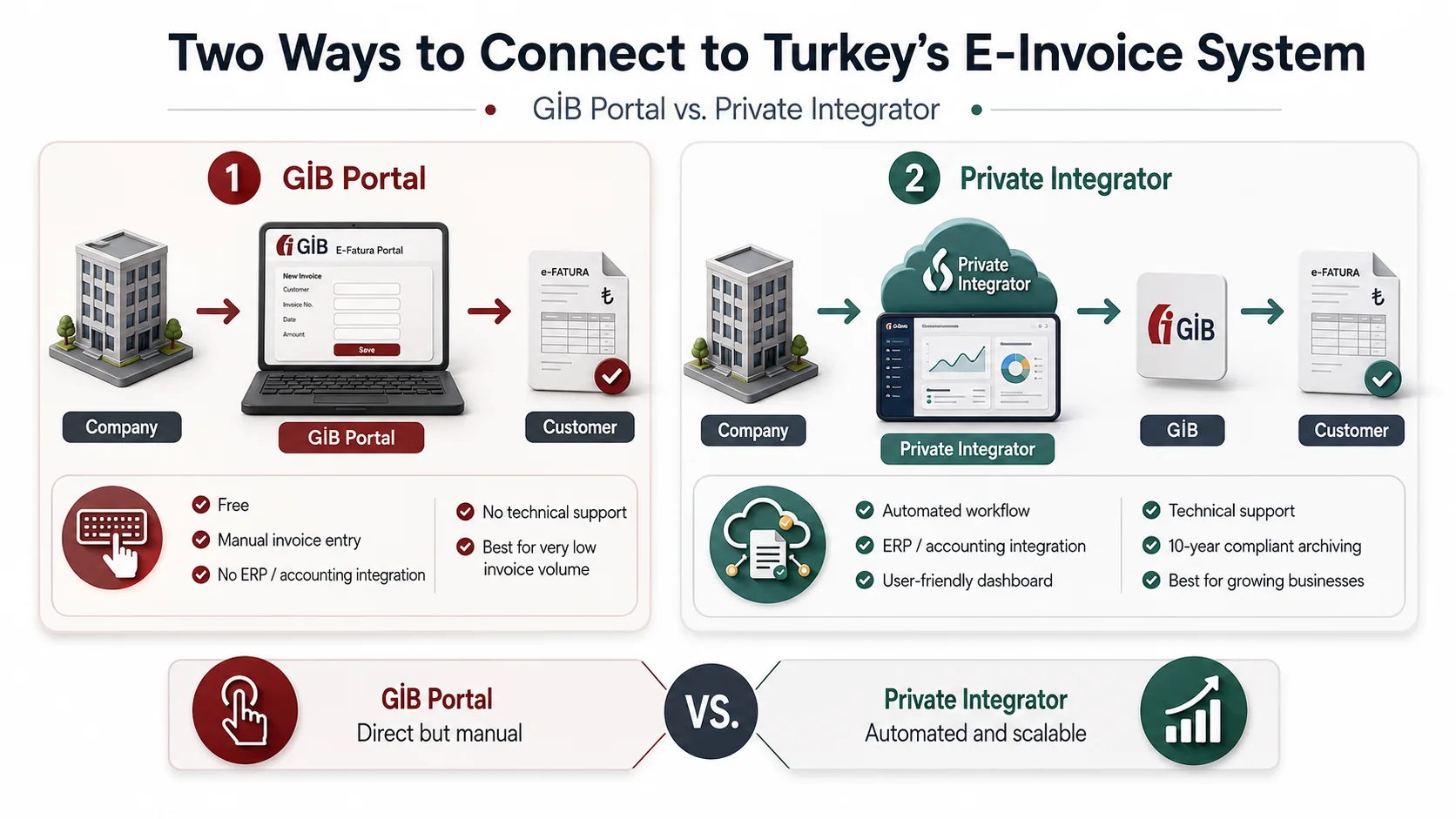
GIB recognises three methods. The correct choice depends on transaction complexity, integrations, controls, continuity needs and internal capability—not on an invented universal invoice-volume cutoff.
| Method |
What it means |
Decision questions |
| GIB Portal |
Use the basic functions provided through GIB’s portal |
Can the team operate the portal reliably, maintain its evidence and handle the expected workflow without a broader integration? |
| GIB-approved private integrator |
Use an authorised provider’s technical service under the private-integration framework |
Is the provider on GIB’s current approved list? Which ERP connections, user controls, support, archive, export, security and exit arrangements are actually included in the contract? |
| Direct integration |
Connect the taxpayer’s own information system directly to GIB after satisfying the applicable technical and testing requirements |
Does the organisation have the engineering, security, testing, monitoring and continuity capability to operate the connection? |
A private integrator can reduce manual work and support a more complex invoice flow, but “private integrator is always best” is not a compliance rule. Portal users need an operating procedure and backup ownership. Direct-integration users need a genuine technical-control environment. Provider selection should follow the mandate decision, not replace it.
Step-by-Step e-Invoice Registration Process
- Determine whether entry is mandatory or voluntary. Record the exact threshold, activity, licence, status or GIB-notice provision that applies.
- Fix the transition date. Calculate it from the rule that created the obligation; do not automatically copy a 1 July date from another taxpayer.
- Validate the taxpayer record. Confirm the legal name, VKN, activity information, authorised representatives and current tax status.
- Select one of the three official methods. Match the portal, approved integrator or direct integration to the business’s workflow and control needs.
- Check current authentication and application requirements. The applicable electronic-signature or financial-seal steps can depend on the entity and method. Use the current GIB application page and current KamuSM process instead of relying on an old PDF or a promised hardware-delivery time.
- Complete the official application or provider onboarding. Keep the submitted form, authorisation, contract, acceptance and activation evidence.
- Verify registration and test the workflow. Check the registered-user list and test creation, approval, sending, receipt, status handling and accounting reconciliation before the first operational deadline.
- Activate the control calendar. Assign owners for recipient-status checks, invoice scenarios, cancellations or objections, archiving, reconciliations, credentials and business continuity.
Company formation and e-Fatura activation are separate events. A newly incorporated business should therefore keep a post-registration handoff covering its VKN, tax-office commencement, bank and accounting access, financial-seal or signature status, invoicing route and responsible operator. For the legal-entity stage, see Workon’s company registration service in Turkey.
Activation is complete only when the registered-user status, invoice workflow and evidence controls have been tested.
Build an Evidence File Before Go-Live
| Evidence |
What it proves |
| Mandate memo and revenue or activity records |
Why the taxpayer enters, whether entry is voluntary and which deadline applies |
| Current taxpayer and representative records |
Which legal entity and authorised users control the application |
| Application, financial-seal/signature and activation evidence |
That the required onboarding steps were completed through the current route |
| Method decision and provider due diligence |
Why the portal, approved integrator or direct integration was chosen and who owns each control |
| Registered-user lookup and test records |
That recipient routing and the end-to-end invoice process work before live issuance |
| Invoice scenario and exception procedures |
How commercial/basic scenarios, status messages, cancellations, objections and failures are handled |
| Archive, export and reconciliation records |
That issued and received documents remain accessible and agree with the accounts |
| Credential and continuity register |
Who can operate the system if a user, provider or technical connection becomes unavailable |
The accounting ledger must agree with the e-document flow. Workon’s bookkeeping guide for businesses in Turkey explains the broader recordkeeping context, while its VAT rates and compliance guide covers the tax treatment that must be reflected on the invoice. e-Fatura registration does not decide the correct VAT rate, exemption or withholding treatment.
Common e-Fatura Registration Errors
- Checking only the TRY 3 million general threshold and missing a TRY 500,000, licence, activity or direct-notice trigger.
- Assuming every mandatory taxpayer enters on 1 July.
- Buying software before documenting whether and when the taxpayer must register.
- Presenting only two methods and omitting direct integration, or treating a private integrator as universally mandatory.
- Choosing a provider without checking GIB’s current approved list, data-export rights, support scope and continuity arrangements.
- Using e-Fatura for a recipient without first checking whether the recipient is registered in the system.
- Confusing e-Fatura registration with e-Arşiv recipient rules, VAT analysis or the possession of a VKN.
- Relying on a fixed financial-seal delivery promise or an old application guide instead of the current official process.
- Treating activation as complete without an end-to-end test, archive plan and named control owner.
Official Sources for a 2026 Check
The controlling starting point is GIB’s 2026 consolidated General Communiqué No. 509, including its current amendments. Use the official e-Fatura application page, the current GIB-approved private-integrator list, the registered-user lookup and the current private-integration guide when implementing the chosen route.
Rules, system screens and technical guides can change. Recheck the current official source, any taxpayer-specific GIB notice and the actual business facts before filing an application or setting a go-live date.
How Workon Supports the e-Fatura Handoff
Workon can help a foreign founder organise the company and activity facts, build the mandate and deadline evidence pack, compare operating methods and coordinate the handoff to a licensed CPA/SMMM, GİB-approved provider or technical team. The licensed tax professional confirms the taxpayer-specific mandate and regulated filing position, while GİB and the selected approved provider retain responsibility for their own systems and decisions.
Last reviewed: 17 September 2026. The general TRY 3 million threshold, the TRY 500,000 covered online/real-estate/motor-vehicle thresholds and the linked e-Arşiv rule were rechecked against current GİB guidance.
Message Workon with the entity’s VKN, 2025 gross sales, actual activities, any regulated licence, online-sales model and intended first invoice date. Those facts allow the registration route and evidence gaps to be screened before a software contract is signed.
Frequently Asked Questions
There is no single test. The current framework includes a general TRY 3 million gross-sales threshold for 2022 and later periods, lower thresholds for specified activities such as certain online sales and real-estate or motor-vehicle businesses, activity or licence-based categories and direct GİB notices. Eligible taxpayers can also enter voluntarily.
No. For a calendar-year taxpayer meeting the general turnover threshold in 2025, 1 July 2026 is the usual transition point, but activity-specific, licence-based, restructuring and direct-notice rules can use different clocks. For charging-network operators licensed under the Charging Service Regulation and charging-station operators certified by them that started after 7 October 2023, the e-Fatura obligation starts when the activity starts.
An e-Fatura registered issuer generally sends e-Fatura to a recipient that is also registered in the e-Fatura system. Taxpayers entering e-Fatura mandatorily or voluntarily generally also enter e-Arşiv from the e-Fatura transition date, subject to the specific exception for activities that issue other documents replacing an invoice. Invoices to recipients outside the e-Fatura registered-user list are then generally handled through the applicable e-Arşiv route.
GİB recognises three methods: the GİB Portal, a GİB-approved private integrator and direct integration with GİB. The correct choice depends on transaction complexity, integrations, controls, continuity needs and internal technical capability; a private integrator is not universally mandatory.
No. A VKN identifies the taxpayer, and foreign ownership does not create a separate e-Fatura category. Registration depends on the taxpayer's applicable turnover, activity, licence, status, notice or voluntary-entry decision.
Confirm the mandate and transition date, taxpayer and authorised-user records, selected official method, current authentication or financial-seal requirements, completed onboarding, registered-user status, end-to-end invoice routing and status handling, archive and reconciliation controls and business-continuity ownership.