e-Archive invoice Turkey rules changed materially for 2026. The most important point is that e-Arşiv Fatura is not a separate legal class of invoice; it is the electronic form of the ordinary Fatura. Which electronic route you must use depends on your own e-document status, your customer’s e-Fatura status and the transaction-level rules in the current GİB framework.
For taxpayers who are not otherwise included in the e-Fatura/e-Arşiv applications, the 2026 transaction rule is no longer the old 5,000 TRY / 6,900 TRY model. Under the current GİB guidance, taxpayers whose commercial income is determined under the simple method and taxpayers keeping books on the business-account basis must issue the covered invoice as e-Arşiv when the tax-inclusive total exceeds TRY 3,000 during 1 January 2025–31 December 2026. For the other taxpayers covered by this rule, there is no amount limit from 1 January 2026. From 1 January 2027, the amount limit is removed for the first group as well.
Quick Answer: What Is an e-Arşiv Fatura?
An e-Arşiv Fatura is an electronically created, stored, presented and reported form of the invoice under the Turkish Revenue Administration (GİB) e-document framework. It is not a new document type with a different legal nature from the ordinary invoice. The e-Arşiv rule determines the electronic form/routing of an invoice that must be issued; it should not be read as creating a separate obligation to issue an invoice for every transaction regardless of the underlying invoice rules.
For taxpayers enrolled in the e-Arşiv application, the ordinary routing principle is:
- Recipient is registered in e-Fatura: issue e-Fatura, subject to the applicable exceptions.
- Recipient is not registered in e-Fatura: issue e-Arşiv Fatura, subject to the applicable rules.
Taxpayers that enter e-Fatura mandatorily or voluntarily generally also enter the e-Arşiv Fatura application from the e-Fatura transition date, subject to the specific exception for activities that issue other documents replacing an invoice. The detailed trigger and e-Fatura transition calculation remain a separate decision; see E-Invoice Registration in Turkey: 2026 e-Fatura Requirements.
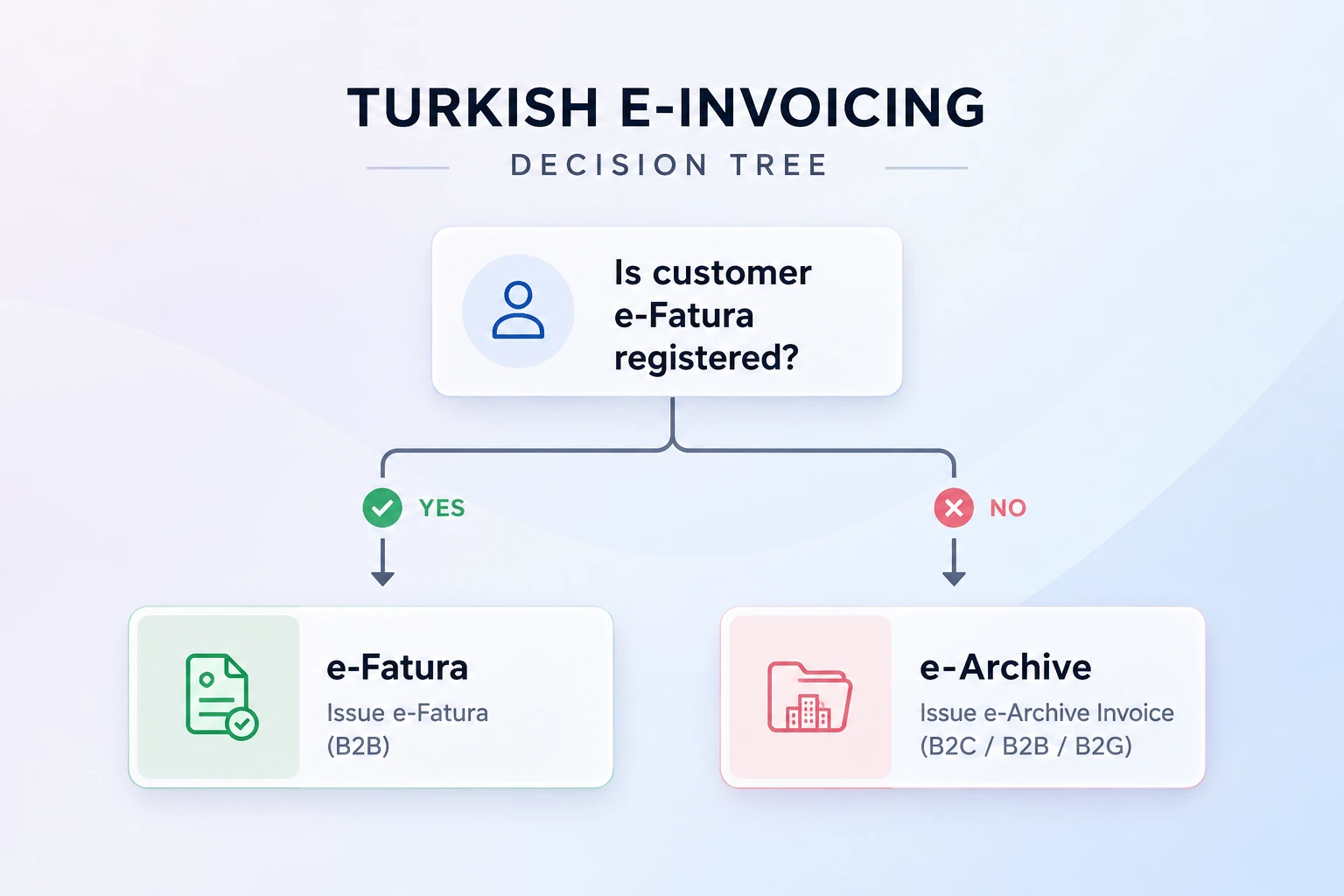
Invoice routing starts with the taxpayer’s e-document status and the recipient’s e-Fatura registration, not with an outdated universal threshold.
2026 e-Arşiv Transaction Rules
The 31 December 2025 amendment to General Communiqué No. 509 changed the timetable for the transaction-level e-Arşiv rule. The change was made by VUK General Communiqué No. 589. GİB’s April 2026 e-Arşiv Fatura infographic summarizes the current position as follows:
| Taxpayer group |
2026 rule for invoices covered by IV.2.4.3 |
From 1 January 2027 |
| Commercial income under the simple method + taxpayers keeping books on the business-account basis |
Tax-inclusive total exceeds TRY 3,000 → covered invoice must be issued as e-Arşiv. |
No amount limitation. |
| Other taxpayers covered by this rule |
No amount limitation from 1 January 2026. |
No amount limitation continues. |
This rule should not be confused with the separate criteria that can require a taxpayer to join the e-Fatura/e-Arşiv applications. Those enrollment criteria can depend on turnover, sector and other conditions under Communiqué No. 509. There is therefore no single “3 million TRY rule” that explains every e-Arşiv obligation in 2026.
What Happened to the Old 5,000 TRY and 6,900 TRY Limits?
They should not be presented as the current 2026 rule. Older articles often repeat a 5,000 TRY non-taxpayer threshold and the annual general invoice limit such as 6,900 TRY for 2024. That framing is obsolete for the current IV.2.4.3 rule.
For 2026, use the current GİB matrix above. Historical limits can be useful only when explaining an older tax period; they should be clearly date-labeled rather than mixed into current operating guidance.
What If You Are Not Otherwise Registered for e-Fatura/e-Arşiv?
GİB’s current 2026 guidance expressly covers taxpayers who are not otherwise included in the e-Fatura/e-Arşiv applications. When the transaction falls within the rule above, the invoice is issued through the GİB e-Arşiv Portal (Interactive) using Digital Tax Office credentials.
This is an important distinction: a business does not need to assume that “I am below the normal e-Fatura enrollment threshold, so electronic invoicing can never apply.” Transaction-level e-Arşiv obligations can still arise.
e-Fatura vs e-Arşiv: The Practical Difference
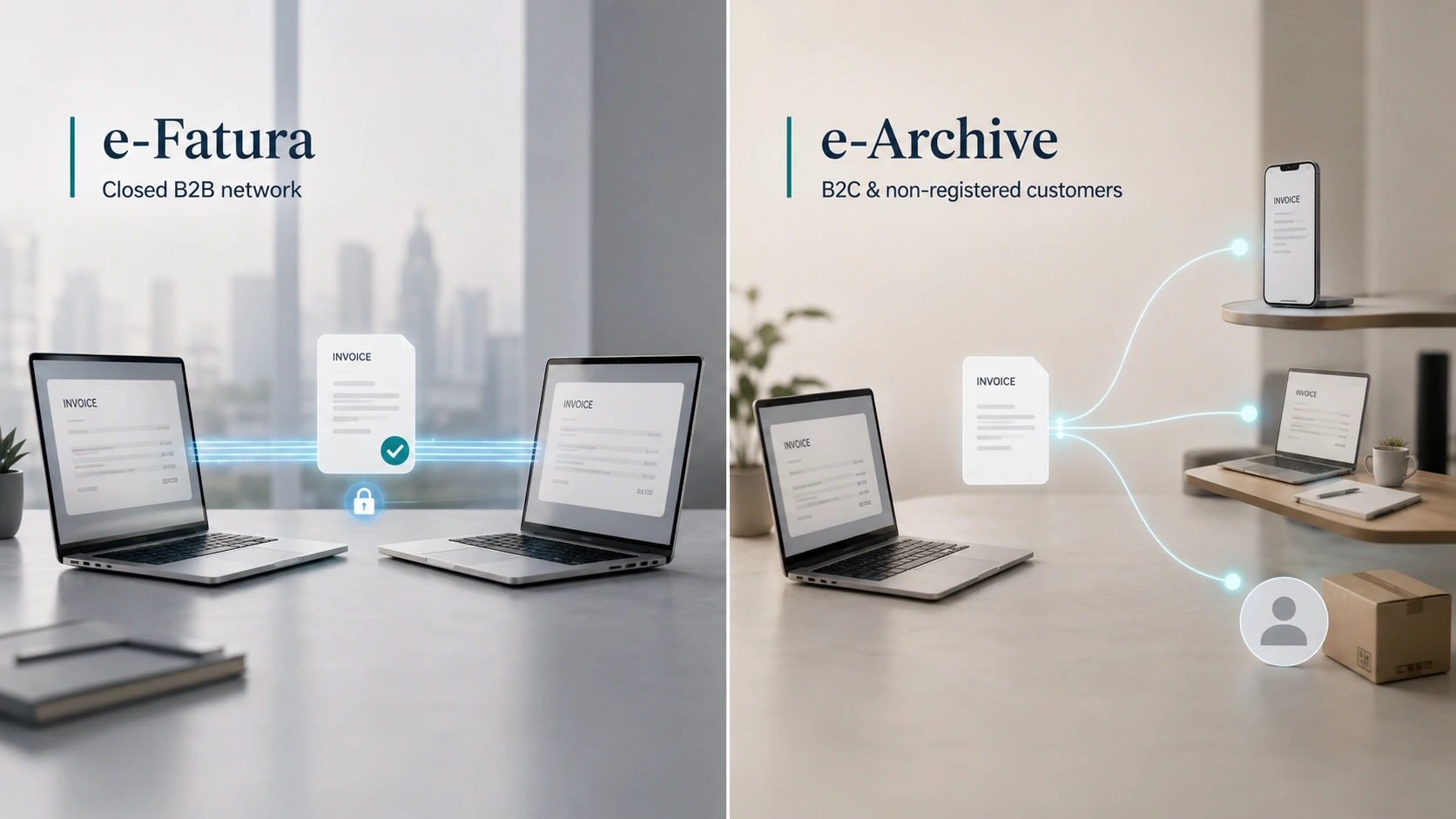
e-Fatura and e-Arşiv are different electronic routing methods within the Turkish invoice framework.
| Question |
e-Fatura |
e-Arşiv Fatura |
| Recipient route |
Generally used when the recipient is an e-Fatura-registered taxpayer. |
Generally used by an e-Arşiv user when the recipient is not registered in e-Fatura, and in other cases required by the Communiqué. |
| Legal nature |
Electronic invoice under the GİB framework. |
Electronic form of the ordinary invoice; not a separate new document type. |
| System decision |
Depends on taxpayer/recipient registration and applicable rules. |
Depends on taxpayer status, recipient status and the transaction rules. |
| Operational setup |
Portal, integrator or integration route depending on the taxpayer’s setup. |
Portal, integrator or integration route depending on the taxpayer’s status and chosen method. |
Three Questions to Ask Before Issuing an Invoice
- Are we enrolled in e-Fatura/e-Arşiv? If yes, apply the routing rules for enrolled taxpayers.
- Is the recipient registered in e-Fatura? This is a key routing check for an enrolled issuer.
- If we are not otherwise enrolled, does IV.2.4.3 require this invoice to be e-Arşiv in 2026? Apply the correct taxpayer-group rule: TRY 3,000 threshold for the specified simple/business-account group, no amount limit for the other covered taxpayers.
How Businesses Issue e-Arşiv Invoices
The technical route depends first on the taxpayer’s application status. Taxpayers already included in the e-Arşiv application may use the applicable GİB portal, authorised private-integrator or direct-integration route under the current technical rules. By contrast, taxpayers not otherwise included in e-Fatura/e-Arşiv who must issue an e-Arşiv invoice under the 2026 IV.2.4.3 transaction rule are directed by GİB to the e-Arşiv Portal (Interactive) using Digital Tax Office credentials.
Do not choose or describe a technical route based only on invoice volume. For enrolled taxpayers, consider the approved application method, accounting/ERP integration, user permissions, reconciliation, continuity and current GİB technical requirements.
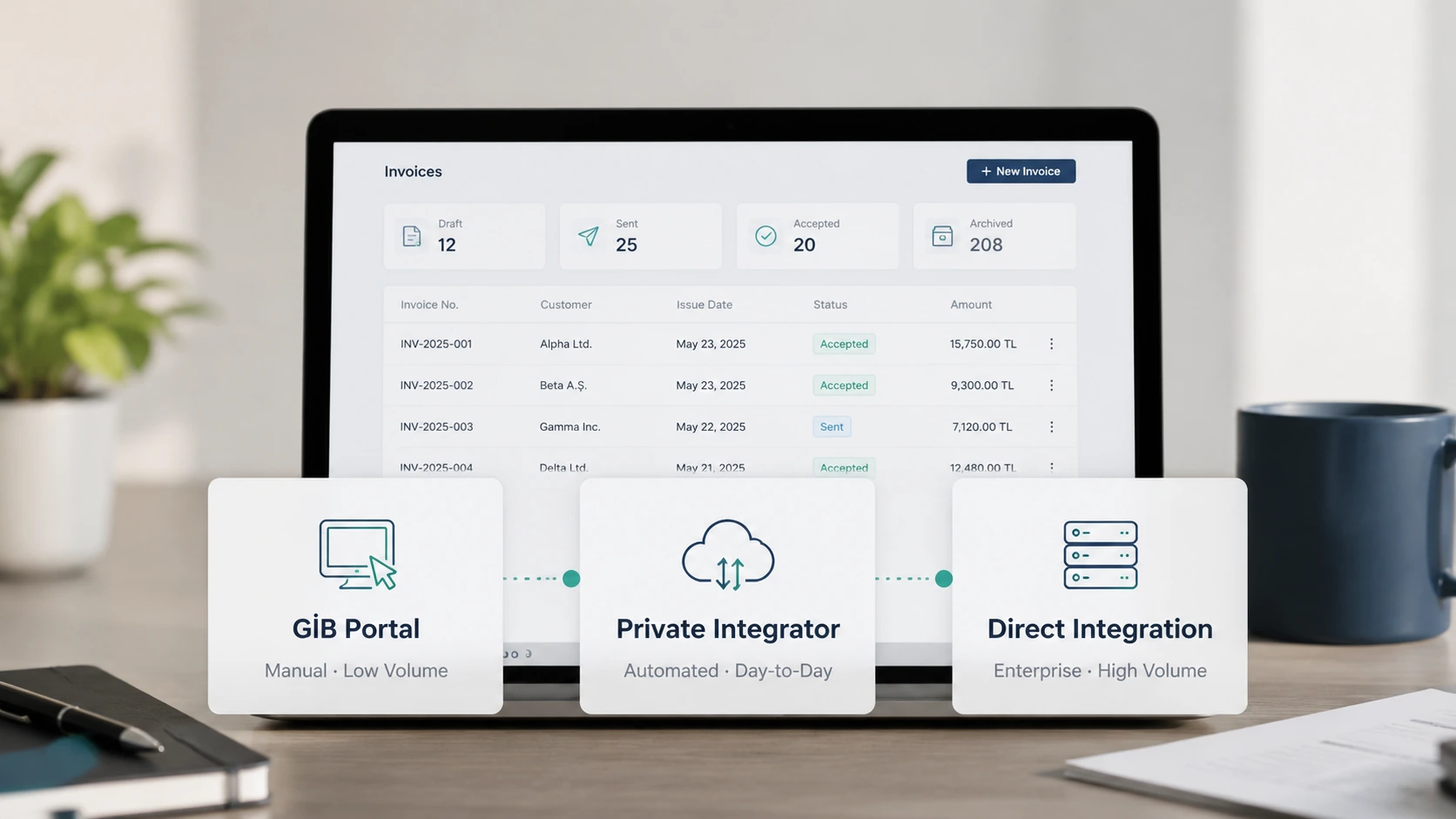
Common technical routes include the GİB portal, an authorised private integrator and direct integration, depending on the taxpayer’s status and workflow.
GİB Portal
The GİB portal can be appropriate where the taxpayer’s status and workflow fit the portal route. For taxpayers not otherwise in the e-Fatura/e-Arşiv applications who must issue an invoice under the 2026 transaction rule, GİB specifically directs them to the e-Arşiv Portal (Interactive) with Digital Tax Office credentials.
Private Integrator
An authorised private integrator can connect the invoicing workflow with accounting or ERP processes and reduce manual steps. Provider functionality, pricing, support and integrations are commercial matters and should be compared separately; provider use does not transfer the taxpayer’s legal responsibility for accurate records and compliant invoicing.
Direct Integration
Direct integration is a technical architecture decision for taxpayers with the systems and controls to operate it. It should not be described as automatically “better” for every large company. Technical standards, continuity, security and GİB requirements must be maintained.
Do You Need a Mali Mühür?
The authentication/signing method depends on the taxpayer and application route. A Mali Mühür is a distinct company e-document credential and should not be confused with a personal qualified electronic signature, KEP or UETS. See Financial Seal (Mali Mühür) in Turkey for the credential decision.
What Information Must Be Correct?
Invoice content must comply with the Turkish invoice rules and the current e-document technical standards. Rather than relying on a static internet checklist, validate the current schema and your transaction facts. Operational controls should cover at least:
- seller and recipient identification information appropriate to the transaction;
- invoice date/number and transaction description;
- quantity, price, tax base and applicable VAT treatment;
- currency and payment information where relevant;
- internet-sale fields where the current technical standard requires them;
- required technical elements such as the current data/QR structures generated by the compliant system.
VAT treatment is a separate tax decision. See VAT in Turkey: 2026 Rates, Exemptions & Compliance.
Reporting, Delivery, Storage and Corrections
For an e-Arşiv invoice, the recipient copy can be delivered on paper or electronically according to the recipient’s request and the applicable route, while the issuer’s copy is retained and produced electronically under the e-Arşiv framework. Do not treat “electronic invoice” as meaning that every customer must receive only an electronic file.
Avoid using one fixed reporting, cancellation or retention sentence for every e-Arşiv workflow. The applicable process depends on the taxpayer’s application method, transaction type, current GİB technical rules and the legal record-retention framework.
- Reporting: follow the current GİB technical rule for the chosen portal/integrator/integration method rather than relying on an old “every report is due by midnight the next day” statement.
- Corrections/cancellations: use the current GİB process and transaction-specific commercial/tax documentation. Do not assume every invoice can be unilaterally cancelled under one universal seven-day rule.
- Storage: electronic records must be retained and produced under the applicable tax/commercial rules. Confirm the relevant retention period for the company and record type with the responsible SMMM/CPA or legal adviser.
Common 2026 e-Arşiv Mistakes
- Using 2024 thresholds in a 2026 transaction.
- Treating TRY 3,000 as a universal threshold for every taxpayer.
- Assuming a low annual turnover means e-Arşiv can never be required.
- Sending e-Arşiv without checking e-Fatura recipient status when that routing check applies.
- Conflating e-Arşiv enrollment thresholds with transaction-level e-Arşiv issuance rules.
- Using a fixed cancellation/reporting deadline copied from an old article without checking the current GİB route.
- Applying VAT treatment mechanically without checking the actual supply, exemption or withholding rule.
- Assuming an integrator removes the taxpayer’s responsibility for invoice accuracy.
2026 Readiness Checklist
- Confirm whether the taxpayer is already in e-Fatura/e-Arşiv.
- Map the taxpayer’s book-keeping/status group for the 2026 IV.2.4.3 rule.
- Check the recipient’s e-Fatura registration where relevant.
- Apply the correct 2026 transaction threshold—or no-limit rule.
- Choose the appropriate GİB portal, integrator or integration workflow.
- Confirm signing/authentication credentials and user access.
- Map VAT and other tax treatment with the responsible licensed professional.
- Test invoice fields, internet-sale data and technical output before routine use.
- Define correction, cancellation, reconciliation and record-retention procedures.
- Keep the accounting/e-document workflow aligned with e-Defter and other applicable compliance systems.
How e-Arşiv Fits Into the Wider Compliance Stack
e-Arşiv should not be implemented in isolation. It normally interacts with bookkeeping, VAT, e-Fatura, e-Defter and company credentials. Useful next guides include:
How Workon Can Support the Setup
Workon can coordinate the operational setup around company records, e-document readiness and communication with the company’s licensed SMMM/CPA and relevant software/integration providers. The licensed tax professional confirms regulated filing and tax-treatment questions, while GİB controls the e-document systems and regulatory requirements.
Last reviewed: 17 September 2026. The 2026 IV.2.4.3 transaction rules and the 31 December 2025 amendment to Communiqué No. 509 were rechecked against current GİB guidance.
Key Takeaways
- e-Arşiv Fatura is the electronic form of the invoice, not a different legal document type.
- Do not use the old 5,000 TRY / 6,900 TRY model as the current 2026 rule.
- For the specified simple-method/business-account group, the 2026 transaction threshold is tax-inclusive total over TRY 3,000.
- For the other taxpayers covered by IV.2.4.3, there is no amount limit from 1 January 2026.
- From 1 January 2027, the amount limit is removed for the first group as well.
- Mandatory application enrollment rules and transaction-level e-Arşiv issuance rules are separate decisions.
- e-Fatura recipient status remains a key routing check for enrolled issuers.
Frequently Asked Questions
An e-Arşiv Fatura is the electronic form of the ordinary Turkish invoice under the GİB e-document framework. It is generally used when the applicable invoice route is not e-Fatura, including invoices to recipients who are not registered in e-Fatura and transaction-level cases required by the current Communiqué. It is not limited to B2C, small-business or foreign-customer transactions.
For an issuer enrolled in the applicable e-document systems, the recipient's e-Fatura registration is a key routing check: registered recipients generally receive e-Fatura and other recipients e-Arşiv, subject to the applicable rules. Taxpayers that enter e-Fatura mandatorily or voluntarily generally also enter e-Arşiv from the e-Fatura transition date, subject to the specific exception for activities that issue other documents replacing an invoice.
Application-enrolment obligations and transaction-level issuance rules are separate. In 2026, for invoices covered by IV.2.4.3, the tax-inclusive TRY 3,000 limit applies to the specified simple-method and business-account taxpayers; other covered taxpayers have no amount limit. Check the taxpayer category rather than relying only on turnover.
Follow the current GİB rules for the portal or integration method used. The recipient copy can be delivered on paper or electronically according to the recipient's request and applicable route, while the issuer's copy is retained and produced electronically. Sending the customer a PDF is not by itself the full compliance process; current reporting, correction and cancellation rules must also be followed.
Yes. E-Archive invoices can be issued to foreign customers, including individuals or companies without a Turkish tax ID. The invoice should include the correct customer details, such as name, address, and the accepted identification information.
Important: This guide provides general information on Turkey’s e-Arşiv framework and is not tax, accounting or legal advice. e-document obligations can depend on taxpayer status, sector, transaction type and current GİB rules. Confirm material invoicing, VAT, cancellation, reporting and retention decisions with the current GİB guidance and the company’s licensed SMMM/CPA or other appropriate professional. Workon coordinates operational readiness but does not replace GİB or a licensed tax professional.