
Is e-Defter mandatory for a Turkish company in 2026? It depends on the company’s tax/bookkeeping status and other legal triggers. Turkey’s e-Defter is the GİB electronic accounting-ledger system for the Yevmiye Defteri and Büyük Defter. It should not be confused with the Ministry of Trade’s ETDS, which is a separate system for specified non-accounting commercial/corporate books.
The key 2026 point for foreign founders is that e-Defter coverage is broader than the old “only large e-Fatura companies” rule. Since 1 January 2025, taxpayers required to keep books on the balance-sheet basis, as well as those voluntarily choosing that basis, are within the e-Defter transition framework in addition to the other official triggers.
Quick Answer: What Is e-Defter?
GİB defines e-Defter as electronic records containing the information required in statutory books under the Tax Procedure Law and Turkish Commercial Code, created and kept electronically with integrity and source-authenticity controls.
The current e-Defter format covers:
- Yevmiye Defteri — Journal Book
- Büyük Defter / Defter-i Kebir — General Ledger
- Envanter Defteri — Inventory Book, which GİB currently lists as an optional e-Defter format.
These are accounting books. Corporate-governance books such as the share ledger and general-assembly meeting/negotiation ledger belong to a different electronic system, ETDS, discussed below.
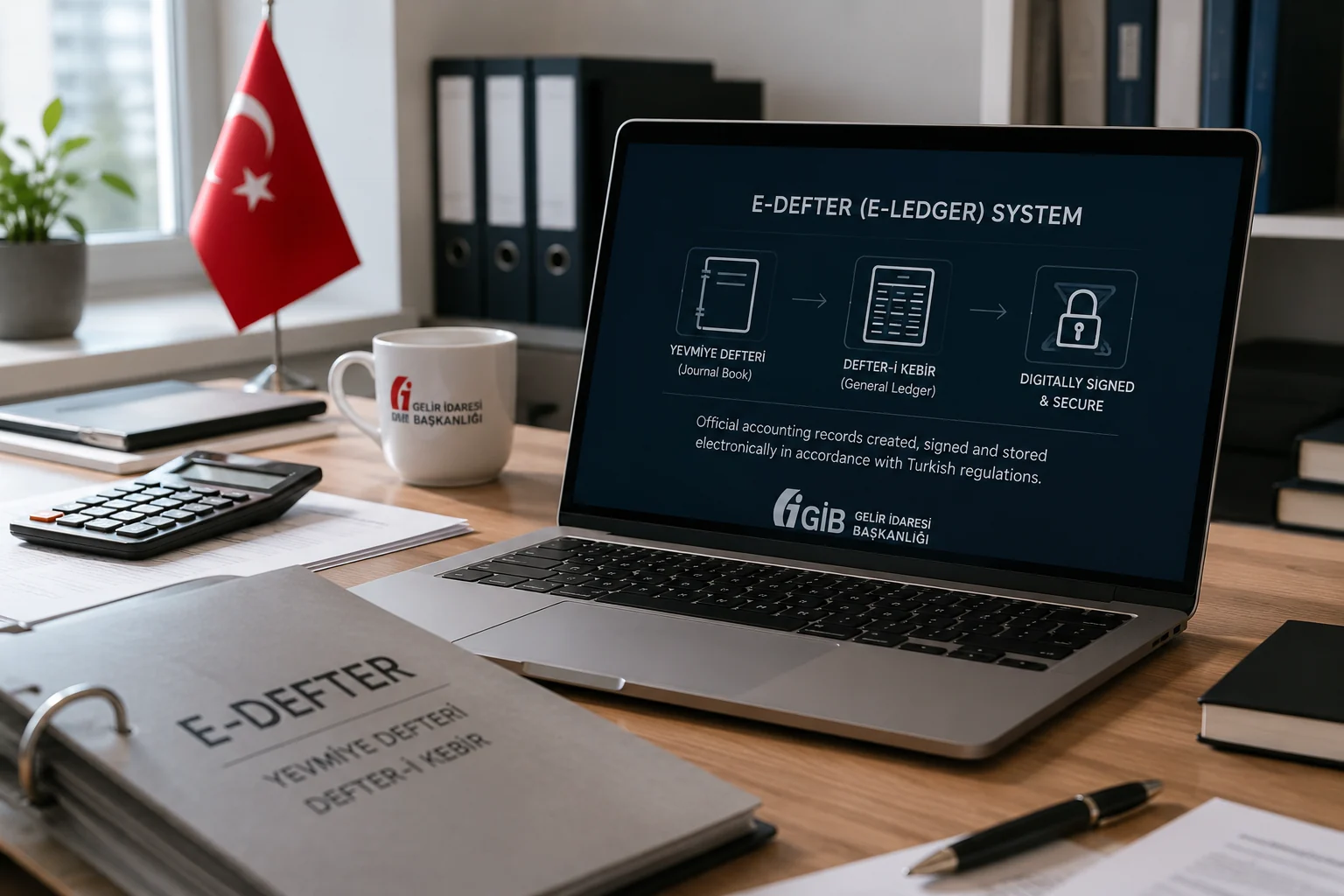
GİB e-Defter is the electronic accounting-ledger system for the journal and general ledger.
Who Must Use e-Defter in 2026?
Do not use one universal trigger. Current GİB guidance identifies several routes into the application.
| Trigger |
Current rule |
When the obligation starts |
| e-Fatura-mandated taxpayers |
Taxpayers required to enter e-Fatura also enter e-Defter under the linked timing rules. |
Depends on the e-Fatura transition date and whether the transition occurs during the year. |
| Companies subject to independent audit |
Companies within TCC Article 397/4 independent-audit scope are included. |
Generally from the beginning of the year following the year the conditions are met, subject to the current rule. |
| Balance-sheet-basis taxpayers |
Taxpayers required to keep books on the balance-sheet basis and those voluntarily choosing it are included. |
Expansion applies from 1 January 2025; new/restarting/reclassified taxpayers can enter from the relevant start/change date. |
| GİB written-notice / risk cases |
GİB can require transition following risk/compliance analysis regardless of ordinary sector/turnover triggers. |
Within the period stated in the written notice, subject to the minimum period in the current rule. |
| Merger / full demerger / type change |
Special transition timing applies to qualifying restructuring cases. |
The current rule caps the transition period by reference to the Trade Registry registration date. |
Missing the transition date does not keep the taxpayer on paper books. Under the current GİB rule, if a taxpayer is required to enter e-Defter but has not completed the transition, GİB opens the e-Defter account ex officio from the date the obligation began and notifies the taxpayer. The absence of that notification does not remove the obligation. From the mandatory start date, the taxpayer cannot validly continue the relevant books on paper; paper books kept for that period are treated as not kept under the e-Defter rule. This makes the trigger date a substantive compliance control, not merely an application deadline.
What About a Newly Formed LLC or JSC?
A newly formed company should not be told “you have three months because every new company is automatically e-Defter.” The correct question is which e-Defter trigger applies to that company.
In practice, many Turkish limited and joint-stock companies keep books on the balance-sheet basis, which can bring them into e-Defter under the 1 January 2025 expansion. But the legal reason is the applicable bookkeeping/e-Defter rule—not the separate ETDS reform discussed later.
Who Uses Defter-Beyan Instead?
e-Defter is not the only electronic bookkeeping system. GİB’s Defter-Beyan system is designed for specified categories such as taxpayers keeping books on the business-account basis, self-employed professionals and taxpayers under the simple method within its scope.
This matters because a sole proprietor or small business should not be forced into an e-Defter explanation simply because “all Turkish businesses are digital.” First determine the taxpayer’s bookkeeping basis and system.
How the e-Defter Workflow Works
- Close the accounting period. Source documents, invoices, payroll and other records should be posted and reconciled.
- Generate the e-Defter files. Use software that has the required GİB compatibility approval.
- Sign/approve using the applicable credential. The route depends on whether the taxpayer is a natural person or legal entity and the current GİB credential options.
- Create the related berat files. The berat is part of the integrity/onay lifecycle; it should not be described as GİB approving the accounting accuracy.
- Upload/process within the selected period model and deadline. Monthly and provisional-tax-period options have different timing mechanics.
- Retain the required files and backups. Keep the e-Defter, berat and related records in accordance with the applicable tax/commercial retention and secondary-copy rules.
Digital Credentials and Software
Current GİB guidance provides different credential options depending on the taxpayer type. Legal entities can use the applicable Mali Mühür / Digital Tax Office / e-Government access route under the current application rules; natural persons can have additional qualified electronic certificate options.
For the credential itself, see Financial Seal (Mali Mühür) in Turkey: 2026 Guide.
The software used to create, record, approve, store and present e-Defter must follow the current GİB technical/compatibility framework. A private integrator is not universally mandatory. Choose the workflow based on:
- accounting/ERP integration;
- transaction volume and month-end workflow;
- user permissions and segregation of duties;
- CPA/SMMM access and review process;
- backup/secondary-storage controls;
- support and business-continuity needs.
Monthly vs Provisional-Tax-Period Upload Choice
Current GİB rules allow e-Defter files and berat files to be handled on monthly periods or, for taxpayers who meet the conditions and make the required electronic choice, on provisional-tax-period groupings.
Important: this does not mean one combined “quarterly ledger file.” Even when the provisional-tax-period option is used, the files for each month are created separately. The upload preference and notification mechanics should be checked against the current e-Defter guidance.

Berat timing depends on taxpayer class and upload preference; there is no single universal deadline formula.
Berat Deadlines: Do Not Memorize One Universal Formula
e-Defter deadlines vary by taxpayer class and by the selected upload model. GİB’s 2026 tax calendar shows different due dates for income-tax taxpayers, other taxpayers, monthly-upload users and provisional-tax-period users.
Therefore, do not rely on a generic “every month is due three months later” rule. The operational control should be:
- identify taxpayer class;
- confirm monthly vs provisional-tax-period preference;
- check the current GİB Tax Calendar;
- build the internal close/review deadline earlier than the statutory date.
A berat is part of the electronic integrity and approval process. It does not mean GİB has audited or approved the substantive correctness of every accounting entry.
Do Not Confuse e-Defter With ETDS
This is one of the most important 2026 distinctions for new Turkish companies.
| Feature |
GİB e-Defter |
Ministry of Trade ETDS |
| Authority |
Turkish Revenue Administration (GİB) |
Ministry of Trade |
| Main purpose |
Electronic accounting ledgers |
Electronic non-accounting commercial/corporate books |
| Core books |
Yevmiye Defteri + Büyük Defter |
Share ledger + general-assembly meeting/negotiation ledger; board/management decision ledger can be optional under the current company/system rules |
| Key 2026 change |
2025 balance-sheet-basis expansion continues to determine many companies’ e-Defter position |
Companies registered from 1 January 2026 must keep the share ledger and general-assembly meeting/negotiation ledger in ETDS |
| Accounting entries? |
Yes |
No — ETDS is specifically for books not related to the business’s accounting |
For companies registered from 1 January 2026, ETDS opens the required corporate books together with registration. The Ministry’s current announcement states that the board of directors decision ledger is kept electronically by choice; the exact applicable management/decision-book setup also depends on company type.
Bottom line: a new company can have both e-Defter and ETDS obligations at the same time, but for different legal reasons and different books.
For the decisions recorded in an LLC’s corporate books, use the LLC governance guide and annual general assembly guide. Continue below for the accounting-ledger and month-end controls specific to e-Defter.
How e-Fatura and e-Arşiv Relate to e-Defter
e-Fatura, e-Arşiv and e-Defter are connected parts of Turkey’s digital compliance environment, but they are not interchangeable.
- e-Fatura controls electronic invoice enrollment/routing.
- e-Arşiv controls the electronic form/routing of invoices outside the e-Fatura recipient route and other required cases.
- e-Defter controls the electronic accounting books.
Do not assume that being in one application automatically defines every obligation in the other two unless the current rule expressly links them.
Month-End e-Defter Control Checklist
- All source documents for the period are collected and posted.
- Sales/purchase invoices, payroll, bank movements and tax-relevant records are reconciled.
- Accounting classifications are reviewed by the responsible licensed SMMM/CPA where required.
- The period is closed under the company’s accounting-control process.
- e-Defter files are generated using GİB-compatible software.
- Signing/approval credentials are valid and accessible.
- Berat files are created and processed under the correct upload model.
- GİB acceptance/onay status is checked.
- Primary and required secondary copies/backups are current.
- Exceptions and corrections are documented before the next close.
Common e-Defter Failure Points
- Confusing ETDS with e-Defter.
- Assuming only e-Fatura users can be required to use e-Defter.
- Missing the balance-sheet-basis trigger introduced from 1 January 2025.
- Forcing Defter-Beyan taxpayers into the e-Defter workflow.
- Assuming every company has the same entry date.
- Using one universal three-month berat formula.
- Treating one provisional-tax period as a single combined ledger file.
- Assuming a private integrator is legally mandatory for all taxpayers.
- Allowing Mali Mühür/access credentials to expire or become unavailable near a deadline.
- Treating the berat as tax-authority approval of accounting accuracy.
- Failing to maintain the required files and backup/secondary-copy controls.
Company Formation and 2026 Digital Books

Company registration, e-Defter accounting books and ETDS corporate books are related but legally distinct setup layers.
For a new foreign-owned company, digital-book readiness should be designed during onboarding rather than after the first filing deadline. The company’s bookkeeping basis, SMMM/CPA engagement, Mali Mühür/access, accounting software and ETDS users should be mapped as separate checklist items.
For the accounting workflow, see Bookkeeping in Turkey for Small Businesses.
How Workon Can Support the Setup
Workon can coordinate company onboarding, e-document/access readiness and the handoff between the founder, the company’s licensed SMMM/CPA and relevant software providers. Accounting classifications, bookkeeping, tax filings and professional tax/accounting conclusions remain within the scope of the appropriately licensed professional.
Key Takeaways
- e-Defter is the GİB accounting-ledger system for Yevmiye Defteri and Büyük Defter.
- Coverage is broader than e-Fatura-mandated taxpayers; balance-sheet-basis taxpayers have been included from 1 January 2025 under the current expansion.
- Entry timing depends on the actual trigger; do not use one rule for every newly formed company.
- Defter-Beyan is a separate system for specified taxpayer categories.
- Monthly and provisional-tax-period upload models have different timing mechanics, while each month’s files remain separately created.
- Berat due dates vary; verify the current GİB Tax Calendar.
- ETDS is a separate Ministry of Trade system for non-accounting corporate books. From 1 January 2026, newly registered companies keep the share ledger and general-assembly meeting/negotiation ledger there.
- Private integrators can be useful operationally but are not a universal legal requirement.
Frequently Asked Questions
Not under one universal rule. A company’s e-Defter position depends on its bookkeeping and taxpayer status and other applicable triggers. Current routes include e-Fatura-linked obligations, independent-audit scope, balance-sheet-basis bookkeeping, certain GİB notices and specified restructuring cases.
Missing the date does not preserve a paper-ledger option. Under the current GİB rule, the e-Defter account is opened ex officio from the date the obligation began for taxpayers that were required to enter but did not. Lack of notification does not remove the obligation, and paper books kept for the mandatory e-Defter period are treated as not kept under the e-Defter rule.
e-Defter is the Turkish Revenue Administration’s electronic accounting-ledger system, principally covering the journal and general ledger. ETDS is a separate Ministry of Trade system for specified non-accounting corporate books such as the share ledger and general-assembly meeting and negotiation ledger.
No. The correct transition date depends on the e-Defter trigger that applies to the company. Many LLCs and JSCs can fall within the framework because they keep books on the balance-sheet basis, but there is no single universal deadline formula for every newly formed company.
No. A private integrator can be operationally useful, but it is not universally mandatory for every taxpayer. The company should use the applicable GİB-compatible software and credential route and select its workflow according to its accounting, ERP, access, backup and support needs.
No. The berat is part of the electronic integrity and approval lifecycle. It should not be interpreted as GİB auditing or approving the substantive accuracy of every accounting entry. The company and its responsible accounting professionals must maintain the underlying accounting controls.
Last reviewed: 17 September 2026. This guide provides general information on Turkey’s e-Defter and ETDS frameworks. Eligibility, transition dates, berat deadlines, signing methods, software requirements and book-retention obligations can change according to taxpayer status and current GİB/Ministry rules. Workon coordinates operational readiness and the handoff to the company’s licensed SMMM/CPA and relevant software providers; GİB, the Ministry of Trade and the licensed professional retain responsibility for their respective systems, regulated filings and professional conclusions.