
Quick answer: Choose a logistics partner in Istanbul by matching the provider to the exact role you need—3PL/fulfilment, freight forwarding, road transport, warehousing, bonded warehousing, last-mile delivery or customs support—then verify the relevant authorisation, service scope, insurance/liability, technology, performance metrics and escalation process. A company calling itself a “logistics provider” does not automatically hold every licence or perform every regulated function itself.
Use this guide when buying logistics services: define the work, compare providers and quotes, check responsibilities and test the service before expanding the contract. If you plan to operate the logistics business yourself, use the separate logistics-company setup and authorisation guide. For the company that buys and sells the goods, start with the import-export company setup guide.
1. Define the Logistics Role Before You Compare Providers
“Logistics” can mean very different things. Start by defining the function you are actually outsourcing.
| Need |
Provider capability to assess |
| Freight forwarding / transport organisation |
Route design, carrier procurement, multimodal coordination, documentation and relevant TİO authorisation where the activity falls within that regime. |
| Road transport |
Appropriate transport authorisation for the operator/activity, vehicle network, route coverage and driver/vehicle controls. |
| 3PL / fulfilment |
Storage, receiving, pick-pack, order integration, dispatch, returns and inventory reporting. |
| Warehouse |
Location, capacity, handling, security, fire/safety controls, WMS and activity/product suitability. |
| Bonded warehouse / antrepo |
Official customs status/code, goods suitability, customs workflow and tariff/handling terms. |
| Customs declaration / brokerage |
Authorised customs-broker role where engaged; do not assume the logistics company itself is the licensed customs professional. |
| Last-mile delivery |
Coverage, service levels, proof of delivery, failed-delivery process, reverse logistics and customer communication. |
2. Verify the Authorisation That Matches the Activity
The Ministry of Transport and Infrastructure publishes current information and e‑Government verification routes for Taşıma İşleri Organizatörlüğü (TİO) authorisation. If a provider is acting as a transport organiser within that framework, verify the relevant certificate rather than relying on the wording on a sales page.
For road transport, the exact authorisation depends on the operator and transport activity. Ask the provider to identify the certificate it relies on and verify that the scope matches the service being sold.
For customs representation, the Ministry of Trade states that businesses may handle customs declarations themselves or authorise a gümrük müşaviri. Customs brokers receive an official permission document from the Ministry. The key point is role clarity: a 3PL, carrier or forwarder should not be presented as the customs broker unless the authorised professional/entity structure actually supports that role.
3. Check Bonded-Warehouse Status Separately
A standard commercial warehouse and a customs-controlled bonded warehouse are not the same thing. If imported goods will remain under customs procedures, confirm whether the facility is an authorised antrepo and whether it is suitable for the goods and transaction.
The Ministry of Trade publishes current warehouse codes and Istanbul regional lists/tariffs. Ask for the exact antrepo code and verify it against the official source before contracting.

Warehouse, bonded-warehouse, fulfilment and customs roles should be verified separately.
4. Build a Freight Profile Before Requesting Quotes
Providers cannot quote accurately from “we ship products in Turkey.” Give them a structured freight profile.
- product type and HS/customs classification where known;
- dangerous, temperature-controlled, fragile or oversized characteristics;
- origin and destination;
- FCL/LCL, pallet, parcel or project cargo;
- monthly/seasonal volume;
- weight and dimensions;
- Incoterms and commercial responsibility;
- required delivery windows;
- returns/reverse-logistics needs;
- insurance/value exposure;
- product-specific import controls or permits.
For import/export regulatory ownership, use Customs Clearance in Turkey: Import & Export Guide.
5. Normalize the Quote: Transport Price Alone Is Not Total Cost
A low freight rate can become expensive after surcharges, storage or exceptions. Ask each provider to separate the same cost layers.
| Cost layer |
Clarify |
| Main transport |
Route, mode, chargeable weight/volume and validity period. |
| Origin/destination charges |
Handling, terminal, pickup/delivery and local service charges. |
| Storage |
Free period, daily/weekly storage, minimums and overflow. |
| Customs/antrepo |
Broker/warehouse/official costs and who invoices them. |
| Fuel / toll / peak / security |
Which surcharges can change and how they are calculated. |
| Waiting / demurrage / detention |
Trigger, free time and responsibility. |
| Returns / failed delivery |
Reverse-logistics and redelivery pricing. |
| Insurance |
Included liability vs separate cargo cover and limits. |
6. Ask Who Is Contracting With You and Who Is Actually Carrying the Goods
In logistics, the contracting provider may use subcontracted carriers, warehouse operators, customs professionals or overseas agents. That is not automatically a problem, but the chain should be visible.
Ask:
- Who is my contractual counterparty?
- Which transport legs are subcontracted?
- Who selects and audits subcontractors?
- Who is liable if a subcontractor loses or damages cargo?
- Which country’s partner handles the foreign leg?
- Who owns customs/document errors?
Do not accept a vague “we handle everything” answer when responsibility matters.
7. Review Liability, Cargo Insurance and Claims Before the First Loss
Carrier/forwarder liability and cargo insurance are different concepts. Liability may be limited by contract, transport convention or applicable law; cargo insurance may provide a different scope of cover.
Before shipping high-value or fragile goods, confirm:
- declared cargo value;
- liability basis and limits;
- excluded goods or events;
- cargo-insurance option;
- packing requirements;
- claim notification deadline;
- evidence required for a claim;
- salvage/damaged-goods process.
For material exposure, have the contract and insurance wording reviewed by the appropriate professionals rather than relying on a sales summary.
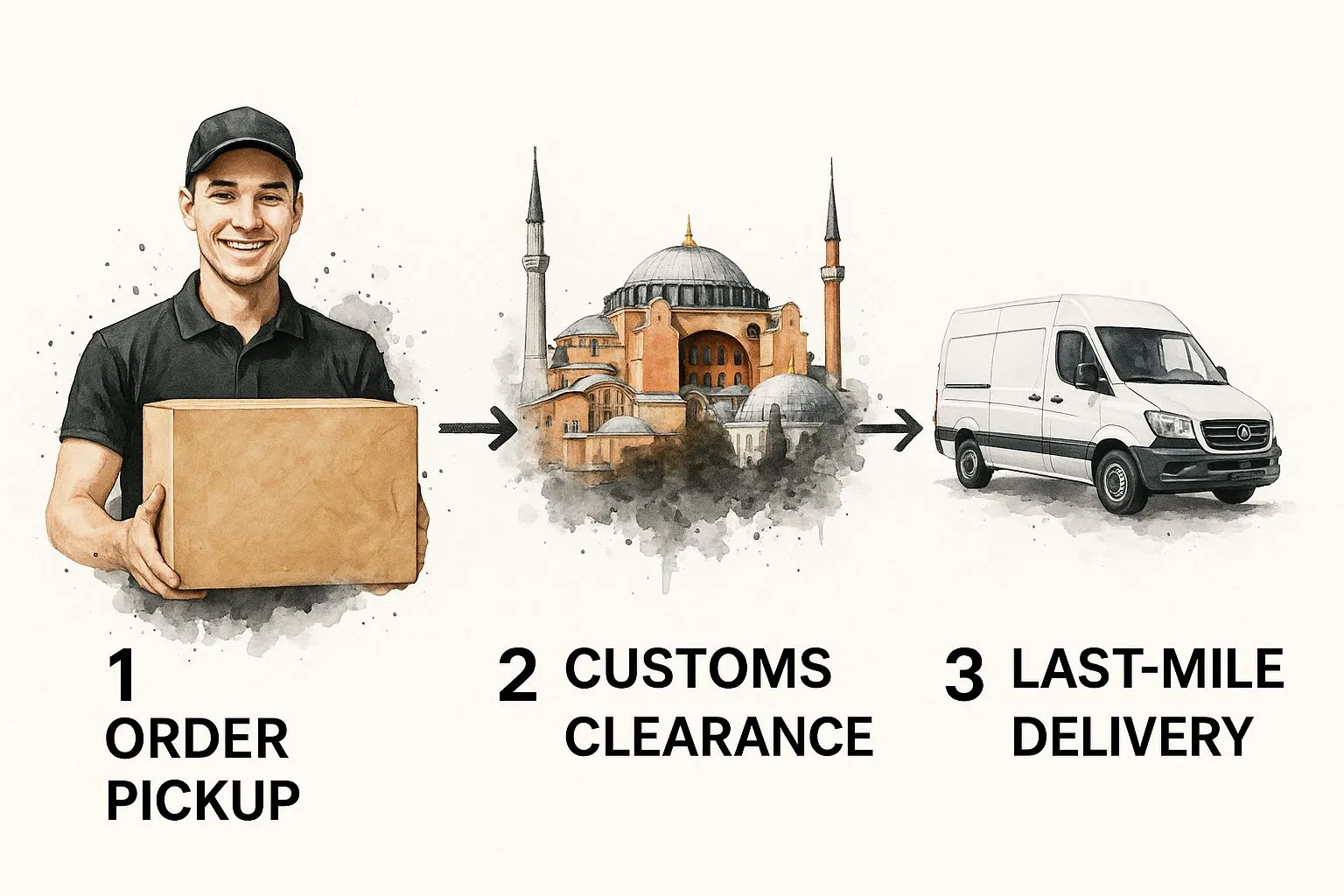
Map responsibility across pickup, transport, customs, storage and final delivery before problems occur.
8. Technology Should Prove What Happened, Not Just Look Modern
A WMS/TMS/client portal is useful only if it gives the information your business needs. During a demo, test real workflows.
- inventory by SKU/location/status;
- shipment milestones;
- proof of delivery;
- exception alerts;
- returns and quarantine stock;
- API/EDI/e-commerce integration;
- user permissions and audit trail;
- downloadable operational reports;
- data export if the relationship ends.
Ask how system downtime is handled and how manual corrections are logged. “Real-time tracking” should be defined by event source and update frequency, not used as a generic marketing phrase.
9. Use Service Levels That Match the Business Model
| Business model |
Metrics worth defining |
| E-commerce fulfilment |
Order cut-off, pick accuracy, same/next-day dispatch, return processing, inventory accuracy. |
| Importer/wholesaler |
Port/airport pickup, customs handoff, storage, pallet accuracy, B2B delivery windows. |
| Manufacturing |
Inbound delivery adherence, line-stop risk, milk-run/JIT performance, damage rates. |
| Cross-border freight |
Transit milestones, document cut-offs, exception communication, carrier performance. |
| High-value goods |
Chain of custody, security events, geofencing/route controls, claims handling. |
A provider may be excellent at international forwarding but weak at urban fulfilment, or vice versa. Score the service against your operational need.
10. Istanbul Geography Matters—But Avoid Generic “Best Location” Rules
European/Asian-side location, access to main road corridors, airport/port choice and customer density can affect service performance. But the correct warehouse or hub depends on the flow of goods.
For example, a business serving Anatolia may value Asian-side access differently from an importer using Ambarlı or a time-sensitive air-freight operation. Ask providers to show the network logic behind the proposed facility and route instead of accepting “central Istanbul” as proof of efficiency.

The right Istanbul logistics network depends on the actual origin, destination, mode and service level.
11. Run a Pilot Before Moving the Whole Supply Chain
When practical, test a shortlisted provider with a limited shipment, SKU group, route or fulfilment batch. A pilot exposes issues that a presentation cannot.
Measure:
- onboarding speed;
- document accuracy;
- response time;
- shipment visibility;
- exception escalation;
- invoice accuracy;
- damage/shortage controls;
- actual versus quoted lead time;
- data/report quality.
Record the baseline before expanding volume.
12. Red Flags When Selecting a Logistics Partner
- No clear authorisation answer for a regulated transport/organiser role.
- Customs brokerage described as “in-house” without identifying the authorised customs professional/structure.
- Bonded warehouse offered without a verifiable antrepo code.
- One-line all-inclusive price with undefined surcharges.
- No written liability/claims process.
- No visibility into subcontractors for critical legs.
- Technology demo shows dashboards but not your workflow.
- No exit/data-return plan.
- Unsupported “best/top provider” claims without objective criteria.
13. Logistics Partner Comparison Scorecard
| Dimension |
Weight in your decision |
| Activity/authorisation fit |
Must-pass |
| Route/product experience |
High |
| Cost transparency |
High |
| Liability/insurance |
High |
| Service levels |
High |
| Technology/reporting |
Medium-high |
| Subcontractor/network control |
Medium-high |
| Scalability |
Depends on growth plan |
| Commercial responsiveness |
Medium |
| Pilot performance |
High when available |
How Workon Supports Market Entry Around the Logistics Function
Workon supports foreign founders with company formation, registered address/workspace, bank-account application coordination and operational-readiness planning. Where the project needs customs, logistics or another regulated specialist input, Workon can coordinate the relevant authorised professionals/providers according to scope, while the licensed customs broker, transport-authorisation holder or other competent regulated provider retains responsibility for the regulated function itself.
Review Workon’s company registration and market-entry support.

Workon coordinates business setup; regulated logistics and customs roles remain with the relevant authorised providers and professionals.
Official Verification Sources
Last reviewed: 17 September 2026. Authorisation and bonded-warehouse status should still be verified against the live official register for the specific provider and service.
First define the exact role you need, such as freight forwarding, road transport, 3PL fulfilment, warehousing, bonded warehousing, customs support or last-mile delivery. Then verify the authorisation and service scope, liability and insurance, subcontractor chain, technology, pricing, service levels and escalation process.
No. Logistics functions can be regulated separately. A provider should identify the authorisation it relies on for the activity being sold, and customs brokerage should be distinguished from forwarding, transport and warehousing unless the authorised professional or entity structure actually supports that role.
No. A customs-controlled antrepo has a separate official status and code. If imported goods will remain under customs procedures, verify the exact bonded-warehouse code and suitability for the goods and transaction rather than relying on a generic warehouse description.
Provide the product and customs classification where known, origin and destination, mode, monthly or seasonal volume, weight and dimensions, Incoterms, delivery windows, returns, insurance exposure and any dangerous, temperature-controlled, oversized or product-specific requirements.
The headline transport rate may exclude origin or destination handling, storage, customs or antrepo charges, fuel and toll surcharges, waiting, demurrage or detention, failed delivery, returns and cargo insurance. Compare normalized quotes using the same cost layers and assumptions.
Where practical, yes. A limited pilot can test document accuracy, response time, shipment visibility, escalation, invoice accuracy, damage or shortage controls, actual versus quoted lead time and data quality before the relationship is scaled.
Important: This guide is general logistics-partner selection information, not customs, transport, insurance or legal advice. Authorisation, customs treatment, liability, insurance and product controls depend on the exact service, goods, route and transaction. Verify current licences/authorisations with the relevant official authority and use appropriately authorised professionals.