A real estate investment company in Turkey is not a special company type created only for property investors. In most ordinary projects, the founders establish a standard Turkish company—commonly a Ltd. Şti. or A.Ş.—and define lawful activities such as acquiring, holding, leasing, managing, developing or selling property in the articles of association. Regulated capital-markets vehicles such as REIT-style structures are a different regime and should not be confused with an ordinary property investment company.
The right 2026 sequence is: define the property business model → decide whether a company adds real operational value → test foreign-capital property rules → choose the company form/governance → draft the activity scope → set up banking/accounting → perform asset-level due diligence → complete the Land Registry route → manage licences, tax and operations according to the actual activity.
Quick Answer: Do You Need a Turkish Company to Invest in Property?
| Goal |
Company may add value when… |
Relevant next guide or review |
| Buy one property personally |
Usually not merely for ownership; compare personal purchase first. |
Foreign Buyer Property Guide |
| Build a rental portfolio |
Multiple assets, investors, employees, financing, contracts or formal governance justify an operating vehicle. |
This page + licensed tax/legal review. |
| Develop / renovate / construct for sale |
The project has organised commercial activity, contractors, permits and repeat transactions. |
This page + project/municipal/sector specialists. |
| Broker properties for third parties |
This is not simply property investment; brokerage is a regulated activity. |
Real Estate Agency / TTBS Guide |
| Buy for citizenship |
Citizenship is an individual exceptional-acquisition route, not a reason to create a generic property company. |
Citizenship by Investment Guide |
| Use a regulated property fund / capital-markets vehicle |
Professional fund/REIT-style structuring is intended. |
SPK-regulated specialist route, not an ordinary Ltd./A.Ş. |
1. There Is No Generic Legal Form Called a “Real Estate Investment Company”
The first legal decision is the normal Turkish company form. The property activity is then reflected in the articles and actual operating model.
A Ltd. Şti. may fit a closely held property operation with a relatively simple shareholder structure. An A.Ş. may fit projects where share-transfer flexibility, institutional investors, more formal governance or future financing makes that structure useful. Do not assume every A.Ş. is automatically an SPK-regulated company; ordinary joint-stock companies are not regulated investment funds simply because they hold property.
Choose the form using:
- number and type of investors;
- governance and reserved matters;
- future capital raising;
- share-transfer/exit plans;
- financing and security structure;
- public-debt and management-liability considerations;
- tax/accounting consequences;
- foreign-capital property-acquisition rules;
- licences triggered by the actual property activity.
For the general company-form comparison, see LLC vs Joint Stock Company in Turkey: 2026 Decision Guide.

The company form is a normal corporate-law choice; the property business model determines the activity and compliance layers.
2. Define the Property Business Model Before Drafting the Articles
| Model |
Main operating question |
Additional layer to check |
| Buy and hold |
Will the company own assets for long-term value/income? |
Title due diligence, financing, accounting/tax, property management. |
| Long-term rental |
Will the company lease its own assets? |
Lease law, invoicing/tax, tenant management. |
| Short-term / tourism rental |
Will units be rented for tourism-purpose short stays? |
Tourism-purpose residence-rental permit and applicable building/site rules. |
| Development / construction |
Will the company build, convert or materially redevelop property? |
Zoning, construction, contractor, technical and municipal permissions. |
| Renovate and sell |
Is the activity repeated commercial trading rather than passive investment? |
Commercial, tax/VAT, construction/renovation and consumer-contract controls. |
| Property management for third parties |
Is the company managing only its own assets or providing services to others? |
Contract, licence and brokerage/management boundaries. |
| Brokerage / agency |
Will the company intermediate third-party sales/leases? |
TTBS / Taşınmaz Ticareti Yetki Belgesi route. |
Draft the articles around the activities the company genuinely plans to perform. Avoid adding broad regulated activities merely “in case” if they create licensing or bank/KYC questions without a business need.
3. Foreign-Capital Turkish Companies: Article 36 Can Change the Acquisition Route
Current official Invest in Türkiye guidance identifies a Turkish company as falling within the foreign-capital property route where:
- foreign investors own 50% or more of its shares; or
- foreign investors have the right to appoint and dismiss the majority of the board of directors.
Such a company may acquire real estate and limited rights in rem for activities stated in its articles, subject to the applicable Article 36 procedure. The current general route involves an application to the governor’s office / Provincial Directorate of Planning and Coordination for the property, then Land Registry registration after the required positive result.
Official guidance also lists transactions that can proceed without that prior governor-office permission, including specified acquisitions in organized industrial zones, industrial zones, technology development zones and free zones, plus certain mortgage, merger/demerger and banking-receivable cases.
Do not create a Turkish company as a blanket workaround for foreign-buyer restrictions. First test whether Article 36 applies to the ownership/control structure and whether the target property is compatible with the company’s stated activities.
4. Company Formation and Property Acquisition Are Separate Closings
Registering the company through MERSIS/Trade Registry creates the legal entity. It does not automatically transfer any property to the company. The company then completes its own property-acquisition route as buyer.
Keep the workstreams separate:
- Corporate closing: company name, articles, shareholders, managers/board, capital, registered address and Trade Registry registration.
- Banking/KYC readiness: corporate bank application, UBO/source-of-funds/business-model evidence.
- Asset due diligence: seller/title, encumbrances, zoning/use, building status, tenant/lease position and project feasibility.
- Property-acquisition permission route: Article 36 / governor-office step where triggered and any applicable exception.
- Land Registry closing: payment evidence, official title-transfer file and registration.
For the incorporation sequence, use the company-formation guide. This page focuses on how the property business affects the company structure, investor decisions and continuing operations.
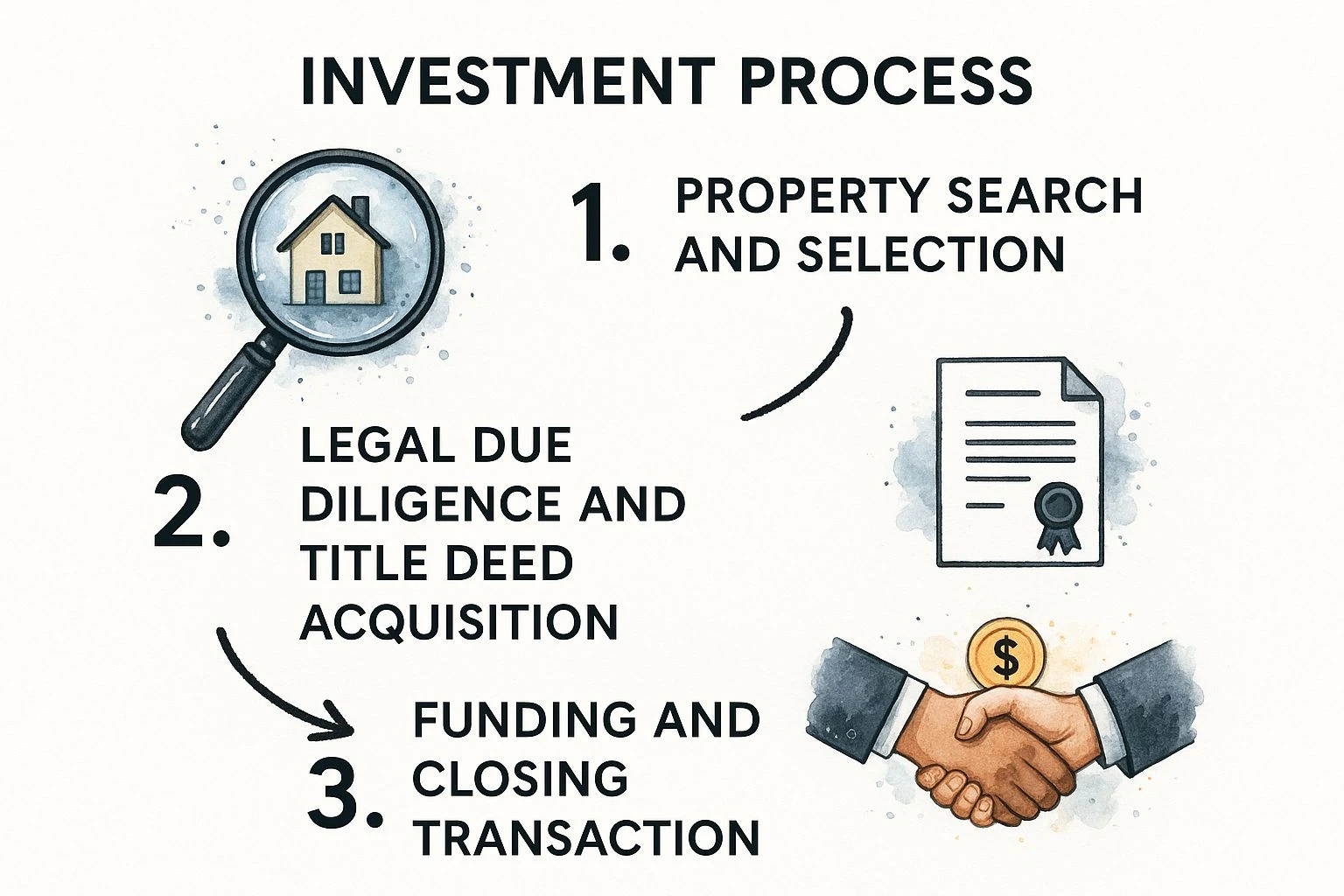
Company formation, property due diligence and title transfer are connected but legally distinct workstreams.
5. Property Due Diligence Belongs at Asset Level
A company structure does not make a weak property safer. Before acquisition, verify the actual asset.
- Registered owner and title data: confirm seller authority and the exact parcel/independent unit.
- Mortgages, liens and annotations: identify restrictions or security interests.
- Zoning and permitted use: confirm the intended rental, commercial, development or industrial use is possible.
- Building / occupancy / project status: inspect the approvals relevant to the asset and business model.
- Tenant / lease position: understand possession, rent, deposits and termination constraints.
- Technical condition: use appropriate engineering/inspection support for material assets or development projects.
- Management/site obligations: understand common expenses and restrictions.
- Tax/debt/fee evidence: verify transaction-specific exposures with appropriate professionals.
Use the foreign-buyer property acquisition guide for the buyer category, title and transaction-level checks. Keep those findings in the acquisition file alongside the company’s approval and funding records.
6. Tax Treatment: Model the Activity, Not a Headline Rate
Do not form a company because an article claims that corporate ownership always lowers tax. The answer depends on what the company does and how returns are realised.
A property model can involve different consequences for:
- corporate income;
- VAT depending on transaction/property/activity;
- rental income and invoicing;
- property-related local taxes/charges;
- financing and interest;
- renovation/development costs;
- asset sale;
- share sale;
- dividend/distribution or other repatriation;
- related-party transactions.
Compare personal ownership and corporate ownership on the same investment assumptions with a licensed SMMM/CPA and transaction counsel. Do not use stale fixed tax-rate tables to choose the structure.
7. Banking and Source of Funds Are Operational Gates
A newly registered property company does not automatically receive a bank account, financing or mortgage. Banks apply their own KYC, risk and credit processes.
Prepare a bank-ready file covering:
- shareholders and UBOs;
- source of capital / source of funds;
- business model and target property type;
- expected transaction values/currencies;
- seller/developer contracts where available;
- planned rental/sale cash flows;
- signatories and management structure;
- countries/counterparties involved;
- evidence of operating substance where relevant.
For bank-account workflow, see How to Open a Business Bank Account in Turkey.
8. Own-Asset Investment vs Brokerage: Keep the Regulatory Boundary Clear
A company buying, holding or leasing its own property is not automatically a real-estate brokerage agency. But if the company begins intermediating sales/leases between third parties, marketing third-party listings or earning brokerage commissions, the Taşınmaz Ticareti Yetki Belgesi / TTBS rules can become relevant.
Changing the invoice description to “consultancy” does not remove a licensing obligation if the substance is regulated real-estate brokerage. Use the Real Estate Agency in Turkey: 2026 TTBS Guide for that activity.
9. Short-Term Rental, Tourism and Development Need Separate Permissions
Property ownership is not an operating licence. Additional permissions can be triggered when the company changes how the property is used.
| Activity |
Separate issue to check |
| Long-term residential/commercial lease |
Lease law, tax/invoicing and property-specific restrictions. |
| Tourism-purpose short-term rental |
Current tourism-purpose residence-rental permit rules. |
| Hotel / accommodation operation |
Tourism facility certification and workplace/fire/operating layers. |
| Office/shop/other business use |
Premises suitability and workplace/sector licence. |
| Construction/development |
Zoning, construction, technical, contractor and municipal approvals. |
Use Business License in Turkey: 2026 Decision Guide for the licence layer.
10. Citizenship by Investment Is Not the Company Business Model
The existence of Turkey’s exceptional citizenship-by-investment route should not be used as a blanket sales argument for a property company. Citizenship qualification depends on the investor, qualifying investment, official evidence, required restriction/holding conditions and sovereign approval process.
A company can invest in property without being a citizenship intermediary. If the owners plan to advise or sell property to citizenship applicants, use appropriately licensed legal/property professionals and current official rules. Never guarantee a passport from a property sale.
11. Governance for Multi-Investor Property Companies
When several investors own the company, agree the rules before the first acquisition:
- who can approve a purchase/sale;
- maximum acquisition price / leverage;
- capital-call mechanics;
- related-party transactions;
- property-manager appointment and fees;
- renovation/development budgets;
- bank-signing authority;
- profit distribution vs reinvestment;
- deadlock and reserved matters;
- investor exits / share transfers;
- asset sale vs share sale decision process;
- reporting and valuation frequency.
This is especially important where one shareholder sources properties and another provides most of the capital.

Formal governance, banking and asset controls matter more as the portfolio and investor base grow.
12. Pre-Launch Decision Checklist
- Define whether the activity is passive ownership, rental, development, trading, management or brokerage.
- Decide whether personal ownership or a Turkish company better fits the actual model.
- If using a company, choose Ltd. vs A.Ş. from governance/funding/exit needs.
- Draft the articles around the real property activities.
- Map foreign shareholders/control and whether Article 36 applies.
- Set up the SMMM/CPA and banking/KYC workstream.
- Build a repeatable property-title/zoning/technical due-diligence process.
- Identify licences triggered by rental, tourism, development or brokerage activity.
- Model tax/VAT/cash flow and financing before buying the asset.
- Define investor approvals, reporting, distributions and exit rules.

Use a Turkish company when it supports the property operating model—not because a company is assumed to make every acquisition simpler.
How Workon Can Support the Company-Setup Side
Workon can coordinate Turkish company formation, registered-address/workspace setup, bank-account application support, corporate-document readiness and the handoff to appropriately licensed property, legal and tax professionals. Property title/legal opinions, regulated brokerage, valuation, tax advice, investment advice and citizenship legal services remain with the relevant licensed professionals and authorities.
Key Takeaways
- There is no ordinary special legal form called a real estate investment company; most projects use a standard Turkish company form.
- An ordinary A.Ş. is not automatically an SPK-regulated fund/REIT.
- Use the company only when it adds genuine governance, operating, financing or portfolio value.
- Foreign-capital Turkish companies can fall under Article 36 when the 50%+ shareholding or board-control test applies.
- The company can acquire property only through the applicable property and Land Registry route; incorporation itself transfers nothing.
- Property due diligence remains asset-specific regardless of company structure.
- Do not assume company ownership always reduces tax or bypasses foreign-buyer restrictions.
- Brokerage/TTBS, tourism rental and development permissions are separate from own-asset investment.
- Citizenship by investment is a separate individual/sovereign process and should never be guaranteed.
No. Most ordinary property-investment businesses use a standard Turkish company form such as an LLC or JSC and define the actual property activities in their articles. Regulated fund or REIT-style structures are a separate capital-markets regime.
Generally yes, subject to sector and property rules. A Turkish company with foreign ownership or control can fall under the specific Article 36 property-acquisition route, so the ownership structure and target property should be checked before acquisition.
The current general statutory minimum is TRY 50,000 for an LLC and TRY 250,000 for a JSC. The commercially appropriate capital can be much higher depending on the property, financing and operating model.
No. Company formation and property acquisition are separate closings. The buyer must complete the applicable foreign-capital property rules, asset due diligence, permissions where triggered and Land Registry process for the specific property.
Not merely because it buys, holds or leases its own assets. If it intermediates third-party sales or leases, markets third-party listings or earns brokerage commissions, the TTBS real-estate trade authorisation rules can become relevant.
No. Citizenship by investment is a separate individual and sovereign process, and tax outcomes depend on the activity, ownership, transactions and distributions. Neither citizenship nor tax savings should be assumed from the company structure alone.
Important: Last reviewed 17 September 2026. This guide provides general information on setting up and operating a property-investment company in Türkiye and is not legal, tax, investment, title, valuation, brokerage, immigration or citizenship advice. Company structure, Article 36 treatment, property eligibility, licences, tax/VAT, financing and transaction risks depend on the ownership structure, activity and asset. Obtain current advice from the competent authorities and appropriately licensed legal, tax, property and other professionals before incorporating, raising capital or acquiring property. Workon coordinates business setup and operational readiness but does not guarantee title, returns, licences, bank financing or citizenship outcomes.