Turkish citizenship by investment is an exceptional citizenship route for foreign investors who meet one of the investment conditions in the Turkish Citizenship Regulation. It is not automatic citizenship in exchange for money. The investor first completes a qualifying investment, obtains the relevant Uygunluk Belgesi (Certificate of Conformity), obtains the short-term residence permit under Article 31(1)(j) of Law No. 6458, and then submits the citizenship application for official evaluation.
In 2026, the most widely used threshold is USD 400,000 for qualifying real estate. The main alternative routes generally use a USD 500,000 threshold, while the employment route requires creation of at least 50 jobs.
Quick Answer: What Are the 2026 Investment Routes?
| Investment route |
Current minimum |
Main holding / verification condition |
| Real estate |
USD 400,000 or the equivalent amount recognised under the current rule |
NVI’s current FAQ states USD 400,000 or equivalent foreign currency/Turkish lira; the property transaction must also satisfy the separate TKGM foreign-currency/payment-evidence and title-eligibility rules, with the required 3-year restriction. |
| Fixed capital investment |
USD 500,000 or equivalent foreign currency / Turkish lira |
Investment is attested by the Ministry of Industry and Technology. |
| Bank deposit |
USD 500,000 or equivalent foreign currency / Turkish lira |
Kept in a bank operating in Türkiye for at least 3 years; attested by BDDK. |
| Government bonds |
USD 500,000 or equivalent foreign currency / Turkish lira |
Held for at least 3 years; attested by the Ministry of Treasury and Finance. |
| Real-estate investment fund / venture-capital investment fund shares |
USD 500,000 or equivalent foreign currency |
Held for at least 3 years; attested by SPK. |
| Private pension contribution |
USD 500,000 or equivalent foreign currency |
Placed in qualifying funds and kept in the private-pension system for at least 3 years; attested by SEDDK. |
| Employment creation |
At least 50 jobs |
Employment is attested by the Ministry of Labour and Social Security. |
Current official thresholds and authorities are published by the General Directorate of Population and Citizenship Affairs (NVI) and Invest in Türkiye.
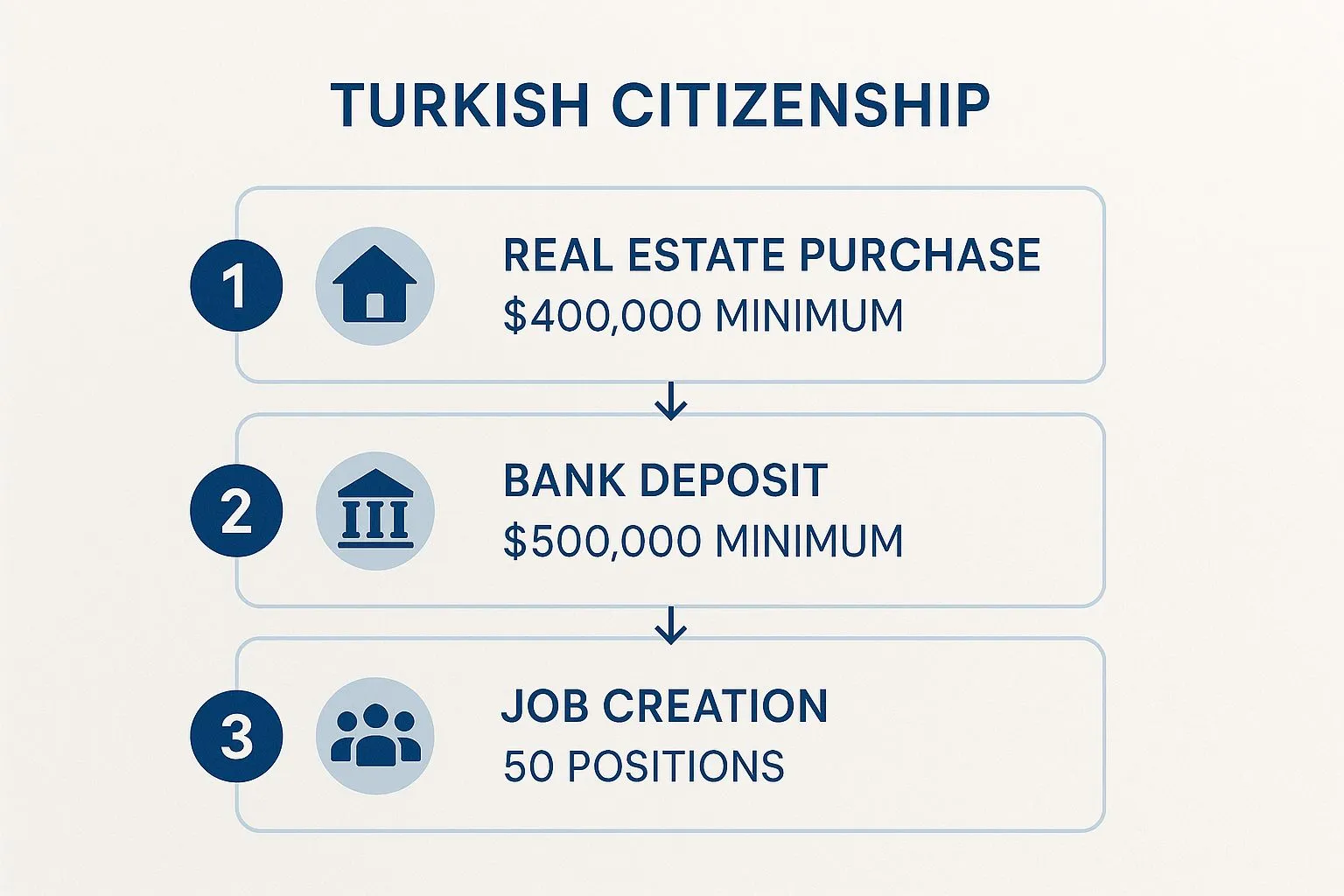
Real estate is only one route; alternative investment and employment routes have separate verification authorities.
1. Real Estate Route: USD 400,000, Property Eligibility and a 3-Year Restriction
The real-estate route requires acquisition of qualifying real estate meeting the current USD 400,000 threshold and the required annotation/restriction that it will not be sold for at least three years. NVI’s current FAQ expresses the threshold as USD 400,000 or the equivalent in foreign currency/Turkish lira, while the actual foreign-buyer transaction must also follow TKGM’s current foreign-currency/payment-evidence procedures.
Property type matters. Following the amendment reflected in the Citizenship Regulation, the acquisition route is not an unrestricted “buy any land” rule: the qualifying immovable should fall within the current category such as condominium ownership, construction servitude, or land registered with a building on it. The notarised promise-of-sale route has its own narrower title-status conditions and should be checked separately before payment.
Do not treat the threshold as the only property rule. Before paying a deposit, verify:
- whether the buyer’s nationality can acquire the specific real estate under Turkish land-law restrictions;
- whether the property type and title status qualify for the citizenship route under the current post-2023 rule;
- seller/property eligibility and any restrictions affecting the transaction;
- official valuation / amount-determination and payment/foreign-currency evidence requirements;
- the exact title-deed annotation or promise-of-sale structure required for the chosen route;
- whether the investment can be combined across multiple qualifying properties under the current procedure;
- mortgages, encumbrances, zoning, occupancy and other due-diligence issues;
- financing method: TKGM issued a 22 January 2026 instruction stating that foreign nationals may not acquire real estate using loans provided by Turkish savings-finance companies (tasarruf finansman şirketleri), so do not assume every local financing product can be used for the acquisition.
Meeting the USD 400,000 value alone does not guarantee a valid citizenship file. Property due diligence should be completed before an irreversible purchase.
For general foreign real-estate investment risks, see Investing in Real Estate in Turkey.
2. Fixed Capital Investment: USD 500,000
The fixed-capital route requires at least USD 500,000 or equivalent foreign currency, with the qualifying investment attested by the Ministry of Industry and Technology.
This is not the same as simply incorporating a Turkish company with statutory minimum share capital. The citizenship route requires the investment to satisfy the separate exceptional-citizenship investment criteria and obtain the relevant conformity determination.
Before using this route, confirm:
- what expenditure/equity qualifies as fixed capital;
- how the investment is evidenced;
- which company/investment structure will hold the assets;
- timing of the investment relative to the conformity application;
- how subsequent changes, disposals or restructuring affect compliance.
For ordinary company formation, use Company Formation in Turkey: 2026 Guide; do not confuse general incorporation capital with citizenship investment capital.
3. Bank Deposit: USD 500,000 for at Least 3 Years
The bank-deposit route requires at least USD 500,000 or equivalent foreign currency to be deposited in a bank operating in Türkiye with a commitment not to withdraw it for at least three years. BDDK is the authority that attests the qualifying deposit.
The practical bank file can involve KYC, source-of-funds, account-opening, transfer evidence and the specific restriction/commitment documentation required for the citizenship route. Bank approval to open an account is separate from citizenship eligibility.
For an individual investor’s ordinary account-opening preparation, see the bank-account guide for foreign individuals. Confirm the separate citizenship-deposit commitment and conformity procedure with the bank; ordinary account opening does not complete that investment route.
4. Government Bonds, Funds and Private Pension: USD 500,000
Other current investment routes use the USD 500,000 threshold but are verified by different authorities:
- government bonds: Ministry of Treasury and Finance;
- real-estate investment fund / venture-capital investment fund shares: Capital Markets Board (SPK);
- qualifying private-pension contribution: Insurance and Private Pension Regulation and Supervision Agency (SEDDK).
Each route has its own product, custody, holding and evidence mechanics. Do not choose a financial product merely because it has a USD 500,000 value; confirm that it falls within the specific citizenship route before investing.
5. Employment Route: At Least 50 Jobs
The employment route requires creation of at least 50 jobs, as attested by the Ministry of Labour and Social Security.
This should not be reduced to “incorporate a company and hire 50 people.” The operating business needs to maintain real, compliant employment records and satisfy the Ministry’s current evidence/verification process.
For employer setup, see SGK Employer Registration in Turkey and Payroll in Turkey: 2026 Setup.
6. The Official Process: Investment → Conformity → Residence → Citizenship
NVI’s current guidance sets out the investment-citizenship process in three core stages:
- Complete one qualifying investment condition and obtain the Uygunluk Belgesi.
- Obtain the short-term residence permit under Article 31(1)(j) of Law No. 6458.
- Apply to the Provincial Directorate of Population and Citizenship Affairs for citizenship by investment.
The Uygunluk Belgesi confirms that the competent authority has determined that the relevant minimum investment condition is satisfied. It is not itself a citizenship decision.
Citizenship remains subject to the competent authority’s evaluation and decision. An investor should therefore avoid contracts or marketing statements that treat approval as guaranteed once the money has been invested.
The qualifying investment is followed by conformity, residence-permit and citizenship-application stages.
7. Which Authority Issues the Certificate of Conformity?
| Investment |
Conformity authority |
| Fixed capital |
Ministry of Industry and Technology |
| Real estate |
Relevant Ministry / Land Registry and Cadastre route |
| Employment |
Ministry of Labour and Social Security |
| Bank deposit |
Banking Regulation and Supervision Agency (BDDK) |
| Government bonds |
Ministry of Treasury and Finance |
| REIF / VCIF fund shares |
Capital Markets Board (SPK) |
| Private pension |
SEDDK |
This authority split is why there is no single “citizenship investment approval office” for the investment stage.
8. Residence Requirement: No Long Naturalisation Period, But There Is a Residence-Permit Step
The investment route is an exceptional citizenship route and does not use the ordinary long-term residence period required for general naturalisation. However, the current NVI procedure still includes the Article 31(1)(j) short-term residence-permit step before the citizenship application.
Do not advertise the route as “no residence process at all.” Equally, do not imply that the investor must first live in Türkiye for five years before applying under the qualifying investment route.
9. Personal Application / Representation: Check the Current NVI Rule
NVI’s current citizenship FAQ states that, for exceptional investment citizenship, the foreign applicant should personally carry out the conformity-certificate, short-term residence permit, residence-card and citizenship application stages under the current rule.
This makes blanket marketing such as “a lawyer can complete every citizenship step remotely without the applicant” unsafe. Professional advisers can prepare, coordinate and represent the investor where legally permitted, but the applicant should confirm the current personal-appearance/application requirement for each stage with NVI and the competent authority.
10. Family Applications: Verify the Current Legal Conditions
Investment-citizenship projects often include family members, but do not assume that every relative is automatically covered by a single investment. Family status, age, dependency, custody/consent and document requirements should be checked under the current citizenship rules and the applicant’s specific family structure.
Prepare civil-status documents only after confirming who is actually included in the intended application file.
11. Foreign Documents: Apostille Is Not One Universal Rule
Foreign passports, civil-status records, powers of attorney and other supporting documents can require translation, certification, apostille or consular legalisation depending on:
- the document type;
- country of issue;
- Hague Apostille Convention status;
- bilateral treaty/practice;
- the receiving Turkish authority;
- whether the document is original, electronic or multilingual.
Do not send every document automatically through “apostille → translation → notary” without checking the receiving authority’s actual requirement.
Use Apostille for Turkey Documents: 2026 Guide and Sworn Translation in Turkey: 2026 Guide.
12. There Is No Safe Fixed “3–6 Month” Citizenship Promise
The total timeline varies by:
- investment route;
- property/bank/fund transaction readiness;
- conformity-certificate processing;
- residence-permit stage;
- document authentication/translation;
- family file complexity;
- security/background review;
- requests for additional information;
- current workload of the competent authorities.
Use stage-by-stage milestones instead of a guaranteed 3–6 month completion claim.
13. Separate the Investment Amount From the Total Cost
The statutory investment threshold is not the complete project cost. Depending on the route, additional costs can include:
- property appraisal and land-registry costs;
- bank/transfer and investment-product costs;
- taxes and transaction charges;
- translation, certification and authentication;
- legal/trademark/financial/tax advisers where required;
- residence/citizenship government service charges;
- property or fund due diligence;
- ongoing holding/management costs.
Ask for a route-specific cost schedule rather than accepting an “all-inclusive citizenship for USD X” headline.
14. Citizenship Does Not Automatically Decide Tax Residency
Turkish citizenship and Turkish tax residence are different legal questions. Do not assume that receiving citizenship automatically makes all worldwide income taxable in Türkiye, and do not rely on a simplified “more/less than six months” rule without checking the Income Tax Law, treaty position, domicile/residence facts and any special circumstances.
For tax residency/income-tax analysis, use the dedicated Income Tax in Turkey for Foreigners: 2026 Guide and obtain professional tax advice for cross-border structures.
15. Do Not Buy Citizenship for Passport-Mobility Marketing Claims
Visa-free access, visa-on-arrival rules and third-country investor visas change over time and depend on the destination’s current immigration rules. Turkish citizenship should not be marketed with a fixed “110+ countries” promise or an outdated claim that it automatically creates a specific UK business visa route.
If global mobility is central to the investment decision, verify the exact destination-country rule immediately before relying on it.
16. Dual Citizenship: Check Both Countries
Türkiye can recognise multiple nationality status under its citizenship framework, but whether the investor can retain the original nationality depends on the law of the investor’s existing country/countries of citizenship.
Do not promise “you never have to choose.” Check the original country’s nationality law before completing the process.
17. Real-Estate Due Diligence Before Citizenship Strategy
The most common investment route also creates ordinary property risk. Before buying:
- verify title and seller;
- check mortgages, liens and annotations;
- review zoning, building/occupancy status and intended use;
- use the required official valuation/transaction evidence;
- verify citizenship eligibility before payment;
- avoid inflated “citizenship package” pricing disconnected from market value;
- understand rental yield, tax, management and exit risk separately from citizenship eligibility.
Citizenship eligibility does not make a property a good investment.
18. Workon’s Role and the Regulated-Legal Boundary
Workon can coordinate Turkish company setup, registered-address/workspace, document readiness, bank-account application support and business-side operational preparation for foreign investors. Citizenship applications, immigration/legal opinions, property legal due diligence and regulated representation should be handled with the competent authorities and appropriately licensed legal/immigration professionals.
For Workon’s commercial citizenship support scope, see Citizenship in Turkey.

Citizenship investment and business setup are separate workstreams; align them only where the investor’s commercial plan requires both.
Key Takeaways
- Turkish citizenship by investment is an exceptional citizenship route, not automatic citizenship after payment.
- 2026 thresholds remain USD 400,000 for qualifying real estate and generally USD 500,000 for the main capital/deposit/bond/fund/pension routes; the employment route requires at least 50 jobs.
- The official process is qualifying investment → Certificate of Conformity → Article 31(1)(j) short-term residence permit → citizenship application.
- Most financial/property routes include a three-year holding restriction.
- Each investment route has a different conformity authority.
- Do not rely on a universal 3–6 month completion promise.
- Foreign-document authentication, family inclusion and personal-appearance requirements should be checked for the actual file.
- Citizenship does not automatically decide tax residence, investment return, or third-country visa rights.
- Property citizenship eligibility should never replace independent property due diligence.
The widely used real-estate route uses a USD 400,000 qualifying investment threshold. The main fixed-capital, bank-deposit, government-bond, qualifying fund-share and private-pension routes generally use USD 500,000, while the employment route requires creation of at least 50 jobs. Each route has separate verification and holding conditions.
No. The investor must first complete a qualifying investment, obtain the relevant Certificate of Conformity, complete the Article 31(1)(j) short-term residence-permit step and then submit the citizenship application for official evaluation. Meeting the investment threshold does not guarantee the final decision.
No. The property, title status, buyer eligibility, payment and valuation evidence, required three-year restriction and other current Land Registry conditions must all fit the citizenship route. Property due diligence should be completed before an irreversible payment.
No. Citizenship by investment is an exceptional route rather than ordinary naturalisation, so it does not use the general long-residence path. However, the current process still includes the specific short-term residence-permit stage before the citizenship application.
No. Timing depends on the investment transaction, conformity review, residence stage, foreign-document preparation, family file, security checks, additional-information requests and authority workload. Use stage-based milestones rather than a guaranteed end date.
No. Citizenship, tax residence and third-country immigration rights are separate legal questions. Tax residence depends on the relevant Turkish and treaty facts, while visa-free access and destination-country rules can change and should be checked separately.
Important: Last reviewed 23 October 2026. The current NVI citizenship FAQ was rechecked for the USD 400,000 real-estate threshold, USD 500,000 alternative investment routes, 50-job route, conformity-residence-citizenship sequence and current applicant-stage controls. This guide provides general information on Turkish citizenship by investment and is not immigration, citizenship, legal, tax, investment or property advice. Thresholds, eligible assets, family rules, document requirements, personal-application requirements and approval procedures can change and citizenship remains subject to official evaluation. Confirm the current route with NVI, the relevant conformity authority and appropriately licensed legal/tax/investment professionals before committing capital. Workon coordinates business and operational readiness but does not issue citizenship decisions, guarantee approval or replace regulated legal/immigration services.