Business license in Turkey is not one universal document that every company receives after incorporation. The correct licence/permit stack depends on what the company actually does, whether it operates from a physical workplace, where that workplace is located, whether the activity is regulated, and whether a product, profession or sector has its own authority.
For foreign founders, the most useful distinction is: company registration creates the legal entity; operational licences determine which activities that entity may actually perform. A consultancy office, factory, restaurant, travel agency, clinic, real-estate agency, cosmetics importer and telecom operator can all require very different approval layers.
Quick Answer: Which Business Licence Does Your Company Need?
| Business model |
First licence/permit layer to check |
Typical authority |
| Ordinary office / retail / physical workplace |
Workplace opening and operating licence analysis |
Municipality or other competent licensing authority |
| Factory / workshop / industrial activity |
Workplace class + zoning/environment/technical permits |
Municipality/competent authority + environmental/industrial authorities as applicable |
| Restaurant / café / food business |
Workplace licence + food-business registration/approval and activity-specific rules |
Municipality + Ministry of Agriculture and Forestry/other competent authorities |
| Travel agency / accommodation |
Tourism-sector authorisation |
Ministry of Culture and Tourism / TÜRSAB depending on activity |
| Healthcare facility |
Health-service planning, ownership and facility licence |
Ministry of Health / Provincial Health Directorate |
| Real-estate agency |
Taşınmaz Ticareti Yetki Belgesi |
Ministry of Trade / TTBS / Provincial Directorate |
| Medical-device or cosmetics business |
Product/operator registration + import/product-safety layers |
TİTCK, Ministry of Trade/customs and other relevant authorities |
| Telecom / MVNO / ISP |
Electronic-communications authorisation classification |
BTK |
The correct first question is therefore not “Where do I apply for my business licence?” but “Which approval layers attach to my activity, premises, product and professional model?”

A workplace-opening licence is one possible layer in the wider business-permit map.
1. Company Registration Is Not an Operating Licence
A Turkish LLC or JSC can be registered through MERSIS and the Trade Registry before every operational approval is complete. Registration confirms the company’s legal existence, shareholders, managers, capital, address and corporate purpose. It does not automatically prove that:
- the selected premises is suitable for the activity;
- a municipality has licensed the workplace;
- a Ministry has authorised a regulated sector;
- a professional is licensed to practise a regulated profession;
- an imported product can be placed on the Turkish market;
- a telecom or financial-regulatory authorisation exists.
For the corporate filing route, see Company Formation in Turkey: 2026 Guide.
2. When Does the Workplace Opening Licence Matter?
Turkey’s İşyeri Açma ve Çalışma Ruhsatlarına İlişkin Yönetmelik is the core framework for many physical workplaces. It distinguishes different workplace classes, including sıhhî workplaces, gayrisıhhî establishments and public rest and entertainment places.
But this article should not turn that framework into “every company needs the same municipality licence.” The analysis follows the actual premises and activity, and the competent authority can vary by location and sector.
For the detailed workplace-opening process, Article 12/13 rules and the 2025/2026 Ministry route under Article 45/A, use Workplace Opening License in Turkey: 2026 Requirements & Process. That page is the detailed owner for the municipal/workplace layer.
3. Do Not Use One Universal Document Checklist
There is no reliable universal pack such as “lease + tax plate + chamber certificate + fire report + occupancy permit” that applies identically to every Turkish business licence application.
A case-specific file can involve:
- company/tax/chamber records;
- right-to-use evidence for the premises;
- building/use/zoning documentation;
- fire or technical evidence where the workplace category requires it;
- professional certificates;
- sector authorisations;
- environmental or industrial approvals;
- product registration/conformity documents;
- special security, hygiene, capacity or accessibility requirements.
The safest method is activity classification first, document collection second. Do not collect an expensive generic file before confirming which authority and regulation applies.
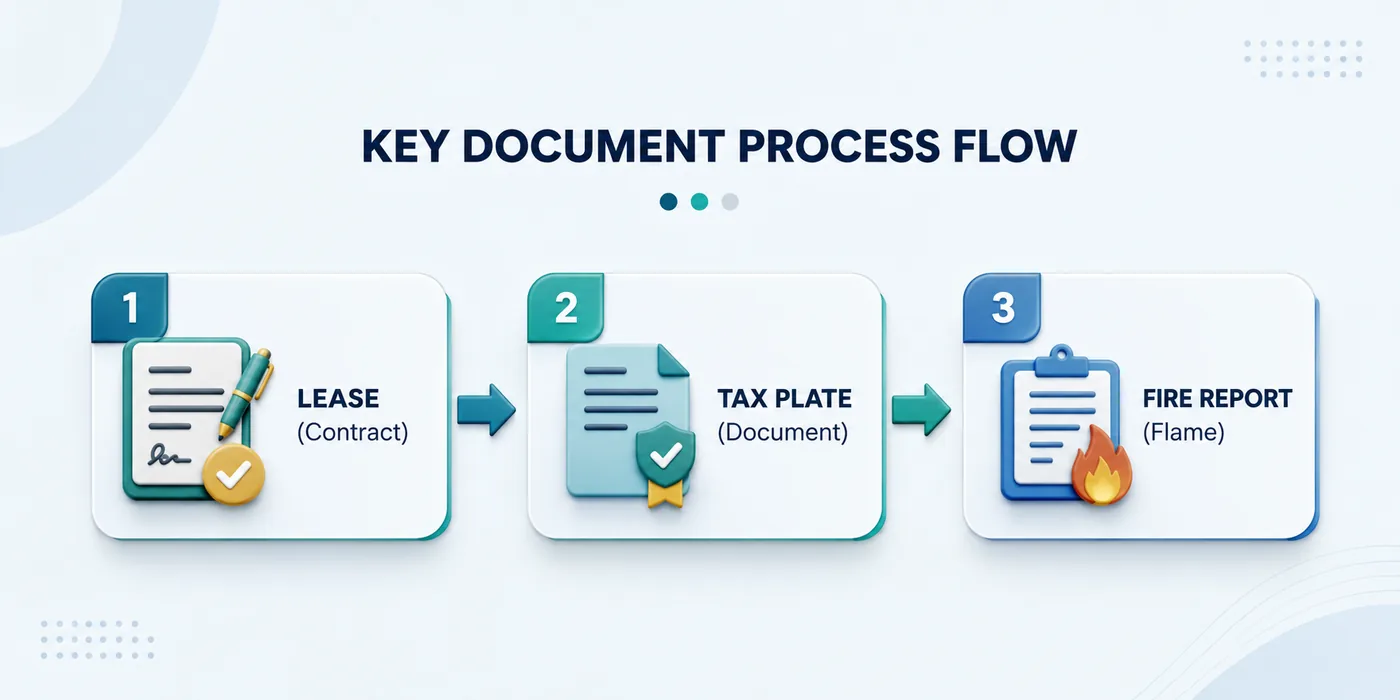
Premises documents are important, but the exact file depends on the workplace and sector.
4. Fire Report and Occupancy Permit: Avoid Blanket Rules
Fire-safety and building/occupancy documentation can be critical, particularly for public-facing, high-occupancy, industrial, accommodation, health and other higher-risk premises. But do not state that every physical business universally needs the same separate fire-department report or that one document called an iskan is always the single make-or-break test.
The competent authority should determine which fire/building evidence is required for the specific activity and premises. Before signing a long lease or fitting out the property, verify:
- approved use of the premises;
- zoning/activity compatibility;
- building/occupancy status;
- fire-safety obligations;
- condominium/property-law restrictions where applicable;
- activity-specific technical conditions.
For lease-side due diligence, see Commercial Lease Agreement Turkey: 2026 Guide.
5. Virtual Office: Registered Address and Operating Premises Are Different Questions
A virtual office can be suitable as a registered business address for many activities, but it should not be presented as a universal “business licence exemption.”
Ask two separate questions:
- Can this address be used as the company’s registered/legal address?
- Where is the actual regulated or physical activity carried out, and what licence applies there?
A remote consultancy that does not operate a licensable physical customer facility has a different profile from a restaurant, clinic, warehouse, factory or travel-agency workplace. If the business later opens an operating location, the licence analysis follows that real site.
See Virtual Office in Turkey for Foreigners for the registered-address decision.
6. Tourism Businesses Have Their Own Sector Layer
Tourism is a good example of why “business licence” cannot mean only a municipal licence.
- A travel agency requires the relevant Ministry operating certificate + TÜRSAB membership.
- Accommodation facilities follow a separate Ministry tourism-facility certification route.
- Tourism-purpose residence rental has its own permit framework.
- Tourist transport can add transport authorisations.
See Tourism Business License in Turkey: 2026 Travel Agency & Hotel Guide.
7. Healthcare Businesses: Incorporation Is Only the First Gate
Hospitals, tıp merkezleri, polyclinics, physician offices and other health facilities are subject to Ministry of Health rules on ownership, planning, premises, personnel, licence and activity permission. In 2026, new private-health capacity can also depend on Ministry planning/licence allocation.
A non-clinical health software or consulting company may have a much lighter licensing profile, but once the entity actually provides regulated health services, remote healthcare or health-tourism intermediation, specialist authorisations can apply.
See Healthcare Company Registration in Turkey: 2026 Licensing Guide.
8. Real-Estate Agencies Need TTBS Authorisation
A company registered with a real-estate activity does not automatically become an authorised real-estate agency. The business must satisfy the current Taşınmaz Ticareti Yetki Belgesi requirements through TTBS, including responsible-adviser qualification/training/experience conditions where applicable.
See Starting a Real Estate Agency in Turkey: 2026 TTBS License Guide.
9. Product Businesses Can Need Market-Access Approvals
A normal import-export company registration does not prove that every regulated product can be imported or sold.
Examples:
- Medical devices: classification/conformity, operator roles, ÜTS and where applicable TAREKS/customs/sales-centre rules.
- Cosmetics: responsible person, safety assessment/PIF, GMP, product notification, label/claims and customs/product-safety layers.
- Food, chemicals and other regulated products: product- and authority-specific registrations/approvals can apply.
Use Medical Device Import: 2026 ÜTS & TAREKS Guide and Importing Cosmetics to Turkey: 2026 TİTCK Guide.
10. Telecom Businesses Need BTK Classification Before Incorporation
Electronic communications is another sector where the licence logic should be determined before the articles of association are finalised. BTK requires qualifying applicants to use an appropriately structured Ltd. or A.Ş. and align the corporate purpose with the requested electronic communications activity.
An “eSIM company” can be a software vendor, reseller, MVNO/SMŞH operator or another communications business; the underlying service determines the authorisation.
See eSIM Company Setup in Turkey: 2026 BTK & MVNO Guide.
11. Industrial and Free-Zone Businesses Add Location-Specific Layers
Manufacturing and industrial businesses can trigger workplace classification, zoning, environmental, emissions/waste, fire, technical, organised-industrial-zone or other approvals. If the activity will operate in a free zone, a Ministry of Trade Activity Licence is a separate core requirement.
See Turkey Free Zone Company Setup: 2026 Activity Licence & Tax Guide.
12. Professional Licence vs Company Licence
In regulated professions, the company and the professional can have different legal permissions. A company may be registered while the individual professional still needs a Turkish professional qualification, recognition, chamber membership, work authorisation or professional licence.
This is especially important in healthcare, legal/professional services, engineering, regulated financial activities and other licensed occupations. Do not treat a Trade Registry activity code as permission for an unlicensed person to practise a regulated profession.
13. A 10-Question Licence Map Before You Spend Money
- What exactly will the company sell or do?
- Will customers enter a physical workplace?
- Will goods be manufactured, stored, prepared or imported?
- Does the activity affect health, environment, public safety or public order?
- Is the profession itself regulated?
- Is the product regulated before import/market placement?
- Is there a Ministry/BTK/TİTCK/TTBS/TÜRSAB or other sector authorisation?
- Does the selected property legally support the activity?
- Does the company/shareholder structure satisfy sector ownership rules?
- Which approvals must exist before signing a lease, buying equipment, hiring staff or taking customers?
Answer these questions before creating a generic licence-document pack.

Workon can coordinate company setup and map the operational-readiness handoffs before regulated activity begins.
How Workon Can Support the Licence-Readiness Process
Workon can coordinate company registration, registered-address/workspace planning, corporate document readiness and the operational handoff to the appropriate authorities and licensed professionals. Public licences remain under the competent municipality, Ministry, BTK, TİTCK, TTBS or other authority, while regulated legal, tax, medical, customs and technical work remains with the appropriately licensed professionals.
Last reviewed: 17 September 2026.
Key Takeaways
- Turkey does not have one universal business licence for every company.
- Company registration and operational authorisation are separate layers.
- The workplace-opening licence applies based on the actual activity/premises and should not be generalised to every registered company.
- Fire, occupancy and other premises documents are case-specific, not one universal checklist.
- A virtual office is a registered-address solution, not a universal exemption from sector/workplace licensing.
- Tourism, healthcare, real estate, telecom and regulated-product businesses have separate sector authorisations.
- Professional permission and company permission can be different.
- The best sequence is activity → owner authority → premises/product/professional requirements → company structure → licence plan → incorporation/lease/investment.
Frequently Asked Questions
No. Identify the activity, operating premises, product and any regulated profession or sector. A workplace-opening licence is one possible layer; some businesses also need specialist authorisations. Company incorporation alone does not authorise every planned activity.
Because 'business licence' can describe different municipal, workplace, product, professional or sector authorisations. Identify the competent authority and licence category first; only then build the company, premises, technical and qualification documents required for that specific approval.
Registration establishes the company. Before starting an activity, confirm which operating, premises, product or professional permissions must already be in place. Do not treat a registered company purpose or activity code as the required sector authorisation.
No universal exemption follows from the address model. Check whether the address is suitable for registration and separately assess the activity and its actual operating location. A registered address cannot replace premises or sector permissions where those are required.
The route and timing depend on the licence category, premises readiness, completeness of the file and any specialist approvals. Check the applicable statutory procedure with the competent authority; neither a general few-weeks estimate nor a same-day rule applies to every business.
Important: This guide provides general information on business licences and permits in Turkey and is not legal, municipal, sector-regulatory, tax, customs, health, telecom or professional-licensing advice. The correct licence stack depends on the activity, premises, product, profession, location and current rules. Confirm requirements with the competent authority and appropriately licensed professionals before signing a lease, investing in fit-out/equipment or beginning regulated operations. Workon coordinates business setup and operational readiness but does not issue public licences or replace competent authorities.