


















An exporter VAT refund in Turkey is available when a Turkish VAT taxpayer carries out a qualifying full-exemption export and cannot absorb the related input VAT through ordinary deduction. The refund is not automatic: the export, the input-VAT trail, the amount requested and the chosen cash or offset route must all be supported. Goods exports and service exports also follow different evidence and report thresholds.
This guide covers business VAT refunds for exporters. It does not cover tourist tax-free shopping, a foreign visitor’s retail refund or a general refund of Turkish business expenses. For the broader rate, exemption and input-output rules, see VAT in Turkey: 2026 Rates, Exemptions & Compliance.

Who can claim an export VAT refund?
The claimant is generally the Turkish VAT taxpayer that performs and declares the qualifying export. Four tests must be passed:
- Taxpayer test: the claimant is in the Turkish VAT system and files the relevant VAT return.
- Transaction test: the supply qualifies as a full-exemption export under VAT Law No. 3065.
- Input-VAT test: the claimed VAT is attributable to that export, deductible in principle and supported by valid records.
- Unabsorbed-VAT test: the amount has not already been recovered through deduction and fits within the refund calculation and period-end carried-forward VAT.
A Turkish company does not become eligible merely because its customer is foreign or an invoice is denominated in foreign currency. The legal export conditions must be satisfied. Equally, a non-resident business does not generally obtain an exporter refund simply because it paid Turkish VAT on travel or local costs. First determine the correct Turkish VAT route through VAT Registration in Turkey: Which Route Applies?.
Goods exports and service exports: the decisive differences
| Issue | Export of goods | Export of services |
|---|---|---|
| Core condition | Supply to a qualifying customer abroad or other legally covered buyer, and the goods leave the Turkish customs territory under the applicable export evidence. | The service is supplied to a customer abroad and is enjoyed abroad; an invoice to a foreign customer alone is not enough. |
| Declaration period | The period containing the customs declaration’s closing date, subject to the special evidence rules for certain export routes. | The period in which the service is performed or completed. |
| Primary proof | Export sales invoice plus customs declaration/list or the special evidence required for the route. | Invoice/list issued to the foreign customer plus facts proving that the benefit is abroad. |
| Payment evidence | Not a universal condition in the ordinary goods-export document list. | Not required merely to declare the exemption. Under the current Communiqué, 50% of otherwise refundable VAT can be paid without evidence that the service fee was brought into Türkiye; the remaining 50% is released in proportion to how much of half of the service fee is evidenced as brought into Türkiye. |
| Refund route | Cash and offset routes have goods-export-specific thresholds. | Cash and offset routes have service-export-specific report rules. |
Goods: shipment must become a qualifying export
For an ordinary customs-declaration export, the invoice must be issued to the covered customer and the goods must leave the Turkish customs territory. The export exemption is declared for the period containing the customs declaration’s closing date—even if the invoice was issued earlier. A mismatch between the invoice and customs data can hold the file for verification.
Services: where the customer benefits matters
A service supplied from Turkey can qualify only where it is for a customer abroad and the benefit is abroad. For example, work relating to the foreign customer’s operations outside Turkey may qualify. Market research, customer-finding or similar work that supports the foreign customer’s Turkish activity may remain Turkish-VAT taxable even when invoiced abroad. The contract, deliverables, users, project location and commercial outcome should tell one consistent story.
Optional manufacturer route: refund based on export value
Qualifying manufacturers that directly export goods they manufacture can choose a separate optional method under the VAT General Application Communiqué instead of calculating the loaded VAT for that export. Under this route, the manufacturer may request a refund of up to 10% of the export value, limited by the carried-forward VAT balance. The route is available only to manufacturers within the Communiqué’s manufacturer definition and for goods covered by their manufacturing capacity; goods bought ready-made from the market and then exported do not qualify for this method.
The choice is transaction-specific. A manufacturer using the export-value method cannot claim an additional loaded-VAT refund for the same export merely because the 10% method produced a lower result, although the manufacturer may use the ordinary loaded-VAT route instead and may choose a different permitted method in another period. For this optional route, offset claims can be processed regardless of amount without a tax inspection report, YMM report or guarantee once the required documents are complete. Cash claims up to TRY 50,000 use the ordinary no-report/no-guarantee threshold; for taxpayers with a timely YMM full-certification agreement, that cash threshold is TRY 100,000. Claims above the applicable threshold follow the report or guarantee rules.
How the refundable VAT amount is built
Exports are treated as a full exemption (tam istisna), not simply as an informal “0% rate.” This distinction matters because input VAT related to a qualifying full exemption may remain deductible and the unabsorbed amount may be refundable.
- Identify direct input VAT. Trace purchase invoices and import VAT directly connected to the exported goods or service.
- Allocate indirect costs. Apply a consistent, supportable method to eligible general production or operating costs connected with the export.
- Apply legal restrictions. Remove non-deductible items and apply the special rules for capital assets, returned goods, discounts, exchange differences and mixed activities where relevant.
- Reconcile to the VAT return. The amount requested must fit the loaded-VAT calculation, the refund calculation table and the VAT carried forward for the period.
- Prevent double recovery. An amount already absorbed, refunded, offset or attributed to another transaction cannot be claimed again.
Illustration: if TRY 240,000 of otherwise eligible VAT is attributed to qualifying exports but the period-end carried-forward VAT is TRY 180,000, the claim cannot simply be filed for TRY 240,000. The carried-forward balance and any other statutory caps or allocations must be applied; the final refundable amount may be lower.
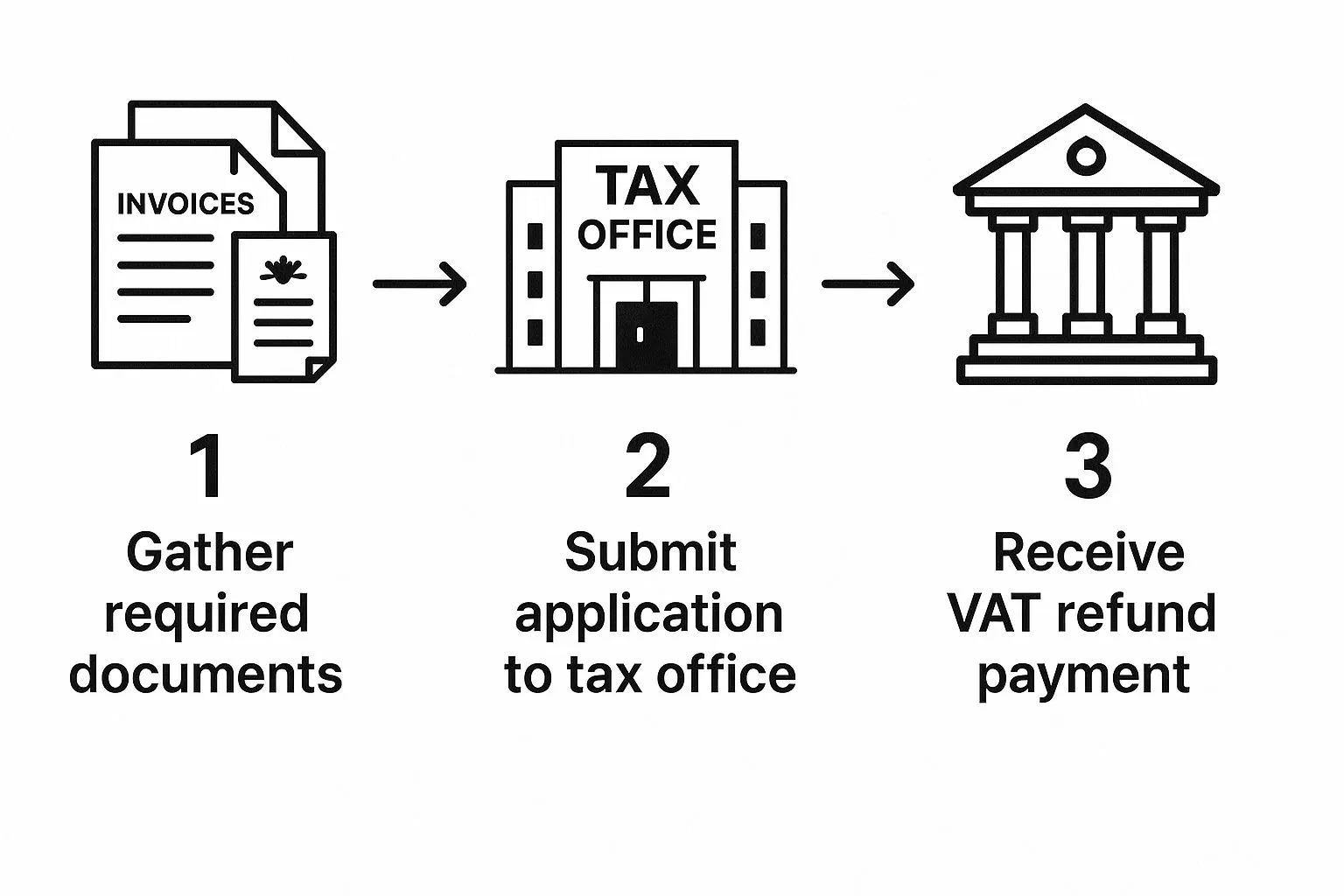
Documents required for the refund file
| Record | Goods export | Service export |
|---|---|---|
| Standard refund request petition | Required | Required |
| Export sales invoice or invoice list | Required | Required |
| Customs declaration or permitted export list/evidence | Required for the relevant goods route | Not the ordinary service-export proof |
| Payment evidence showing the service fee brought into Türkiye | Not in the ordinary goods-export list | Relevant to the amount released: current rules permit 50% of the otherwise refundable VAT without this evidence, while the remaining 50% is released proportionately as the required service-fee amount is evidenced as brought into Türkiye |
| Deductible VAT list for the declaration period | Required | Required |
| Loaded VAT list (yüklenilen KDV listesi) | Required | Required |
| Refund calculation table | Required | Required |
Depending on the transaction, taxpayer profile and refund method, the tax office may also require a sworn financial adviser’s report, tax inspection report, guarantee and explanations resolving electronic risk-analysis findings. The file should therefore be designed as an audit trail, not as a last-minute upload of unrelated spreadsheets.
Cash refund or offset: choose the route deliberately
As of September 2026, the consolidated VAT General Application Communiqué sets the following ordinary loaded-VAT exporter routes. The optional export-value method for qualifying manufacturers described above has its own processing limits and should not be merged into this table. Thresholds and procedures can change, so verify them for the transaction period before submission.
| Export type | Offset refund (mahsuben) | Cash refund (nakden) |
|---|---|---|
| Goods export | Once the listed documents are complete, the ordinary route is processed regardless of amount without a tax inspection report, YMM report or guarantee. | Up to TRY 50,000 may be processed without those reports or guarantee. The excess is generally resolved through a tax inspection report or YMM certification report; a guarantee can support earlier payment and is later released against the required report. |
| Service export | Up to TRY 50,000 may be processed without a tax inspection report, YMM report or guarantee. The excess follows the report or guarantee route. | Regardless of amount, the ordinary route requires a tax inspection report or YMM report; a guarantee route may be used subject to later release against the report. |
YMM means Yeminli Mali Müşavir, a Turkish sworn financial adviser authorised for the relevant certification work. A YMM report is not a universal shortcut and does not cure missing export evidence or an unsupported input-VAT allocation.
The current minimum refund-request amount is TRY 10,000 for transactions from 1 April 2025. This minimum is distinct from the TRY 50,000 processing thresholds above; it is not an amount automatically deducted from an otherwise valid claim.
Claim deadline: the two-year rule
For full-exemption transactions, the refund must be requested by the end of the second calendar year following the period in which the qualifying transaction occurred. By that deadline, the taxpayer must complete the relevant loaded-VAT field in the return and submit the standard refund petition and the documents required for the claim route. A timely YMM-based claim has a separate six-month period after that deadline for presenting the YMM report under the Communiqué.
Do not treat this as a reason to wait. Customs mismatches, missing supplier invoices, service-benefit evidence and allocation defects become harder to repair with time. Prepare the file as part of the monthly VAT close.
Common reasons exporter refund files stall
- Wrong owner of the claim: an intermediary exporter, manufacturer or party using the export-registered delivery route is assumed to own input VAT that legally belongs to another participant.
- Invoice-customs mismatch: dates, quantities, buyer details, currency values or declaration data do not reconcile.
- Service used in Turkey: a foreign invoice is treated as a service export even though the commercial benefit is tied to Turkish operations.
- Unsupported overhead allocation: general costs are pushed into the claim without a consistent allocation key or transaction connection.
- Duplicate or non-deductible VAT: the same tax appears in another claim or is restricted under the VAT Law.
- Payment proof incomplete for services: the exemption may still be declared, but payment evidence affects how much of the refund can be released. Under the current rule, 50% of the otherwise refundable VAT can be paid without this evidence; the remaining portion is released proportionately as the required service-fee amount is evidenced as brought into Türkiye.
- Late claim: the return fields, petition or required evidence are not completed within the statutory claim window.

Exporter VAT refund readiness checklist
- Confirm whether the transaction is goods export, service export or another exemption route.
- Confirm that the claimant is the correct Turkish VAT taxpayer.
- Reconcile the invoice, contract, customs or service-performance evidence and accounting period.
- Trace direct and allocated input VAT to valid deductible documents.
- Reconcile the loaded-VAT list and refund calculation to the VAT return and carried-forward VAT.
- Choose cash or offset and identify the applicable report, guarantee and threshold rules.
- Resolve supplier and invoice exceptions before filing.
- Calendar the statutory claim deadline and retain evidence of submission.
A VAT withholding refund follows a different claim route from an exporter refund. Confirm which transaction creates the refund right before preparing the file. See VAT Withholding in Turkey: Tevkifat Guide for the buyer-seller split and VAT 1/VAT 2 workflow.

Official sources used for this 2026 guide
- Turkish Revenue Administration: 2026 consolidated VAT General Application Communiqué
- VAT Law No. 3065
- Revenue Administration declaration and payment deadlines
Need a defensible exporter refund file? Workon can coordinate the operational preparation of the export evidence, input-VAT calculation file, cash-versus-offset route and submission controls around your actual transaction flow, with the regulated tax analysis, certification and filing work handled by the appropriately licensed SMMM/YMM or other authorised tax professional.
Frequently Asked Questions
Last reviewed: 17 September 2026. The consolidated 2026 VAT General Application Communiqué was rechecked for the goods-export and service-export refund routes and current TRY 50,000 processing thresholds. This article provides general information, not legal or tax advice. Eligibility, evidence, thresholds and review routes depend on the transaction period and taxpayer facts; confirm material claims against the latest official text with a qualified Turkish tax professional.