Quick answer: VAT registration in Turkey is not a single route for every foreign business. A foreign-owned Turkish company normally operates through the ordinary Turkish tax system. A non-resident with a Turkish establishment may also use ordinary VAT reporting. A non-resident supplying a service to a Turkish customer may instead fall under recipient-side reverse charge, while a non-resident supplying paid electronic services to Turkish consumers may need the special VAT 3 registration. Identify the transaction, customer and establishment facts before collecting documents or appointing a representative.
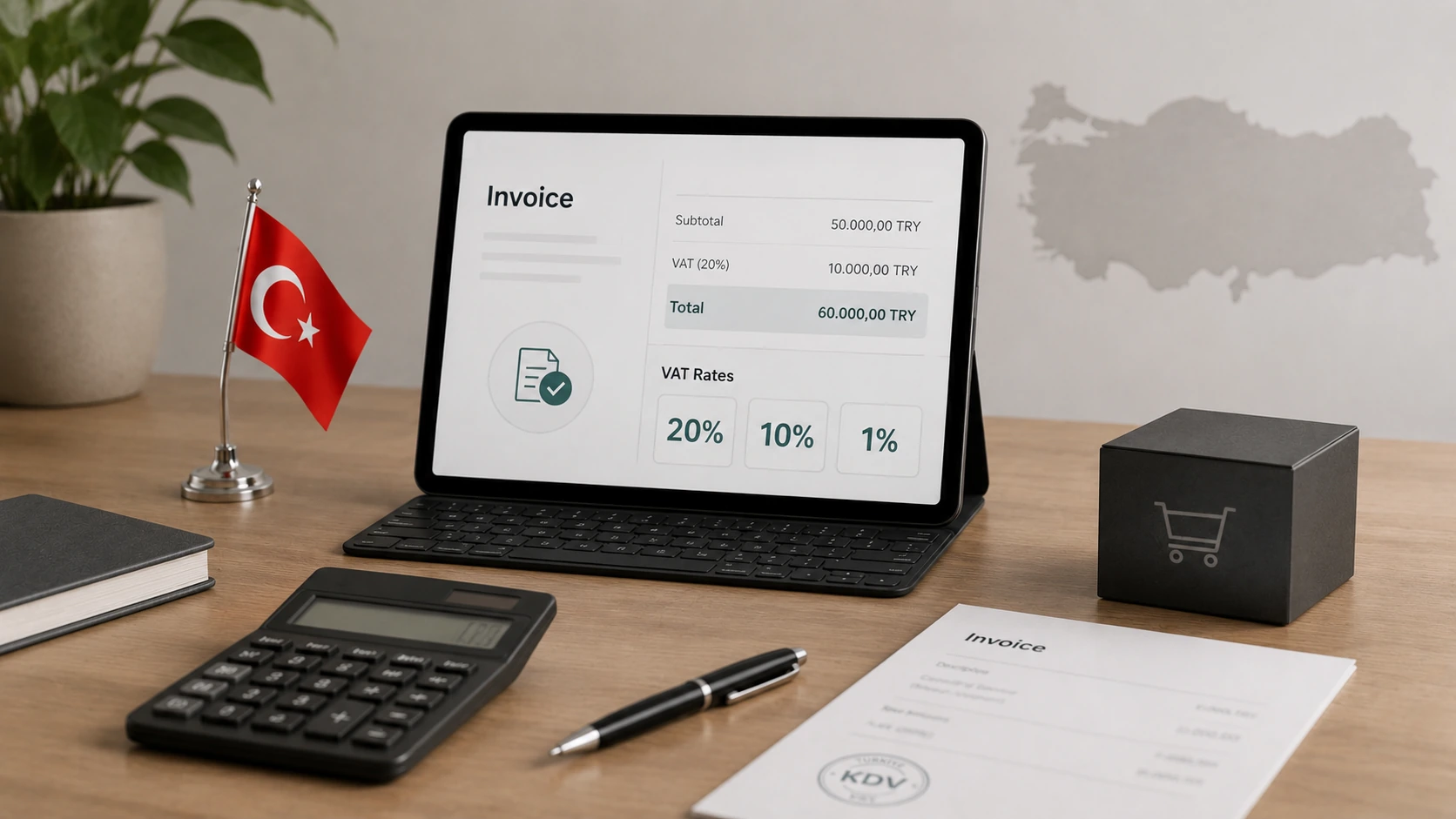
The correct Turkish VAT route depends on who supplies what, where the supplier is established and whether the customer is a business or consumer.
Turkey calls value added tax Katma Değer Vergisi, abbreviated as KDV. The underlying rule is transaction-based: taxable supplies made in Turkey, imports and services performed or used in Turkey can enter the VAT system. Nationality alone does not decide the answer, and an overseas supplier does not automatically follow the same process as a Turkish limited company.
Which Turkey VAT Registration Route Applies?
Start with the route map below. It separates four situations that are often incorrectly presented as one universal “VAT registration for foreigners” procedure.
| Business situation |
Likely VAT mechanism |
First control |
| Foreign-owned Turkish company or local business |
Ordinary Turkish VAT liability and 1 No.lu VAT return, where the activity is taxable |
Confirm the company’s tax registration, activity, start date and VAT status with its licensed CPA/SMMM |
| Non-resident supplier with a Turkish establishment |
Ordinary VAT rules may apply through the Turkish establishment |
Determine whether the facts create a Turkish workplace/establishment and which supplies belong to it |
| Non-resident without a Turkish establishment supplying a service used in Turkey |
The Turkish recipient may declare the VAT under the reverse-charge mechanism through a 2 No.lu return |
Classify the place of supply, recipient and any exemption before assuming the supplier needs its own registration |
| Non-resident without a Turkish establishment supplying paid electronic services to Turkish non-VAT individuals |
Special VAT liability for electronic service providers and 3 No.lu VAT return |
Confirm that the service is electronic and the Turkish customer is a non-VAT individual |
Goods, imports, marketplaces, intermediaries, partial withholding and exempt transactions can require a different analysis. The table is a routing tool, not a substitute for transaction-level tax advice.
Do You Need a Turkish VAT Number?
Searches for a “VAT number Turkey” often combine three different questions:
- Does a Turkish company have a tax identification number? A Turkish legal entity is identified by its tax number (VKN) in the ordinary tax system.
- Is the business actually registered for KDV? A number by itself does not prove which VAT obligations or return types are active. Check the taxpayer record and activity.
- Does a non-resident digital supplier need a special account? A qualifying supplier registers electronically for the special electronic-services VAT liability before filing its first 3 No.lu return.
A potential tax number issued to a foreign individual is also not the same thing as confirming a company’s VAT position. See the separate Turkish tax ID guide for foreigners for that identity step.
Route 1: Foreign-Owned Turkish Company
A Turkish LLC or JSC does not become a different type of VAT taxpayer merely because its shareholders or managers are foreign. Once the company is established and its tax commencement is registered, its taxable domestic supplies are generally handled through the ordinary Turkish VAT framework.
The practical setup should align:
- the legal entity, VKN and registered activity;
- the actual start and nature of taxable transactions;
- the applicable rate or exemption;
- invoice and e-document obligations;
- input-VAT evidence and bookkeeping; and
- the 1 No.lu VAT filing calendar.
Do not treat a generic “zero threshold” statement as a complete answer. A Turkish company’s position follows its activities and the ordinary taxpayer setup; a non-resident digital supplier’s special rule is a different route. For the corporate steps around the local entity, see Workon’s company registration service in Turkey.
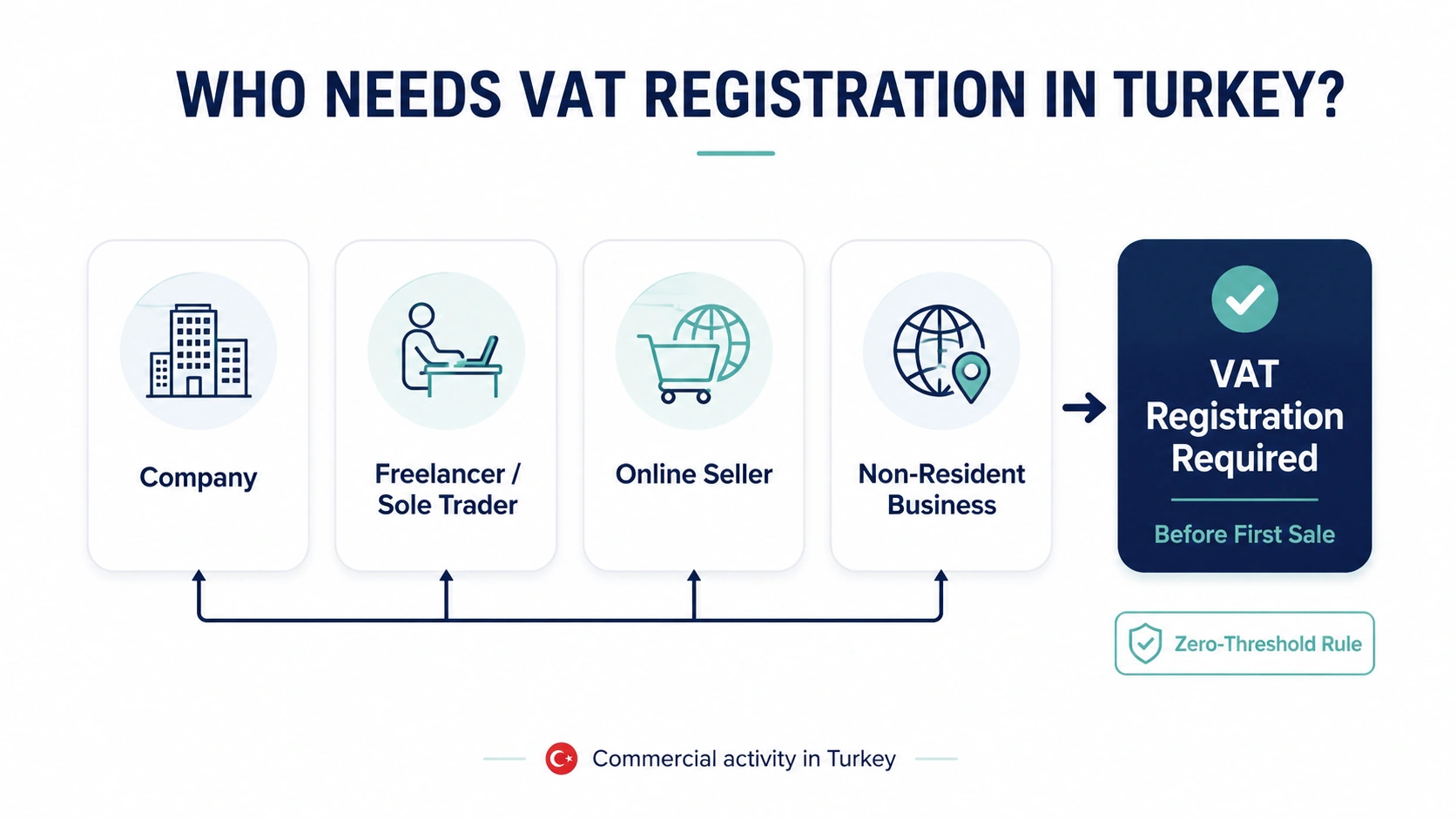
Foreign ownership is not the decision point: entity, establishment, supply and customer status determine the reporting route.
Route 2: Non-Resident With a Turkish Establishment
A business incorporated abroad may still have a workplace or establishment in Turkey for tax purposes. The conclusion depends on the real operating facts, not only on whether the company has called a location a branch, liaison office, coworking desk or remote team.
The Revenue Administration’s consolidated VAT communiqué specifically states that electronic services supplied in a way that creates a workplace in Turkey are reported under the general rules through the 1 No.lu return, rather than through the special VAT 3 route. Establishment questions can also affect corporate tax, invoicing and registration, so they should be reviewed together by appropriately authorised tax professionals.
Route 3: Cross-Border Service and Reverse Charge
Where a supplier has no residence, workplace, legal centre or business centre in Turkey, a service performed in Turkey or used in Turkey can still be within Turkish VAT. Under the general rule described by the Revenue Administration, the Turkish recipient declares and pays the VAT as responsible party through the 2 No.lu VAT return. This can apply even where the recipient is not otherwise a VAT taxpayer.
Reverse charge is not a label to place on every international invoice. Before using it, verify:
- what the supplier actually provides;
- where the service is performed and used;
- whether the supplier has a Turkish establishment;
- the customer’s status;
- whether an exemption or a more specific withholding rule applies; and
- who must document, declare and pay the tax.
For the wider buyer-side withholding framework, use the dedicated VAT withholding in Turkey guide.
Route 4: Non-Resident Digital B2C Supplier
A special online route applies where a supplier has no residence, workplace, legal centre or business centre in Turkey and supplies paid electronic services to individuals in Turkey who are not VAT taxpayers. The supplier establishes the “Special VAT Liability for Electronic Service Providers” and reports through the 3 No.lu VAT return.
The official process is materially different from an ordinary local-company file:
- Complete the electronic form on the Revenue Administration’s digital-services portal before the first 3 No.lu return.
- The special liability is established at the Large Taxpayers Tax Office.
- No separate commencement-of-business notification is requested for this special registration.
- The provider receives the access credentials needed for the online tax account.
- The 3 No.lu return is filed in Turkish lira for the relevant monthly period.
Marketplace and intermediary control: do not assign the VAT 3 account solely from the brand name shown to the customer. Under the current consolidated Communiqué, where the electronic-service provider is not clearly identified in the parties’ contract and the invoice or similar documents, the VAT on the electronic service is declared and paid by the intermediary that facilitates the electronic supply. A party that has authority to charge the customer, determine the general terms of the service or bears the obligation to perform the service is treated as the electronic-service provider for this rule. Map the contract, invoice identity and payment flow before deciding which entity should establish the special VAT liability.
The consolidated communiqué also states that these special VAT filers are not required to have the return signed by a tax professional, regardless of a monetary limit. That does not prevent a provider from obtaining licensed advice; it means the article must not claim that every VAT 3 return legally requires a Turkish accountant’s signature.
If there is no reportable transaction in a period, the communiqué states that a VAT 3 return is not required for that period. This exception should not be copied to an ordinary Turkish company’s filing calendar.
Is a Fiscal Representative Always Mandatory?
No universal answer should be inferred from the word “foreign.” The special VAT 3 process is designed as an electronic non-resident route and the official guidance does not make a local accountant’s signature a condition of the return. In a local-company or Turkish-establishment case, a legal representative, power of attorney, professional engagement or electronic authorisation may be needed for particular steps, but those roles are not interchangeable.
Determine the VAT route first. Only then decide:
- who represents the legal entity;
- who can access the tax system;
- who prepares and submits regulated returns;
- which documents must be translated, notarised or apostilled for that specific file; and
- who retains filing and payment evidence.
This prevents a foreign supplier from paying for an unnecessary generic “representative package” before knowing whether the customer, the supplier or a Turkish establishment is the actual VAT actor.

Workon coordinates the operational handoff between company setup, tax records and appropriately authorised professionals.
Current VAT Filing Deadlines
The Revenue Administration’s current deadline table distinguishes the return types. Always check official holiday extensions and later circulars for the actual filing month.
| Return |
Typical user |
Current standard filing and payment deadline |
| 1 No.lu VAT return |
Ordinary VAT taxpayer, including a qualifying Turkish establishment |
By 23:59 on the 28th of the following month; payment within the filing period |
| 2 No.lu VAT return |
Recipient declaring VAT as responsible party |
By 23:59 on the 25th of the following month; payment by the evening of the 25th |
| 3 No.lu special VAT return |
Qualifying non-resident electronic-service provider |
By 23:59 on the 28th of the following month; payment within the filing period |
Older explanatory text may still display an earlier day for the special VAT 3 return. The Revenue Administration’s current deadline table reflects the later circular and should control the working calendar.
Build the Registration File Around the Route
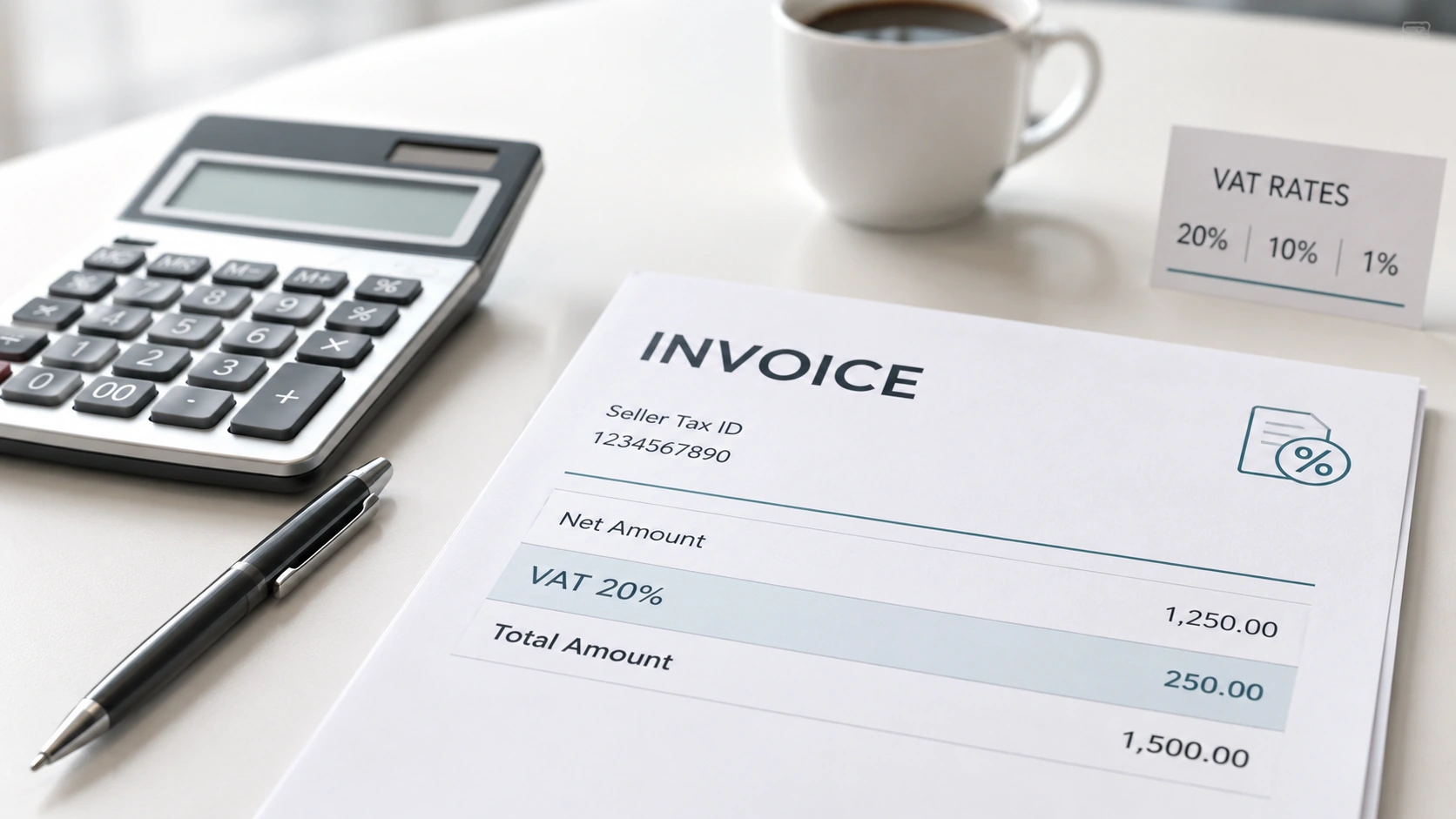
A reliable VAT file connects the registration route to customer evidence, invoices, bookkeeping and the correct return calendar.
A document list should follow the legal route instead of deciding it. Prepare an evidence matrix covering:
| Evidence |
Question it answers |
| Entity and establishment records |
Is the supplier a Turkish taxpayer, a foreign entity with a Turkish establishment or a non-resident without one? |
| Product and service description |
What is actually supplied, and is it an electronic service? |
| Customer status and location evidence |
Is the Turkish customer a VAT taxpayer, another business or a non-VAT individual? |
| Contract, order and payment flow |
Who sets the terms, charges the customer and performs the service? |
| Tax registration and system access |
Which return type and filing account are active? |
| Invoice, ledger and payment records |
Can each reported amount be reconciled to the transaction? |
For rates, exemptions, input VAT and refunds, keep this registration decision separate from Workon’s broader VAT in Turkey rates and exemptions guide. For the post-registration e-document decision, see the e-Invoice registration guide for Turkey.
Common VAT Registration Errors
- Assuming every foreign seller must open the same Turkish VAT account.
- Using a broad “zero threshold” statement without identifying the transaction and taxpayer route.
- Treating a potential VKN or company tax number as proof that the correct VAT return type is active.
- Sending a non-resident B2B service through VAT 3 without checking recipient-side reverse charge.
- Using the special digital-services route even though the supplier has a Turkish establishment.
- Appointing a fiscal representative or ordering notarised documents before confirming that the chosen route requires them.
- Applying the ordinary 28th-day deadline to a 2 No.lu reverse-charge return.
- Assuming every VAT declaration requires a licensed accountant’s signature, despite the express VAT 3 rule.
Official Sources and 2026 Verification
This guide uses the Revenue Administration’s 2026 consolidated VAT General Application Communiqué for the ordinary, reverse-charge and electronic-services routes, and its current declaration and payment deadline table for the 25th/28th-day calendar. The facts of the actual supply and the current official systems should be checked again before registration or filing.
How Workon Supports the Operational Handoff
Workon can help a foreign founder or overseas business map the operating facts, organise company and transaction records, distinguish the local-company path from the non-resident routes and coordinate the handoff to a licensed CPA/SMMM or other appropriately authorised professional. The licensed tax professional confirms the transaction-specific VAT treatment and regulated filings, while the Revenue Administration controls the applicable tax systems and procedures.
Last reviewed: 17 September 2026.
Message Workon with the supplier’s country, whether it has people or premises in Turkey, what it sells and whether the Turkish customer is a business or consumer. Those four facts are the fastest starting point for the correct VAT route.
Frequently Asked Questions
No. Distinguish a Turkish business or establishment from a non-resident supplier, then check the supply and customer. Ordinary VAT, recipient-side reverse charge and the special electronic-services VAT route address different situations; nationality alone does not determine the route.
No. Identify the taxable transaction, establishment and customer first. A local company's ordinary VAT position, a customer's reverse-charge obligation and a qualifying non-resident digital supplier's special VAT account are separate questions.
Prepare records for the applicable route: entity and establishment evidence, supply description, customer status, contracts, transaction flow and authorised tax-system access. Do not order a generic notarised company-document pack before confirming which party and return type are involved.
The contract, invoice identity and payment flow matter. Under the electronic-services rule, if the service provider is not clearly identified in the contract and invoice or similar documents, the intermediary facilitating the supply can be responsible for declaring and paying the VAT. A party that can charge the customer, set the general service terms or is obliged to perform the service can be treated as the electronic-service provider.
Do not assume so solely because the supplier is foreign. Determine the VAT route and then check the applicable representation, access and filing requirements. The special VAT 3 route differs from ordinary local-company and Turkish-establishment procedures.
No. Confirm the relevant return type and current GİB calendar. Ordinary VAT, recipient-side VAT and special electronic-services VAT can have different deadlines or no-transaction rules. Do not transfer a VAT 3 exception to an ordinary Turkish company's filing obligations.
Disclaimer: This guide provides general information, not legal or tax advice. Turkish VAT registration, reverse-charge, establishment, representative, filing and documentation requirements depend on the supplier, customer, transaction and rules in force for the relevant period. Confirm material decisions against current Revenue Administration guidance with a qualified Turkish tax professional.