The Turkey work permit 5 employee rule generally requires five Turkish employees for each foreign worker. However, exemptions may apply to qualifying IT specialists, certain foreign shareholders, and employers with at least TRY 50 million in previous-year net sales. This guide explains these exemption routes and their requirements.
A foreign founder can therefore face an unexpected problem. The company may be registered, the product may be ready, and the founder may be the person investors expect to see in Türkiye, yet the employer may not have enough Turkish employees for the ordinary work permit route. The answer depends on who the applicant is, what role they will perform, which sector the employer operates in, and which evidence supports the exemption.
The Ministry’s framework is not a single blanket waiver. It combines a workplace-level employment criterion with narrow, category-specific exceptions. The official Ministry evaluation criteria should be checked before filing, because a specialist employee, a shareholder-director, and a temporary technician may be assessed under different rules.
What the 5 Employee Rule Actually Means in 2026
The 5:1 rule is the ordinary benchmark for an employer-sponsored foreign work permit. In practical terms, the workplace is generally expected to employ five Turkish nationals for each foreign employee at that workplace, as described in the current Ministry criteria and summarised in Türkiye’s employment criterion guidance. It isn’t a separate quota assigned to each applicant. It’s a company and workplace test.
That distinction matters. A Turkish limited liability company with no Turkish employees can fall below the ordinary employment floor before the first foreign application is filed. The relevant evidence normally comes from the employer’s personnel and SGK records, so a founder shouldn’t count an informal contractor, an unregistered worker, or a person who isn’t employed by the sponsoring workplace.
Start with the workplace, not the applicant
Before choosing an exemption, verify three points:
- Employer identity: Confirm which Turkish legal entity will sign the employment relationship and which workplace or branch will sponsor the application.
- Turkish headcount: Check the Turkish nationals recorded for that workplace, including whether their SGK employment records support the claimed headcount.
- Foreign headcount: Count the foreign workers connected to the employer when assessing whether the intended application fits the ordinary criterion or an exemption.
The ratio can become relevant at initial applications and in certain workplace or employer changes. An exemption also isn’t a permanent guarantee that the company can expand its foreign workforce without further review. As foreign headcount changes, the employer must reassess whether the ordinary ratio applies to new filings.
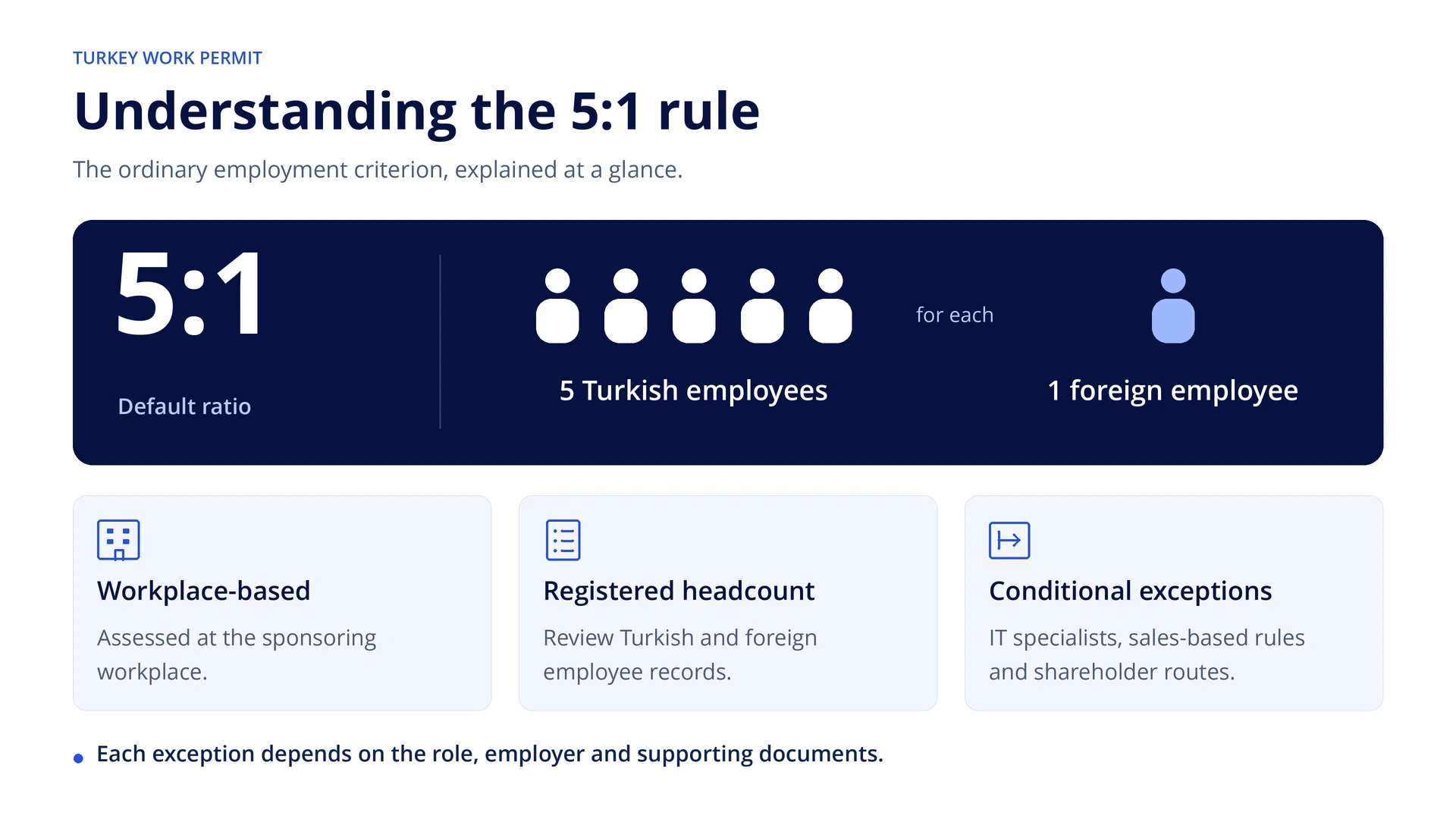
Understanding the five-employee requirement starts with the sponsoring workplace, registered headcount and applicable exemptions.
Three routes deserve separate analysis. A company with prior-year net sales of at least TRY 50,000,000 may obtain an employment-criteria exemption for up to its first five foreign hires, certain IT-sector specialists may qualify for a quota exemption, and a foreign shareholder or company owner may use a capital-based or post-approval hiring route. These routes don’t have the same applicant profile or evidence requirements.
For broader coordination around employment authorisation and related status matters, see Workon’s Turkish work permit services. The application still needs a case-specific legal assessment, especially where the proposed role combines ownership, management, technical work, and board authority.
IT Sector Specialist Exemptions and Advanced Technology Roles
An IT-sector exemption is role-driven, not founder-driven. A company operating in software, information technology, gaming, or an advanced technology field may have a stronger exemption case, but the applicant’s actual job, qualifications, salary, and supporting project evidence must align with the Ministry’s qualifying framework.
The Ministry’s current criteria include sector-specific quota exemptions for certain specialist roles. The safest way to assess a proposed position is to test four elements together rather than relying on the company’s website or a broad “technology business” description.

Simplify your business setup with Workon’s all-in-one company registration service in Turkey.
Four questions for the specialist route
Is the employer in a recognised technology field? The application should identify the relevant business activity and sector classification. A software product company and a trading company that merely uses software internally won’t necessarily be treated alike.
Does the job title describe specialist work? Roles such as software architect, AI engineer, data scientist, cybersecurity specialist, embedded systems engineer, and digital game designer may fit more naturally than a generic manager or sales lead. The title should match the actual duties, employment contract, and professional evidence.
Does the salary satisfy the applicable standard? The Ministry applies salary criteria according to the occupation and responsibility level, with requirements linked to the applicable minimum wage framework. The exact current threshold should be verified at filing rather than copied from an older article.
Can the employer prove the technical need? Project descriptions, product materials, R&D documentation, technical architecture, relevant client work, and evidence of the technology stack can help explain why the foreign specialist is needed. The record should show what the person will do, not merely that the company calls itself a startup.
| Role Category |
Typical Ministry Treatment |
Notes for Applicants |
| Software architect |
More suitable for specialist review |
Match the title to architecture responsibilities and professional background. |
| AI engineer or data scientist |
Potentially suitable |
Explain the project, tools, and technical contribution clearly. |
| Cybersecurity or embedded systems engineer |
Potentially suitable |
Provide evidence connecting the role to the employer’s technology activity. |
| Digital game designer |
Potentially suitable in a gaming business |
The employer’s sector and the applicant’s portfolio should support the classification. |
| Generic IT support |
Often weaker |
Routine support work may not demonstrate specialist status. |
| Marketing technologist |
Fact-specific and commonly challenged |
Marketing duties can obscure whether the role is genuinely technical. |
| Junior developer |
Not automatically exempt |
A developer title alone doesn’t establish that the specialist criteria are met. |
| General manager or sales lead |
Usually outside the specialist carve-out |
Consider the shareholder or ordinary employer route if appropriate. |
A foreign founder may personally write code and still apply as a company owner, director, or executive. Those are not interchangeable classifications. The Ministry can assess the applicant’s registered position and real duties, so describing every founder as an IT specialist creates avoidable risk.
The TRY 50 Million Sales Threshold and How It Changes Headcount
The sales-based pathway is a company-level exemption. Where the employer’s previous-year net sales are at least TRY 50,000,000, current guidance allows an employment-criteria exemption for up to the first five foreign employees, as explained in the 2025 evaluation framework summary.
Operationally, this changes the order in which a high-revenue company can build its team. The company can use the exemption for foreign hire one through foreign hire five, provided the other conditions for each application are satisfied. The sixth foreign hire doesn’t remain inside that same five-person carve-out. At that point, the standard employment criterion must be reassessed across the workplace, unless another exemption applies.
Evidence matters more than the label
The company should be ready to support the sales figure with corporate records, including the relevant tax declarations and financial documentation. The application file may need to reconcile the claimed net sales with records submitted to the Revenue Administration, rather than relying on a management forecast, investor presentation, or group-wide headline turnover.
This creates practical issues for newer businesses:
- A startup with no qualifying prior-year sales may need to examine the IT specialist route or the foreign shareholder route instead.
- A subsidiary should not assume that a holding company’s consolidated turnover automatically belongs to the subsidiary’s application.
- Foreign-currency sales need a defensible conversion method and supporting records before they can be compared with a TRY threshold.
- The sales exemption applies to the first five foreign employees, not to every later application made by the same company.
The threshold also doesn’t replace the rest of the evaluation. The employer still needs a genuine employment relationship, a suitable position, accurate company information, and evidence supporting the selected route. A sales figure can address the employment criterion while leaving other questions open.
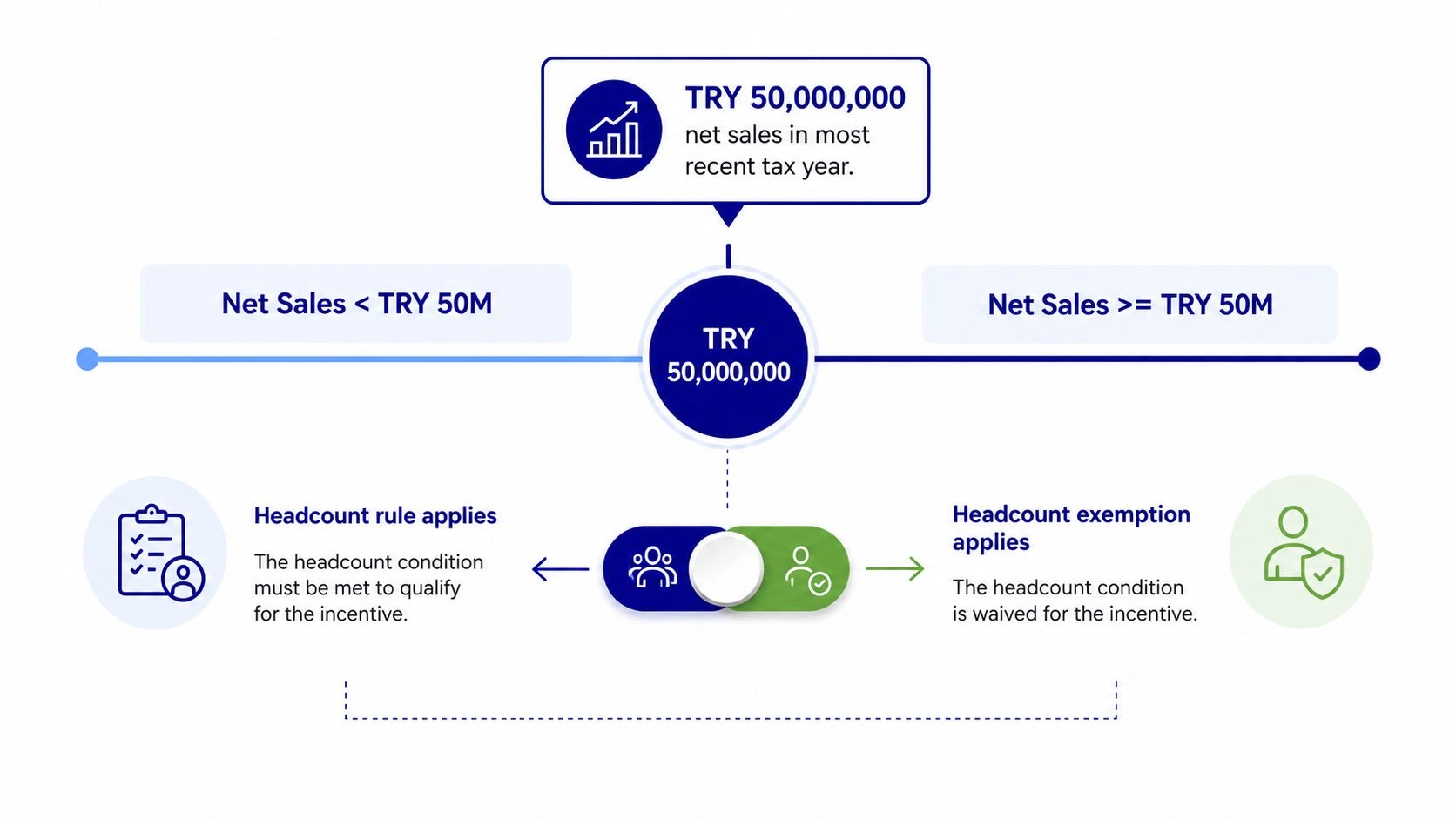
Employers with at least TRY 50 million in previous-year net sales may qualify for a staffing exemption covering up to five foreign employees.
The right filing sequence depends on the employer’s records at the time of application. Don’t treat the sales threshold as a general waiver for a foreign team, and don’t count projected revenue as if it were already reported net sales.
Decision Table for Applicants by Role and Route
The route should be selected after separating the applicant’s position from the company’s business model. A technology company may employ both a qualifying software specialist and a commercial director, while a foreign shareholder may also hold an operational technical role. The same company can therefore have different exemption analyses for different people.
| Applicant Role |
Sector |
Route |
Threshold |
Evidence |
| Foreign shareholder or owner acting as an executive |
Any eligible business activity |
Shareholder-owner route |
USD 100,000 capital share may bypass the post-approval hiring condition, or the company may need to employ five Turkish citizens within seven months |
Capital and shareholding records, company documents, board or management records, and the proposed employment position. See the shareholder-director evaluation guidance. |
| Specialist employee |
IT, software, gaming, or advanced technology activity |
IT-sector specialist quota exemption |
The role must satisfy the applicable specialist and salary criteria |
Employment contract, qualifications, job description, sector classification, and project or technology evidence. |
| Foreign employee sponsored by a high-revenue employer |
Any sector that meets the relevant employer conditions |
Sales-based employment-criteria exemption |
Prior-year net sales of at least TRY 50,000,000, covering up to the first five foreign hires |
Tax-base declarations, financial statements, and prior-year corporate tax records supporting the employer’s net sales. |
| Foreign national applying from inside Türkiye |
Role and employer specific |
In-country application under the applicable Ministry rules |
The employment and financial criteria may still apply unless a specific domestic-application exemption is available |
Valid immigration status, employer records, position evidence, and documents proving the applicable exemption or ordinary criteria. |
This table is a screening tool, not an approval formula. A company owner who also wants to work as an engineer should ask which role is primary in the application and whether the evidence supports that role consistently.
Domestic applications can involve additional exemptions for certain foreign nationals and circumstances. The Ministry also lists groups that may work under separate legal arrangements, including Blue Card holders, refugees or subsidiary protection holders, and certain diplomatic personnel. Because these categories are person-specific, the applicant’s status and documents should be reviewed before assuming a standard permit is required.
Two Founder Scenarios That Read Very Differently
Consider a Turkish software firm founded by a returning citizen and a foreign-owned trading company entering Türkiye. Both founders want to be active in the business, both may plan to hire foreign personnel, and neither should assume that the word “founder” answers the work permit question.
Scenario one, a technical founder in a technology company
The first founder is responsible for product architecture and leads development of an advanced software platform. The company prepares a job description that describes technical responsibilities, gathers evidence of the founder’s qualifications, and documents the product, development work, and technology stack. If the role fits the Ministry’s specialist criteria, the IT-sector route may be relevant.
The founder’s shareholding doesn’t prove the specialist classification. The file must still connect the actual role to a qualifying technical position and satisfy the applicable salary and employer requirements. If the founder will also sign contracts, supervise staff, and manage daily operations, the company should check whether the registered role accurately reflects those duties.
Scenario two, a foreign owner of a trading company
The second founder owns a trading business that imports and distributes products. The founder may use software to manage inventory, but that fact doesn’t turn the company’s commercial activity into an IT-sector specialist case. The likely analysis instead concerns the employer’s sales evidence, the owner’s shareholder status, capital structure, and the post-approval hiring condition.
A foreign shareholder can have an initial permit tied to employing five Turkish citizens within seven months, or may bypass that condition where the shareholder has at least USD 100,000 in capital share, according to the company-owner evaluation criteria. The company still needs to prove the claimed capital and present a coherent operational role.
The refusal logic differs too. In the first scenario, the issue may be that the role isn’t sufficiently specialist or the technology evidence is weak. In the second, the problem may be inadequate capital evidence, an unclear ownership position, or failure to support the required Turkish hiring plan. Country of origin doesn’t create the distinction. Sector, role, ownership, and evidence do.
Common Misconceptions That Lead to Refusals
Online founder discussions often compress several different rules into one sentence. That shortcut can make a potentially viable application look simple while hiding the condition that matters.
Myth one, a software founder is automatically exempt
A software founder isn’t automatically covered by an IT-sector quota exemption. The applicant must fit the qualifying role and satisfy the relevant specialist, salary, and technology evidence requirements. A founder applying as a general manager, commercial director, or owner should be assessed under the route that matches those duties.
Myth two, the sales threshold permits unlimited foreign hiring
The sales-based exemption covers up to the first five foreign hires where the employer meets the TRY 50,000,000 prior-year net sales condition, as set out in guidance on expanded quota exemptions. It isn’t a permanent company-wide removal of the employment criterion. The next foreign hire requires a fresh assessment of the ordinary ratio or another available exemption.
Myth three, shareholding alone is enough
Owning shares doesn’t automatically authorise operational work. A shareholder who will manage or work in the company needs the appropriate work authorisation route, and the shareholder exemption has its own capital or Turkish-hiring condition. Passive ownership and day-to-day employment shouldn’t be presented as the same activity.
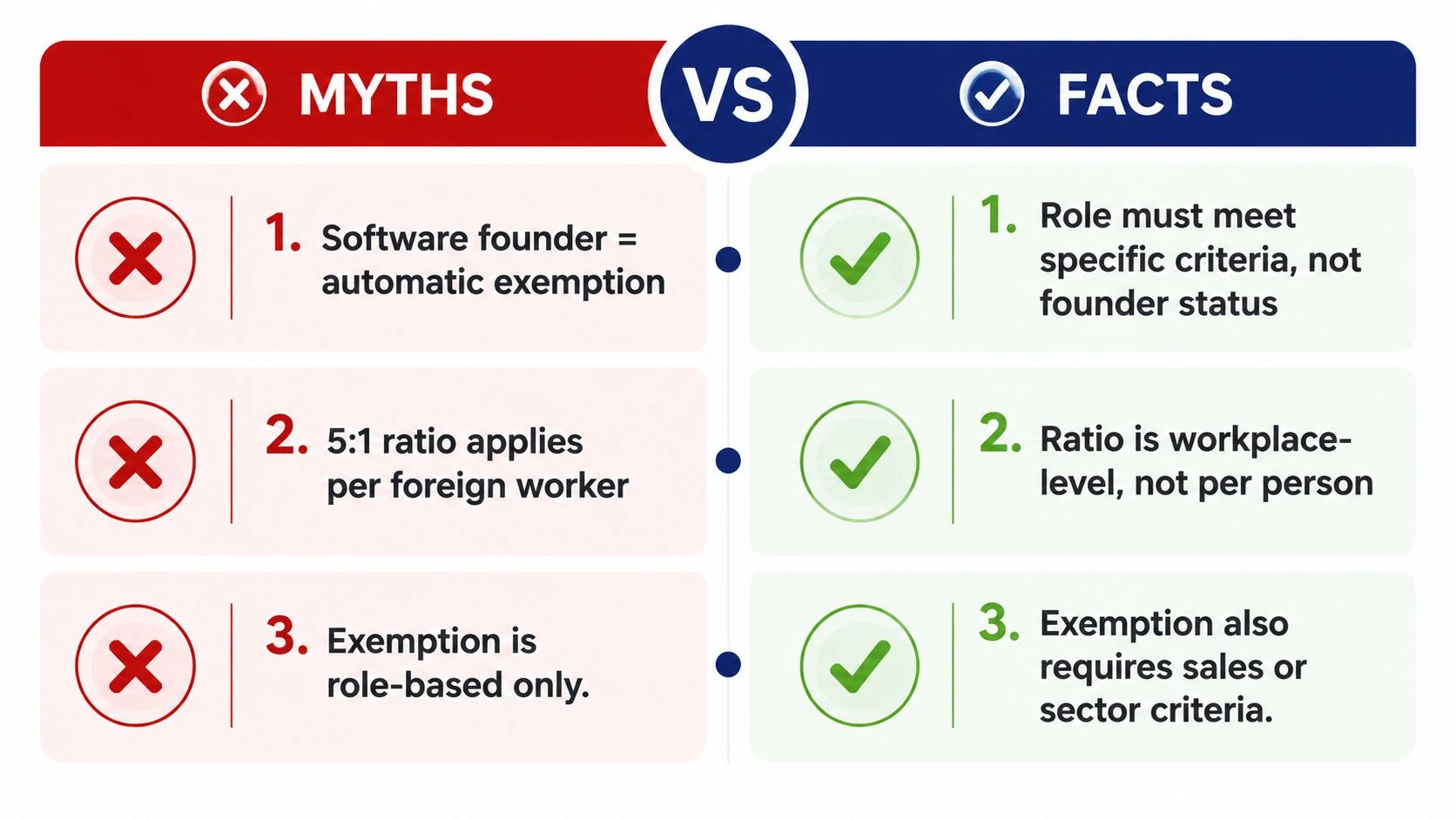
Common assumptions about founder status, staffing ratios and exemption eligibility can lead to errors in work permit applications.
Other exemptions are also narrow. Some public procurement, agreement-based, liaison office, advanced technology, family, foreign direct investment, scientific, cultural, artistic, and temporary technical categories may be treated separately, but the conditions and duration depend on the applicant and activity. The Ministry’s exemption types explains that exemption documents are issued separately for each foreigner, so one person’s status shouldn’t be copied onto another person’s application.
Practical Checklist Before You File
Use the following checklist before an employer uploads an exemption claim. It is designed to identify route errors early, when the company can still adjust the role description or evidence package.
- Confirm the employer’s Turkish workforce: Identify the sponsoring entity and workplace, then reconcile Turkish employee records with SGK registration. Don’t rely on planned hires that haven’t been formally recorded.
- Check the sales route: Determine whether the employer can document prior-year net sales of at least TRY 50,000,000. Keep the financial and tax records together so the claimed figure can be traced to the relevant corporate filing.
- Classify the applicant’s real role: Decide whether the person is applying as an IT specialist, shareholder-owner, executive, or another employee. A title chosen only to obtain an exemption can create inconsistencies elsewhere in the file.
- Verify capital and ownership: For a shareholder route, confirm the capital share, ownership records, and board or management structure. The capital-based condition is distinct from the commitment to employ five Turkish citizens within seven months.
- Gather employment evidence: Prepare the contract, job description, qualifications, payroll material, SGK records, and project documents that support the selected route. For technology roles, map the proposed duties to the Ministry’s specialist classification rather than using a broad “software” label.
- Choose the correct filing basis: Check whether the ordinary ratio, sales exemption, IT specialist exemption, shareholder route, domestic-application exemption, or a separate legal status applies. Temporary categories can have strict durations and may require a separate exemption document for each foreigner.
The employer should also review how the application will be maintained after approval. A change in workplace, employer entity, job duties, ownership, or foreign headcount can require a new assessment. Workon’s SGK employer registration support can help coordinate administrative records, but regulated legal conclusions should be confirmed by appropriately licensed Turkish legal counsel.
Before filing, ask one final question: what exact fact makes this applicant exempt from the ordinary 5:1 rule? If the answer is only “the founder owns the company” or “the business is a software company”, the file needs more analysis.
Workon can coordinate company-side documentation, SGK-related records, work and residence permit logistics, and the practical steps needed to prepare a Türkiye market-entry file. Visit Workon to discuss the applicant’s role, employer structure, and the evidence needed for a case-specific review, with substantive legal conclusions left to licensed Turkish counsel.
For workplaces subject to balance-sheet accounting, employers generally need five Turkish citizens employed at the workplace for each foreign worker applying for a work permit.
Yes, if the applicant or employer qualifies for an applicable exemption. Exemption from the staffing requirement does not remove the need for work authorisation.
Qualifying specialist roles can be exempt. The criteria also cover up to two qualifying IT specialists at employers outside the IT sector. Applicable salary requirements still apply.
Employers with at least TRY 50 million in previous-year net sales can receive an employment-criterion exemption for up to five foreign employees. Other work permit requirements remain applicable.
Generally, five Turkish employees are required from the start of the initial permit’s seventh month. Foreign shareholders with a capital share of at least USD 100,000 are exempt from this employment criterion.