





















A foreign shareholder who actively manages or works for a Turkish company should obtain the correct work authorisation before performing that role. Company ownership, incorporation, a tax number or a residence permit does not grant a right to work. Classify the role, confirm the owner eligibility tests, choose the domestic or overseas route, align the evidence in e-İzin and complete the post-approval controls.
Last reviewed: 17 September 2026. This application guide reflects the Ministry of Labour and Social Security information available on that date. Criteria, fees, document requests and system steps can change, so confirm the live official pages before filing.
| Decision point | Application answer |
|---|---|
| Does every shareholder need a work permit? | No. Separate passive ownership from active work. The Ministry identifies limited exemptions for a non-resident joint-stock-company board member and a non-managing partner of another company type. |
| Can an active owner start after forming the company? | No. A foreigner opening a workplace or working on their own account must obtain the required work permit before starting the activity. |
| Who submits the Turkish-side filing? | The company’s authorised user completes and electronically signs the e-İzin application. In an overseas case, this follows the owner’s consular application and 16-digit reference number. |
| Official decision benchmark? | The Ministry states that a duly completed application is evaluated within 30 days once all required information and documents are complete. |
| 2026 government charges for a permit up to one year? | TRY 12,574.90 work-permit fee plus TRY 964.00 valuable-paper fee, paid separately after approval notice. |

Illustration of a company-owner work-permit consultation and the business evidence discussed in this guide.
Record the Eligibility Decision Before Opening the Application
Document the owner’s actual duties, signature authority and intended workplace presence before choosing the application route. A label such as “investor” or “director” is not enough to establish the person’s status. Use the company-owner eligibility guide for the active/passive-role distinction and capital/shareholding calculations, and confirm the conclusion against the current official criteria for the case.
The application file should then record the assessed role, any exception relied on, the supporting company records and their effective dates. Resolve inconsistencies before entering e-İzin rather than describing planned changes as already completed. Incorporation or a residence permit should not be treated as permission to begin productive work.
Run a company-owner eligibility preflight
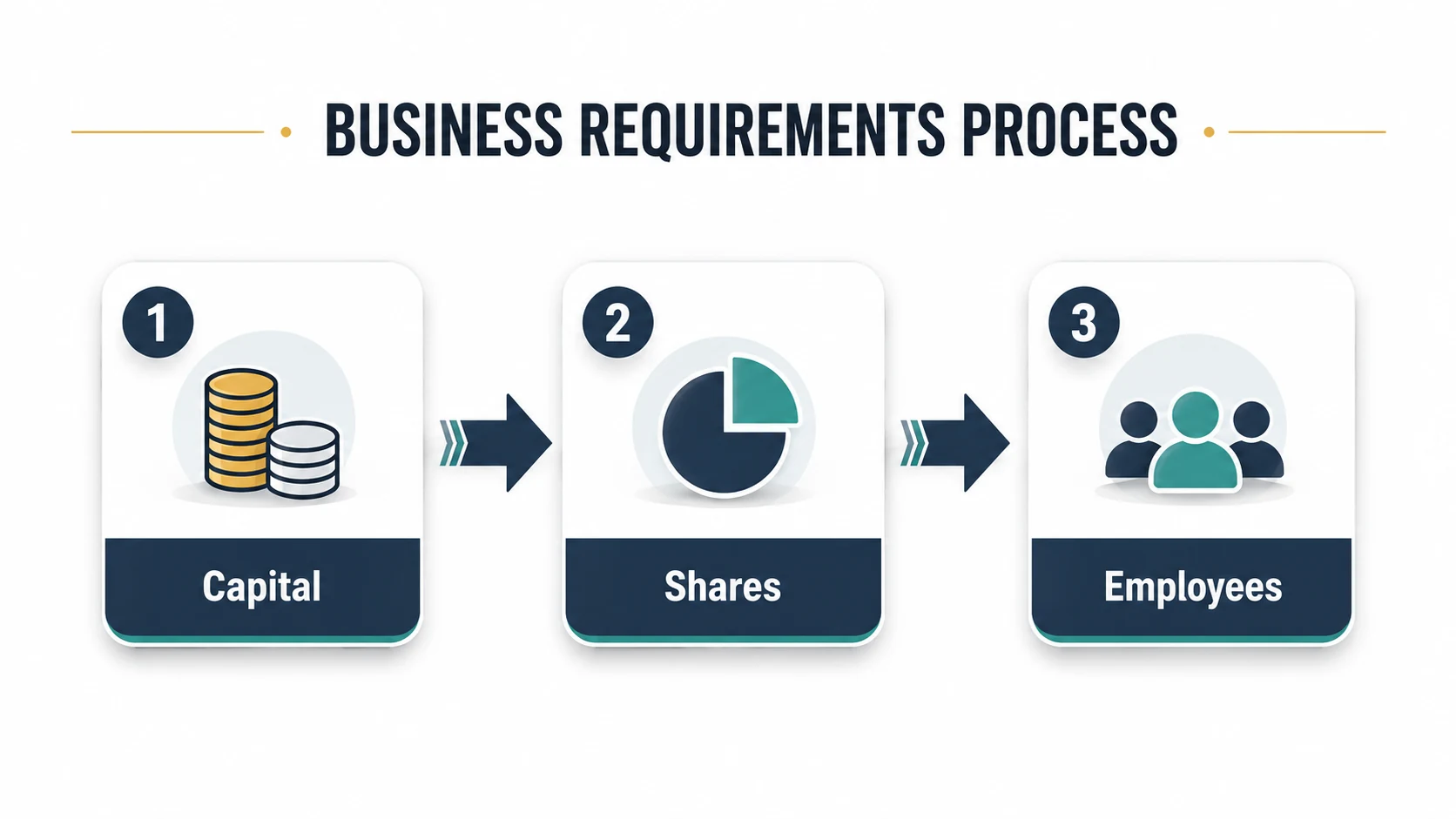
This page focuses on application execution. The separate Turkey work-permit eligibility guide for company owners explains the detailed threshold analysis. For a business operating under the balance-sheet method, the current owner/partner criteria generally require:
- the foreign owner’s own capital share to be at least TRY 500,000;
- the company’s total paid-up capital to be at least TRY 500,000;
- the foreign owner’s shareholding to be at least 20%; and
- at least five Turkish citizens to be employed by the business from the beginning of the permit’s seventh month and in every subsequent month.
The Ministry states that these criteria do not apply where the foreign partner’s capital share is at least USD 100,000. The exception does not guarantee approval or remove route, document and sector review. Freeze the shareholding and capital evidence before filing; registry, financial and e-İzin figures must agree.
Owners who will be employed in an ordinary role by a separate Turkish employer should use the broader Turkey work-permit guide. Do not force an employee case into the owner/partner criteria merely because the applicant also holds an incidental investment.
Choose the domestic or overseas application route
Domestic application from Turkey
For the ordinary domestic route, the foreign owner must hold a Turkish residence permit that was issued for at least six months and remains valid on the application date. This is not a requirement to have six months remaining. The Ministry also recognises limited categories of legally present foreign nationals who may apply domestically without a valid residence permit; treat that as an exception to verify, not a default assumption.
The company’s authorised user opens the file in e-İzin, selects the correct workplace and owner/partner role, enters the corporate and applicant data, uploads the evidence and completes the application with an electronic signature. A residence permit supports access to this route; it does not authorise the owner to start work while the first application is pending.
Application from abroad
- The foreign owner applies in person at the Turkish embassy or consulate general in the country of citizenship or legal residence.
- The Turkish mission issues a 16-digit reference number for the work-permit process.
- The owner sends that reference number and the controlled identity documents to the Turkish company.
- The company’s authorised user enters the reference number, completes the linked e-İzin filing and electronically signs it.
- After approval and payment, the owner completes the consular work-visa step and enters Turkey within the permitted period.
Treat the consular and company stages as one case. The name, passport number, company identity, role and dates must match. A consular application without the connected company filing does not complete the process, and the visa is not an alternative to the work permit.
Build and reconcile the evidence file before the authorised user signs the e-İzin submission.
Build one controlled owner-and-company evidence file
Evidence depends on the route, company type, sector and Ministry requests. Use a source matrix rather than treating a generic list as universal.
| Issue to prove | Typical evidence to control | Consistency check |
|---|---|---|
| Identity and route | Passport copy, biometric photograph, valid residence permit for an ordinary domestic filing, or the 16-digit consular reference for an overseas filing | Names, passport number, nationality and validity dates must match every screen and attachment. A Turkish translation may be required where the passport is not in Latin characters. |
| Company existence and authority | Tax number, MERSİS and trade-registry records, current Trade Registry Gazette entries, and the authorised e-İzin/e-signature user | Legal name, registration number, address, company type and representation authority must be current. |
| Ownership and capital | Current registry/share records and financial evidence supporting paid-up capital and the applicant’s own capital share | Confirm the applicant’s percentage, TRY amount and any USD 100,000 exception claim against the same effective date. |
| Operating and financial position | Prior-year balance sheet and profit-and-loss statement approved by the tax office or an authorised professional, where applicable | Use the correct period and entity; do not substitute projected figures for filed records. |
| Turkish employment test | SGK workplace and employee records for the months in which the five-citizen requirement applies | Plan for the requirement from the beginning of month seven and monitor it monthly, rather than checking only on the filing date. |
| Actual business and regulated activity | Activity certificate, licence, prior authorisation or professional evidence only where the activity or Ministry request requires it | Company purpose, permit role and sector permissions must describe the same real operation. |
Do not order apostilles, notarisation, diploma equivalency, health records, no-debt letters or business plans by habit. Map each item to the live Ministry screen and actual sector. Authentication and translation depend on the document, jurisdiction and use.
Corporate housekeeping belongs before e-İzin. The company formation guide for Turkey, MERSİS company-registration guide and activity-certificate guide explain the upstream records that may feed the permit file.

Use one evidence index for identity, corporate authority, ownership, capital, activity and staffing records.
Execute the e-İzin application in the right order
- Establish the entity and tax record. Complete incorporation or share acquisition, tax registration and required registry updates before presenting the person as a current owner.
- Confirm the legal role. Record whether the applicant is an active partner, managing director or another authorised officer, and ensure the corporate resolutions and registry entries support it.
- Lock the eligibility evidence. Reconcile the owner’s capital share, total paid-up capital, ownership percentage and the staffing plan against the official owner criteria.
- Set up the authorised company filer. Confirm the correct SGK workplace, e-İzin account permissions and valid electronic signature. A draft that is saved but not signed is not complete.
- Open the correct route. Use the valid residence-permit data for an eligible domestic file or the 16-digit mission reference for an overseas file.
- Enter and upload from the evidence index. Keep spelling, identifiers, dates, address, role and capital figures identical to the controlled sources.
- Sign and monitor. Complete the e-signature step, keep the application/tracking number and monitor both e-İzin and the declared email address.
- Answer requests as part of the same case. If the Ministry asks for missing information, upload it to the relevant file and electronically sign the response.
The Ministry’s 30-day benchmark applies to a duly completed application. When extra information is requested, the evaluation period runs from the date the requested items are uploaded. Consular appointments, company-record corrections, evidence preparation, payment and card delivery are outside that narrow decision period.
Pay the 2026 fees only after the approval notice
| 2026 charge | Amount | Control |
|---|---|---|
| Fixed-term work permit for up to one year | TRY 12,574.90 | Use the exact amount and reference details in the approval/payment notice. |
| Valuable-paper fee | TRY 964.00 | Pay separately from the permit fee. |
| Combined permit and document amount | TRY 13,538.90 | Consular visa and case-specific third-party costs may be separate. |
The Ministry requires both government charges to be paid separately within 30 days after notification; otherwise the application is rejected. Use the reference-number route in the Digital Tax Office or a payment method listed by the Ministry. Do not send money in response to an unofficial email or treat the filing date as the payment trigger.
Do not work before approval
Incorporation, share ownership and pre-opening administration do not authorise productive work. Separate shareholder conduct from management and operations. The official guidance states that a foreigner who opens a workplace or works on their own account must obtain the work permit before starting work.
Use the Ministry’s official inquiry and e-İzin tracking channels for status. Do not upload a passport, foreign identity number or permit card to an unofficial “status check” site.
Complete the post-approval handoff
| Post-approval event | Required operational control |
|---|---|
| Permit issued | Check the holder, company, workplace, role, dates and annotations before activity starts. |
| Company/workplace operation | Complete the municipal workplace-opening and operating-licence step where applicable; the official guidance requires the work permit to be presented in this process. |
| Owner starts active work | Complete the applicable SGK start and declaration process and align it with the permit. Treaty-based social-security treatment requires case-specific evidence. |
| Start, end or a change that triggers cancellation | The company—and the permit holder for an independent or permanent permit—must make the Ministry notification within 15 days. |
| Month seven onward | Where the ordinary owner criterion applies, verify five Turkish employees at the business every month from the beginning of the seventh month. |
| Overseas approval | Coordinate entry, address registration and commencement deadlines rather than treating card approval as the end of the case. |
Coordinate the permit with SGK employer registration and the Turkey payroll process. Corporate minutes, permit role, SGK records and payroll or management remuneration should not contradict one another.
Renew without losing continuity
An extension application may be filed from 60 days before expiry and must be completed before the current permit expires. A first fixed-term permit may be granted for up to one year. For the same employer or permitted business, a positive first extension may be granted for up to two years and later extensions for up to three years, subject to the Ministry’s review.
When a timely extension is pending, the foreign national may continue the same work at the same workplace for up to 90 days after expiry. This is a limited continuity rule, not an automatic 90-day renewal. Keep evidence of the timely filing, avoid changing the business or work facts without checking the permit consequences, and continue to monitor the application.
Respond to rejection with the decision, not guesswork
Read the notified reason against the exact e-İzin record and source documents. A reasoned electronic objection may be submitted within 30 days after notification. If the problem can be corrected, a new application may also be filed after the deficiency is resolved; resubmitting the same inconsistent record is unlikely to change the outcome. Judicial review may be available, so obtain legal advice where the decision or deadline is contested.
Common preventable failures include choosing the wrong route, treating passive ownership as proof of active-work authority, relying on pre-2025 capital thresholds, mismatching registry and financial figures, assuming the USD 100,000 exception guarantees approval, leaving an e-İzin file unsigned, missing a document request, or paying after the 30-day notice period.
Official sources checked for this application guide
- Ministry of Labour and Social Security — work-permit FAQ
- Directorate General of International Labour Force — current evaluation criteria
- Directorate General — domestic and overseas application types
- Directorate General — work-permit application documents
- Directorate General — conditions for foreigners opening a company or workplace
- Directorate General — 2026 permit and valuable-paper fees
- Directorate General — social-security and notification duties
For a coordinated company-owner file, see Workon’s residency and work-permit support. The filing strategy should follow the owner’s real activity, immigration position, company records and the official requirements in force on the submission date.
Frequently Asked Questions
Disclaimer: This article provides general information, not legal, immigration, corporate, tax, employment or social-security advice. Obtain case-specific advice and verify the live Ministry requirements before the owner starts work or the company submits an application.