




















Which business should you test first in Turkey? This comparison is designed for foreign founders who want to validate demand before taking on substantial premises, inventory or payroll commitments. It therefore gives priority to models that can be tested through a defined customer project, sample order or limited launch. A founder with an established factory network, regulated-sector team or committed buyer may reach a different shortlist.
The nine options below are an editorial comparison under those assumptions, not a ranking of measured profitability or guaranteed returns. Compare the business model, the resources you already have and the evidence needed for a first customer; use the separate sector guide when you are still choosing the industry itself.
This page compares nine concrete business models by capital intensity, regulatory burden, local footprint, export potential and speed of validation. For the broader question of which sectors fit your experience, first read our business opportunities in Turkey for foreigners guide. The two pages serve different decisions: sector fit there, model selection here.
Last reviewed: 17 September 2026.

Validate the business model first, then build the right Turkish operating structure around it.
Quick comparison: 9 business models for foreign founders
The ratings below are relative decision aids, not profit forecasts. “Lower capital” does not mean zero cost, and “lower regulation” does not remove tax, consumer, data, employment or sector obligations.
| Rank and business model | Capital intensity | Regulatory burden | Local footprint | Export revenue potential | Fastest credible proof |
|---|---|---|---|---|---|
| 1. Exportable B2B software or automation | Lower | Lower to medium | Lower | High | Paid pilot with one defined buyer |
| 2. Specialized B2B service | Lower | Lower to medium | Lower | Medium to high | Paid diagnostic or retained client |
| 3. Sourcing and export coordination | Lower to medium | Medium | Medium | High | Buyer mandate plus supplier sample |
| 4. Niche e-commerce brand | Medium | Medium | Medium | Medium | Contribution-positive limited launch |
| 5. Merchant enablement and localization | Lower to medium | Medium | Lower to medium | Medium | One merchant with a measurable result |
| 6. Private-label or contract manufacturing | Medium to high | Medium to high | Medium to high | High | Buyer-approved sample and landed-cost model |
| 7. Agrifood processing or packaging | Medium to high | High | High | Medium to high | Compliant pilot batch and channel order |
| 8. Energy-efficiency products and services | Medium to high | Medium to high | Medium | Medium | Site baseline and contracted savings case |
| 9. Tourism or regulated vertical technology | Medium to high | High | Medium to high | Varies | Licensed-path review plus paid pilot |
How the ranking works
A model ranks higher for a typical foreign founder when it can be tested before a long lease, large inventory position, regulated facility or substantial local payroll. It also benefits from an identifiable customer, repeatable delivery and the option to earn revenue outside a single local market. The ranking changes when the founder brings a factory network, a regulated-sector team, land, technology rights, a hotel operation or a committed buyer.
Türkiye’s official FDI Strategy 2024–2028 highlights green and digital transformation, global value chains, talent and investment competitiveness. These themes support the screening logic, but a national priority is not a guarantee of demand, an incentive or a return. Use the Investment Office’s current sector reports as a starting point and verify the precise activity.
1. Exportable B2B software or workflow automation
Best for: founders with technical delivery capacity and access to a narrow business problem.
A focused software product, cybersecurity service, industrial workflow tool or data solution can be validated without committing to a large physical footprint. Turkey can serve as a development and delivery base while the company sells locally, internationally or both. The strongest concepts solve an expensive, recurring workflow for a named buyer—not a vague consumer app idea.
First proof: secure a paid pilot with a defined user, scope, acceptance test and renewal condition. Confirm whether the product handles personal data, electronic payments, health information, financial activity or critical systems, because the regulatory burden can rise quickly.
Lower-priority fit when: the only advantage is “developers cost less,” there is no route to customers, or the plan depends entirely on an unconfirmed grant or technopark benefit.
2. Specialized B2B professional service
Best for: experienced operators who can sell a measurable outcome in procurement, engineering, design, localization, export sales, compliance operations or customer support.
This model can start lean because the founder’s expertise is the initial asset. It becomes defensible when the service is narrow, repeatable and tied to a business result. “General consultancy” is difficult to differentiate; a defined service for a defined industry is easier to price and refer.
First proof: sell a paid diagnostic, project or three-month retainer before building a team. Check whether the work crosses into a regulated profession such as law, accountancy, medicine, architecture or licensed engineering.
Lower-priority fit when: delivery depends entirely on the founder, scope cannot be documented, or customers will not accept staged payments.
3. Specialized sourcing and export coordination
Best for: founders who already know overseas buyers and can qualify Turkish suppliers.
A focused sourcing business can connect a specific buyer group with verified manufacturers, manage samples and quality checkpoints, and coordinate commercial documentation. The value is not merely introducing two parties; it is reducing supplier, specification and delivery risk. Keep the commercial role distinct from licensed customs representation, freight activity or product certification.
First proof: obtain a written buyer brief, compare qualified suppliers, complete a buyer-approved sample and model the landed cost. If the Turkish entity will export goods, review our exporter registration guide and customs clearance guide.
Lower-priority fit when: no party accepts responsibility for quality, product compliance, intellectual property, payment or rejected goods.
4. A niche e-commerce brand
Best for: founders with a differentiated product, reliable supply and disciplined unit-economics management.
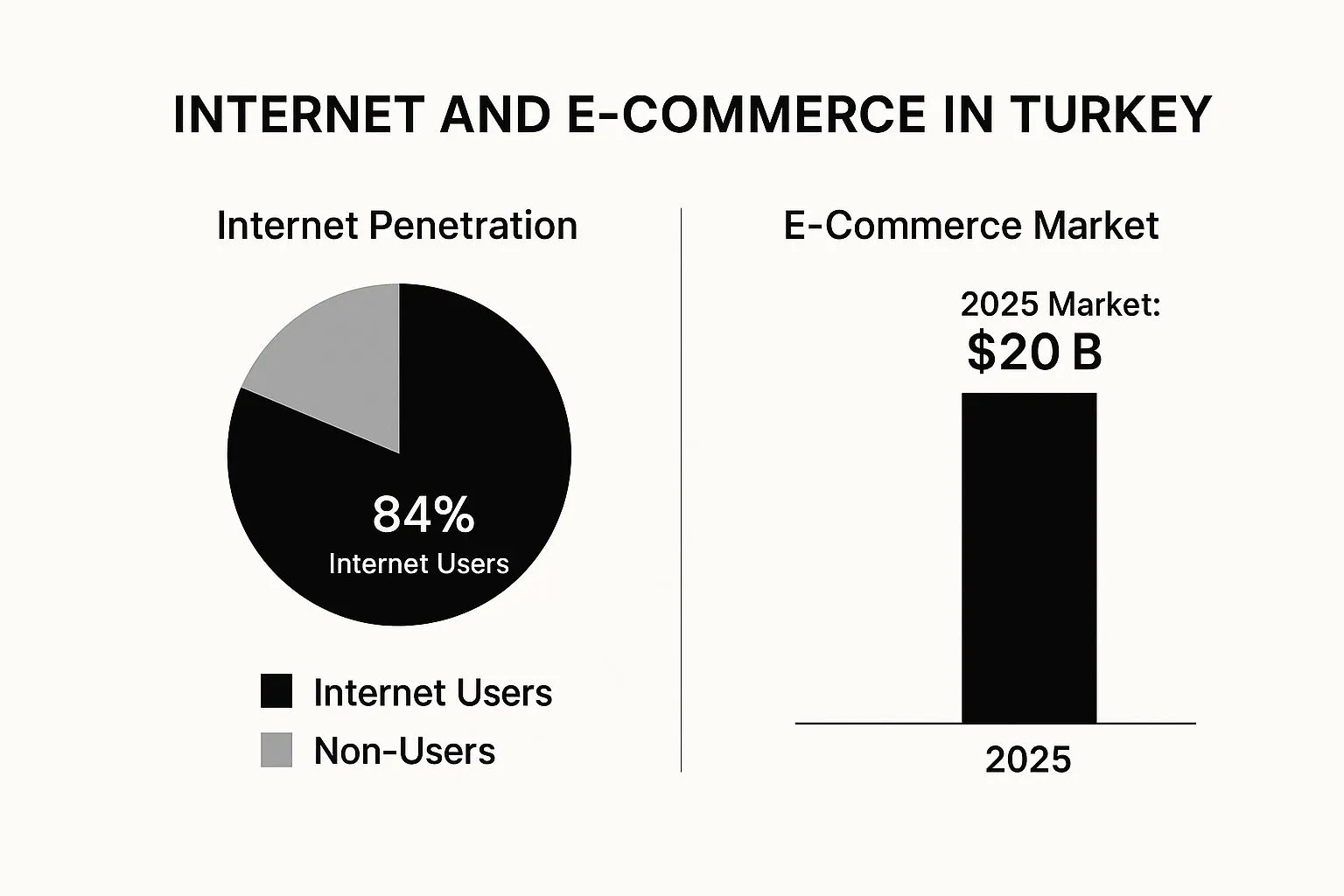
E-commerce can be attractive, but “sell popular products online” is not a strategy. A better model owns a narrow customer promise, protects product quality and understands marketplace, direct-store and social-selling economics. Domestic sales and cross-border sales should be modelled separately.
First proof: launch a limited compliant range and measure contribution margin after VAT treatment, platform commission, payment costs, fulfilment, returns, customer support, discounting and advertising. Our e-commerce business guide for foreign founders covers the operating path.
Lower-priority fit when: the plan relies only on a large population, gross sales or cheap digital ads and ignores returns, consumer law and product conformity.
5. E-commerce merchant enablement and localization
Best for: teams that can improve a merchant’s catalogue, conversion, support, fulfilment or cross-border readiness.
Serving merchants can be less inventory-intensive than owning a brand. Viable offers include product-content localization, marketplace operations, multilingual customer experience, returns analysis, catalogue quality, analytics and fulfilment coordination. The service must own a measurable operational result rather than resell generic marketing activity.
First proof: improve one merchant’s conversion, cancellation rate, support time or cross-border listing quality under a time-boxed paid pilot. Document access to customer data and marketplace accounts.
Lower-priority fit when: results cannot be attributed, client permissions are informal, or the team handles regulated payments or consumer funds without the required authorization.
6. Private-label or contract manufacturing
Best for: operators with buyer specifications, production knowledge and quality-control discipline.
Rather than building a factory immediately, a foreign founder can test a product through a qualified Turkish manufacturer, then decide whether deeper local investment is justified. Potential categories include machinery components, packaging, textiles, household products and specialized industrial inputs, subject to product and destination rules.
First proof: agree the specification, produce a sample, verify conformity and origin evidence, and calculate delivered cost under the intended Incoterm. Buyer concentration, imported inputs, tooling ownership and rejection remedies belong in the contract.
Lower-priority fit when: the model assumes every Turkish product receives duty-free EU access. Product scope, free-circulation evidence and origin are separate questions; our Turkey–EU Customs Union guide explains the boundary.
7. Agrifood processing, packaging or private label
Best for: investors with traceable sourcing, food-quality capability and a confirmed retail, wholesale or export channel.
Agrifood opportunities become more credible when value is added through processing, packaging, shelf-life control, traceability or a defensible route to market. The product category controls the facility, registration, labelling, analysis and export-document path.
First proof: complete a compliant pilot batch and obtain channel feedback tied to price, shelf life, packaging and order size. If exporting, map the destination and product first; health, phytosanitary, free-sale or analysis evidence is conditional rather than universal. See the food export guide for Turkey.
Lower-priority fit when: the financial model excludes rejected batches, temperature control, certification, buyer testing or expiry-related loss.
8. Energy-efficiency products and services

Best for: technical teams with customer access, project references and the ability to measure performance.
For many entrants, monitoring, controls, industrial efficiency, equipment supply, engineering or operations support can be more testable than developing a generation asset. The project must still be assessed for licences, grid or site issues, equipment conformity, contract bankability and currency exposure.
First proof: document a customer’s baseline, proposed intervention, verified savings method, payback assumptions and responsibility for performance. Use our renewable-energy investment guide for the broader project landscape.
Lower-priority fit when: the case depends on a headline national target, an assumed feed-in price or an incentive that has not been confirmed for the project.
9. Tourism solutions or regulated vertical technology

Best for: experienced sector teams that understand licensing, procurement and service quality.
Hospitality software, destination services and specialized guest-experience tools may be testable without owning a hotel. Healthtech, fintech and education technology can solve valuable problems, but they should not be presented as easy businesses: the activity, data, advertising, professional-service and authorization boundaries must be mapped before development or sales.
First proof: obtain a pilot customer and a written regulatory-perimeter review. A restaurant or hospitality venue also needs site-level feasibility, seasonality and permits; prospective operators can use our restaurant-opening guide for Turkey.
Lower-priority fit when: the founding team has no regulated-sector expertise, assumes a technology label avoids licensing, or treats visitor volume as proof of site economics.
Best business by founder profile
| Founder advantage | Models to test first | Reason |
|---|---|---|
| Technical product team | B2B software; merchant enablement | Can prove value with a limited pilot |
| Overseas buyer network | Sourcing; private label; contract manufacturing | Demand can be tested before fixed investment |
| Industry specialist | Specialized B2B service; vertical software | Domain credibility narrows customer acquisition |
| Food supply and distribution | Agrifood processing; private label | Existing sourcing and channel reduce two core risks |
| Engineering and project capability | Energy efficiency; industrial services | Performance can be measured at customer sites |
| Hospitality operating history | Tourism service; restaurant or hospitality technology | Operational experience matters more than destination popularity |
Businesses that are not automatically “best” for a first-time foreign founder
- Speculative real-estate development: title, zoning, construction, financing, tax and exit risk can dominate the thesis.
- Licensed financial activity: a digital interface does not remove authorization, safeguarding or financial-compliance requirements.
- Clinical healthcare delivery: ownership, facility, professional, advertising and health-tourism rules require specialist review.
- Power generation: project development, site rights, grid access, licences, equipment and offtake can require significant capital and time.
- General retail or restaurants without a tested site: rent, staffing, stock loss, seasonality and permits can overwhelm a weak customer proposition.
Foreign founder rules to check before choosing
Türkiye’s Foreign Direct Investment Law generally provides freedom to invest and equal treatment for foreign investors, subject to international agreements and special laws. This does not mean every activity is unrestricted. Certain sectors, professions, assets or operating roles may have special ownership, licensing or personnel rules.
Company formation, permission to conduct an activity and permission for a foreign individual to work are separate layers. Banking, tax registration, accounting, beneficial-owner and foreign-investment reporting, premises, municipal permissions and product obligations may also apply. The Investment Office’s official establishing-a-business guide is a starting reference, while the actual setup must follow the current facts of the project.
A seven-gate test before spending heavily
- Customer gate: can you identify and interview the actual buyer?
- Payment gate: will a buyer sign a paid pilot, sample order or conditional commercial commitment?
- Margin gate: is the model viable after tax treatment, payment timing, returns, logistics, compliance and working capital?
- Regulatory gate: have product, activity, premises, data, personnel and advertising requirements been mapped?
- Local-footprint gate: which city, supplier, staff, warehouse or licensed partner is genuinely necessary? Use the best cities in Turkey for business guide only after answering this.
- Downside gate: does the model survive slower sales, late collections and higher input costs?
- Setup gate: does the company type, ownership, capital, banking and work-authorisation plan fit the operating model?
From shortlist to market-entry plan
Choose no more than two models for validation. For each, document the customer, offer, first paid proof, compliance owner, local resources, twelve-month cash need and stop conditions. Incorporate after you understand what the entity must actually do. When the model has passed those gates, Workon can coordinate the practical setup through its company registration services in Turkey.
Note: Last reviewed 17 September 2026. This comparison provides general operational information for evaluating business models in Türkiye. Workon coordinates the market-entry and setup workflow with the relevant authorities and appropriately qualified professionals according to the selected activity and operating model.