
E-commerce in Turkey is a large and still-growing market, but a foreign founder should treat market opportunity and legal readiness as two separate questions. Turkey’s Ministry of Trade reported that 2025 e-commerce volume exceeded TRY 4.57 trillion, retail e-commerce reached about TRY 2.46 trillion, and 634,611 businesses engaged in e-commerce during the year. Those figures show demand; they do not tell you whether your own store, marketplace model, product, payment flow or consumer process is compliant.
The practical 2026 launch test is: choose the sales model, identify who the legal seller is, map ETBIS and consumer obligations, establish invoicing and payment flows, then validate fulfilment and unit economics before scaling.
Last verified: 2 September 2026. This guide explains the broad Turkey e-commerce market-entry and operating-model decision. For the legal-entity-to-go-live setup, use the e-commerce company setup guide. For the foreign-founder question of whether and how to establish a Turkish entity, use the foreign founder e-commerce entry guide.
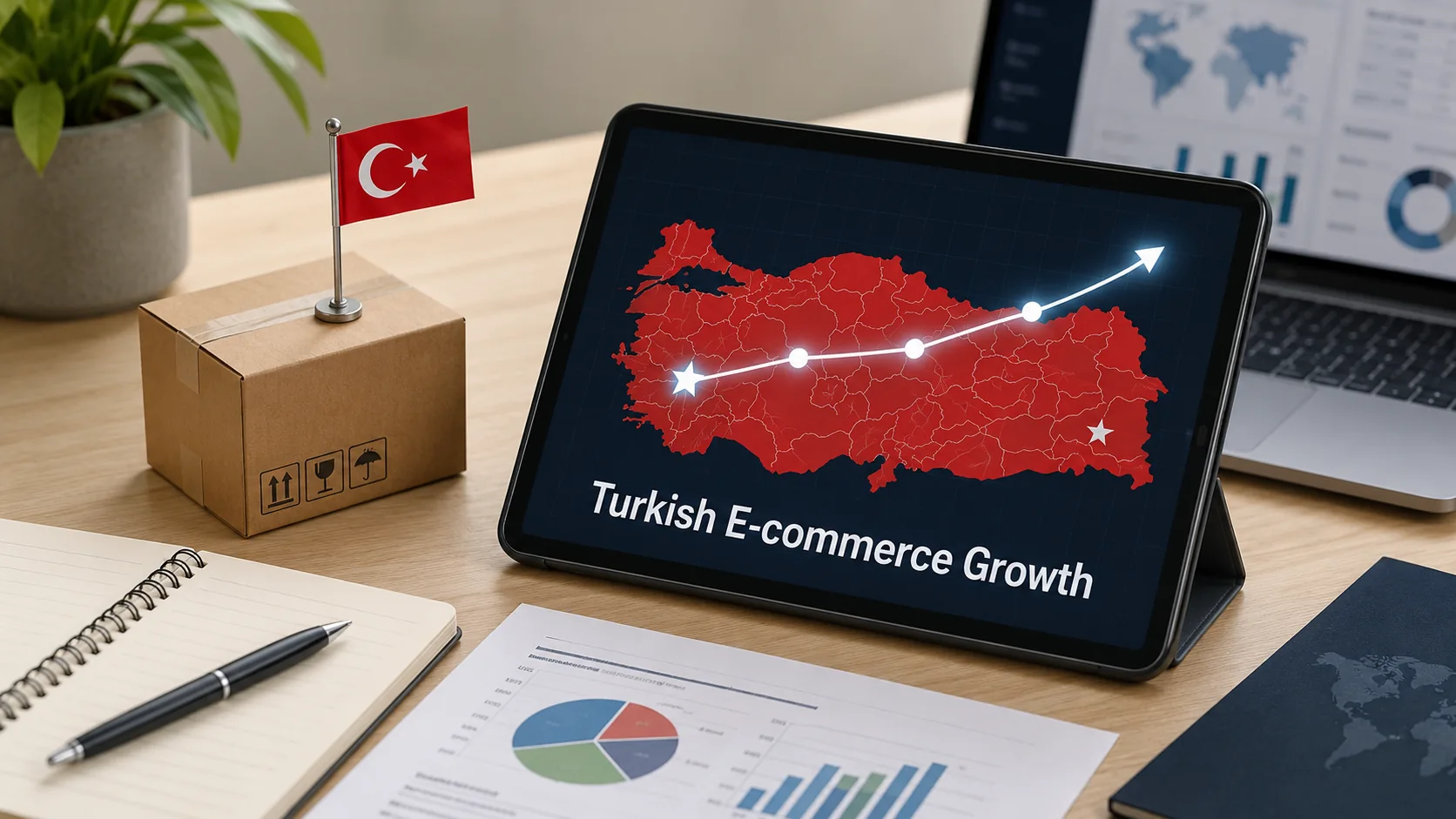
Use market size as a demand signal, then validate the actual sales model and compliance route.
Turkey E-Commerce Market: What the 2025 Official Data Actually Shows
The Ministry of Trade’s May 2026 report states that Turkey’s total e-commerce volume increased 52.2% year on year in 2025 to more than TRY 4.57 trillion, while retail e-commerce reached approximately TRY 2.46 trillion. The number of e-commerce businesses rose to 634,611. Among those businesses, the Ministry reported a mix of sole proprietorships, limited companies and joint-stock companies.
Those figures are useful for market sizing, but they should not be converted into claims that a particular product will be profitable. Your decision should still be based on category margin, acquisition cost, return rate, fulfilment cost, product regulation, working capital and the channel’s control over customer access.
Official source: Ministry of Trade, Turkey E-Commerce Outlook 2025.
Choose the Sales Model Before You Choose the Technology
| Model |
Main advantage |
Main control |
| Own Turkish website/app |
More control over brand, checkout and customer relationship |
ETBIS registration, website information, distance-contract, privacy, invoicing and payment workflow |
| Domestic Turkish marketplace |
Faster access to existing demand and platform infrastructure |
Marketplace seller information, platform rules, product/customer obligations and marketplace economics |
| Own site + domestic marketplace |
Diversifies demand and customer acquisition |
Keep inventory, pricing, returns, invoices and customer records consistent across channels |
| Cross-border marketplace |
Can test demand without building a full local direct store |
Seller residence, tax/customs/product rules and ETBIS treatment must be checked for the exact structure |
| B2B digital ordering |
Repeat procurement and larger basket sizes can reduce consumer-marketing dependence |
Quotation, contract, invoice, credit, stock and delivery controls matter more than consumer-style merchandising |
Do not begin with Shopify, WooCommerce or a marketplace account and work backwards. First decide who is selling, to whom, from where, who holds stock, who collects money and who handles returns.
ETBIS: Own-Site Sellers and Marketplace Sellers Are Not the Same
Turkey’s Electronic Commerce Information System (ETBIS) is one of the most important distinctions missing from many generic launch guides. The Ministry’s current FAQ states that the following categories register before starting the covered activity:
- service providers operating in their own electronic-commerce environment;
- electronic-commerce intermediary service providers; and
- specified Turkey-resident sellers that do not carry out domestic e-commerce but receive orders through an intermediary established abroad.
By contrast, the Ministry’s current FAQ states that a seller selling only through an intermediary/marketplace established in Turkey does not have the same ETBIS registration and notification obligation merely because of those marketplace sales.
This is why “every e-commerce seller must register with ETBIS” and “marketplace sellers never need ETBIS” are both unsafe shortcuts. The channel and establishment structure matter.
ETBIS registration is also not the same thing as the separate electronic-commerce licence regime. Law No. 6563 and its secondary rules impose additional scale-based obligations, including licensing for specified larger electronic-commerce intermediary service providers and electronic-commerce service providers. The Ministry updates the monetary thresholds periodically and published a new 2026 threshold update based on 2025 e-commerce volume. A startup should therefore treat ordinary ETBIS registration as one compliance layer and re-check the current scale thresholds as net transaction volume and transaction count grow, rather than assuming ETBIS registration alone completes every Law No. 6563 obligation.
For a Turkey-resident business that sells only through foreign-established sites or intermediaries without domestic e-commerce activity, the Ministry’s current ETBIS FAQ also requires the applicable annual cross-border e-commerce notification by the end of March. This is different from the domestic-marketplace-only exemption described above.
Official ETBIS FAQ and registration guidance.
What Information Must Be Visible to Buyers?
The e-commerce rules require role-specific seller information. For a merchant selling through a marketplace, the Ministry’s FAQ lists items such as trade name or registered brand/business name, a KEP address suitable for notification, the MERSIS number for merchants, and information showing that the marketplace has the seller’s headquarters address and verified telephone number.
For an own-site operation, the website should also be reviewed for the statutory service-provider information and an işlem rehberi (transaction guide). The Ministry’s guidance describes the transaction guide as covering matters such as the technical order steps, whether the contract is stored and accessible later, how the buyer can identify/correct input errors, privacy rules and available alternative dispute-resolution mechanisms.
The exact disclosure set depends on the seller’s legal status and channel. Build a field-by-field checklist instead of copying another website’s footer.
B2C Sales: Distance-Contract Rules Belong in the Checkout Design
If your customer is a consumer, the legal design cannot be separated from checkout UX. The Ministry’s August 2026 consumer guidance confirms that, before payment, the consumer must receive pre-contract information including the main characteristics of the product/service, seller/intermediary identity and contact information, total price including taxes, additional delivery costs, withdrawal-right information and available remedies.
As a general rule, a consumer in a covered distance contract has a 14-day withdrawal right without giving a reason or paying a penalty. There are important statutory exceptions, including certain customised goods, rapidly perishable goods, specified hygiene-sensitive products after protective packaging is opened, certain instantly supplied digital content/services and other listed categories.
The same official guidance also explains that if no shorter delivery promise has been made, goods are generally to be sent within 30 days, subject to the regulation’s scope and exceptions. Do not turn that into a marketing promise: your checkout should state the actual delivery commitment you can meet.
Official Ministry guidance on distance contracts.
Commercial Messages and Customer Data Need Separate Controls
Order processing, customer-service messages and marketing messages are not the same thing. Turkey regulates commercial electronic communications under Law No. 6563 and the related regulation, while personal-data processing is also subject to the Personal Data Protection Law (KVKK).
Your launch file should therefore separate:
- data needed to fulfil the order;
- privacy/notice requirements for the data collected;
- marketing permission and commercial electronic-message controls, including IYS where applicable;
- cookie/analytics/advertising technology review; and
- access, retention, processor/vendor and breach-response responsibilities.
GDPR experience can help a foreign founder structure the review, but it does not replace Turkey-specific legal analysis.
Ministry of Trade electronic-commerce legislation hub.
Payments: Approval Is Only One Part of the Decision
A payment provider should be selected after the legal seller, bank-account and channel model are clear. Merchant onboarding, settlement, chargebacks, refunds, card/installment functionality, product restrictions, integration and reserves can differ by provider and risk profile.
Compare current provider offers against your product category, settlement needs, refund process and expected order value rather than relying on a generic gateway ranking. For the dedicated merchant-acquiring decision, use the Virtual POS in Turkey guide. Bank-account onboarding is a separate KYC decision handled in the business bank account guide.

Design bank, settlement, refund and reconciliation flows before scaling paid traffic.
Invoicing: E-Fatura and E-Arşiv Are Not Interchangeable
An e-commerce business needs an invoice/document flow that matches its taxpayer status and the recipient. e-Fatura applies when the statutory e-Fatura framework and recipient status require it. e-Arşiv handles the separate electronic-archive invoice route, including invoices to recipients outside the e-Fatura registered-user population where applicable.
Do not assume every new e-commerce company is automatically an e-Fatura taxpayer on incorporation day. Entry can arise from turnover, sector/activity rules, specific triggers or voluntary application. Route the detailed decision to the e-Fatura registration guide and e-Arşiv guide.
Products: Company Registration Is Not Product Approval
A valid Turkish company can sell only products that it is legally permitted to place on the market. Cosmetics, medical devices, food, supplements, electronics, toys and other regulated categories can involve product-specific registrations, safety requirements, labelling, import controls or sector permissions.
Before inventory is purchased, create a product-compliance matrix with GTIP/product classification, producer/importer status, required approvals/registrations, label/language requirements, consumer warnings, customs controls and return/warranty implications.
For imported stock, use the customs clearance steps guide to prepare the shipment’s classification, documents, product controls and release process.
Fulfilment and Returns: Model the Reverse Flow Before Launch
For physical goods, the cost model should include more than outbound courier pricing. Track:
- inbound stock and customs cost;
- storage and pick/pack;
- outbound shipping;
- failed delivery;
- consumer withdrawal/return shipping where applicable;
- damaged or non-resalable returns;
- marketplace penalties/commissions; and
- refund timing versus payment-provider settlement.
A profitable order before returns can become an unprofitable customer after reverse logistics. Run unit economics on the expected return and cancellation rate, not only on successful deliveries.
Marketplace vs Own Store: A Practical 30-Day Test
| Week |
Decision |
Evidence to collect |
| 1 |
Define seller, product and customer |
Legal seller, channel, product compliance, target city/customer, price/margin |
| 2 |
Build compliance and payment path |
ETBIS route, seller disclosures, consumer documents, invoice route, bank/payment requirements |
| 3 |
Test fulfilment and customer support |
Pick/pack time, courier SLA, return flow, Turkish support and refund process |
| 4 |
Run a limited paid validation |
Conversion, CAC, contribution margin, cancellation, return rate and support contacts |
Only after these controls pass should you broaden inventory, geography or paid acquisition. The fastest route to growth is not automatically the widest launch.
How Workon Fits into an E-Commerce Launch
Workon can coordinate the company-side operating setup for foreign founders: company formation, registered business address and office solutions, bank-account application support, document workflows and coordination with appropriately licensed accounting/legal professionals. Product approvals, consumer-law opinions, tax filings and other regulated professional work should be handled by the relevant authorised professional.
If you have already chosen the business model, continue with the e-commerce company setup checklist. If you are still deciding whether a Turkish entity is the right entry route, use the foreign founder entry-route guide.
Frequently Asked Questions
Identify the legal seller, customer type, sales channel, inventory location, importer, payment recipient and returns responsibility first. Those facts determine the company, product, consumer, invoicing and fulfilment checks; choosing a website platform should follow that decision.
No. The Ministry's ETBIS FAQ distinguishes own-site operators and intermediaries from sellers using only Turkey-established marketplaces. Turkey-resident businesses that do not conduct domestic e-commerce but sell through foreign-established intermediaries have a separate ETBIS registration route and annual cross-border e-commerce notification by the end of March. Check the actual channel and establishment structure against the official guidance.
No. ETBIS registration and the scale-based electronic-commerce licence regime are separate compliance layers. Law No. 6563 and its secondary rules impose additional obligations on specified larger electronic-commerce intermediary service providers and service providers, and the Ministry updates the monetary thresholds periodically. Re-check the current thresholds as net transaction volume and transaction count grow.
For covered distance contracts, the Ministry's guidance requires pre-contract information including product or service characteristics, seller and intermediary details, the total price including taxes, extra delivery charges, withdrawal rights and available remedies. Build those disclosures into checkout rather than relying only on a footer.
The general withdrawal period for a covered consumer distance contract is 14 days, but statutory exceptions apply. Product-specific conditions matter, including rules for customised, perishable, certain hygiene-sensitive and specified digital supplies. Use the current Ministry distance-contract guidance linked in this guide rather than promising one return policy for every item.
No. Treat channel onboarding separately from the seller's product, consumer, invoicing, data and import responsibilities. Confirm which party performs each task and test settlement, refunds and customer-support workflows before expanding sales.
Model inbound stock, storage, pick-and-pack, delivery, failed delivery, returns, non-resalable stock, commissions and the timing of refunds versus settlement. Validate contribution margin on the expected mix of completed, cancelled and returned orders, not only successful deliveries.
Disclaimer: This article provides general information about e-commerce market entry and operating controls in Turkey as of September 2026 and is not legal, tax, consumer-law, data-protection, customs or product-compliance advice. Obligations depend on the seller, channel, product, customer type, payment flow and current legislation. Verify material launch decisions against current official rules and with appropriately qualified Turkish professionals.